ASUS Vivobook 16" M1607KA-V16.R516512 2025, Ryzen AI 5 330, 16GB, 512GB SSD, Quiet Blue

Salida HDMI 2.1 para monitores de alta frecuencia verificado el 29 nov
51/100 puntuación global 4,6 media de 134 valoraciones de propietarios
- CPU
- AMD Ryzen AI 5 330
- RAM
- 16 GB
- Storage
- 512 GB
- Screen
- 16" 1920x1200
- GPU
- AMD Radeon Graphics
- OS
- Windows 11 Home
- Weight
- 1.9 kg
- Battery
- 65 Wh


Resumen
The 30-Second Version
The Vivobook M1607KA still nails user satisfaction with a 4.6-star average and one of the best social proof scores, though sentiment has cooled to 78/100. The CPU is only average at the 46th percentile and the AI performance is a disappointing 30.2 out of 100. The 16-inch display and 16GB of RAM are the real selling points. Prices have climbed to USD 501 to USD 1,000, so this is only worth it near the bottom of that range.
Pros & Cons
Ventajas
- 97th percentile social proof with a 4.6-star average from 119 reviews 93rd
- 16-inch 1920x1200 IPS display with 300 nits brightness
- 16GB DDR5 RAM keeps multitasking smooth
- Integrated Radeon Graphics at the 70th percentile handles light gaming and 4K streaming
- Wi-Fi 6 and Bluetooth 5.3 for modern connectivity
Desventajas
- CPU at the 46th percentile, just average for the price
- 512GB SSD at the 38th percentile, tight for media hoarders
- 42Wh battery in a 1.89kg chassis, portability score is a weak 23rd percentile
- AI performance score of 30.2/100 despite heavy Copilot+ marketing
- 45% NTSC color coverage limits creative work accuracy
Opinión de los propietarios
The Word on the Street
- Multiple owners rave about the large, beautiful display and how smooth everyday performance feels.
- The keyboard gets split opinions, with some finding it solid and others saying it's uncomfortable for heavy typing sessions.
- A few buyers mention the laptop feels heavier and bulkier than they expected for a portable machine.
Cómo cambió la opinión de los propietarios con el tiempo
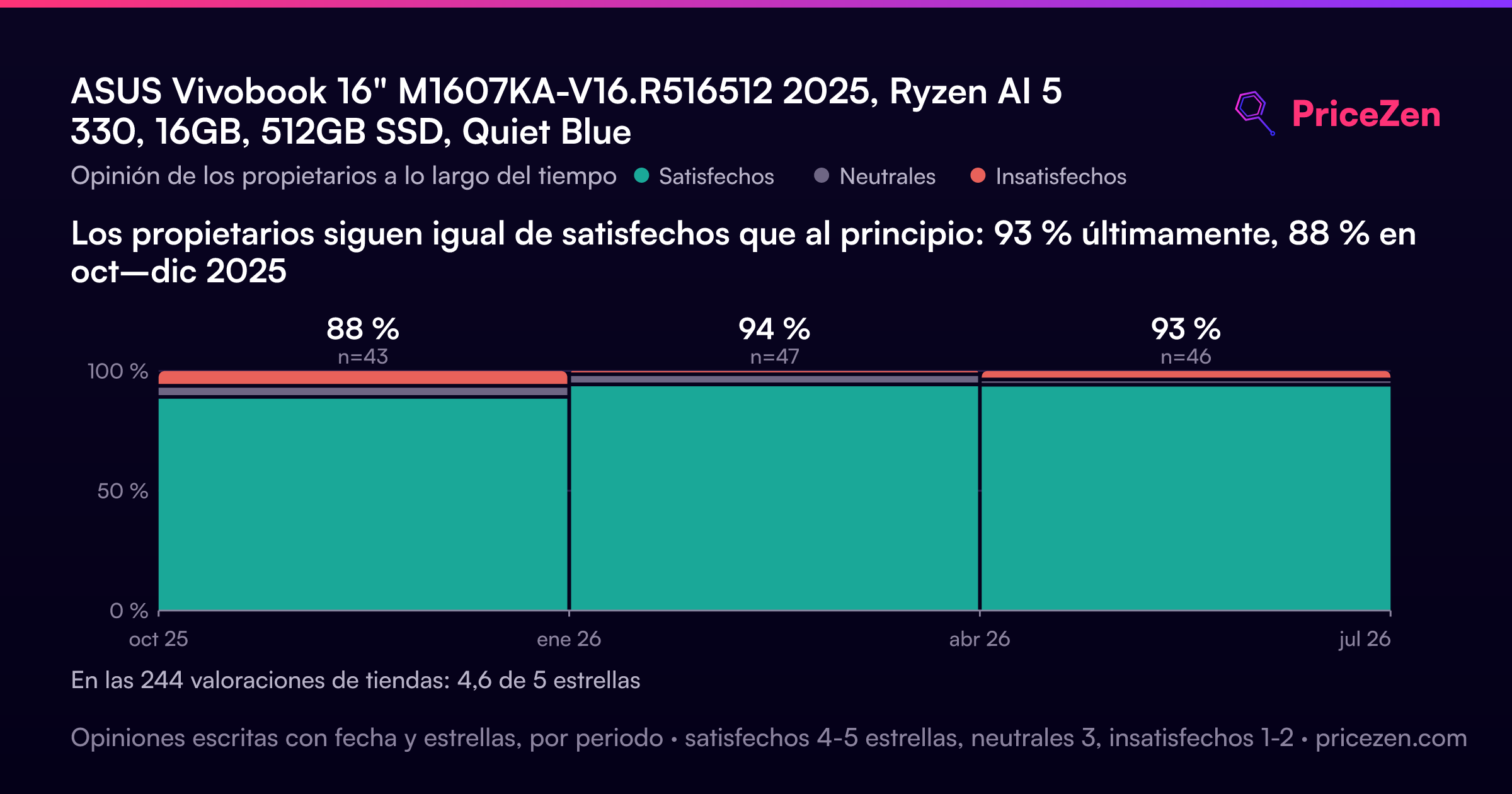
ExclusivaSegún cuándo escribieron realmente sus opiniones los clientes, para ver si los elogios iniciales se mantuvieron.
Los propietarios siguen igual de satisfechos que al principio: 93 % últimamente, 88 % en oct–dic 2025
En las 134 valoraciones de tiendas: 4,6★. El gráfico cuenta las 136 opiniones escritas con estrellas y fecha propia.
Ver las cifras
| Periodo | Opiniones | Satisfechos | Neutrales | Insatisfechos | Proporción satisfechos |
|---|---|---|---|---|---|
| oct–dic 2025 | 43 | 38 | 2 | 3 | 88 % |
| ene–mar 2026 | 47 | 44 | 2 | 1 | 94 % |
| abr–jun 2026 | 46 | 43 | 1 | 2 | 93 % |
- abr–jun 202643 de 46 satisfechos
Buyers in Q2 2026 largely praised the laptop's speed, display, and value, with many using it for school, work, and light gaming. A few noted issues like a dead unit, muffled speakers, and no keyboard backlight.
- Fast performance and quick boot-up praised by many, handling multitasking, gaming, and schoolwork smoothly.
- Great value for the price, with buyers highlighting the large, clear screen and sleek design as standout features.
- Battery life generally good, but some note it requires midday charging for heavy use; not all-day.
- One unit failed after 18 days with an uncorrectable error; return/replacement process was difficult.
- ene–mar 202644 de 47 satisfechos
Buyers in Q1 2026 generally praised the laptop's performance, value, and display, with many using it for school or work. Some noted minor issues like a 60Hz screen, bloatware, or occasional Wi-Fi drops.
- Performance and speed are frequently praised, with users noting smooth multitasking, fast boot times, and good value for the price.
- Display quality is often highlighted as bright, clear, and spacious, though a few found it not sharp or bright enough.
- Battery life is generally seen as solid, lasting through a workday, but some users mention it could be better.
- A few reliability issues were reported, including Wi-Fi cutting out, a driver glitch, and one undelivered item.
- oct–dic 202538 de 43 satisfechos
Buyers in Q4 2025 praised the laptop's value, performance, and display, especially at Black Friday prices. Some noted missing backlit keyboard, occasional slowness, and one reported dead pixels.
- Excellent value for money, especially during Black Friday sales, with strong performance for everyday tasks.
- Display quality and size are appreciated, with many noting the 16-inch screen as a highlight.
- Performance is generally good, but a few users experienced slowness or expected more speed.
- Missing backlit keyboard and touchscreen were common disappointments; one unit had dead pixels.
Cada columna une trimestres hasta reunir al menos 10 opiniones con estrellas y fecha propia. Satisfechos = 4-5★, neutrales = 3★, insatisfechos = 1-2★. Los resúmenes por periodo están en inglés.
Las pruebas
Performance
Let's talk about that Ryzen AI 5 330. Four cores, eight threads, 2.0GHz base clock. In our database, that lands at the 46th percentile for CPUs, which is about average for a budget-to-midrange laptop right now. The integrated AMD Radeon Graphics does better, hitting the 70th percentile, so light gaming and 4K video streaming are actually reasonable here. The 16GB of DDR5 helps with multitasking, though it's only about average for RAM, which is solid but not exciting.
The 512GB SSD is where things get a little tight. It's below average for storage, which means you're getting less room than most laptops in this category. PCIe 4.0 speeds are nice for boot times and app launches, and owners do report fast startups and smooth operation. But if you're hoarding games or raw video files, you'll feel that 512GB ceiling quickly. The NPU's 50 TOPS figure is a marketing highlight, but our AI language model score of 30.2 out of 100 suggests the real-world AI performance is underwhelming compared to what the Copilot+ branding implies.
Specifications
Full Specifications
Processor
| CPU | AMD Ryzen AI 5 330 |
| Cores | 4 |
| Frequency | 2.0 GHz |
| L3 Cache | 4 MB |
Graphics
| GPU | AMD Radeon Graphics |
| Type | Integrated |
Memory & Storage
| RAM | 16 GB |
| RAM Generation | DDR5 |
| Storage | 512 GB |
| Storage Type | SSD |
Display
| Size | 16" |
| Resolution | 1920x1200 (Full HD) |
| Panel | IPS |
| Refresh Rate | 60 Hz |
| Brightness | 300 nits |
| Color Gamut | 45% NTSC |
Connectivity
| USB-C Ports | 2 |
| USB Ports | 2 |
| HDMI | HDMI 2.1 |
| Wi-Fi | Wi-Fi 6 |
| Bluetooth | Bluetooth 5.3 |
Physical
| Weight | 1.9 kg / 4.2 lbs |
| Battery | 65 Wh |
| OS | Windows 11 Home |
vs Competition
Stacked against the Apple MacBook Air 13.6" M5, this Vivobook gives up ground on raw CPU performance and efficiency, but its 16-inch 1920x1200 panel gives you noticeably more room to work than a 13.6-inch screen. Our ranking puts the ASUS CPU at the 46th percentile, so if compute is your priority, the MacBook is the stronger machine. Against the Lenovo Legion 5i 15.1" 83F00008US, the ASUS trades muscle for size and simplicity: the Legion sits in gaming territory, while the Vivobook's integrated Radeon Graphics at the 70th percentile is really only suited to light gaming and 4K streaming. The Samsung Galaxy Book5 Pro 14" NP944XHA-KG3US is the pick if display quality matters most, since 45% NTSC coverage on this ASUS is a genuine weak point for color-sensitive work. The HP OmniBook X Flip 14-fk0033dx is the more portable option, which counts when the Vivobook's compact score is poor and it weighs 1.89kg. The MSI Katana 15 HX is another performance-first alternative for anyone who finds the Ryzen AI 5 330 too modest. Where the Vivobook still holds its own is owner satisfaction, with a 4.6-star average across 119 reviews and one of the best social proof scores, plus that big screen. At USD 501 it makes sense as a big-screen everyday machine. Near USD 1,000, these alternatives deserve a serious look.
| Spec | ASUS Vivobook 16" M1607KA-V16.R516512 | Apple MacBook Pro 14.2" M4 Pro | Lenovo Legion Pro 7i Gen 10 16" | HP OMEN Transcend | Samsung Galaxy Book5 Pro 14" NP944XHA-KG3US | MSI Raider 16 Max HX |
|---|---|---|---|---|---|---|
| CPU | AMD Ryzen AI 5 330 | Apple M4 Pro | Intel Core Ultra 9 275HX | Intel Core Ultra 9 285H | Intel Core Ultra 7 258V | Intel Core Ultra 9 290HX |
| RAM (GB) | 16 | 48 | 32 | 32 | 32 | 32 |
| Storage (GB) | 512 | 4096 | 1024 | 1024 | 1024 | 1024 |
| Screen | 16" 1920x1200 | 14.2" 3024x1964 | 16" 2560x1600 | 14" 2880x1800 | 14" 2880x1800 | 16" 2560x1600 |
| GPU | AMD Radeon Graphics | Apple (16-Core) | NVIDIA GeForce RTX 5070 Ti | NVIDIA GeForce RTX 5070 | Intel Arc Graphics 140V | NVIDIA GeForce RTX 5080 |
| OS | Windows 11 Home | macOS | Windows 11 Home | Windows 11 Home | Windows 11 Pro | Windows 11 Home |
| Weight (kg) | 1.9 | 1.6 | 2.7 | 1.6 | 1.2 | 2.6 |
| Battery (Wh) | 65 | 72 | 99 | 71 | 63 | 100 |
| Compare | Compare | Compare | Compare | Compare |
| Producto | CPU | GPU | RAM | Puertos | Pantalla | Portabilidad | Almacenamiento | User Sentiment | Fiabilidad | Valoración social | Affordability |
|---|---|---|---|---|---|---|---|---|---|---|---|
| ASUS Vivobook 16" M1607KA-V16.R516512 | 40.7 | 38.9 | 59.9 | 51.7 | 63.8 | 23.2 | 35.8 | 61.4 | 60.6 | 93.3 | 44.4 |
| Apple MacBook Pro 14.2" M4 Pro Compare | 92.4 | 78.9 | 90.6 | 73.8 | 99.1 | 68.9 | 98.4 | 90.9 | 98.2 | 99.7 | 4.7 |
| Lenovo Legion Pro 7i Gen 10 16" Compare | 97.2 | 96.7 | 89 | 97.3 | 95 | 9.5 | 79.3 | 90.9 | 82 | 99.7 | 5.9 |
| HP OMEN Transcend Compare | 90.1 | 93.5 | 89.6 | 89.4 | 96 | 72.3 | 65.4 | 81.7 | 33.7 | 93.3 | 9.1 |
| Samsung Galaxy Book5 Pro 14" NP944XHA-KG3US Compare | 65.8 | 69.6 | 79.5 | 83.5 | 90.3 | 89.4 | 79.3 | 0 | 82 | 95.7 | 21.4 |
| MSI Raider 16 Max HX Compare | 99.6 | 98.3 | 86.3 | 98.6 | 91.4 | 10.9 | 79.3 | 75.3 | 60.6 | 78 | 7.9 |
Precio
Value & Pricing
Pricing on this Vivobook has moved up, and it changes the math. We're tracking USD 501 to USD 1,000 across current listings, roughly 31% higher than where we last had it. That's a wide spread, and the value proposition shifts completely depending on where you buy. At the low end, around USD 501, you're still getting a 16-inch screen, 16GB of RAM and a Copilot+ badge for reasonable money, though it's no longer the bargain it was. At USD 1,000, you're paying flagship-adjacent money for a 46th-percentile CPU, a 512GB SSD and an AI score of 30.2 out of 100, and that's a hard sell. We track prices over time, partly through our community browser extension, so watch for a dip toward the bottom of that range before you commit. The same laptop at USD 501 and USD 1,000 are two very different purchases.
Leer más
Overview
The ASUS Vivobook M1607KA-V16.R516512 is a Copilot+ PC that leans hard into the AI story, but the numbers that actually matter for daily use are more mixed. You get 16GB of DDR5, a 512GB PCIe 4.0 SSD, and a 16-inch 1920x1200 IPS display, all wrapped in a 1.89kg chassis. The AMD Ryzen AI 5 330 is a 4-core, 8-thread chip with an XDNA NPU rated up to 50 TOPS, which sounds impressive until you look at our database and see the CPU sitting at the 46th percentile. That's about average for this class, not a barn burner.
Where this laptop still does well is social proof. It's one of the best there, and owners back that up with a 4.6-star average across 119 reviews. People love the big screen, the solid keyboard, and the smooth everyday performance. The user sentiment score has slipped to 78/100 from 85/100 in our data, so buyers are still broadly happy, just less uniformly so than before. Just don't expect it to punch above its weight in raw compute or portability, because the compact score is poor.
Common Questions
Q: Does this laptop have a built-in microphone?
Yes, the Vivobook M1607KA includes a built-in microphone as part of its 1080p IR camera setup, which also supports Windows Hello facial recognition. The camera and mic array are standard for video calls and Copilot+ features like Live Captions.
Q: What kind of memory does this laptop use?
It uses 16GB of LPDDR5 RAM. That's the low-power DDR5 standard, which helps with battery efficiency while still providing solid multitasking performance. In our database, 16GB puts it at the 62nd percentile for RAM, which is above average for this class.
Q: How long does the battery actually last?
ASUS claims up to 10 hours, but that's with a 42Wh battery, which is on the smaller side. Our compact score of 23rd percentile reflects the trade-off between the big 16-inch screen and the modest battery capacity. Real-world use with the 300-nit display at higher brightness will likely land well below that 10-hour claim, especially with AI features running.
Who Should Skip This
Skip this if you need real AI horsepower. The 30.2 out of 100 AI language model score is one of the weakest areas of this laptop, and the Copilot+ branding oversells what the Ryzen AI 5 330 can actually do. Heavy typists should also think twice, since multiple owners found the keyboard uncomfortable for long writing sessions. If you're a creative professional who needs accurate color, the 45% NTSC coverage on the display will frustrate you. And if portability matters, the 1.89kg weight and poor compact score mean this is more of a desk laptop than a travel companion. Anyone needing more than 512GB of storage should look elsewhere too, since that's below average. Budget shoppers should pause as well: with prices now starting at USD 501 and running to USD 1,000, and user sentiment down to 78/100, the easy recommendation this once was has gotten harder to make.
Verdict
The ASUS Vivobook M1607KA is a laptop that wins on user satisfaction, not spec sheet dominance. A 4.6-star average and one of the best social proof scores tell you real owners are happy, even if our user sentiment score has eased to 78/100. The 16-inch display is the star here, and 16GB of RAM keeps things snappy for everyday work. But the CPU is average, the storage is tight, and the AI performance ASUS markets so heavily scores just 30.2 out of 100 in our scoring model. The price climb hurts: at USD 501 it's still a reasonable buy for students, writers, and casual users who want a big screen without spending big money. Push toward USD 1,000 and you should look elsewhere.
Usage Scores
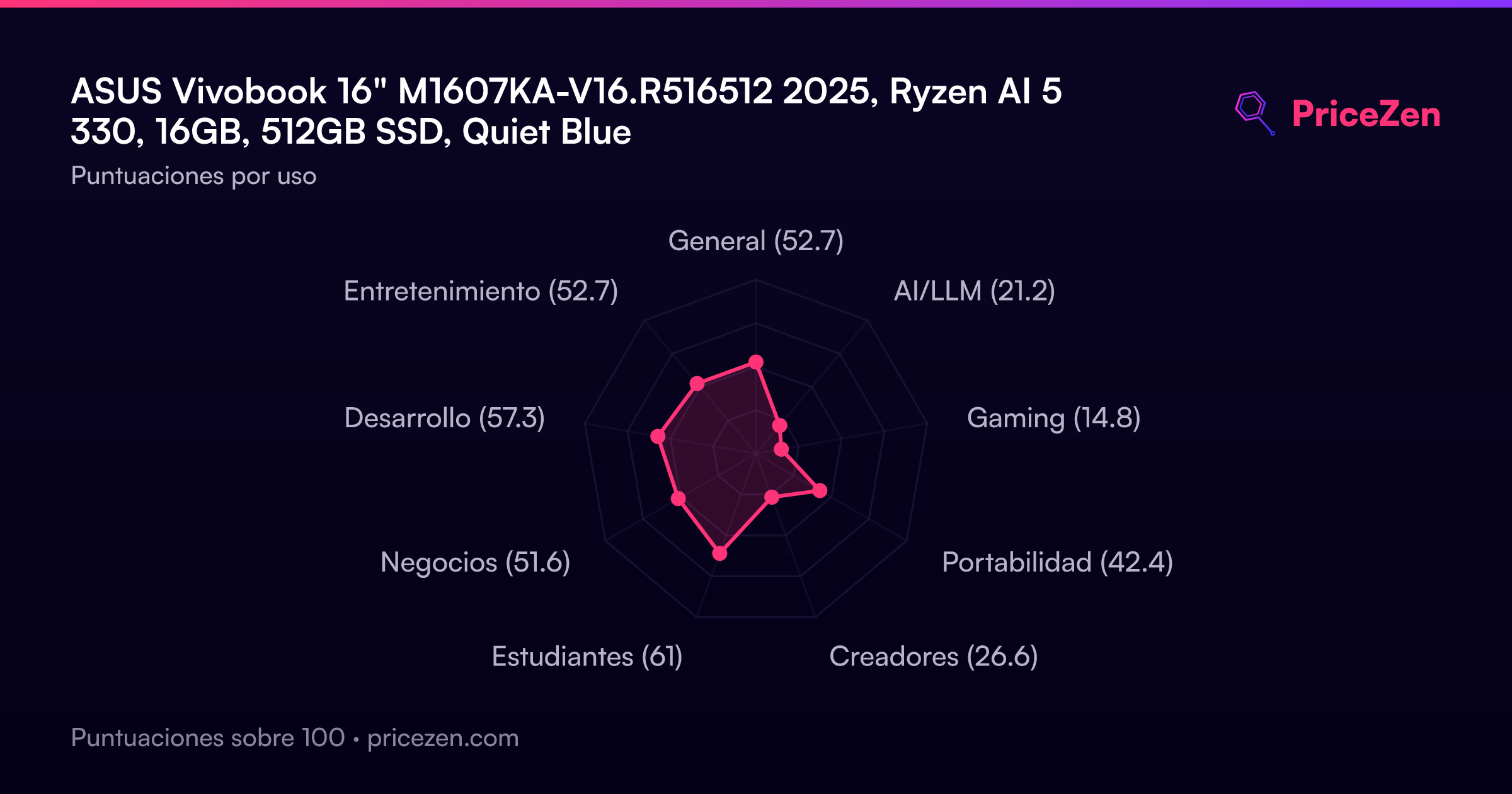
- General50.6
- AI/LLM21.2
- Gaming14.8
- Portabilidad42.4
- Creadores26.7
- Estudiantes61
- Negocios51.6
- Desarrollo57.3
- Entretenimiento52.7