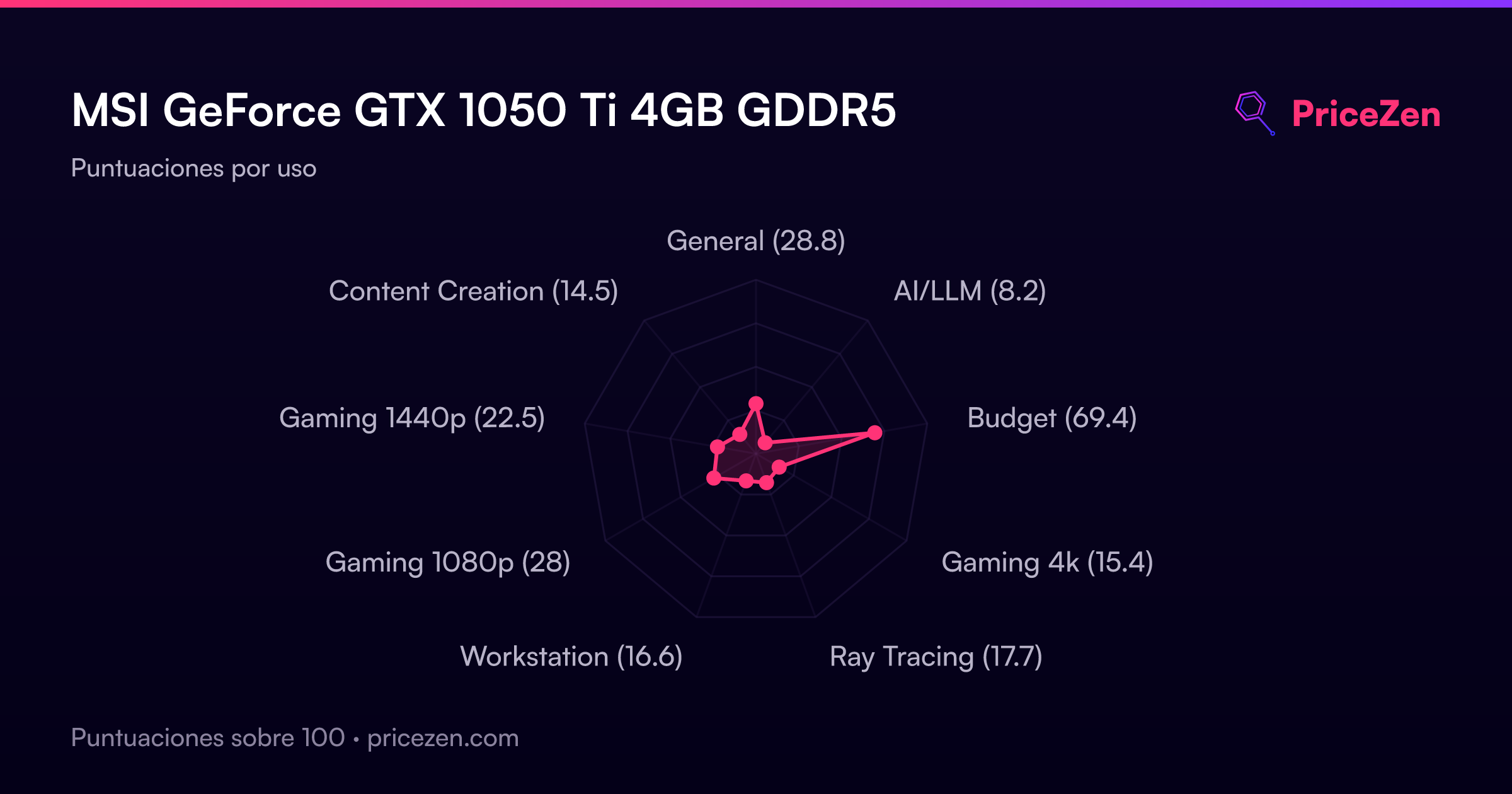
MSI GeForce GTX 1050 Ti 4GB GDDR5
The 14nm Pascal GPU delivers 1455MHz boost clocks and 4GB of GDDR5 memory on a 128-bit bus, with a 75W TDP that runs cool on a dual-fan design. Its 182mm length and single 6-pin connector make it a drop-in fit for compact builds, backed by a 4.6/5 rating from over 1,900 buyers. Best for budget gamers targeting 1080p esports titles like CS:GO or Fortnite, where its 30.4/100 gaming score is sufficient.

Sin precio actual de tiendas











Resumen
The 30-Second Version
A 2016 budget card still kicking, but the prices people are asking for it are a joke. Buy used, buy cheap, or buy something else.
Pros & Cons
Ventajas
- Runs on a 300W PSU, no power connector drama 84th
- 182mm length fits in almost any case 78th
- 4GB VRAM is enough for older games and esports
- Dual fan cooler keeps it quiet under load
Desventajas
- Bottom-tier compute and AI performance
- No modern features, no ray tracing, no DLSS
- Only one HDMI and one DisplayPort
- Priced like a collector's item in some regions
Opinión de los propietarios
The Word on the Street
Cómo cambió la opinión de los propietarios con el tiempo
ExclusivaSegún cuándo escribieron realmente sus opiniones los clientes, para ver si los elogios iniciales se mantuvieron.
9 opiniones escritas, ene 2018 – nov 2022: 9 satisfechos
En las 1921 valoraciones de tiendas: 4,6★. La mayoría de los propietarios valora sin escribir una opinión. El gráfico cuenta las 9 opiniones escritas.
Cada punto es una opinión escrita, en el mes en que se escribió. Satisfechos = 4-5★, neutrales = 3★, insatisfechos = 1-2★.
Las pruebas
Performance
The PassMark G3D score of 6366 puts this card in the bottom fifth of everything we track. That's not a surprise, Pascal is nearly a decade old. What did surprise us is how well it still handles the basics. The 1455MHz boost clock and 112 GB/s memory bandwidth are enough for CS2, Valorant, and older AAA titles at medium settings. But the compute score is one of the worst we've seen, and the AI performance is basically a rounding error. Don't even think about ray tracing or any modern rendering workload.
Specifications
Full Specifications
Chipset
| GPU Chipset | GeForce GTX 1050 Ti |
| Brand | NVIDIA |
| Architecture | Pascal |
| Class | consumer |
| Process | 14 |
Memory
| VRAM | 4 GB |
| Memory Type | GDDR5 |
| Memory Bus | 128 |
| Bandwidth | 112.1 |
Compute
| Base Clock | 1341 |
| Boost Clock | 1455 |
| FP32 TFLOPS | 2.138 |
Performance
| PassMark G3D | 6366 |
| GPU Compute | 2661 |
Power & Cooling
| TDP | 75 |
| Recommended PSU | 250 |
| Power Connectors | 6-pin |
| Cooler | Dual Fan |
| Fans | 2 |
Connectivity
| Interface | PCI Express 3.0 x16 |
| DisplayPort | 1 |
| HDMI | 1 |
| Max Resolution | 7680x4320 |
Physical
| Length | 182 |
| Slot Width | 2.9 |
| Weight | 0.5 kg / 1.0 lbs |
Features
| Ray Tracing | No |
| AV1 Encode | No |
| VR Ready | No |
| DirectX | 12 |
| RGB | Yes |
vs Competition
Against the PNY OC VCG5070T16TFXPB1-O or the ASUS PRIME RTX 5070, this MSI card isn't even in the same conversation. Those cards are 10 to 15 times faster in raster performance and have 16GB of VRAM. The XFX Mercury RX 9070 and Gigabyte Gaming RX 9070 XT are similarly in a different universe. The only real comparison is against other used Pascal cards like the GTX 1060 6GB, which beats this card by a solid margin and usually costs about the same on the used market. If you're stuck with a low-power PSU, the GTX 1650 is the better low-profile choice, it's newer, faster, and still sips power.
| Spec | MSI GeForce GTX 1050 Ti | ASUS GeForce RTX 5090 TUF Gaming | Gigabyte GeForce RTX 5080 AERO OC | ZOTAC GeForce RTX 5080 AMP Extreme Infinity | PNY GeForce RTX 5080 ARGB OC | ASRock Radeon RX 7900 XTX Phantom Gaming |
|---|---|---|---|---|---|---|
| Chipset | GeForce GTX 1050 Ti | GeForce RTX 5090 | GeForce RTX 5080 | GeForce RTX 5080 | GeForce RTX 5080 | Radeon RX 7900 XTX |
| Vram | 4GB GDDR5 | 32GB GDDR7 | 16GB GDDR7 | 16GB GDDR7 | 16GB GDDR7 | 24GB GDDR6 |
| Boost Clock Mhz | 1455 | 2407 | 2730 | 2670 | 2620 | 2615 |
| Tdp W | 75 | 575 | 360 | 360 | 360 | 355 |
| Memory Bus Bits | 128 | 512 | 256 | 256 | 256 | 384 |
| Ray Tracing | false | true | true | true | true | true |
| GPU Class | consumer | consumer | consumer | consumer | consumer | consumer |
| Compare | Compare | Compare | Compare | Compare |
| Producto | AI | Rt | Vram | Raster | Compute | Feature | Thermal | Efficiency | Connectivity | Valoración social | Affordability |
|---|---|---|---|---|---|---|---|---|---|---|---|
| MSI GeForce GTX 1050 Ti | 14.1 | 16.2 | 13.5 | 16.6 | 8 | 21.9 | 42.2 | 39.7 | 20.3 | 83.9 | 77.5 |
| ASUS GeForce RTX 5090 TUF Gaming Compare | 97.1 | 90.6 | 97.8 | 98.8 | 97.6 | 95.8 | 72.1 | 23.6 | 99.3 | 98.7 | 2.4 |
| Gigabyte GeForce RTX 5080 AERO OC Compare | 85.5 | 95.3 | 89.1 | 94.5 | 93.4 | 95.8 | 91.8 | 56.6 | 94.1 | 83.9 | 11.2 |
| ZOTAC GeForce RTX 5080 AMP Extreme Infinity Compare | 85.5 | 97.6 | 89.1 | 94.5 | 93.4 | 95.8 | 91.8 | 56.6 | 94.1 | 98.7 | 7.3 |
| PNY GeForce RTX 5080 ARGB OC Compare | 85.5 | 97.6 | 89.1 | 94.5 | 93.4 | 95.8 | 91.8 | 56.6 | 94.1 | 74.8 | 15 |
| ASRock Radeon RX 7900 XTX Phantom Gaming Compare | 95.1 | 96.3 | 92 | 83.4 | 95.6 | 83 | 91.8 | 46.1 | 87.2 | 62.3 | 13.7 |
Precio
Value & Pricing
Here's the weird part. This card is listed at USD 264 in the US, which is absolutely bonkers for 2016 hardware. But in Europe, the spread is EUR 416 to EUR 707 across two listings, and that's even more absurd. If you're in France or Italy, the EUR 416 listing is the least bad option, but you're still paying way too much for what you get. For the same money, you could find a used RTX 2060 or RX 6600 that would absolutely embarrass this card. The only way this makes sense is if you find it used for under USD 80.
Historial de precios
Leer más
Overview
The MSI GeForce GTX 1050 Ti 4GT OC is a relic from 2016 that somehow still gets bought. And honestly, for a very specific kind of build, it still makes sense. This is the card you grab when you've got an old office PC, a 300W power supply, and a dream of playing esports titles at 1080p. It sips power at 75W, fits in almost anything at 182mm, and the 4GB of GDDR5 means it won't choke on texture-heavy older games the way 2GB cards do. But let's be real: in 2025, this thing is a budget stopgap, not a gaming solution.
Common Questions
Q: Will this run on my 300W power supply?
Yes, that's the whole point of this card. It pulls 75W max and doesn't need a 6-pin connector on most versions. Your 300W PSU is fine as long as it's not ancient and dying.
Q: Can this play modern games at 1080p?
Barely. Esports titles like CS2 and Valorant will run fine at medium settings. But anything from the last few years will need low settings and you'll still see frame drops. This is not a modern gaming card.
Q: Is 4GB of VRAM enough in 2025?
For older games and esports, yes. For anything modern, no. Games like Cyberpunk 2077 or Hogwarts Legacy will eat 4GB for breakfast and ask for more. You'll be stuck at low textures and still stutter.
Who Should Skip This
If you're building a new PC or upgrading for modern games, this isn't it. Go get a used RTX 2060, RX 6600, or even a GTX 1650 Super instead. If you need ray tracing or DLSS, this card doesn't have either. And if you're spending more than USD 100, you're getting ripped off. This is a card for people with a specific old prebuilt and a very tight budget, everyone else should look elsewhere.
Verdict
Don't buy this card new. Full stop. The MSI GTX 1050 Ti 4GT OC was a decent budget card in 2016, but in 2025 it's a trap for people who don't know better. If you already own one and it's doing what you need, fine, keep it. But if you're shopping, look for a used GTX 1650 or RX 6400 instead. They're faster, more efficient, and actually supported by modern drivers. This card is for people with a very specific old prebuilt and zero budget, and even then, only if you find it dirt cheap.
Usage Scores
- General28.8
- AI/LLM8.2
- Budget69.4
- Gaming 4k15.4
- Ray Tracing17.7
- Workstation16.6
- Gaming 1080p28
- Gaming 1440p22.5
- Content Creation14.5