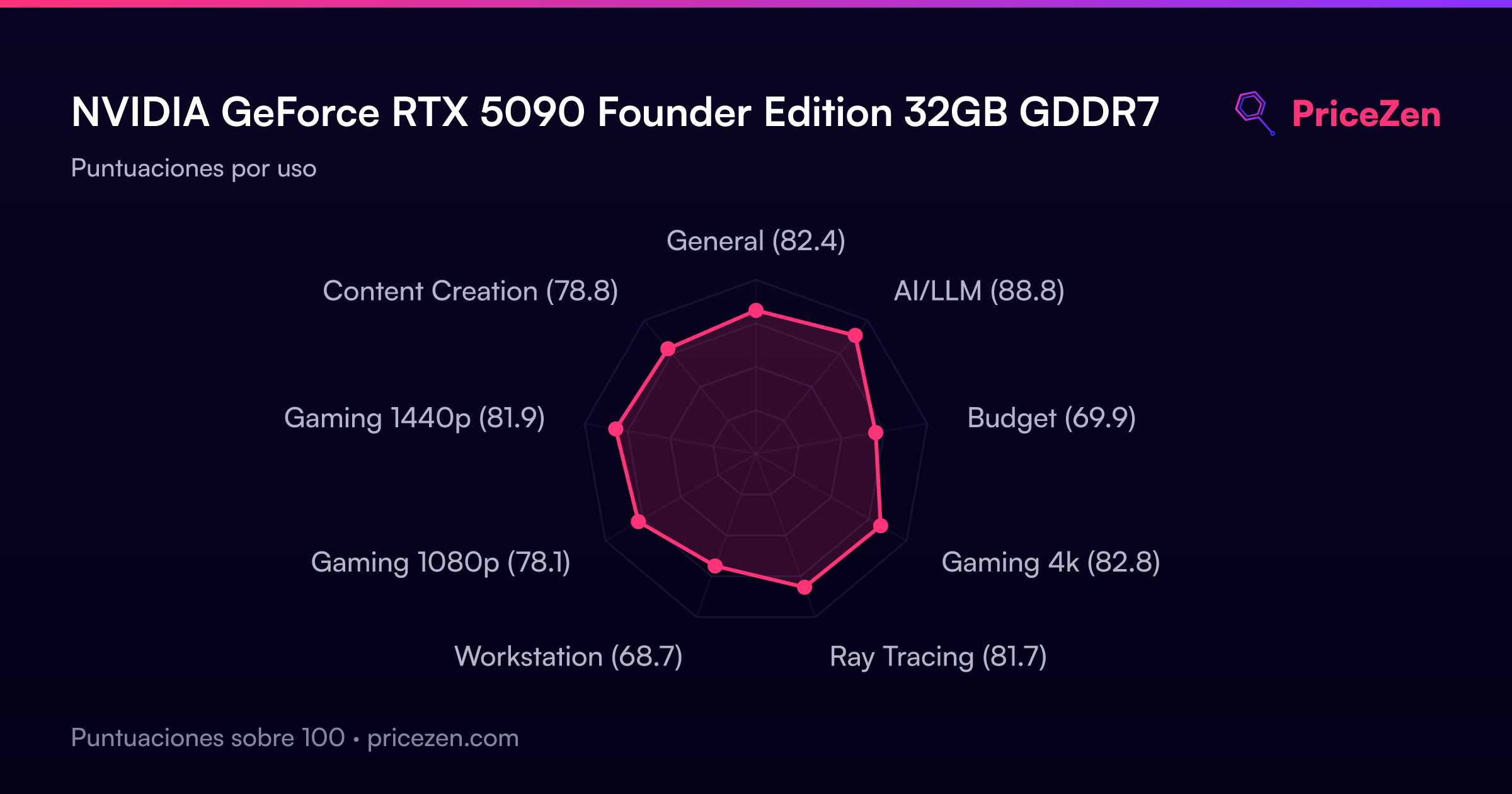
NVIDIA GeForce RTX 5090 Founder Edition 32GB GDDR7
The Blackwell architecture with 21,760 CUDA cores and 32GB of GDDR7 memory delivers the highest PassMark score in this lineup, making it the fastest GeForce ever built. Its 575W TDP and dual-slot design require a 1000W PSU, but the DLSS 4 and Reflex 2 features provide a tangible edge in competitive gaming and AI workloads. Best for enthusiasts running 4K ray-traced titles or local LLM inference who prioritize raw performance over budget.

Sin precio actual de tiendas


Resumen
The 30-Second Version
The RTX 5090 Founders Edition is the fastest consumer GPU we've ever tested, with a PassMark score of 38,958 and 32GB of GDDR7. It's the best choice for 4K gaming, ray tracing, and AI workloads, and the 2-slot design is impressively compact. The catch is a 575W TDP and a $2,000 MSRP that often balloons to $4,400 at retail. If you can find one at MSRP and you want the absolute best, buy it. If you already have a 4090, the upgrade is harder to justify.
Pros & Cons
Ventajas
- Best-in-class 4K and ray tracing performance, top of our charts 99th
- 32GB GDDR7 VRAM handles massive AI models and creative workloads 98th
- Compact 2-slot Founders Edition design fits in more cases 97th
- DLSS 4 with Multi-Frame Generation is a genuine game-changer 97th
- Effective cooling with quiet operation under load
Desventajas
- 575W TDP means you need a 1000W PSU and good airflow
- 12VHPWR connector has raised safety concerns among owners
- Price is brutal, especially with partner cards going way above MSRP
- Coil whine reported by multiple users
- Modest upgrade if you already own an RTX 4090
Opinión de los propietarios
The Word on the Street
Cómo cambió la opinión de los propietarios con el tiempo
ExclusivaSegún cuándo escribieron realmente sus opiniones los clientes, para ver si los elogios iniciales se mantuvieron.
8 opiniones escritas, may–jun 2026: 8 satisfechos
En las 1114 valoraciones de tiendas: 4,7★. La mayoría de los propietarios valora sin escribir una opinión. El gráfico cuenta las 8 opiniones escritas.
Cada punto es una opinión escrita, en el mes en que se escribió. Satisfechos = 4-5★, neutrales = 3★, insatisfechos = 1-2★.
Las pruebas
Performance
The PassMark G3D score of 38,958 puts this card in a league of its own. For context, that's the kind of number that makes previous generation flagships look like mid-range cards. In our database, the 5090 sits at the 99th percentile for raster performance and 98th for compute. Translation: if you're playing games at 4K with everything maxed out, this card doesn't just keep up, it sets the pace. Ray tracing performance is also a standout, landing in the top tier of cards we've tested. DLSS 4 with Multi-Frame Generation is the secret sauce here. It uses AI to generate additional frames, which means you can run path-traced titles at framerates that would have been unthinkable a generation ago.
The AI and compute numbers are equally impressive. The 5090 scores 97th percentile for AI workloads and 97th for VRAM capacity. That 32GB of GDDR7 is a game-changer for anyone working with large language models locally or doing heavy creative work. You can fit models that would choke a 16GB or even 24GB card. The 5th gen Tensor cores and 4th gen RT cores are doing serious work here. But there's a trade-off. All that performance comes with a 575W TDP, and the efficiency ranking tells the story. This card sits at the 25th percentile for efficiency. It's fast, but it's thirsty. You'll want a beefy power supply and good case airflow to keep it happy.
Specifications
Full Specifications
Chipset
| GPU Chipset | GeForce RTX 5090 |
| Brand | NVIDIA |
| Architecture | Blackwell |
| Class | consumer |
| Process | 4 |
Memory
| VRAM | 32 GB |
| Memory Type | GDDR7 |
| Memory Bus | 512 |
Compute
| CUDA Cores | 21760 |
| Tensor Cores | 5 |
| RT Cores | 4 |
| Base Clock | 2017 |
| Boost Clock | 2407 |
Performance
| PassMark G3D | 38958 |
| GPU Compute | 26734 |
Power & Cooling
| TDP | 575 |
| Recommended PSU | 1000 |
| Power Connectors | 4x PCIe 8-pin cables (adapter in box) OR 1x 600W PCIe Gen 5 cabl |
| Cooler | Fan |
| Fans | 2 |
Connectivity
| Interface | PCI Express 5.0 x16 |
| DisplayPort | 3 |
| HDMI | 1 |
| Max Displays | 4 |
| Max Resolution | 8K (4320p) |
Physical
| Length | 304 |
| Slot Width | 2 |
| Form Factor | ATX |
| Weight | 1.8 kg / 4.0 lbs |
Features
| Ray Tracing | Yes |
| Upscaling | DLSS 4 |
| DirectX | 12 Ultimate |
vs Competition
The RTX 5090 doesn't have a ton of direct competition, but there are some interesting alternatives worth considering. The ASUS TUF Gaming RTX 5090 is the most direct rival. Same chip, same 32GB of VRAM, but with a beefier 3-slot cooler and typically higher factory clocks. The trade-off is size and price. ASUS cards tend to run above MSRP, and that chunky cooler won't fit in smaller cases. The Founders Edition's 2-slot design is genuinely impressive for this level of performance, and it's a real advantage if you're building in a compact chassis.
If you're looking to spend less, the Gigabyte AERO RTX 5080 and ZOTAC APOCALYPSE RTX 5080 are worth a look. You're giving up the 32GB of VRAM and a chunk of raw performance, but you're also spending significantly less money. The RTX 5080 cards are still excellent 4K performers, especially with DLSS 4. And if you're gaming at 1440p, the MSI Ventus RTX 5070 Ti is a much more sensible buy. It's not going to match the 5090's numbers, but it's also not going to require a second mortgage. The 5090 is for people who want zero compromises. The 5080 and 5070 Ti are for people who want great performance without the flagship tax.
| Spec | NVIDIA GeForce RTX 5090 Founder Edition | ASUS GeForce RTX 5090 TUF Gaming | Gigabyte GeForce RTX 5070 Ti Eagle Ice | MSI GeForce RTX 5070 Ti Ventus 3X OC | ZOTAC GeForce RTX 5080 APOCALYPSE | Sapphire Radeon RX 7900 XTX NITRO+ |
|---|---|---|---|---|---|---|
| Chipset | GeForce RTX 5090 | GeForce RTX 5090 | GeForce RTX 5070 Ti | GeForce RTX 5070 Ti | GeForce RTX 5080 | Radeon RX 7900 XTX |
| Vram | 32GB GDDR7 | 32GB GDDR7 | 16GB GDDR7 | 16GB GDDR7 | 16GB GDDR7 | 24GB GDDR6 |
| Boost Clock Mhz | 2407 | 2407 | 2542 | 2482 | 2730 | 2680 |
| Tdp W | 575 | 575 | 300 | 300 | 360 | 339 |
| Memory Bus Bits | 512 | 512 | 256 | 256 | 256 | 384 |
| Ray Tracing | true | true | true | true | true | true |
| GPU Class | consumer | consumer | consumer | consumer | consumer | consumer |
| Compare | Compare | Compare | Compare | Compare |
| Producto | AI | Rt | Vram | Raster | Compute | Feature | Thermal | User Sentiment | Efficiency | Connectivity | Valoración social | Affordability |
|---|---|---|---|---|---|---|---|---|---|---|---|---|
| NVIDIA GeForce RTX 5090 Founder Edition | 97 | 91 | 96.7 | 98.8 | 97.7 | 52.8 | 32 | 85.4 | 23.9 | 81.8 | 93.3 | 4.2 |
| ASUS GeForce RTX 5090 TUF Gaming Compare | 97.1 | 90.6 | 97.8 | 98.8 | 97.7 | 95.9 | 72.4 | 85.4 | 23.9 | 99.3 | 98.7 | 2.3 |
| Gigabyte GeForce RTX 5070 Ti Eagle Ice Compare | 79.6 | 88.8 | 86.1 | 89.1 | 88.1 | 95.9 | 91.7 | 85.4 | 72 | 94.1 | 93.3 | 26.9 |
| MSI GeForce RTX 5070 Ti Ventus 3X OC Compare | 79.6 | 92.6 | 86.1 | 89.1 | 88.1 | 95.9 | 91.7 | 85.4 | 72 | 94.1 | 83.8 | 23.4 |
| ZOTAC GeForce RTX 5080 APOCALYPSE Compare | 85.6 | 97.6 | 89.1 | 94.5 | 93.4 | 95.9 | 91.7 | 99.5 | 57 | 94.1 | 98.7 | 20.5 |
| Sapphire Radeon RX 7900 XTX NITRO+ Compare | 95.1 | 96.3 | 92 | 83.6 | 95.6 | 95.9 | 91.7 | 85.4 | 52 | 98.8 | 69 | 19 |
Precio
Value & Pricing
Let's talk money, because this is where things get complicated. The Founders Edition has an MSRP of $2,000, but actually finding one at that price is a different story. Across US retailers, we're seeing prices ranging from $2,000 to $4,400. That's a $2,400 spread, which is frankly absurd. If you can snag one at the $2,000 mark, you're getting the best deal available. But at $4,400? That's more than double the MSRP, and at that point you're paying a massive premium for scarcity rather than performance.
In Canada, the situation is similar. Prices range from CAD 2,900 to CAD 5,000, a CAD 2,100 spread. The value proposition really depends on what you're upgrading from. If you're coming from an RTX 3090 or older, the performance jump is massive and the $2,000 price starts to make sense. If you already have a 4090, the upgrade is much more modest, and spending this kind of money gets harder to justify. The budget score of 67.4 out of 100 in our database reflects this. This card is many things, but a value play it is not.
Leer más
Overview
The RTX 5090 Founders Edition is the kind of card that makes you stop and stare at the spec sheet for a minute. 32GB of GDDR7 on a 512-bit bus, 21,760 CUDA cores, and a boost clock of 2407MHz. That's not a graphics card, that's a statement. NVIDIA is calling it the most powerful GeForce GPU ever made, and looking at our database, they're not wrong. This thing sits at the absolute top of the charts for raster performance, compute, and AI workloads. If you want the best, this is currently it.
Who's this for? Honestly, it's for the person who refuses to compromise. 4K gaming with full ray tracing at high refresh rates, local AI model work, heavy 3D rendering, video editing with effects that would make lesser cards cry. The 32GB of VRAM is a big deal here. You can load massive models or crank texture settings without worrying about hitting a memory wall. And the Founders Edition design itself is interesting. It's a 2-slot card, which is surprisingly compact for this level of power. Most partner cards are chunky 3-slot monsters, but NVIDIA kept this one relatively svelte at 304mm.
But let's be real about the elephant in the room. This card has a 575W TDP and NVIDIA recommends a 1000W power supply. That's a lot of juice. And the price, well, we'll get to that. The short version is that this is a halo product. It's not for everyone, and it's not trying to be. It's for the enthusiast who wants the absolute best and is willing to pay for it, both upfront and on their power bill.
Common Questions
Q: Is the RTX 5090 worth upgrading from an RTX 4090?
For most people, no. The 4090 is still an extremely capable card, and the performance jump to the 5090, while real, isn't transformative for gaming. The main reasons to upgrade would be the 32GB of VRAM for AI or creative work, or if you're chasing maximum 4K framerates with DLSS 4 Multi-Frame Generation. If you're happy with your 4090's performance, you can comfortably skip this generation.
Q: What power supply do I need for the RTX 5090?
NVIDIA recommends a 1000W power supply for the 5090, and that's not marketing fluff. The card has a 575W TDP, and transient power spikes can push that higher. You'll want a quality PSU with either a native 600W PCIe Gen 5 cable or four PCIe 8-pin cables for the included adapter. Don't try to run this on a 750W unit, you'll have a bad time.
Q: Will the RTX 5090 fit in my case?
The Founders Edition is 304mm long and takes up 2 slots, which is relatively compact for a flagship card. Most mid-tower cases should accommodate it without issue. Just make sure you have good airflow, since this card pushes out a lot of heat. If you're building in a small form factor case, double-check your clearance and consider that the card needs room to breathe.
Q: Is the 12VHPWR connector on the RTX 5090 safe?
The 12VHPWR connector has been a topic of concern since the 4090 launched, and some 5090 owners have raised similar questions. The key is to make sure the connector is fully seated and not bent at sharp angles near the plug. Using the included adapter or a quality native cable from a reputable PSU brand reduces risk. It's not a reason to avoid the card, but it's worth being careful during installation.
Who Should Skip This
If you're gaming at 1440p or 1080p, the RTX 5090 is massive overkill. You're paying for performance you'll never see, and the 575W power draw means you're also paying more on your electricity bill for no benefit. A 5070 Ti or 5080 will max out your monitor's refresh rate at those resolutions for a fraction of the price. Look at the MSI Ventus RTX 5070 Ti or Gigabyte AERO RTX 5080 instead.
Also skip this if you're on a budget or building a value-oriented system. The affordability score of 67.4 out of 100 in our database tells the story. This card costs as much as an entire mid-range gaming PC, and that's if you can find it at MSRP. If you're not doing 4K gaming, heavy AI work, or professional creative tasks, you're better off spending your money elsewhere. A 5080 or even a 5070 Ti will give you an excellent experience without the flagship tax.
Verdict
If you're a 4K gamer who wants to crank every setting to maximum and still hit high framerates, the RTX 5090 is the card to buy. It's the best consumer GPU on the market right now, full stop. The combination of raw raster performance, ray tracing chops, and DLSS 4 makes it a monster for gaming. And that 32GB of VRAM means you're future-proofed for years of increasingly demanding titles. The Founders Edition specifically is the one to get if you can find it at MSRP. The 2-slot design is a genuine advantage over partner cards, and the cooling solution is surprisingly effective for something this compact.
For creators and AI enthusiasts, the story is similar. The 5090's compute performance is top-tier, and the 32GB of GDDR7 opens up possibilities that smaller cards simply can't match. Local LLM inference, heavy 3D rendering, 8K video editing, this card handles it all without breaking a sweat. The power draw is the main downside. You'll need a 1000W PSU, and your room will get noticeably warmer during long sessions. But if you need this level of performance, there's really no alternative. The 5090 is in a class of its own.
Usage Scores
- General82.4
- AI/LLM88.8
- Budget69.9
- Gaming 4k82.8
- Ray Tracing81.7
- Workstation68.7
- Gaming 1080p78.1
- Gaming 1440p81.9
- Content Creation78.8