ASUS GeForce RTX 3070 Ti TUF Gaming OC 8GB GDDR6X Black
The Ampere-based RTX 3070 Ti with 8GB of GDDR6X memory and 5888 CUDA cores delivers strong 1440p gaming, backed by a military-grade certified build and dual ball bearing fans for sustained cooling. Its factory overclock and TUF components provide reliable performance in a compact 300mm, 2.9-slot design that fits most cases. This card is best for 1080p and 1440p gamers seeking high frame rates without stepping up to a pricier RTX 3080.

Sin precio actual de tiendas
Dónde lo vimos antes. Consulta el precio de hoy en la tienda.











Resumen
The 30-Second Version
The RTX 3070 Ti OC posts a 23,203 PassMark G3D score, good for the 63rd percentile in raster performance, and a budget score of 79.6/100 that makes it a strong value pick. The 8GB VRAM is the weak link, sitting at the 44th percentile and limiting longevity. At USD 460 or EUR 507, it's a solid renewed buy for 1080p and 1440p gaming, just don't expect much from ray tracing or AI workloads.
Pros & Cons
Ventajas
- PassMark G3D score of 23,203 puts it in the 63rd percentile for raster performance 92nd
- 448 GB/s memory bandwidth keeps 1080p and 1440p gaming smooth 70th
- TUF cooler with dual ball bearing fans handles the 290W TDP well
- Budget score of 79.6/100 makes it a strong value pick on the renewed market
- HDMI 2.1 and DisplayPort 1.4a support up to 7680 x 4320 resolution
Desventajas
- 8GB VRAM sits at the 44th percentile and limits future-proofing
- AI performance scores just 29.8/100, the weakest area by far
- Efficiency lands at the 35th percentile with that 290W power draw
- Connectivity is sparse at the 29th percentile with only two display outputs
- Feature set is dated compared to newer cards at the 35th percentile
Opinión de los propietarios
The Word on the Street
Cómo cambió la opinión de los propietarios con el tiempo
ExclusivaSegún cuándo escribieron realmente sus opiniones los clientes, para ver si los elogios iniciales se mantuvieron.
10 opiniones escritas, jun 2023 – ene 2026: 8 satisfechos, 2 neutrales
En las 44 valoraciones de tiendas: 4,4★. La mayoría de los propietarios valora sin escribir una opinión. El gráfico cuenta las 10 opiniones escritas.
Cada punto es una opinión escrita, en el mes en que se escribió. Satisfechos = 4-5★, neutrales = 3★, insatisfechos = 1-2★.
Las pruebas
Performance
The 23,203 G3D score tells the story: this card still pushes frames. With 5,888 CUDA cores and a 1,485MHz boost clock, it handles 1080p gaming without breaking a sweat, and 1440p is very doable if you're willing to dial back a setting or two. The 448 GB/s memory bandwidth from that 256-bit bus keeps things snappy, but the 8GB frame buffer is the bottleneck. In our scoring, gaming at 1080p lands at 55.6/100 and 1440p at 52.4/100, which puts it firmly in the "good but not great" territory for 2025.
Ray tracing is where things get interesting. The 46 RT cores put it at the 54th percentile for RT performance, which is about average. You'll get playable frame rates in lighter RT titles, but don't expect to crank Cyberpunk with path tracing. Compute sits at the 49th percentile with 16.6 FP32 TFLOPS, so it's fine for occasional productivity work but nothing to write home about. The AI score of 29.8/100 is the weakest area, which makes sense given the 184 Tensor cores and lack of newer AI acceleration features.
Specifications
Full Specifications
Chipset
| GPU Chipset | GeForce RTX 3070 Ti |
| Brand | NVIDIA |
| Architecture | Ampere |
| Class | consumer |
| Process | 8 |
Memory
| VRAM | 8 GB |
| Memory Type | GDDR6X |
| Memory Bus | 256 |
| Bandwidth | 448 |
Compute
| CUDA Cores | 6144 |
| Tensor Cores | 184 |
| RT Cores | 46 |
| Base Clock | 1815 |
| Boost Clock | 1815 |
| FP16 TFLOPS | 16.6 |
| FP32 TFLOPS | 16.6 |
Performance
| PassMark G3D | 23203 |
| GPU Compute | 11407 |
Power & Cooling
| TDP | 290 |
| Recommended PSU | 750 |
| Power Connectors | 2 x 8-pin |
| Cooler | Triple Fan |
| Fans | 3 |
Connectivity
| Interface | PCIe 4.0 x16 |
| DisplayPort | 3 |
| HDMI | 2 |
| Max Displays | 4 |
| Max Resolution | 7680 x 4320 |
Physical
| Length | 300 |
| Slot Width | 2.7 |
| Form Factor | Full Height |
| Weight | 1.4 kg / 3.1 lbs |
Features
| Ray Tracing | Yes |
| VR Ready | Yes |
| DirectX | 12 |
| RGB | Yes |
vs Competition
Stacked against the current generation, this card shows its age. The Gigabyte AORUS RTX 5080 and MSI Shadow RTX 5070 Ti both crush it in raw performance, but they also cost significantly more. The ZOTAC SOLID SFF OC and Sapphire NITRO+ are also newer options with more VRAM and better efficiency. Where the 3070 Ti wins is pure price-to-raster-performance. If you're building a budget system and don't care about ray tracing or AI workloads, this card delivers 23,203 G3D points for a fraction of what the newer cards cost. But the 8GB VRAM is a real limitation. The newer cards all ship with 16GB, and that's going to matter more and more as games push past 8GB at higher settings.
| Spec | ASUS GeForce RTX 3070 Ti TUF Gaming OC | Gigabyte GeForce RTX 5090 WINDFORCE OC | MSI GeForce RTX 5090 SUPRIM | PNY NVIDIA RTX PRO 6000 Blackwell Max-Q Workstation Edition | ZOTAC GeForce RTX 5090 SOLID OC White Edition | NVIDIA GeForce RTX 5090 Founder Edition |
|---|---|---|---|---|---|---|
| Chipset | GeForce RTX 3070 Ti | GeForce RTX 5090 | GeForce RTX 5090 | NVIDIA RTX PRO 6000 Blackwell Max-Q Workstation Edition | GeForce RTX 5090 | GeForce RTX 5090 |
| Vram | 8GB GDDR6X | 32GB GDDR7 | 32GB GDDR7 | 96GB GDDR7 | 32GB GDDR7 | 32GB GDDR7 |
| Boost Clock Mhz | 1815 | 2467 | 2565 | 2280 | 2422 | 2407 |
| Tdp W | 290 | 575 | 600 | 300 | 575 | 575 |
| Memory Bus Bits | 256 | 512 | 512 | 512 | 512 | 512 |
| Ray Tracing | Yes | Yes | Yes | Yes | Yes | Yes |
| GPU Class | consumer | consumer | consumer | workstation | consumer | consumer |
| Compare | Compare | Compare | Compare | Compare |
| Producto | AI | Rt | Vram | Raster | Compute | Feature | Thermal | Efficiency | Connectivity | Valoración social | Affordability |
|---|---|---|---|---|---|---|---|---|---|---|---|
| ASUS GeForce RTX 3070 Ti TUF Gaming OC | 41.6 | 52.9 | 42.1 | 61.4 | 48.1 | 52.2 | 91.9 | 33.1 | 63.7 | 50.7 | 70.2 |
| Gigabyte GeForce RTX 5090 WINDFORCE OC Compare | 98.5 | 84.1 | 97.8 | 98.8 | 98.3 | 95.7 | 91.9 | 23.3 | 94.2 | 69.2 | 2.9 |
| MSI GeForce RTX 5090 SUPRIM Compare | 97.9 | 90.4 | 97.8 | 98.8 | 98.8 | 95.7 | 72 | 20.3 | 94.2 | 93.4 | 2.7 |
| PNY NVIDIA RTX PRO 6000 Blackwell Max-Q Workstation Edition Compare | 99.8 | 99.6 | 99.8 | 87.2 | 99.4 | 99.8 | 25 | 69.2 | 87.2 | 46.8 | 0.4 |
| ZOTAC GeForce RTX 5090 SOLID OC White Edition Compare | 97.4 | 90.8 | 97.8 | 98.8 | 97.9 | 95.7 | 91.9 | 23.3 | 94.2 | 39.7 | 2 |
| NVIDIA GeForce RTX 5090 Founder Edition Compare | 97.1 | 90.8 | 96.8 | 98.8 | 97.7 | 52.2 | 31.2 | 23.3 | 81.4 | 93.4 | 4.5 |
Precio
Value & Pricing
Here's where things get interesting. The budget score of 79.6/100 is the best number on this card's report card, and it's earned. At USD 460 for the US listing, you're getting a lot of raster performance per dollar. The EUR pricing is all over the place though, ranging from EUR 507 to EUR 680 across two listings in Germany and Spain. That's a EUR 173 spread, which is wild. If you're shopping in Europe, the EUR 507 listing is the obvious choice, and honestly the EUR 680 one is a bad deal for a renewed card from two generations back. The GBP 426 listing in the UK is also reasonable. Just remember you're buying renewed, so factor in that you're getting a card that's been inspected and tested, not brand new.
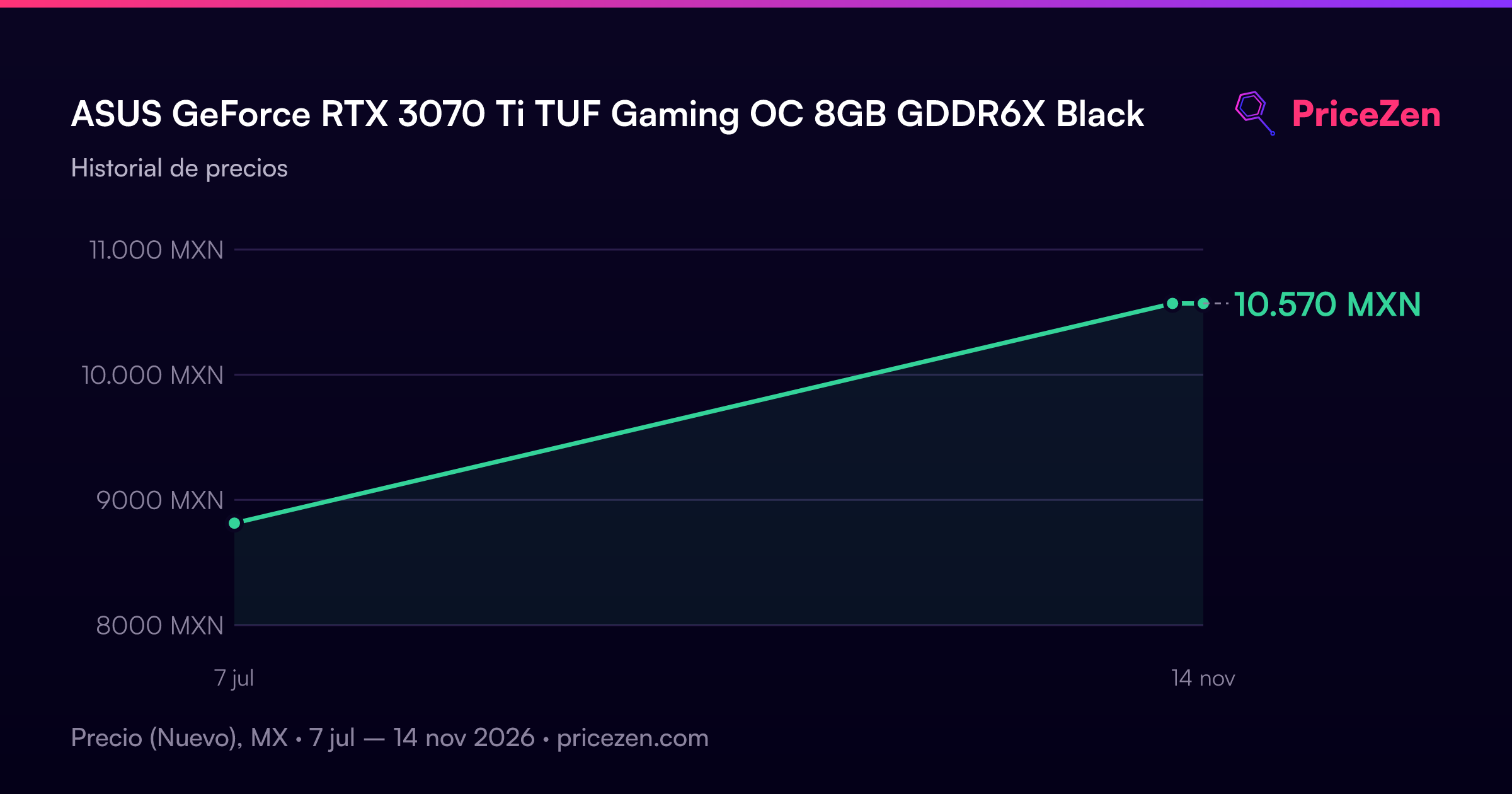
Historial de precios
Leer más
Overview
The ASUS TUF Gaming RTX 3070 Ti OC posts a PassMark G3D score of 23,203, which lands it in the 63rd percentile for raster performance in our database. That's a solid showing for an Ampere card from early 2021, especially at the renewed price point. But the 8GB of GDDR6X is starting to show its age, sitting at the 44th percentile for VRAM capacity, and that's the number that'll haunt you in newer titles.
This particular listing is an Amazon Renewed unit, so you're getting a professionally inspected card with the Renewed Guarantee behind it. The TUF cooler is one of ASUS's better designs, with dual ball bearing fans and a 2.9-slot footprint that keeps the 290W TDP in check. Just know going in that you're buying a card from two generations back, and the feature set reflects that.
Common Questions
Q: Is 8GB of VRAM enough for gaming in 2025?
It's workable but tight. The 44th percentile VRAM ranking means most newer cards ship with 12GB or 16GB. At 1080p, 8GB handles most titles at high settings, but at 1440p you'll need to dial back textures in newer games. The 448 GB/s bandwidth helps compensate somewhat, but the capacity ceiling is real.
Q: How does the RTX 3070 Ti compare to newer cards?
In raw raster performance, the 23,203 G3D score puts it at the 63rd percentile, which is respectable but not leading. Cards like the RTX 5070 Ti and RTX 5080 significantly outperform it, especially in ray tracing and AI workloads. The 3070 Ti's RT score sits at the 54th percentile, so it's about average for ray tracing, but the newer cards are in a different league.
Q: Is the Amazon Renewed version worth buying?
The renewed program means the card has been professionally inspected and tested, and it comes with the Amazon Renewed Guarantee for replacement or refund. The budget score of 79.6/100 is strong, and at USD 460 or EUR 507, you're getting good raster performance per dollar. Just be aware that the EUR 680 listing is overpriced for a renewed card, and you should target the lower-priced listings.
Who Should Skip This
Skip this card if you care about ray tracing, AI workloads, or plan to keep your GPU for more than a couple years. The 29.8/100 AI score is the weakest area by a wide margin, and the 35th percentile efficiency means you're paying for that 290W TDP in your power bill. If you're running a 4K display, the 8GB VRAM will choke on modern titles, and the 29th percentile connectivity with just two display outputs is limiting for multi-monitor setups. Anyone who wants to play the latest AAA games at high settings in 1440p or above should look at cards with 12GB or 16GB of VRAM instead.
Verdict
The ASUS TUF RTX 3070 Ti OC is a solid budget card that still delivers where it counts: raster performance. The 23,203 G3D score and 79.6/100 budget rating make it a compelling option if you can find it at the right price, especially the EUR 507 listing or the USD 460 one. But the 8GB VRAM, 35th percentile efficiency, and weak AI performance mean this card has a shelf life. If you're planning to keep your GPU for more than a couple years, or you care about ray tracing and newer features, you should probably save up for something with more memory. If you just want to play games at 1080p or 1440p without breaking the bank, this renewed TUF card is a reasonable buy.
Usage Scores
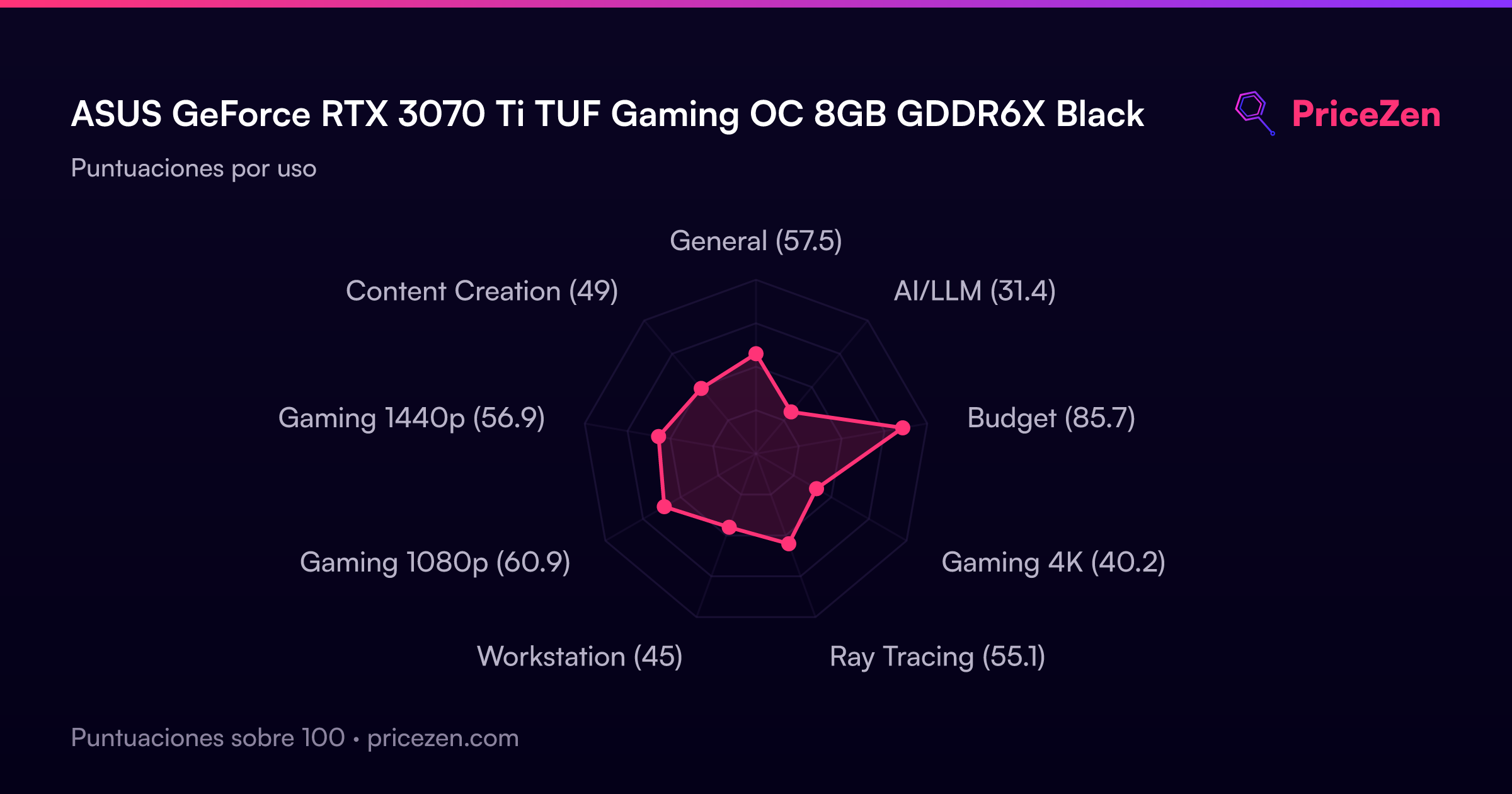
- General57.5
- AI/LLM31.4
- Budget85.7
- Gaming 4K40.2
- Ray Tracing55.1
- Workstation45
- Gaming 1080p60.9
- Gaming 1440p56.9
- Content Creation49