ASUS Radeon RX 7800 XT ATS Gaming OC 16GB GDDR6
Equipped with 16GB of GDDR6 memory on a 256-bit bus and RDNA 3 architecture, this card delivers 37.3 FP32 TFLOPS for smooth 1440p gaming. Its dual BIOS switch and reinforced backplate offer practical flexibility and durability, while the axial-tech fan design maintains lower noise under load. This GPU is best for 1440p gamers seeking a reliable, cool-running card with a factory overclock and a robust build quality.

Sin precio actual de tiendas
Resumen
The 30-Second Version
The RX 7800 XT ATS Gaming posts a 24,397 PassMark G3D score and packs 16GB of GDDR6, which is the real selling point here. Compute performance is a standout at the 82nd percentile with 74.65 FP16 TFLOPS. But the dual fan cooler runs warm, connectivity is limited to two ports, and the feature set is nearly bare at the 11th percentile.
Pros & Cons
Ventajas
- 16GB GDDR6 with 624 GB/s bandwidth, 73rd percentile for VRAM 83rd
- 74.65 FP16 TFLOPS puts compute at the 82nd percentile 81st
- PassMark G3D score of 24,397 is solid for 1440p gaming 73rd
- Dual BIOS switch for quiet or performance profiles
- Dual ball bearing fans should outlast oil-sealed alternatives
Desventajas
- Thermal performance at the 44th percentile with a dual fan cooler
- Only one DisplayPort 2.1 and one HDMI 2.1, 37th percentile connectivity
- 263W TDP with efficiency at the 53rd percentile
- Feature set ranks at the 11th percentile, bare bones extras
- Affordability at the 33rd percentile, not a budget bargain
Las pruebas
Performance
The 24,397 PassMark G3D score is the headline number here. It puts this card in the 64th percentile for raster performance, which means it's above average but not leading the pack. For 1440p gaming, that translates to high refresh rates in most titles without breaking a sweat. The 16GB of VRAM is a real asset too, sitting at the 73rd percentile. Games are getting hungrier for memory, and 16GB gives you headroom that 12GB cards simply don't have.
Compute is where this card quietly shines. The 74.65 FP16 TFLOPS figure lands at the 82nd percentile, which is impressive for a card in this price bracket. The 60 RT cores put ray tracing at the 62nd percentile, so it's not going to embarrass itself in RT workloads, but it's not going to challenge NVIDIA's dedicated RT hardware either. The 2430MHz boost clock is respectable, and the dual BIOS switch lets you toggle between quiet and performance profiles without touching software. Just don't expect the dual fan cooler to keep things frosty under sustained load, thermal performance sits at the 44th percentile.
Specifications
Full Specifications
Chipset
| GPU Chipset | Radeon RX 7800 XT |
| Brand | AMD |
| Architecture | RDNA 3 |
| Class | consumer |
| Process | 5 |
Memory
| VRAM | 16 GB |
| Memory Type | GDDR6 |
| Memory Bus | 256 |
| Bandwidth | 624.1 |
Compute
| Tensor Cores | 120 |
| RT Cores | 60 |
| Base Clock | 1295 |
| Boost Clock | 2430 |
| FP16 TFLOPS | 74.65 |
| FP32 TFLOPS | 37.32 |
Performance
| PassMark G3D | 24397 |
| GPU Compute | 13562 |
Power & Cooling
| TDP | 263 |
| Recommended PSU | 600 |
| Cooler | Dual Fan |
| Fans | 2 |
Connectivity
| Interface | PCIe 4.0 |
| DisplayPort | 1 |
| HDMI | 1 |
vs Competition
Against the MSI Ventus RTX 5070 Ti, the ASUS card gives up ground in ray tracing and efficiency. The 5070 Ti's dedicated RT hardware and newer architecture will outpace the 7800 XT in RT workloads, and the 62nd percentile RT score here confirms that gap. The Sapphire NITRO+ 7800 XT variant is the more direct comparison, and Sapphire typically packs better coolers and higher factory clocks. The Gigabyte AERO and ZOTAC APOCALYPSE cards are in a different performance tier entirely, so they're not fair fights. Where the ASUS holds its own is VRAM capacity and compute throughput. The 16GB buffer matches what you get on pricier cards, and the 82nd percentile compute score means this card can pull double duty for productivity tasks better than its gaming rank suggests.
| Spec | ASUS Radeon RX 7800 XT ATS Gaming OC | Gigabyte GeForce RTX 5070 Ti Eagle Ice | MSI GeForce RTX 5070 Ti Ventus 3X OC | ZOTAC GeForce RTX 5080 APOCALYPSE | PNY GeForce RTX 5080 ARGB OC | Sapphire Radeon RX 9070 XT PULSE |
|---|---|---|---|---|---|---|
| Chipset | Radeon RX 7800 XT | GeForce RTX 5070 Ti | GeForce RTX 5070 Ti | GeForce RTX 5080 | GeForce RTX 5080 | Radeon RX 9070 XT |
| Vram | 16GB GDDR6 | 16GB GDDR7 | 16GB GDDR7 | 16GB GDDR7 | 16GB GDDR7 | 16GB GDDR6 |
| Boost Clock Mhz | 2430 | 2542 | 2482 | 2730 | 2620 | 2970 |
| Tdp W | 263 | 300 | 300 | 360 | 360 | 304 |
| Memory Bus Bits | 256 | 256 | 256 | 256 | 256 | 256 |
| Ray Tracing | - | true | true | true | true | true |
| GPU Class | consumer | consumer | consumer | consumer | consumer | consumer |
| Compare | Compare | Compare | Compare | Compare |
| Producto | AI | Rt | Vram | Raster | Compute | Feature | Thermal | Efficiency | Connectivity | Valoración social | Affordability |
|---|---|---|---|---|---|---|---|---|---|---|---|
| ASUS Radeon RX 7800 XT ATS Gaming OC | 83.4 | 62 | 72.6 | 63.9 | 81.1 | 11 | 42.8 | 52.7 | 36.2 | 56.8 | 33.1 |
| Gigabyte GeForce RTX 5070 Ti Eagle Ice Compare | 79.6 | 88.6 | 85.9 | 89 | 88.2 | 96 | 91.6 | 72.3 | 94 | 95.4 | 26 |
| MSI GeForce RTX 5070 Ti Ventus 3X OC Compare | 79.6 | 92.4 | 85.9 | 89 | 88.2 | 96 | 91.6 | 72.3 | 94 | 88.9 | 23.1 |
| ZOTAC GeForce RTX 5080 APOCALYPSE Compare | 85.6 | 97.5 | 89 | 94.5 | 93.5 | 96 | 91.6 | 57.3 | 94 | 99.1 | 19.1 |
| PNY GeForce RTX 5080 ARGB OC Compare | 85.6 | 97.5 | 89 | 94.5 | 93.5 | 96 | 91.6 | 57.3 | 94 | 82.8 | 14.2 |
| Sapphire Radeon RX 9070 XT PULSE Compare | 89.3 | 84.7 | 73.8 | 75.3 | 90.2 | 96 | 72.2 | 45.8 | 88.8 | 95.4 | 42.1 |
Precio
Value & Pricing
Pricing is tricky here since we only have CAD listings, ranging from 1,479 to 1,490 Canadian dollars across two listings. That puts affordability at the 33rd percentile, which means this card is not cheap relative to other GPUs in our database. The 66.8 out of 100 budget score reflects that tension. You're paying for the ASUS name and the OC edition binning, but the feature set is sparse and the cooler is modest. If you can find this card at a discount, the 16GB of VRAM and strong compute numbers make it a reasonable buy. At full price, you're leaving value on the table.
Leer más
Overview
The RX 7800 XT posts a PassMark G3D score of 24,397, which lands it in the 64th percentile for raster performance in our database. That's a solid showing for a card aimed at 1440p gaming, and the 16GB of GDDR6 on a 256-bit bus gives it 624 GB/s of memory bandwidth to work with. The 74.65 FP16 TFLOPS figure also puts compute at the 82nd percentile, so this thing has some serious muscle beyond just gaming.
But the ATS Gaming variant from ASUS is a budget-focused take on the chip. The dual fan cooler and 263W TDP put thermal performance at the 44th percentile, and connectivity sits at the 37th percentile with just one DisplayPort 2.1 and one HDMI 2.1. You're getting the core performance of the 7800 XT without many frills, which is fine if you just want frames and don't care about RGB or a massive heatsink.
Common Questions
Q: Is 16GB of VRAM enough for 1440p gaming in 2025?
Yes, 16GB is more than enough for 1440p gaming right now. The 73rd percentile VRAM ranking means this card has more memory than most GPUs in our database. Games are using more VRAM, but 16GB gives you comfortable headroom for high resolution textures and future titles.
Q: How does the RX 7800 XT handle ray tracing?
Ray tracing is serviceable but not a strength. The 60 RT cores put this card at the 62nd percentile for RT performance, so you can enable ray tracing in most games at 1440p with some settings tweaks. But NVIDIA cards in this price range will generally deliver better RT frame rates.
Q: Will a 600W power supply be enough for this card?
Yes, ASUS recommends a 600W PSU for this card, and the 263W TDP leaves reasonable headroom. Just make sure your power supply has the proper PCIe power connectors and is a quality unit from a reputable brand. A cheap 600W PSU that can't actually deliver its rated wattage will cause problems.
Who Should Skip This
Skip this card if you care about thermals or connectivity. The 44th percentile thermal ranking means the dual fan cooler will get loud and warm under sustained load, and the 37th percentile connectivity score gives you just one DisplayPort and one HDMI. If you run multiple monitors or want a quiet build, look elsewhere. Also skip it if you're buying at the full CAD 1,479 price. The 33rd percentile affordability ranking means you're paying a premium for a card with an 11th percentile feature set. There are better cooled 7800 XT variants and more feature-rich alternatives at similar prices.
Verdict
The ASUS ATS Gaming RX 7800 XT is a capable 1440p card with a strong 16GB VRAM buffer and surprisingly good compute performance. The 24,397 PassMark score and 82nd percentile compute ranking are the reasons to buy. But the dual fan cooler, sparse connectivity, and 11th percentile feature set make this a no-frills card at a not-quite-no-frills price. If you can find it below the CAD 1,479 starting point, it's worth considering. At full price, you're paying for the ASUS badge without getting ASUS's best cooling or extras.
Usage Scores
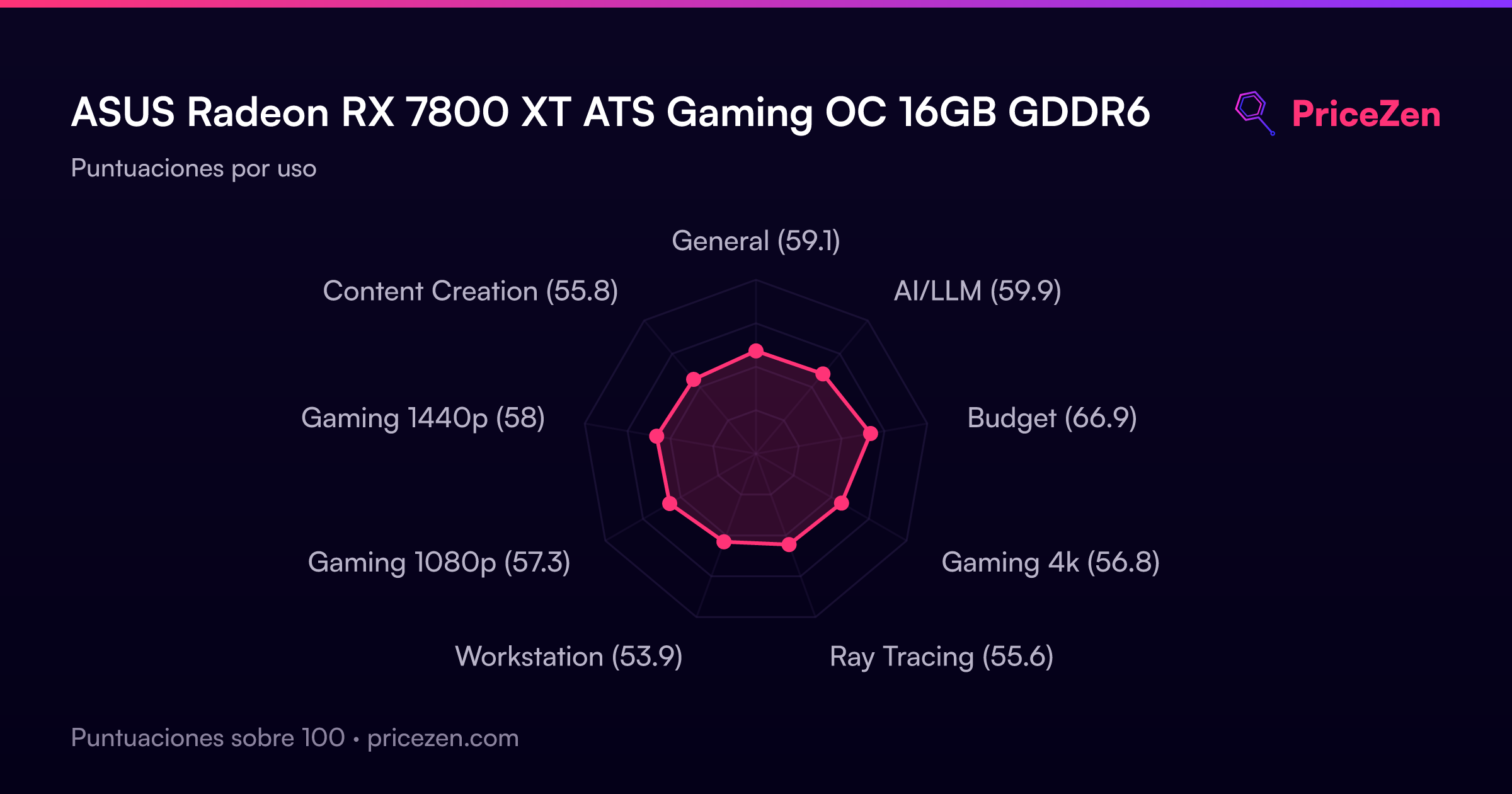
- General59.1
- AI/LLM59.9
- Budget66.9
- Gaming 4k56.8
- Ray Tracing55.6
- Workstation53.9
- Gaming 1080p57.3
- Gaming 1440p58
- Content Creation55.8