Sigma 50mm f/1.4 DG DN Art
The 14-element optical design with three aspherical and one SLD element suppresses astigmatism and field curvature, while the HLA linear motor delivers fast, quiet autofocus for tracking moving subjects. At 670g with weather sealing and an 11-blade diaphragm, it balances portability with build quality for a fast prime. Best for professional portrait and street photographers on Sony E-mount who need reliable low-light performance and sharp bokeh.

No current retailer price
Where we saw it before. Check the store for today's price.











Snapshot
The 30-Second Version
Sigma's 50mm f/1.4 DG DN Art is a portrait and low-light specialist with autofocus in the top tier and an 85.9/100 professional score. Owners love the sharpness and bokeh, and the main gripe is the 670g weight. US pricing spans USD 839 to USD 1,037, with Amazon and PROCAM cheapest at USD 839. Buy it for people in dim rooms, skip it if you need close-up work or an all-day walkaround.
Pros & Cons
Pros
- HLA linear motor ranks in the top tier for autofocus, top of the charts 95th
- f/1.4 constant maximum aperture, among the brightest for low-light work 89th
- Owners repeatedly praise sharpness and color rendering, around ten mentions 77th
- Weather sealed with water and oil repellent front coating, build at the 77th percentile 76th
- Professional use-case score of 85.9/100 and 5/5 rating across 29 reviews
Cons
- 670g is heavy for a 50mm prime, portability is below average
- 1:6.8 max magnification and 450mm minimum focus make macro a 35.6/100 use case
- No stabilization, ranking below average
- Fly-by-wire manual focus frustrates owners who pull focus manually
- Affordability is below average even at the cheapest USD 839 listing
What owners think
The Word on the Street
How owner sentiment changed over time
ExclusiveBased on when customers actually wrote their reviews - so you can see whether early praise held up.
14 written reviews, Aug 2023 – Feb 2026: 6 happy, 8 without stars
Across all 29 store ratings: 5.0★. Most owners rate without writing a review. The chart counts the 14 written reviews.
Each dot is one written review, in the month it was written. Happy = 4-5★, mixed = 3★, unhappy = 1-2★.
The proof
Performance
Autofocus is the headline. The HLA linear motor lands in the top tier against every other lens in our database, which puts it at the absolute top of the charts for focusing speed. Owners back that up: fast and quiet AF is one of the most repeated bits of praise in the review data, showing up around eight times. Practically, that means eye-detect tracking on a moving subject in a dim reception hall is a reasonable ask rather than a gamble. The f/1.4 maximum aperture is among the brightest options on the market, and paired with that motor it's genuinely useful in low light rather than just theoretically bright.
Optically it's strong but not chart-topping. Our optical score is above average and bokeh is solidly above average without being best-in-class. Interestingly, owners are more enthusiastic than the numbers: sharpness comes up about ten times in the reviews and bokeh around six, with color rendering getting specific praise. The eleven-blade diaphragm helps keep out-of-focus highlights round when you stop down. Where it falls apart is close work. Minimum focus is 450mm and max magnification is 1:6.8, which puts macro in the lower third and gives it a use-case score of just 35.6 out of 100. You will not be shooting rings on a wedding cake with this. Video is decent, though the fly-by-wire manual focus ring is a recurring complaint from anyone trying to pull focus by hand.
Specifications
Full Specifications
Optics
| Type | Prime |
| Focal Length Min | 50 |
| Focal Length Max | 50 |
| Elements | 14 |
| Groups | 11 |
| Aspherical Elements | 3 |
| ED Elements | 1 |
| Coating | water and oil repellent coating |
Aperture
| Max Aperture | f/1.4 |
| Min Aperture | f/16 |
| Constant | Yes |
| Diaphragm Blades | 11 |
Build
| Mount | Sony E |
| Format | full-frame |
| Weather Sealed | Yes |
| Weight | 0.7 kg / 1.5 lbs |
| Filter Thread | 72 |
AF & Stabilization
| AF Type | HLA Linear Focusing Motor |
| Stabilization | No |
Focus
| Min Focus Distance | 450 |
| Max Magnification | 1:6.8 |
vs Competition
The competitors our system surfaces are mostly a different species of lens, which is itself informative. The Sony FE 70-200mm f/2.8 GM OSS II, Tamron 70-180mm f/2.8 Di III VC VXD G2 and Nikon NIKKOR Z 70-200mm f/2.8 VR S are all telephoto zooms. If your work is events from the back of a room or compressed outdoor portraits, cross-shop those instead, because a 50mm prime simply can't reach and our reach score reflects that. What the Sigma gives you in exchange is that f/1.4 maximum, among the brightest, and a fixed focal length that forces you to move rather than zoom. Different tool, different job.
The closer fight is the Canon RF 24-70mm f/2.8L IS USM, which represents the do-everything standard zoom approach, and the Viltrox AF 35mm f/1.2 LAB FE, which is the other bright-prime philosophy. Against a standard zoom, the Sigma's argument is brightness and its 85.9 professional score; the zoom's argument is that our flexibility ranking for this lens is in the lower third, which is a polite way of saying it does one thing. Against the Viltrox, you're choosing between focal lengths and rendering character, and Sigma's counter is that HLA motor in the top tier plus a build score at the 77th. If you shoot environmental wider frames, 35mm suits you better. If you shoot people, 50mm is the safer default.
| Spec | Sigma 50mm f/1.4 DG DN Art | Sony FE 400mm f/2.8 GM OSS | Canon RF 100-300mm f/2.8L IS USM | Nikon NIKKOR Z 120-300mm f/2.8 TC VR S | Fujifilm Fujinon XF 200mm f/2 R LM OIS WR | Leica APO-Vario-Elmarit-SL 90-280mm f/2.8-4 |
|---|---|---|---|---|---|---|
| Focal Length | 50mm | 400mm | 100-300mm | 120-300mm | 200mm | 90-280mm |
| Max Aperture | f/1.4 | f/2.8 | f/2.8 | f/2.8 | f/2 | f/2.8-4 |
| Mount | Sony E | Sony E | Canon RF | Nikon Z | Fujifilm X | L-Mount |
| Format Coverage | full-frame | full-frame | full-frame | full-frame | APS-C | full-frame |
| Stabilization | No | Yes | Yes | Yes | Yes | Yes |
| Weather Sealed | Yes | Yes | Yes | Yes | Yes | No |
| Weight (g) | 670 | 2895 | 2630 | 2735 | 2265 | 1850 |
| AF Type | HLA Linear Focusing Motor | XD Linear Motor | Dual Nano USM | Silky Swift VCM (SSVCM) | Linear motor | Autofocus |
| Lens Type | prime | super-telephoto | zoom | super-telephoto | prime | zoom |
| Compare | Compare | Compare | Compare | Compare |
| Product | AF | Bokeh | Build | Macro | Reach | Video | Optical | Aperture | User Sentiment | Wide Angle | Portability | Versatility | Social Proof | Affordability | Stabilization |
|---|---|---|---|---|---|---|---|---|---|---|---|---|---|---|---|
| Sigma 50mm f/1.4 DG DN Art | 95.4 | 76.2 | 77.1 | 39.2 | 43.2 | 70 | 72.2 | 89.3 | 55.1 | 39.4 | 37.5 | 32.6 | 46.2 | 37.9 | 41.5 |
| Sony FE 400mm f/2.8 GM OSS Compare | 95.4 | 99.7 | 90.8 | 89 | 91.6 | 70 | 70.8 | 43.4 | 98.3 | 4.4 | 2.5 | 32.6 | 93.8 | 4.6 | 97.2 |
| Canon RF 100-300mm f/2.8L IS USM Compare | 90 | 86 | 98.9 | 46.4 | 88.1 | 85.6 | 90.3 | 43.4 | 84.4 | 13.9 | 3.1 | 81.8 | 51.9 | 3.2 | 98.7 |
| Nikon NIKKOR Z 120-300mm f/2.8 TC VR S Compare | 95.4 | 86 | 95.5 | 70 | 88.1 | 85.6 | 82.9 | 43.4 | 0 | 10.6 | 2.9 | 75.6 | 7.3 | 4.5 | 99.5 |
| Fujifilm Fujinon XF 200mm f/2 R LM OIS WR Compare | 95.4 | 98.6 | 90.8 | 27.2 | 88.1 | 70 | 77.4 | 64.5 | 94.6 | 5.2 | 4 | 32.6 | 31.2 | 9 | 97.2 |
| Leica APO-Vario-Elmarit-SL 90-280mm f/2.8-4 Compare | 54.5 | 83 | 64 | 61.2 | 86.5 | 61.2 | 94.4 | 43.4 | 0 | 16.3 | 6.4 | 83.6 | 26 | 6.8 | 92.5 |
Price
Value & Pricing
Where you buy matters more than usual. We track prices across stores, partly through our community browser extension, and the US spread right now is USD 198, from USD 839 at the low end to USD 1,037 at the high. Amazon and PROCAM are tied at the bottom at USD 839. Newegg wants USD 920, and both Adorama and B&H Photo sit at USD 939. Same lens, same warranty situation, roughly two hundred dollars apart. Buy from the cheap end.
In Canada the range runs CAD 1,140 to CAD 1,347 across five listings, a CAD 207 spread, and in Europe EUR 899 to EUR 999. Brazil currently shows BRL 7,159 from a single listing. Even at the best price, our affordability ranking puts it in the lower third, so this isn't a budget optic and we won't pretend otherwise. But value-for-money is one of the recurring positive themes from owners, mentioned about five times, and the sentiment summary specifically frames it as a strong buy against pricier alternatives. Paying USD 839 for top-tier autofocus and a weather-sealed f/1.4 is a fair trade. Paying USD 1,037 for the exact same thing is not.
We started tracking prices for this product on Nov 4, 2026. The chart appears once we have more data.
Read more
Overview
Fifty millimeters is the focal length everyone ends up owning eventually, and f/1.4 is the aperture that makes it interesting. Sigma's Art 50mm f/1.4 DG DN is the mirrorless-native version of a lens they've been refining for years, built here for Sony E full-frame bodies. Fourteen elements in eleven groups, three aspherical pieces and one SLD element, an HLA linear focusing motor doing the driving, and a dust and splash resistant build with a water and oil repellent front coating. On paper it's a portrait lens that moonlights as everything else.
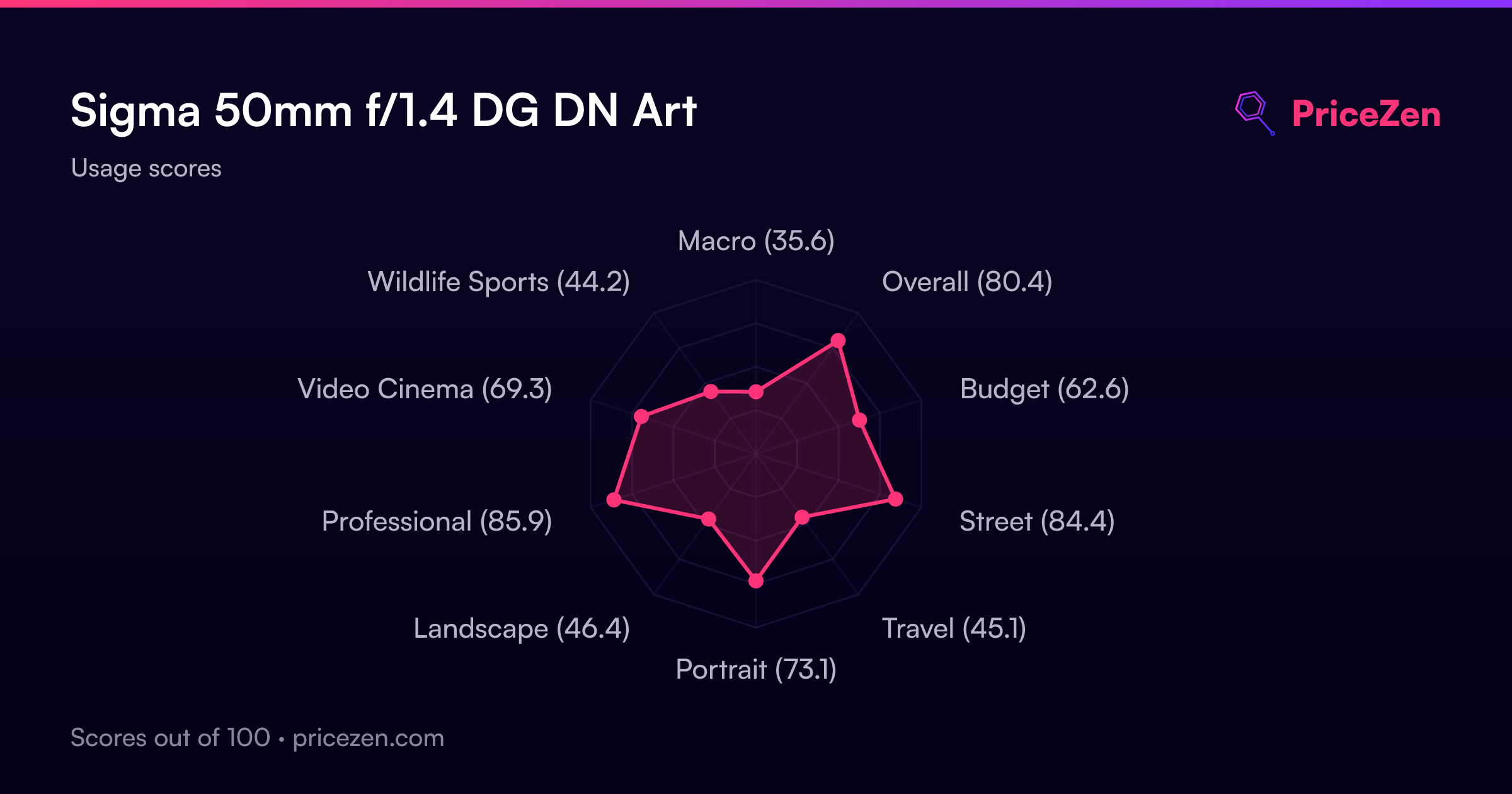
Our scoring model puts it at 85.9 out of 100 for professional work and 84.6 for street shooting, with a total score of 78.8. That gap between the use-case scores and the overall number tells you most of what you need to know: this thing is excellent at a specific job and merely fine at several others. It's a prime. It doesn't zoom, it doesn't focus close, and it doesn't stabilize anything. If you want one lens that does everything, this isn't it. If you want one lens that makes people look good in dim rooms, keep reading.
What makes it worth a look right now is the price spread. We track listings across stores with our own system, and the US price currently runs from USD 839 to USD 1,037 depending on where you click. That's a real chunk of money for identical glass. Owners seem happy too, with sentiment sitting at 82 out of 100 across the reviews we collected and a 5/5 customer rating from 29 reviews. The catch, and there's always one, is that 670g hanging off the front of your camera.
Common Questions
Q: Is 670g actually too heavy for everyday shooting?
It's heavy for a 50mm prime, and our portability ranking puts it below the middle of the pack. Owner feedback matches that: weight and size come up around seven times in the reviews we collected, though most describe it as manageable rather than a dealbreaker. On a full-frame body with a grip it balances fine, but on a small compact-style body or a long day of handheld street work, you'll feel it.
Q: Can I use it for close-up or product detail shots?
Not really. Minimum focus distance is 450mm and maximum magnification is 1:6.8, which puts macro in the lower third and gives it a macro use-case score of just 35.6 out of 100. That's enough for a tight head-and-shoulders portrait, but you can't fill the frame with a ring or a watch face. If detail work is a regular part of your job, plan on a dedicated macro lens alongside it.
Q: How good is the autofocus for video and moving subjects?
The HLA linear focusing motor ranks in the top tier in our data, which is the top of the charts for AF among lenses we track, and owners repeatedly describe it as fast and quiet. Video overall scores in the upper third, so it's solid rather than class-leading. The sticking point is manual work: the focus ring is fly-by-wire, and owners who pull focus by hand flag that as a limitation.
Q: Where should I buy it to get the best price?
In the US, our price tracking currently shows Amazon and PROCAM tied at USD 839, with Newegg at USD 920 and both Adorama and B&H Photo at USD 939. The full US range runs to USD 1,037, so the spread is USD 198 for the same lens. Canadian listings run CAD 1,140 to CAD 1,347 and European ones EUR 899 to EUR 999, so it's worth checking a couple of stores before you commit.
Who Should Skip This
Skip this if you want one lens that covers everything. Our flexibility ranking puts it in the lower third and reach is below average, which is exactly what you'd expect from a fixed 50mm with no stabilization. If you shoot travel, events from a distance, or family stuff where you can't reposition yourself constantly, a standard zoom like the Canon RF 24-70mm f/2.8L IS USM or a telephoto option like the Tamron 70-180mm f/2.8 Di III VC VXD G2 will serve you far better. Also skip it if close-up work is a big part of your output, because 1:6.8 magnification isn't going to cut it.
Video-first shooters who pull focus manually should think hard too. The fly-by-wire ring is a genuine recurring complaint, and with no stabilization and a video score in the upper third, this is a capable B-camera lens rather than a purpose-built cinema tool. And if you're building a lightweight kit around a small body, 670g defeats the point. Look at slower, smaller primes instead and put the savings toward a second focal length.
Verdict
If you shoot portraits, weddings, or anything indoors where light is scarce and subjects move, buy it. The 85.9 professional score isn't decoration, it's built on top-tier autofocus and an aperture that lets you keep shutter speeds sane in ugly lighting. Owners consistently report exactly this: sharp files, pleasing background blur, focus that locks quietly and stays locked. At USD 839 from Amazon or PROCAM, it's the kind of purchase you stop thinking about after the first shoot. Street shooters get a similar deal at 84.6 out of 100, provided you don't mind the bulk.
If you're a generalist who wants one lens on the camera permanently, or you shoot video with manual focus pulls, or you like detail shots of small objects, be honest with yourself before clicking. The 35.6 macro score, the low flexibility ranking and the fly-by-wire focus complaints are all real limits, not nitpicks. And if you carry your camera all day on a small body, 670g of lens will remind you it's there every hour. Great lens, narrow mission.
Usage Scores
- Macro35.6
- Overall80.4
- Budget62.6
- Street84.4
- Travel45.1
- Portrait73.1
- Landscape46.4
- Professional85.9
- Video Cinema69.3
- Wildlife Sports44.2