Western Digital Red SN700 500GB PCIe 3.0 x4 NVMe M.2 2280
The PCIe 3.0 NVMe interface delivers 3430 MB/s reads and 2600 MB/s writes, with 420K random read IOPS for responsive NAS workloads. Its 1000 TBW endurance and 1,750,000-hour MTBF are built for 24/7 operation, and it is tested for compatibility with popular NAS systems. Best for SMB administrators running virtualization, collaborative editing, or database caching on multi-user NAS appliances.












概要
The 30-Second Version
The WD Red SN700 is a NAS cache drive with a 1000 TBW endurance rating that puts it in the 97th percentile of our database. Random I/O is strong at 420K read IOPS, and the 1.75 million hour MTBF backs up the 24/7 rating. Prices swing from $170 to $267, so shop around. One verified review reports receiving an opened drive, which is worth keeping in mind when choosing a seller.
Pros & Cons
長所
- 1000 TBW endurance rating, 97th percentile in our database 97th
- 420K random read IOPS keeps multi-user NAS workloads snappy 85th
- 1.75 million hour MTBF rating for 24/7 operation
- Scales up to 4TB if you need more cache capacity
- PCIe 3.0 speeds maxed out at 3430 MB/s read
短所
- Only 500GB capacity on this model, 27th percentile
- PCIe 3.0 means slower sequential speeds than Gen4 alternatives
- Feature set is thin, 15th percentile in our database
- Price varies wildly, from $170 to $267 across US listings
- One verified review reports receiving an opened, used drive
オーナーの声
The Word on the Street
購入者の評価が時間とともにどう変化したか
独自顧客が実際にレビューを書いた時期に基づいています。発売当初の高評価が続いたかどうかがわかります。
書かれたレビュー 1件、2026年6月:不満 1件
ストア評価全928件:4.5★。 多くの購入者はレビューを書かずに評価だけを付けています。 グラフは書かれたレビュー1件を数えています。
各点は書かれたレビュー1件で、書かれた月に置いています。満足 = 4〜5★、普通 = 3★、不満 = 1〜2★。
実証データ
Performance
The sequential numbers are 3430 MB/s read and 2600 MB/s write. For a PCIe 3.0 drive, that's about as good as it gets. You're saturating the interface on reads, and writes aren't far behind. But the real story here is the random performance. 420K random read IOPS and 380K random write IOPS put this drive in the 85th percentile for random workloads in our database. That translates to a NAS that stays responsive when multiple users are pulling files, running VMs, or hitting a database cache at the same time.
In practice, that means you can throw this into a Synology or QNAP as a read/write cache and forget about it. The drive handles the constant small-block churn of a busy NAS without breaking a sweat. Sequential speed lands around the 61st percentile overall, which sounds mediocre until you remember this is a Gen3 drive competing against Gen4 and Gen5 hardware. For the interface it's using, it's maxed out.
Specifications
Full Specifications
Drive
| Capacity | 500 |
| Form Factor | M.2 2280 |
| Interface | PCIe 3.0 x4 |
| Protocol | NVMe |
| PCIe Generation | 3 |
| External | No |
Performance
| Sequential Read (MB/s) | 3430 |
| Sequential Write (MB/s) | 2600 |
| Random Read (IOPS) | 420000 |
| Random Write (IOPS) | 380000 |
Reliability
| Endurance (TBW) | 1000 |
| MTBF (hours) | 1750000 |
vs Competition
The Samsung 980 PRO is the obvious alternative if you want more speed. It's a Gen4 drive with significantly higher sequential numbers, and it's often priced competitively. But the 980 PRO's endurance rating is lower, and it's not specifically designed for NAS workloads. If you're building a gaming rig or a workstation, the 980 PRO makes more sense. If you're caching a NAS, the SN700's endurance and 24/7 rating matter more.
The Kingston Fury Renegade and Team Group MP44 are also Gen4 options that will beat the SN700 on raw speed. The Crucial T700 and Lexar NM1090 PRO go even further with Gen5 speeds that make this drive look slow on paper. But none of those are NAS-rated, and none of them match the SN700's TBW rating. You're trading endurance and reliability for speed, and for a NAS cache that's usually the wrong trade.
| Spec | Western Digital Red SN700 | SanDisk Ultrastar DC SN655 | Team Group T-FORCE GC PRO | Solidigm D5-P5336 | KLEVV CRAS C910 | DATO DP580 |
|---|---|---|---|---|---|---|
| Capacity | 500GB | 61.44TB | 2TB | 30.72TB | 500GB | 2TB |
| Form Factor | M.2 2280 | 2.5" | M.2 2280 | 2.5" | M.2 | M.2 |
| Interface | PCIe 3.0 x4 | PCIe 4.0 x4 | PCIe 5.0 x4 | PCIe 4.0 x4 | PCIe 4.0 x4 | PCIe 5.0 x4 |
| Seq Read | 3,430 MB/s | - | 12,500 MB/s | - | 5,000 MB/s | 9,300 MB/s |
| Nand Type | - | TLC | TLC | QLC | TLC | - |
| Dram Cache | - | - | false | - | false | - |
| Endurance | 1000 TBW | - | 1200 TBW | - | 350 TBW | - |
| Compare | Compare | Compare | Compare | Compare |
| 製品 | Speed | Random | Feature | Capacity | User Sentiment | Endurance | ユーザー評価 | Affordability |
|---|---|---|---|---|---|---|---|---|
| Western Digital Red SN700 | 61.1 | 84.8 | 14.7 | 27.7 | 1.6 | 96.6 | 64.7 | 49.7 |
| SanDisk Ultrastar DC SN655 Compare | 68.6 | 87.5 | 53.2 | 99.8 | 0 | 65.6 | 0 | 0 |
| Team Group T-FORCE GC PRO Compare | 96.4 | 61.8 | 85.9 | 78.8 | 0 | 87 | 25.3 | 17.7 |
| Solidigm D5-P5336 Compare | 68.6 | 61.8 | 33.3 | 99.6 | 0 | 57 | 0 | 0.3 |
| KLEVV CRAS C910 Compare | 71.6 | 87.1 | 87.4 | 27.7 | 0 | 71.7 | 64.7 | 64 |
| DATO DP580 Compare | 94.6 | 61.8 | 29.7 | 78.8 | 0 | 14.8 | 13.7 | 22.1 |
価格
Value & Pricing
Pricing on this drive is all over the place. US listings range from $170 to $267, which is a $97 spread for the exact same 500GB drive. That's the kind of gap that makes you want to shop around before clicking buy. The lower end of that range feels fair for a NAS-focused drive with this endurance rating. The higher end? You're getting into territory where a 1TB Gen4 drive starts looking tempting.
Compared to the competition, the SN700 sits in the 51st percentile for affordability. That's dead average. You're not getting a screaming deal, but you're not being gouged either, assuming you find it at the lower end of that price range. The endurance rating is what you're paying for here, and for a NAS cache drive that's going to see constant writes, that's not a bad trade.
Amazon 1件の価格 最安 ¥33,056
価格履歴
詳細情報
Overview
The WD Red SN700 is one of those drives that doesn't chase headline-grabbing Gen4 or Gen5 speeds. Instead, it's built for a specific job: sitting inside a NAS, running 24/7, and not flaking out when three people are hammering it with file transfers at once. The 500GB version we're looking at here is the entry point, but the platform scales up to 4TB if you need more room for cache or hot data.
What makes this drive interesting is the endurance story. Western Digital rates it for 1000 TBW, which puts it in the 97th percentile for endurance in our database. That's a big deal for a NAS drive, because caching workloads chew through write cycles way faster than your average boot drive. The 1.75 million hour MTBF rating backs that up too.
It's a PCIe 3.0 drive, so you're not getting the 7000 MB/s numbers you'd see from newer Gen4 hardware. But for NAS caching, random I/O matters more than raw sequential speed, and the SN700 posts 420K random read IOPS and 380K random write IOPS. That's strong enough to keep a multi-user NAS feeling snappy without paying the Gen4 tax.
Common Questions
Q: How much storage can I get with this drive?
The SN700 platform scales up to 4TB, though this specific model is 500GB. If you're using it as a NAS cache, 500GB is usually plenty for most home and small business setups. For larger deployments with heavy database caching or virtualization, stepping up to 1TB or 2TB might make more sense.
Q: Is this drive fast enough for a NAS cache?
Yes. The sequential speeds top out at 3430 MB/s read and 2600 MB/s write, which saturates the PCIe 3.0 interface. More importantly for NAS workloads, the random performance hits 420K read IOPS and 380K write IOPS. That's what keeps things snappy when multiple users are hitting the cache simultaneously.
Q: How long will this drive last in a 24/7 NAS?
Western Digital rates it for 1000 TBW and 1.75 million hours MTBF. The TBW rating is the more useful number for a cache drive, since caching workloads involve constant writes. At 1000 TBW, you could write 500GB per day for over five years before hitting the rated limit. That's exceptional endurance for a consumer-adjacent drive.
Q: Will this work in my NAS?
WD designed and tested the SN700 for compatibility with popular NAS systems, including Synology and QNAP. It's a standard M.2 2280 form factor with PCIe 3.0 NVMe, so it should slot into any NAS with an M.2 slot. Just check your NAS documentation to confirm it supports NVMe caching, since some older models only support SATA M.2 drives.
Who Should Skip This
If you're building a gaming PC or upgrading a laptop, this isn't your drive. The 500GB capacity is small for a boot drive, and the Gen3 speeds will feel sluggish compared to Gen4 options in the same price range. The Samsung 980 PRO or Kingston Fury Renegade will give you noticeably faster load times for about the same money.
Also skip this if you're on a tight budget and don't actually need NAS-specific endurance. A cheaper Gen3 drive without the 1000 TBW rating will handle light desktop use just fine. The SN700's endurance is its main selling point, and if you're not running a cache that sees constant writes, you're paying a premium for durability you won't use.
Verdict
If you're running a NAS and need a cache drive that won't die on you, the SN700 is a solid pick. The endurance rating is genuinely best-in-class, and the random I/O performance is strong enough to handle multiple users without slowdowns. Just make sure you're getting it at the lower end of that price range, and maybe buy from a seller you trust.
For a laptop or desktop boot drive, look elsewhere. The 500GB capacity is small, the sequential speeds are Gen3, and you can get faster Gen4 drives for similar money. This is a purpose-built drive, and that purpose is NAS caching. If that's not your use case, you're paying for endurance you'll never need.
Usage Scores
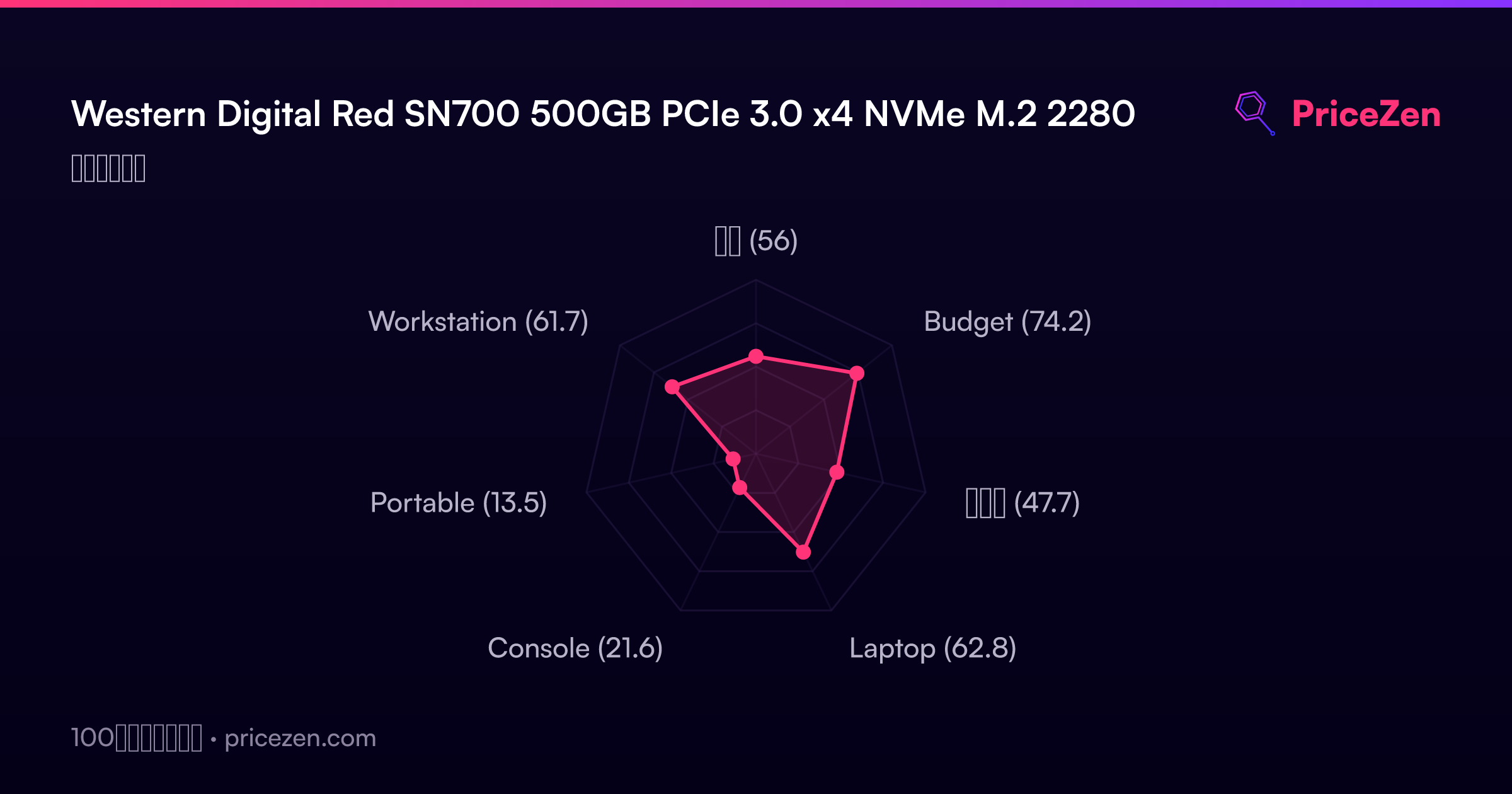
- 総合56
- Budget74.2
- ゲーム47.7
- Laptop62.8
- Console21.6
- Portable13.5
- Workstation61.7