Exascend PE4 16TB PCIe 4.0 x4 NVMe M.2 2280
The PCIe 4.0 x4 interface delivers 3270 MB/s reads and 2980 MB/s writes, with a 16TB capacity in the M.2 2280 form factor. Its sub-7.2W power draw and 2,000,000-hour MTBF support 24/7 operation in thermally constrained systems. This suits workstation builders and NAS administrators needing high-density, low-heat storage for sustained data workloads.

現在、販売店の最新価格はありません


概要
The 30-Second Version
The Exascend PE4 is a 16TB M.2 2280 drive with no direct competitors, but you pay dearly for that density at over $20,000 USD. Sequential speeds of 3,270 MB/s read and 2,980 MB/s write are merely average, and endurance is a weak spot. Buy it only if you absolutely need maximum capacity in a single M.2 slot and have the budget to match.
Pros & Cons
長所
- 16TB capacity in a standard M.2 2280 form factor is unmatched in our database 99th
- Low power draw under 7.2W keeps thermals in check for sustained workloads
- 2,000,000-hour MTBF and 0-70°C operating range suggest serious longevity
- PCIe 4.0 x4 interface means broad compatibility with modern motherboards
- NVMe 1.4 support with firmware tuned for consistent performance under load
短所
- Sequential speeds are middling at 3,270 MB/s read and 2,980 MB/s write
- Endurance rating lands in the bottom third of our database
- Feature set is sparse compared to consumer flagship drives
- Social proof is nearly nonexistent with only one customer review
- Price is eye-watering at over $20,000 USD for the 16TB model
実証データ
Performance
Let's talk numbers. The PE4 is rated for 3,270 MB/s sequential reads and 2,980 MB/s writes. For context, that's solidly in the middle of our database, around the 56th percentile for speed. It's not slow by any stretch, but it's also not going to set any records. A Samsung 990 Pro or Crucial T705 will absolutely smoke it in raw throughput, often by a wide margin. The PE4 is a PCIe 4.0 drive, and those numbers are actually closer to what you'd expect from a good PCIe 3.0 drive that's been pushed a bit.
Where the PE4 does shine is in sustained performance and thermal behavior. Exascend rates active power consumption below 7.2W, which is impressively low for a drive this dense. That means less heat, less throttling, and more consistent performance over long transfers. The 0°C to 70°C operating range and 2,000,000-hour MTBF tell you this thing was designed for 24/7 operation, not just bursty desktop use. Random performance lands around the 59th percentile, so it's fine for everyday tasks, but this is not a drive you buy for snappy 4K random reads. It's a capacity play with enough speed to keep professional workflows moving.
Specifications
Full Specifications
Drive
| Capacity | 16000 |
| Form Factor | M.2 2280 |
| Interface | PCIe 4.0 x4 |
| Protocol | NVMe |
| PCIe Generation | 4 |
| External | No |
Performance
| Sequential Read (MB/s) | 3270 |
| Sequential Write (MB/s) | 2980 |
Reliability
| MTBF (hours) | 2000000 |
vs Competition
Stacked against the Samsung 990 Pro, the PE4 looks rough on paper. The 990 Pro hits much higher sequential speeds and has vastly better random performance, plus it's a consumer darling with tons of reviews and proven reliability. But the 990 Pro tops out at 4TB. You'd need four of them to match the PE4's capacity, and you'd need four M.2 slots to do it. That's the whole ballgame. The Crucial T705 is even faster, pushing PCIe 5.0 speeds, but again, capacity caps out well below 16TB.
The current top five in our database tells the same story from a different angle. The Samsung 9100 PRO, Western Digital Black SN850X, Kingston FURY Renegade G5, Crucial T710, and SanDisk WD_BLACK are all faster drives with better all-around performance and far more reasonable prices. The WD Black SN850X in particular has a strong reputation for sustained write performance and gaming responsiveness. But none of them offers 16TB in a single M.2 stick. The Kingston FURY Renegade G5 and Crucial T710 push PCIe 5.0 speeds that leave the PE4 in the dust on raw throughput. The SanDisk WD_BLACK and Samsung 9100 PRO are consumer flagships with excellent random performance and proven track records.
If you need capacity above all else, the PE4 wins by default. If you need speed, endurance, or value, every competitor in our top five beats it.
| Spec | Exascend PE4 | Western Digital WD_BLACK SN8100 | Samsung 9100 PRO | Kingston FURY Renegade | Crucial T700 | SanDisk WD_BLACK |
|---|---|---|---|---|---|---|
| Capacity | 16TB | 4TB | 8TB | 4TB | 2TB | 8TB |
| Form Factor | M.2 2280 | M.2 2280 | M.2 2280 | M.2 2280 | M.2 2280 | M.2 2280 |
| Interface | PCIe 4.0 x4 | PCIe 5.0 x4 | PCIe 5.0 x4 | PCIe 4.0 x4 | PCIe 5.0 x4 | PCIe 5.0 x4 |
| Seq Read | 3,270 MB/s | 14,900 MB/s | 14,800 MB/s | 7,300 MB/s | 12,400 MB/s | 14,900 MB/s |
| Nand Type | - | TLC | TLC | TLC | TLC | TLC |
| Dram Cache | - | false | true | true | true | true |
| Endurance | - | 2400 TBW | 4800 TBW | 4000 TBW | 1200 TBW | 4800 TBW |
| Compare | Compare | Compare | Compare | Compare |
| 製品 | Speed | Random | Feature | Capacity | Endurance | ユーザー評価 | Affordability |
|---|---|---|---|---|---|---|---|
| Exascend PE4 | 61.8 | 61.8 | 14.6 | 99.4 | 33.7 | 20.2 | 0.1 |
| Western Digital WD_BLACK SN8100 Compare | 99.7 | 99.6 | 85.9 | 92.6 | 80.4 | 94.9 | 8.5 |
| Samsung 9100 PRO Compare | 99.2 | 99.8 | 99.8 | 98.1 | 85.7 | 94.9 | 1.9 |
| Kingston FURY Renegade Compare | 93.5 | 94.4 | 94 | 92.6 | 93.9 | 94.9 | 10.9 |
| Crucial T700 Compare | 96.7 | 97.6 | 97.6 | 78.7 | 82.6 | 75.1 | 22 |
| SanDisk WD_BLACK Compare | 99.1 | 99.3 | 97.6 | 98.1 | 80.4 | 40 | 3.2 |
価格
Value & Pricing
Here's where things get uncomfortable. The 16TB PE4 is listed at $20,669 USD. That's not a typo. You could buy a used car for that, or a very nice gaming PC with multiple high-end SSDs and still have money left over. The price per terabyte works out to roughly $1,292, which is astronomical compared to consumer drives. A 4TB Samsung 990 Pro runs around $300 these days, and even enterprise U.2 drives with similar capacity often come in cheaper.
But here's the thing: you're paying for density. There is no other 16TB M.2 2280 drive in our database. If your use case absolutely requires that much storage in a single M.2 slot, you don't have alternatives. You're paying the early adopter tax for a niche product, and Exascend knows it. For most people, buying two 8TB drives or four 4TB drives and using a PCIe adapter card would be dramatically cheaper. The PE4 only makes financial sense when physical space is the hard constraint.
詳細情報
Overview
The Exascend PE4 is one of those drives that makes you do a double take. A 16TB M.2 2280 stick that slides into a standard slot and just sits there, holding more data than most NAS boxes from a few years ago. That's the headline here, and it's a big one. Exascend isn't a household name like Samsung or Western Digital, but they've been quietly building enterprise and industrial storage for a while, and the PE4 is their shot at the prosumer and workstation crowd.
Who is this for? Honestly, it's for people who need a ridiculous amount of fast local storage in a tiny footprint. Think video editors working with 8K footage, data hoarders who also happen to be gamers, or someone building a compact server that can't fit a stack of 3.5-inch drives. The 16TB capacity is the entire story here. You're not buying this for raw speed bragging rights, you're buying it because nothing else in this form factor comes close on capacity.
And that's the interesting tension with the PE4. The capacity is best-in-class, literally the top of our database for this category. But the speed numbers are more middle of the pack. It's a trade-off drive, and whether it makes sense for you depends entirely on whether you value terabytes over transfer rates.
Common Questions
Q: Is the Exascend PE4 compatible with my motherboard?
The PE4 uses a standard M.2 2280 form factor with a PCIe 4.0 x4 interface, so it will work in any motherboard with an M.2 slot that supports PCIe NVMe drives. It's backward compatible with PCIe 3.0 slots too, though you'll see reduced speeds in that case. The drive supports NVMe 1.4, which is broadly supported across modern systems. Just make sure your motherboard's M.2 slot can physically accommodate a 2280-length drive, which is the most common size.
Q: Why is the 16TB model so expensive compared to other SSDs?
The price reflects the extreme density of packing 16TB into a standard M.2 2280 form factor. This requires very high-capacity NAND flash chips and advanced packaging that few manufacturers offer. There are no other 16TB M.2 2280 drives in our database, so Exascend has no direct competition at this capacity point. You're paying a premium for being an early adopter of a niche enterprise product rather than a mass-market consumer drive.
Q: How does the PE4 handle sustained workloads and heat?
Exascend rates the PE4 for active power consumption below 7.2W, which is quite low for a drive this dense. That helps keep temperatures manageable during long transfers. The drive is rated to operate from 0°C to 70°C, and the 2,000,000-hour MTBF suggests it's built for continuous operation. However, the endurance rating lands in the bottom third of our database, so extremely write-heavy workloads may wear it out faster than enterprise U.2 drives with higher endurance ratings.
Q: Is this drive good for gaming?
The PE4 scores 52.7 out of 100 for gaming in our analysis, which is decent but not exceptional. The sequential speeds are fine for game loading, but random performance is only around the 59th percentile, and modern games benefit more from fast random reads than raw sequential throughput. A Samsung 990 Pro or Crucial T705 will give you noticeably snappier game load times at a fraction of the cost. The PE4 makes sense for gaming only if you want to store an enormous game library on a single drive and don't mind paying a huge premium for that convenience.
Who Should Skip This
Skip the PE4 if you're a gamer or general desktop user. You'll get better real-world performance from a Samsung 9100 PRO, WD Black SN850X, or Crucial T710 for a tiny fraction of the price, and you almost certainly don't need 16TB in a single M.2 slot. The endurance rating is also a concern for anyone doing heavy sustained writes, like database servers or video rendering farms. In those cases, look at enterprise U.2 drives or add-in-card solutions with higher endurance ratings and better sustained write performance.
Also skip it if you're budget-conscious in any way. At over $20,000 USD, the PE4 costs more than most complete high-end PCs. You could buy four 4TB 990 Pros, a PCIe adapter card, and still have enough left over for a new GPU. The only reason to buy the PE4 is if you have a hard physical constraint on M.2 slots and an absolute requirement for 16TB in one drive. If that's not you, walk away.
Verdict
For the right person, the PE4 is a no-brainer. If you're building a compact workstation or server where every M.2 slot counts, and you need maximum storage density, this is the only game in town. Video editors working with massive raw footage, data scientists juggling huge datasets, or homelab enthusiasts who want a single drive that holds everything, the PE4 delivers something no one else does. The low power draw and wide temperature range make it genuinely suitable for 24/7 operation in tight enclosures.
For everyone else, this drive is hard to recommend. Gamers will get better real-world performance from a Samsung 9100 PRO, WD Black SN850X, or Crucial T710 at a fraction of the price. Content creators who don't need 16TB in one slot can buy multiple smaller drives and save thousands. And anyone who cares about endurance ratings should look at enterprise U.2 or add-in-card solutions instead. The PE4 is a specialist's tool, and it's priced like one.
Usage Scores
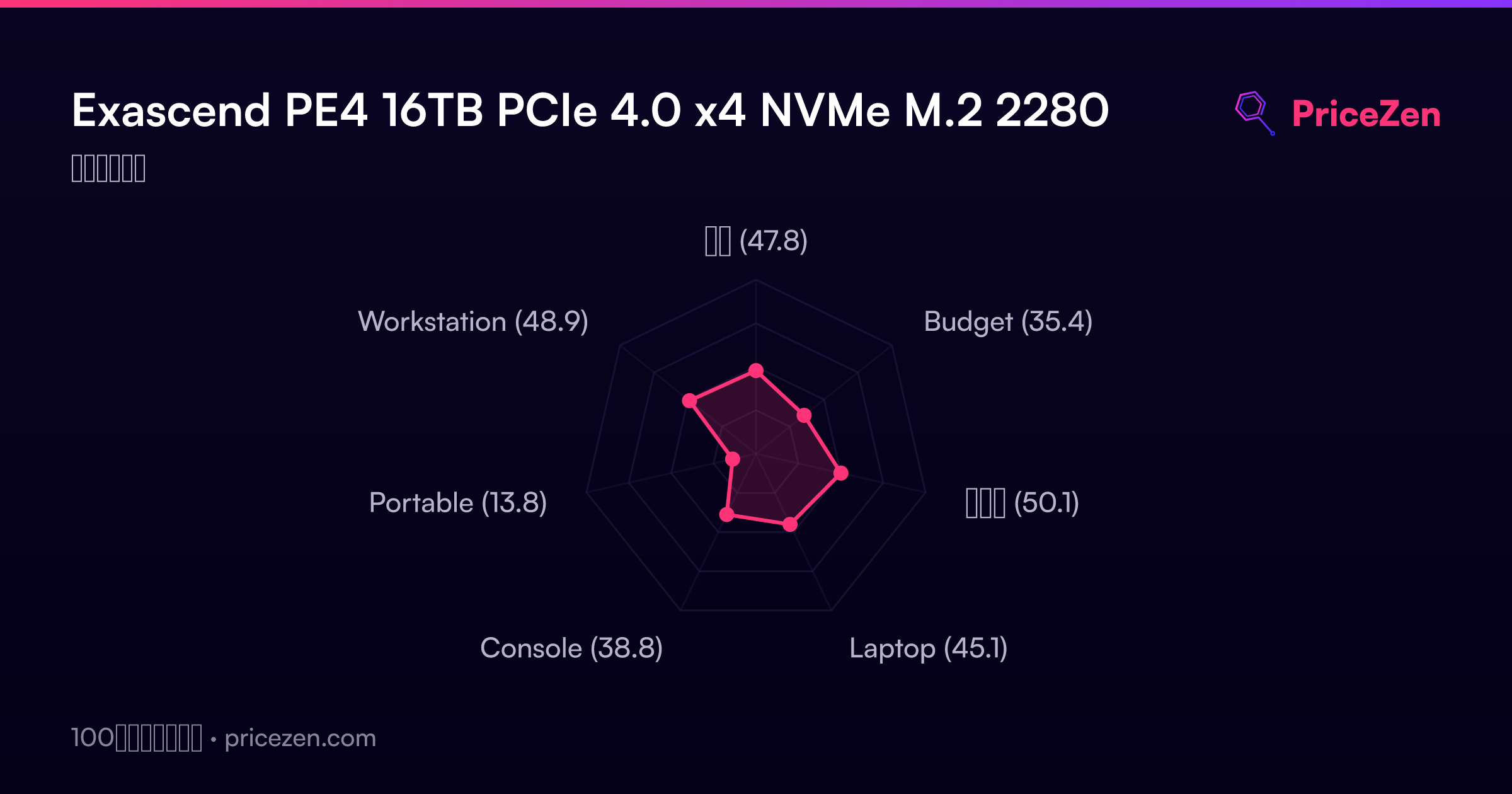
- 総合47.9
- Budget35.4
- ゲーム50.1
- Laptop45.1
- Console38.8
- Portable13.8
- Workstation48.9