Sony BRAVIA 3 II K50XR30M2 50"
The Cognitive Processor XR with XR Triluminos Pro drives over a billion accurate colors and AI-based upscaling, making content look closer to native 4K. It uniquely bundles Sony Pictures Core for streaming movies in premium quality, paired with a 120Hz panel and HDMI 2.1 for smooth gaming. This 50-inch Google TV is best for smart home users and streamers who prioritize cinematic color accuracy and integrated content perks over outdoor brightness.












Resumen
The 30-Second Version
Sony's BRAVIA 3 II packs a 120Hz panel, four HDMI 2.1 ports, and the Cognitive Processor XR into a 50-inch package, and the price has fallen to a USD 397 to USD 650 range. Gaming on PS5 is excellent thanks to VRR, ALLM, and Auto HDR Tone Mapping. The direct LED backlight means contrast is mediocre, so movie buffs should look elsewhere. Near the bottom of that range, it's one of the best mid-range values out there.
Pros & Cons
Ventajas
- 120Hz native panel with VRR and ALLM for smooth gaming 96th
- Four HDMI 2.1 ports, more than most TVs at this price 85th
- Cognitive Processor XR delivers excellent upscaling 83rd
- Google TV with Gemini is fast and genuinely useful 80th
- Dolby Vision and Dolby Atmos support at a mid-range price
Desventajas
- Direct LED backlight means mediocre contrast and black levels
- Picture quality lands in the 36th percentile, below average
- 2.0 channel audio is thin without a soundbar
- Outdoor performance is a real weak spot at 47.7/100
- No local dimming, so HDR highlights lack punch
Opinión de los propietarios
Cómo cambió la opinión de los propietarios con el tiempo
ExclusivaSegún cuándo escribieron realmente sus opiniones los clientes, para ver si los elogios iniciales se mantuvieron.
12 opiniones escritas, may–jul 2026: 11 satisfechos, 1 insatisfecho
En las 161 valoraciones de tiendas: 4,6★. La mayoría de los propietarios valora sin escribir una opinión. El gráfico cuenta las 12 opiniones escritas.
Cada punto es una opinión escrita, en el mes en que se escribió. Satisfechos = 4-5★, neutrales = 3★, insatisfechos = 1-2★.
Las pruebas
Performance
The 120Hz native panel is the headline here. Most TVs in this price range are stuck at 60Hz, which means motion blur and judder when things get fast. The BRAVIA 3 II handles 120Hz content natively, so sports, action movies, and especially games look smoother. Motionflow XR adds frame interpolation for lower frame rate content, though purists will want to turn that off for movies. The Cognitive Processor XR does the heavy lifting for upscaling, and it's one of the better upscalers we've seen in this class. Older 1080p content gets cleaned up nicely, with less noise and better edge definition than you'd expect from a direct LED panel.
Gaming performance is where this TV earns its keep. VRR and ALLM are both supported, and Sony's Auto HDR Tone Mapping with the PS5 means you don't have to fiddle with settings when you switch between games. The 79th percentile gaming score in our database puts it well above average, and the four HDMI 2.1 ports mean you can have a PS5, Xbox, soundbar, and streaming box all connected at full bandwidth. That's not something every TV at this price offers. The picture quality score sits at the 36th percentile, which is the trade-off. Direct LED without local dimming means blacks are more dark gray than true black, and HDR highlights don't pop the way they do on mini-LED or OLED sets. For a bright living room, that's fine. For a dark home theater, it's a compromise.
Specifications
Full Specifications
Display
| Size | 50" |
| Resolution | 4K |
| Panel Type | LED |
| Backlight | Direct LED |
| Aspect Ratio | 16:9 |
| Curved | No |
| Screen Finish | matte |
Picture Quality
| Color Gamut | Not Specified by Manufacturer |
| Motion Tech | Motionflow XR |
| Processor | Cognitive Processor XR |
HDR
| HDR Formats | HDR10, HLG, Dolby Vision |
| Dolby Vision | Yes |
| HDR10+ | No |
| HLG | Yes |
Gaming
| Refresh Rate | 120 Hz |
| VRR | ✓ |
| ALLM | Yes |
| Game Mode | Yes |
Smart TV
| Platform | Google TV |
| Voice Assistant | Gemini |
| Screen Mirroring | Apple AirPlay 2, Google Cast |
| Works With | Apple HomeKit |
Audio
| Speaker Config | 2 |
| Wattage | 20 |
| Dolby Atmos | Yes |
| Surround Sound | DTS:X |
| eARC | Yes |
Connectivity
| HDMI Ports | 4 |
| HDMI Version | 2.1 |
| USB Ports | 2 |
| Wi-Fi | Wi-Fi 6E |
| Bluetooth | 5.3 |
| Ethernet | Yes |
| Optical Audio | Yes |
| VESA Mount | 300x300 |
Power & Size
| Energy Star | No |
| Annual Energy | 215 |
| Weight | 11.2 kg / 24.7 lbs |
vs Competition
The LG OLED evo OLED55C5PUA 55" is the one that hurts most in a dark room. It's an OLED, and the BRAVIA 3 II's direct LED backlight without local dimming simply can't follow it there. Our ranking puts the Sony's picture quality in the 36th percentile, and that number tells you where the gap lives: gray-ish blacks, HDR highlights that don't really flare. What the Sony brings back to the table is motion and connectivity, a 120Hz native panel, VRR, ALLM, four HDMI 2.1 ports, and the PS5-specific Auto HDR Tone Mapping. If your room is bright and your console is a PS5, that trade looks a lot more reasonable than it does on paper.
The Hisense U7 Series 65U75QG 64.5" is the size play. It's a noticeably bigger screen, and if you sit far enough back that 50 inches feels small, that alone can settle the argument. Just weigh it against what you'd be giving up on the Sony side: the Cognitive Processor XR's upscaling, which is among the better work we see in this class, and a gaming score in the 79th percentile in our data. Older 1080p cable and streaming content is where that processing earns its keep, and it's the sort of thing you notice every day rather than once in a demo clip.
Samsung's Neo QLED QN80H 65" is another step up in screen size, and it's the option people gravitate toward for bright rooms. Here's the honest framing from our side: the Sony's outdoor score is 47.7 out of 100, the weakest area in its whole profile, so if this TV is going somewhere with serious ambient light, that's a real mark against it. Samsung's smart platform is also a different animal from Google TV with Gemini, which scores in the 73rd percentile in our data and comes with AirPlay 2 and Google Cast built in. Pick based on which interface you actually want to live with.
The Roku Pro Series 75R8C5 75" is the biggest jump in size of the group, and Roku's interface is about as simple as smart TV software gets. Against that, the Sony's case is gaming and processing rather than square inches. Four HDMI 2.1 ports means a PS5, an Xbox, a soundbar, and a streaming box can all sit connected at full bandwidth, and that's not a given at this price. If you mostly watch TV and want the largest image you can get, the Roku makes sense. If you game seriously and care how fast motion resolves, the Sony's 120Hz panel and VRR are the reasons to stay.
| Spec | Sony BRAVIA 3 II K50XR30M2 50" | LG OLED evo OLED55C5PUA 55" | Hisense U7 Series 65U75QG 64.5" | TCL QM6K Series 55QM6K 55" | Samsung Neo QLED QN80H 65" | Roku Plus Series 55R6C7 55" |
|---|---|---|---|---|---|---|
| Screen Size | 50 | 55 | 64.5 | 55 | 65 | 55 |
| Resolution | 3840x2160 | 3840x2160 | 3840x2160 | 3840x2160 | 3840x2160 | 3840x2160 |
| Panel Type | LED | OLED | Mini-LED | Mini-LED | Mini-LED | Mini-LED |
| Refresh Rate | 120 | 120 | 165 | 144 | 144 | 60 |
| Hdr | HDR10, HLG, Dolby Vision | Dolby Vision, HDR10 | Dolby Vision, HDR 10+, HDR 10, Hybrid Log-Gamma (HLG) | Dolby Vision, HDR 10+, HDR 10, Hybrid Log-Gamma (HLG) | HDR10+, HLG | Dolby Vision, HDR 10+, Hybrid Log-Gamma (HLG) |
| Smart Platform | Google TV | webOS | Google TV | Google TV | Tizen | Roku TV |
| Dolby Vision | true | true | true | true | false | true |
| Dolby Atmos | true | true | true | true | true | true |
| Hdmi Version | 2.1 | 2.1 | 2.1 | 2.1 | 2.1 | 2.1 |
| Compare | Compare | Compare | Compare | Compare |
| Producto | HDR | Audio | Smart | Gaming | Display | Connectivity | Valoración social | Affordability | Picture Quality |
|---|---|---|---|---|---|---|---|---|---|
| Sony BRAVIA 3 II K50XR30M2 50" | 83.1 | 79.7 | 73.7 | 75.6 | 59.2 | 96 | 85.2 | 59.8 | 34.1 |
| LG OLED evo OLED55C5PUA 55" Compare | 90.2 | 93.3 | 86.4 | 97.4 | 86.6 | 98.6 | 92.8 | 36.2 | 92 |
| Hisense U7 Series 65U75QG 64.5" Compare | 88.3 | 94.4 | 93.3 | 94.1 | 76 | 91 | 85.2 | 57.7 | 96.8 |
| TCL QM6K Series 55QM6K 55" Compare | 88.3 | 86.7 | 96.1 | 91.8 | 76 | 85.8 | 85.2 | 61.1 | 90.3 |
| Samsung Neo QLED QN80H 65" Compare | 78.4 | 79.7 | 78 | 91.8 | 82.1 | 96 | 97.8 | 47.9 | 74.6 |
| Roku Plus Series 55R6C7 55" Compare | 70.3 | 79.7 | 99.5 | 57.3 | 76 | 85.8 | 92.8 | 74.1 | 34.1 |
Precio
Value & Pricing
Pricing on this set has come down a long way, and that changes the math in its favor. In the US, listings now run from USD 397 to USD 650 across eight vendors. That's still a USD 253 spread for the exact same TV, so where you buy matters as much as what you buy. We track this price over time, partly through our community browser extension, and the current low sits well under where it was sitting before. At USD 397, the BRAVIA 3 II stops being a compromise pick and starts being a genuinely strong value: Sony's processing, a 120Hz native panel, and four HDMI 2.1 ports for less than plenty of 60Hz sets ask.
At the top of that range, around USD 650, the picture gets murkier. You're paying a premium for the same direct LED panel with no local dimming, and our ranking puts its picture quality in the 36th percentile, which is exactly the thing you notice when you spend more and expect more. The rule here is simple: buy near the bottom of the range and you're getting a lot of TV for the money. Pay the top listing without shopping around and you're leaving value on the table. The CAD 898 and MXN 13,999 listings suggest international pricing hasn't moved the same way, but those are single listings and not directly comparable to the US market.
Best Buy 5 ofertas Desde 438 US$
Amazon 1 oferta Desde 648 US$
B&H Photo 1 oferta Desde 648 US$
Sony 1 oferta Desde 650 US$
Historial de precios
Leer más
Overview
Sony's BRAVIA 3 II is the kind of TV that makes you wonder why you'd spend more. It's a 50-inch 4K LED panel with a 120Hz native refresh rate, the Cognitive Processor XR, and Google TV with Gemini baked in. That's a lot of Sony's premium tech trickling down to a mid-range price point. And for anyone who owns a PS5, the exclusive gaming features alone make this worth a serious look.
The target buyer here is pretty clear. You want a TV that handles movies, streaming, and gaming without breaking the bank. You care about motion clarity and smart features more than absolute black levels. You're not chasing OLED perfection, but you don't want a budget panel that falls apart when things move fast. The BRAVIA 3 II sits in that sweet spot where Sony's processing chops meet practical everyday use.
What makes this interesting is the mix. You get Dolby Vision, VRR, ALLM, four HDMI 2.1 ports, Wi-Fi 6E, and Sony's XR upscaling. That's a feature set that would have cost twice as much a few years ago. The direct LED backlight won't win any contrast awards, but the processing behind it is genuinely good. Sony is betting that smart processing matters more than raw panel tech, and for a lot of people, that bet pays off.
Common Questions
Q: Is this TV good for PS5 gaming?
Yes, this is one of the strongest mid-range options for PS5 owners. The 120Hz native panel supports 4K at 120fps, and VRR plus ALLM are both included. Sony's Auto HDR Tone Mapping automatically optimizes HDR settings when a PS5 is connected, so you don't have to manually adjust picture settings per game. With four HDMI 2.1 ports, you can keep your PS5, a soundbar, and other devices connected at full bandwidth simultaneously.
Q: How does the picture quality compare to OLED or mini-LED TVs?
The BRAVIA 3 II uses a direct LED backlight without local dimming, which means contrast and black levels are noticeably weaker than OLED or mini-LED sets. Our ranking places its picture quality in the 36th percentile, which is below average for its class. Dark scenes will look more gray than black, and HDR highlights won't pop the way they do on the LG OLED evo OLED55C5PUA. That said, Sony's XR processing does excellent upscaling and motion handling, so the image looks clean and sharp even if the contrast is limited.
Q: Does the Google TV interface with Gemini actually work well?
Google TV with Gemini is one of the better smart TV platforms available. The interface is responsive, and Gemini's voice search can find content based on mood or genre, not just exact titles. You also get Apple AirPlay 2 and Google Cast built in, plus Wi-Fi 6E for fast streaming. The smart features score in the 73rd percentile, which is solid, though not class-leading. If you already use Google's services day to day, it fits right in.
Q: Do I need a soundbar with this TV?
Probably, yes. The built-in audio is a 2.0 channel setup with Sony's X-Balanced speakers, and while it supports Dolby Atmos and DTS:X passthrough via eARC, the actual sound output is thin. The audio score sits in the 82nd percentile, which is decent for built-in TV speakers, but that's a low bar. For movies and games, a soundbar or external audio system will make a significant difference. The eARC port makes connecting one straightforward.
Who Should Skip This
If you watch movies in a dark room and care about deep blacks and HDR impact, skip this. The direct LED backlight without local dimming means contrast is the weak link, and the 36th percentile picture quality score in our ranking reflects that. You'd be better served by the LG OLED evo OLED55C5PUA, where each pixel makes its own light and dark scenes actually go black. The difference is immediately obvious, not something you have to squint for.
Also skip this if you plan to use it outdoors or in a very bright sunroom. The outdoor score of 47.7 out of 100 is the weakest area in its entire profile, and direct LED panels without high peak brightness struggle in direct sunlight. For bright environments, Samsung's Neo QLED QN80H is the direction we'd point you instead. And if you sit far back and simply want a bigger image, the Hisense U7 Series and Roku Pro Series both offer far larger screens than 50 inches.
Verdict
For PS5 owners, this is one of the easiest recommendations in the mid-range, and the price drop only makes it easier. The 120Hz panel, VRR, ALLM, and Auto HDR Tone Mapping work together to make games look and feel better than they do on most TVs at this price. The four HDMI 2.1 ports are a practical bonus that most competitors can't match. If gaming is your primary use case, buy this without hesitation, especially near the USD 397 end of the range.
For movie buffs, the calculus changes. The direct LED backlight and lack of local dimming mean dark scenes lose detail and HDR content doesn't hit the way it should, and the 36th percentile picture score in our ranking backs that up. If you watch mostly in a dark room and care about contrast, the LG OLED evo OLED55C5PUA will serve you far better. But for a bright living room where the TV is on all day for news, sports, streaming, and casual gaming, the BRAVIA 3 II is a well-rounded package that's hard to beat at the right price, and right now the right price is easier to find than it used to be.
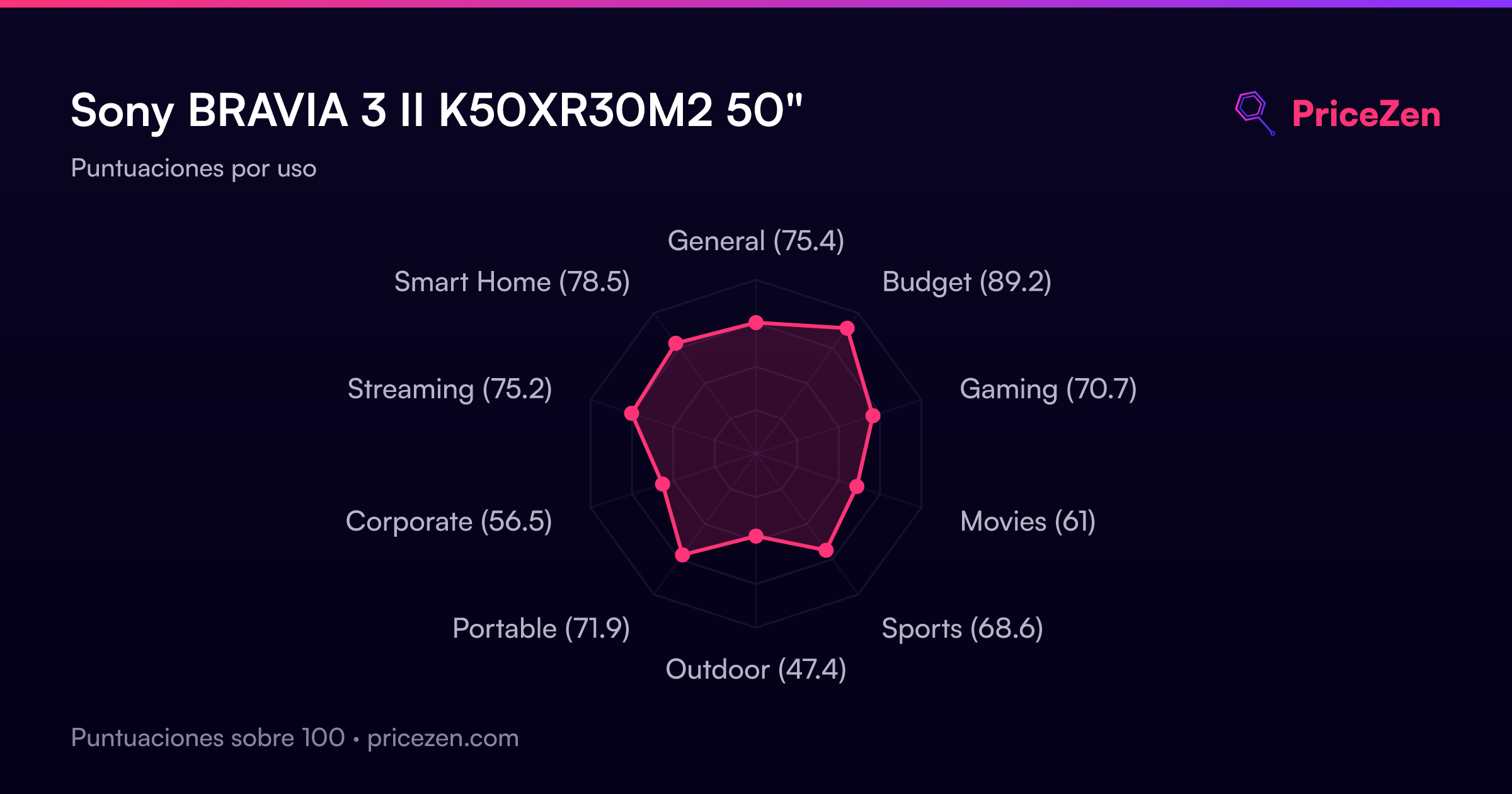
Usage Scores
- General75.4
- Budget89.2
- Gaming70.7
- Movies61
- Sports68.6
- Outdoor47.4
- Portable71.9
- Corporate56.5
- Streaming75.2
- Smart Home78.5