GIGASTONE Home Server SSD 4TB SATA III 2.5"
The 4TB SATA III drive with TLC NAND and SLC caching delivers 550 MB/s reads and 530 MB/s writes, built for 24/7 NAS workloads with power loss protection and ECC. Its DRAM-less design keeps costs down while remaining compatible with Synology, QNAP, and Asustor, and the 3-year warranty adds peace of mind. Best for home users running a NAS server for 4K/8K video editing or collaborative file sharing across multiple devices.












Resumen
The 30-Second Version
Two 4TB SATA SSDs pitched at home NAS owners, with power loss protection, ECC and silent operation, and capacity that ranks near the top of our data. The catch: it's DRAM-less, random performance lags behind most drives we track, and affordability sits near the bottom of the category. US pricing swings from USD 700 to USD 1,300, with Amazon cheapest at USD 700, and European listings span EUR 700 to EUR 1,540. Buy it only if your NAS bays force SATA and you can grab the low-end price.
Pros & Cons
Ventajas
- 8TB total across two 4TB drives, top-tier capacity in our rankings 93rd
- Power loss protection and ECC, useful for an always-on NAS
- Silent operation, no spinning-disk noise or vibration
- Listed compatibility with Synology, QNAP and Asustor
- 7mm 2.5-inch SATA form factor also fits laptops and PS4
Desventajas
- Affordability ranks near the bottom of the category
- Random performance lags behind most drives we track
- DRAM-less design with SLC caching limits sustained writes
- Endurance only about average despite the NAS durability pitch
- Very thin owner feedback pool, social proof is among the lowest we've seen
Las pruebas
Performance
Sequential numbers are 550 MB/s read and 530 MB/s write, which is basically the ceiling of what SATA III can do. That's fine. It's also the whole story on the good side, because our speed ranking puts it in the lower-middle of the category and random performance is a genuine weak spot, sitting well behind most drives we track. Random I/O is what matters when several people hit the same NAS at once, when a database is doing lots of small reads, or when you're using the drive as a cache tier. The marketing talks up virtualization, collaborative editing and intensive database work, and those are exactly the jobs where a DRAM-less controller with weak random scores tends to feel sluggish. Sequential file copies will be fine. Lots of tiny simultaneous requests is where you'll notice the compromise.
The SLC cache is doing a lot of the heavy lifting here. Drives like this hold their rated write speed while the cache has room, then drop once it fills, and without DRAM the mapping table has to live in slower memory. For long sustained writes, think a full media library dump or a big backup job, that means the 530 MB/s figure is a best case rather than a promise. Endurance ranks about average in our scoring, which is odd for something sold on 24/7 TBW reliability, and the feature set lands mid-pack despite the power loss protection and ECC callouts. Those protections are genuinely useful in a NAS that never sleeps. They just don't turn a SATA drive into a fast one.
Specifications
Full Specifications
Drive
| Capacity | 4000 |
| Form Factor | 2.5" |
| Interface | SATA III |
| Protocol | SATA |
| External | No |
Performance
| Sequential Read (MB/s) | 550 |
| Sequential Write (MB/s) | 530 |
Hardware
| NAND | TLC |
| DRAM Cache | No |
Reliability
| Warranty (years) | 3 |
vs Competition
The competitor set in our data is a fast crowd: Western Digital WD_BLACK SN8100, Samsung 9100 PRO, Kingston FURY Renegade, Crucial T700 and SanDisk WD_BLACK. These are the drives people cross-shop when they want speed, and against that group this GIGASTONE gives up a lot of ground. Its sequential ceiling is whatever SATA III allows, its speed ranking is in the lower-middle of the category, and random performance falls behind most of what we track. If your machine has an M.2 slot and you care about how fast a big project loads, the honest answer is that you should be looking at those names instead. We're not going to pretend a 2.5-inch SATA drive competes on throughput.
Where it does carve out a niche is fit and function. If your Synology, QNAP or Asustor only takes 2.5-inch SATA bays, none of those competitors solve your problem, and 8TB of silent flash with power loss protection is a legitimately different proposition. Capacity is this drive's standout, sitting near the top of our rankings, and the overall score of 47.7 out of 100 reflects a product that's specialized rather than broadly good. Cross-shop the WD_BLACK and Samsung options if you have PCIe lanes to spare. Stay here only if the bay dictates SATA and silence matters more than speed.
| Spec | GIGASTONE Home Server SSD | Western Digital WD_BLACK SN8100 | Samsung 9100 PRO | Kingston FURY Renegade | Crucial T500 | SanDisk WD_BLACK |
|---|---|---|---|---|---|---|
| Capacity | 4TB | 4TB | 8TB | 4TB | 2TB | 8TB |
| Form Factor | 2.5" | M.2 2280 | M.2 2280 | M.2 2280 | M.2 2280 | M.2 2280 |
| Interface | SATA III | PCIe 5.0 x4 | PCIe 5.0 x4 | PCIe 4.0 x4 | PCIe 4.0 x4 | PCIe 5.0 x4 |
| Seq Read | 550 MB/s | 14,900 MB/s | 14,800 MB/s | 7,300 MB/s | 7,400 MB/s | 14,900 MB/s |
| Nand Type | TLC | TLC | TLC | TLC | TLC | TLC |
| Dram Cache | false | false | true | true | true | true |
| Endurance | - | 2400 TBW | 4800 TBW | 4000 TBW | 1200 TBW | 4800 TBW |
| Compare | Compare | Compare | Compare | Compare |
| Producto | Speed | Random | Feature | Capacity | Endurance | Valoración social | Affordability |
|---|---|---|---|---|---|---|---|
| GIGASTONE Home Server SSD | 36.9 | 23.5 | 53.4 | 92.5 | 42.3 | 9.1 | 10.2 |
| Western Digital WD_BLACK SN8100 Compare | 99.7 | 99.6 | 86 | 92.5 | 80.5 | 94.9 | 8.5 |
| Samsung 9100 PRO Compare | 99.2 | 99.8 | 99.8 | 98 | 85.7 | 94.9 | 2 |
| Kingston FURY Renegade Compare | 93.5 | 94.5 | 94.1 | 92.5 | 94 | 94.9 | 11.2 |
| Crucial T500 Compare | 94 | 97 | 99 | 78.7 | 82.6 | 94.9 | 17 |
| SanDisk WD_BLACK Compare | 99.1 | 99.3 | 97.7 | 98 | 80.5 | 39.8 | 3.3 |
Precio
Value & Pricing
Let's talk money, because this is where the review gets uncomfortable. In the US we're tracking USD 700 to USD 1,300 across listings, a USD 600 spread on the same product. Amazon is the cheapest right now at USD 700, and if you're buying in the States that's the only number worth looking at. Paying USD 1,300 for a DRAM-less SATA two-pack would be a rough way to spend a weekend.
Europe is messier. We see EUR 700 to EUR 1,540 across eight listings in Germany, Spain, France and Italy, an EUR 840 gap, which tells you the pricing here hasn't settled at all. UK listings run GBP 670 to GBP 2,138 and Japan sits between JPY 129,990 and JPY 199,990. Our affordability percentile is 10, meaning this is one of the priciest options relative to what it delivers in the whole category. The budget score of 51.6 out of 100 is the highest number this product earns anywhere in our model, and even that's barely average. Shop the low end of every range or don't shop it at all.
Amazon 2 ofertas Desde 700 US$
Historial de precios
Leer más
Overview
This is a two-pack of 4TB 2.5-inch SATA III drives, and the pitch is aimed squarely at people running a home NAS who want flash instead of spinning rust. GIGASTONE leans hard on the server angle: power loss protection, ECC, silent operation, and compatibility with Synology, QNAP and Asustor boxes. Under the hood it's TLC NAND with an SLC cache, no DRAM, and a 3-year replacement warranty with lifetime tech support. The form factor is 7mm thick, so it drops into laptop bays and PS4s too, but the marketing is clearly written for someone staring at a RAID array.
The interesting part is the capacity. Two 4TB drives is a lot of quiet, low-power storage in a small enclosure, and our ranking puts capacity in the top tier of everything we track in this category. If your NAS lives in a living room or a bedroom office, killing drive noise and vibration is a real quality-of-life upgrade, not just a spec sheet flex. And if you've ever tried to explain to a housemate why the closet sounds like a coffee grinder at 3am, you already understand the appeal.
But here's the tension we keep coming back to. This thing is built around endurance and always-on reliability claims, yet its endurance score sits below the middle of the pack in our data, and its affordability lands near the bottom of the category. So you're paying a premium for a NAS-branded SATA drive that isn't especially fast and doesn't stand out on write stamina. That combination is worth thinking hard about before you click buy.
Common Questions
Q: Will these actually work in my Synology or QNAP NAS?
GIGASTONE lists compatibility with Synology, QNAP and Asustor, and the drive is a standard 7mm 2.5-inch SATA III unit, which is the form factor those bays expect. Power loss protection and ECC are the features that matter most in an always-on box, since an unexpected shutdown mid-write is how arrays get corrupted. Check your specific model's drive compatibility list before ordering, because NAS vendors can be picky about firmware regardless of what the drive maker claims.
Q: Is 550 MB/s fast enough for video editing or a database?
For pulling large sequential files, yes, 550 MB/s read and 530 MB/s write is essentially the SATA III limit and it'll move big media files along fine. But our rankings put random performance well behind most drives in this category, and that's the metric that governs databases, virtualization and multiple users hitting the box at once. If that's your main workload, the marketing promises more than the scoring supports.
Q: Does the DRAM-less design matter for a 24/7 server?
It matters more under sustained load than in casual use. Without DRAM, the drive leans on its SLC cache for write speed, and once that cache fills during a long transfer the throughput drops below the headline 530 MB/s. Combined with an endurance score that's only about average in our data, we'd hesitate to make this a heavy write cache tier, even though it's marketed for exactly that.
Q: Why is the price so all over the place?
We track USD 700 to USD 1,300 across US listings and EUR 700 to EUR 1,540 across eight European listings, which is an unusually wide spread for one product. Amazon is currently the cheapest US option at USD 700. With affordability ranking near the bottom of the category, paying the top of any of those ranges turns a niche buy into a bad one.
Who Should Skip This
Skip this if your machine has an M.2 slot and you want speed. The WD_BLACK SN8100, Samsung 9100 PRO, Kingston FURY Renegade and Crucial T700 are the names in our comparison set for a reason, and this SATA drive's lower-middle speed ranking and weak random scores mean it isn't playing the same game. Also skip it if you're building a virtualization host, a busy database server or a heavy write cache, since those are precisely the workloads that expose a DRAM-less controller. The box says it's built for that. Our numbers say otherwise.
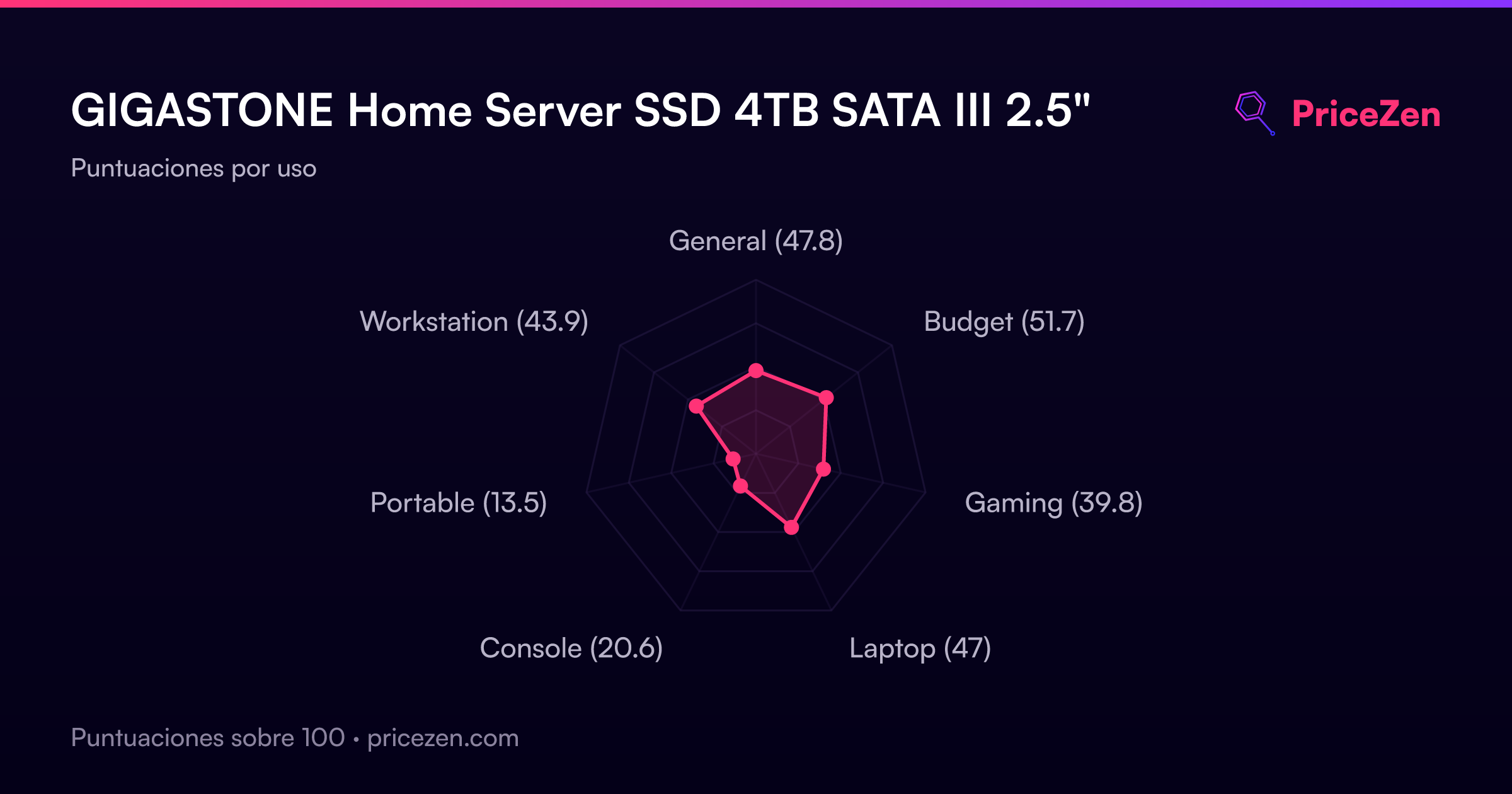
Laptop upgraders should look elsewhere too, given the 46.9 out of 100 laptop score and pricing that ranks near the bottom for value. And if you need something to carry around, the portable score of 13.6 is one of the worst we've seen in this category, so this simply isn't that product. Finally, if you're the kind of buyer who wants hundreds of owner reports before committing, the social proof here is among the thinnest we track, and a 4.5/5 rating doesn't tell you much when hardly anyone has weighed in.
Verdict
If you're running a home NAS with SATA-only bays, you want the noise gone, and you can get the pair at the bottom of the price range, this makes sense as a niche purchase. You're buying capacity, silence and power loss protection, and you're accepting middling endurance and weak random I/O to get them. Media libraries, photo archives, backups that run overnight: those workloads are mostly sequential and won't punish the DRAM-less design much. Buy from the cheapest listing, currently Amazon at USD 700, and treat the higher listings as non-starters.
For almost anything else, we'd pass. As a laptop upgrade the score is 46.9 out of 100, which is unremarkable, and as a portable or external-style solution it's a real letdown at 13.6. Heavy multi-user database work, virtualization hosts and cache tiers are the exact scenarios where the random performance ranking should scare you off, no matter what the box says. And with social proof this thin, you're taking on more unknowns than we like to recommend at this price. Good drive for one specific job. Not a general-purpose recommendation.
Usage Scores
- General47.8
- Budget51.7
- Gaming39.8
- Laptop47
- Console20.6
- Portable13.5
- Workstation43.9