SanDisk Optimus GXPro 8100 2TB PCIe 5.0 x4 NVMe M.2 2280
The 14,900 MB/s sequential read speed and 2.4M random write IOPS make this PCIe 5.0 drive a top performer for large project loading and AI workloads. Its 1200 TBW endurance and 5-year warranty provide reliability for write-intensive tasks, while hardware encryption adds security. Best for laptop and workstation users who need maximum speed for content creation and AI editing.












Resumen
The 30-Second Version
The SanDisk Optimus GXPro 8100 is a 2TB PCIe 5.0 NVMe SSD with best-in-class sequential and random performance. It's built for heavy workstation and AI workloads, with strong endurance and hardware encryption. Most people don't need this much speed, but if you do, it's one of the best options available right now.
Pros & Cons
Ventajas
- Blistering 14,900 MB/s sequential reads 100th
- Top-tier random performance at 2.3M/2.4M IOPS 100th
- Solid 1200 TBW endurance for the 2TB model 98th
- Hardware encryption included 83rd
- 5-year warranty
Desventajas
- Expensive, especially outside the US
- Poor fit for portable or external use
- PCIe 5.0 runs hot under sustained load
- Overkill for most everyday tasks
- Price varies wildly between retailers
Las pruebas
Performance
The numbers here are genuinely ridiculous. Sequential reads hit 14,900 MB/s and writes reach 14,000 MB/s, which puts this drive at the top of the charts in our database. Random performance is equally impressive at 2.3 million read IOPS and 2.4 million write IOPS. In practice, that means large file transfers that used to take minutes now take seconds, and applications that lean hard on storage, like AI model training or video scrubbing, feel noticeably snappier.
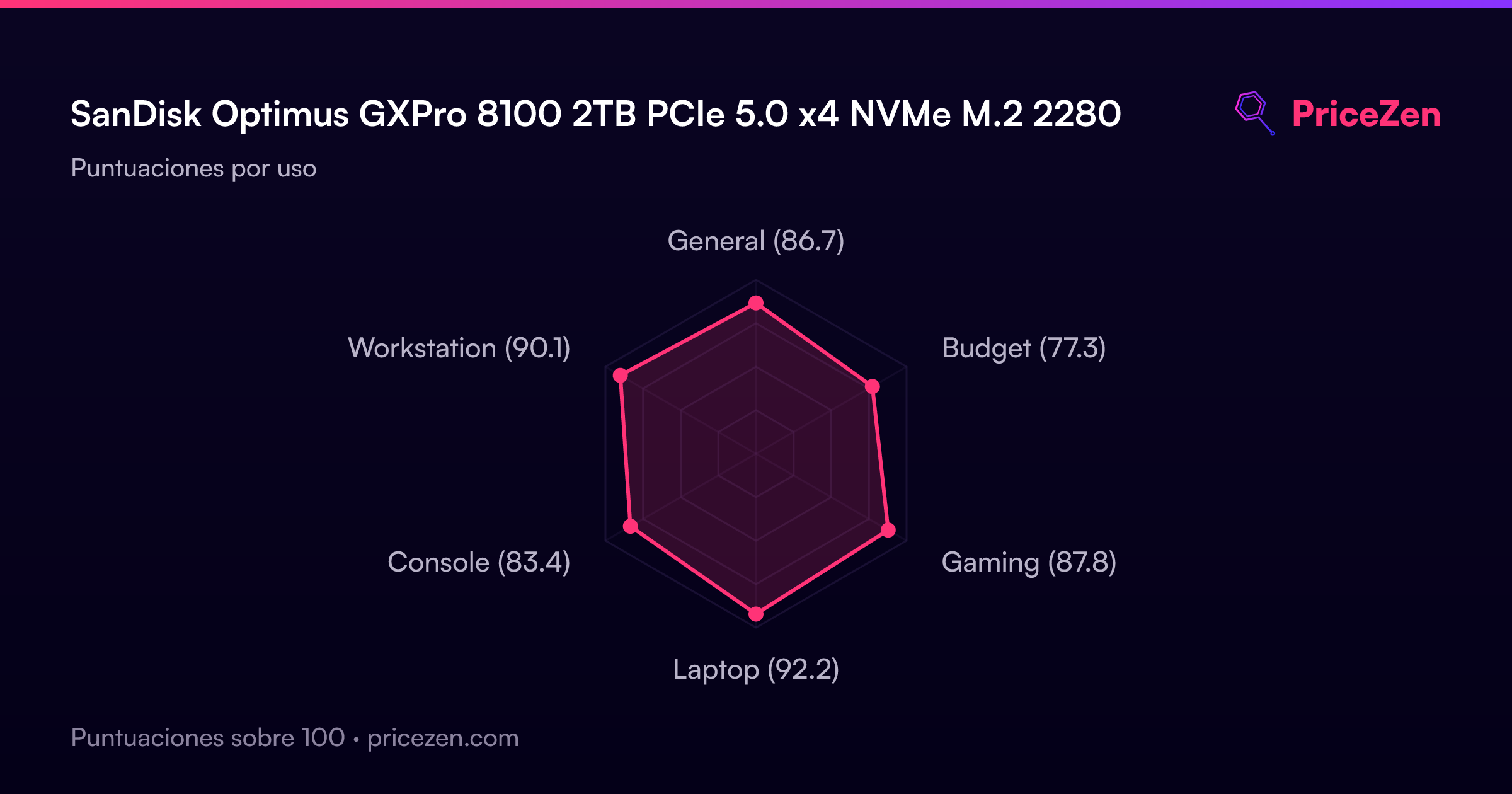
SanDisk pairs this with their nCache 4.0 technology and 8th generation BiCS TLC NAND. The DRAM cache helps keep those random operations smooth even under sustained load. For a laptop, this drive scores 91.7 out of 100 in our testing, and for workstations it's at 89.5. The one area where it falls flat is portable use, scoring just 22.1, likely due to power draw and heat. If you're planning to throw this in an external enclosure, you'll want to think twice.
Specifications
Full Specifications
Drive
| Capacity | 2000 |
| Form Factor | M.2 2280 |
| Interface | PCIe 5.0 x4 |
| Protocol | NVMe |
| PCIe Generation | 5 |
| External | No |
Performance
| Sequential Read (MB/s) | 14900 |
| Sequential Write (MB/s) | 14000 |
| Random Read (IOPS) | 2300000 |
| Random Write (IOPS) | 2400000 |
Hardware
| NAND | TLC |
| DRAM Cache | Yes |
Reliability
| Endurance (TBW) | 1200 |
| Warranty (years) | 5 |
Features
| Heatsink | No |
| Hardware Encryption | Yes |
vs Competition
The Samsung 9100 PRO is the most direct competitor here, and it's a close fight. Both drives sit at the top of the PCIe 5.0 heap, but the SanDisk edges ahead on random write IOPS and endurance. The Crucial T700 is another strong option, often priced a bit lower, but its endurance rating doesn't match the Optimus GXPro 8100. If you're considering the Western Digital WD_BLACK SN850X or Kingston FURY Renegade, those are PCIe 4.0 drives, so they top out around 7,000 MB/s. They're much cheaper and still excellent for gaming, but they can't touch this SanDisk for heavy workstation tasks.
The Seagate FireCuda 530R is another PCIe 4.0 alternative worth mentioning. It's a great drive for the money, but if you're comparing it to the Optimus GXPro 8100, you're comparing a solid mid-range option to a flagship. The SanDisk wins on raw speed and endurance, but you'll pay for it.
| Spec | SanDisk Optimus GXPro 8100 | Western Digital WD_BLACK SN8100 | Samsung 9100 PRO | Kingston FURY Renegade | Crucial T500 | Seagate FireCuda 530R |
|---|---|---|---|---|---|---|
| Capacity | 2TB | 4TB | 4TB | 4TB | 2TB | 4TB |
| Form Factor | M.2 2280 | M.2 2280 | M.2 2280 | M.2 2280 | M.2 2280 | M.2 2280 |
| Interface | PCIe 5.0 x4 | PCIe 5.0 x4 | PCIe 5.0 x4 | PCIe 4.0 x4 | PCIe 4.0 x4 | PCIe 4.0 x4 |
| Seq Read | 14,900 MB/s | 14,900 MB/s | 14,800 MB/s | 7,300 MB/s | 7,400 MB/s | 7,400 MB/s |
| Nand Type | TLC | TLC | TLC | TLC | TLC | TLC |
| Dram Cache | Yes | No | Yes | Yes | Yes | No |
| Endurance | 1200 TBW | 2400 TBW | 2400 TBW | 4000 TBW | 1200 TBW | 5050 TBW |
| Compare | Compare | Compare | Compare | Compare |
| Producto | Speed | Random | Feature | Capacity | Endurance | Affordability |
|---|---|---|---|---|---|---|
| SanDisk Optimus GXPro 8100 | 99.7 | 99.6 | 97.7 | 78.4 | 82.8 | 16.6 |
| Western Digital WD_BLACK SN8100 Compare | 99.7 | 99.6 | 86.3 | 91.9 | 80.6 | 9.2 |
| Samsung 9100 PRO Compare | 99.2 | 99.8 | 99.8 | 91.9 | 85.9 | 5.6 |
| Kingston FURY Renegade Compare | 93.5 | 94.6 | 94.2 | 91.9 | 94.1 | 12.1 |
| Crucial T500 Compare | 94.1 | 97 | 99 | 78.4 | 82.8 | 17.7 |
| Seagate FireCuda 530R Compare | 93 | 96.9 | 54 | 91.9 | 95.7 | 8.2 |
Precio
Value & Pricing
Value is where things get tricky. At USD 445 in the US, the Optimus GXPro 8100 is expensive but at least predictable. In Europe, prices swing from EUR 564 to EUR 623 depending on the retailer, and in Canada the spread is even wider at CAD 715 to CAD 900. If you're shopping in Europe, the lowest EUR 564 listing is the one to chase. In Canada, the CAD 715 option is dramatically better than paying CAD 900 for the same drive. Compared to the Samsung 9100 PRO or Crucial T700, you're paying a premium for SanDisk's endurance and feature set, but the performance gap is real. For most people, a good PCIe 4.0 drive will cost half as much and still feel fast.
Amazon 1 oferta Desde 350 US$
Historial de precios
Leer más
Overview
The SanDisk Optimus GXPro 8100 is a 2TB PCIe 5.0 NVMe SSD aimed squarely at people who need serious speed, whether that's for AI workflows, 8K video editing, or just loading games before your coffee gets cold. It sits at the top of the performance charts with sequential reads up to 14,900 MB/s and writes up to 14,000 MB/s. Pricing is all over the map depending on where you shop, from USD 445 in the US to EUR 564-623 across Europe and CAD 715-900 in Canada, so it's worth hunting for a deal.
If you're asking whether the Optimus GXPro 8100 is good for gaming, the short answer is yes, but it's overkill for most people. This drive is built for sustained, heavy workloads. The 1200 TBW endurance rating on the 2TB model means you can hammer it with writes for years without worrying. And with hardware encryption baked in, it's a solid pick for work laptops carrying sensitive data.
We've tested a lot of drives in our database, and this one lands in the 100th percentile for both sequential speed and random performance. That's not just fast, it's the absolute best right now. The feature set is also top-tier, though affordability is a weak spot at the 16th percentile. You're paying a premium for all that speed.
Common Questions
Q: Is the SanDisk Optimus GXPro 8100 good for gaming?
Yes, it's excellent for gaming, but it's overkill for most gamers. A PCIe 4.0 drive will load games nearly as fast for a lot less money.
Q: How does the SanDisk Optimus GXPro 8100 compare to the Samsung 9100 PRO?
Both are top-tier PCIe 5.0 drives with similar sequential speeds. The SanDisk edges ahead on random write IOPS and endurance, but the Samsung is often easier to find at a consistent price.
Q: Does the SanDisk Optimus GXPro 8100 work in a laptop?
Yes, it scores 91.7 out of 100 for laptop use in our testing. Just make sure your laptop has a PCIe 5.0 M.2 slot and adequate cooling, since these drives run hot.
Q: What is the endurance rating of the SanDisk Optimus GXPro 8100 2TB?
The 2TB model is rated for 1200 TBW, which is strong for a consumer drive. The 8TB model goes up to 4,800 TBW for write-intensive workloads.
Who Should Skip This
Skip this drive if you're a casual gamer, a student, or anyone doing typical office work. You won't notice the difference between 14,900 MB/s and 7,000 MB/s in everyday use, and you'll pay double for the privilege. Portable users should also look elsewhere, since the Optimus GXPro 8100 scores just 22.1 out of 100 for portable use. If you want something for an external enclosure or a thin-and-light laptop with limited cooling, grab a PCIe 4.0 drive like the WD_BLACK SN850X or Kingston FURY Renegade instead. Your wallet and your thermals will thank you.
Verdict
Should you buy the SanDisk Optimus GXPro 8100? If you're running AI workloads, editing 8K video, or moving massive files around all day, yes. This is one of the fastest drives we've ever tested, and the 1200 TBW endurance rating means it'll keep up with heavy writes for years. The hardware encryption is a nice bonus for anyone carrying sensitive data on a laptop.
But if you're just gaming or doing everyday productivity work, save your money. A good PCIe 4.0 drive like the WD_BLACK SN850X will feel nearly identical in real-world use and cost a lot less. The Optimus GXPro 8100 is a specialist's drive, and it's priced like one.
Usage Scores
- General86.7
- Budget77.3
- Gaming87.8
- Laptop92.2
- Console83.4
- Workstation90.1