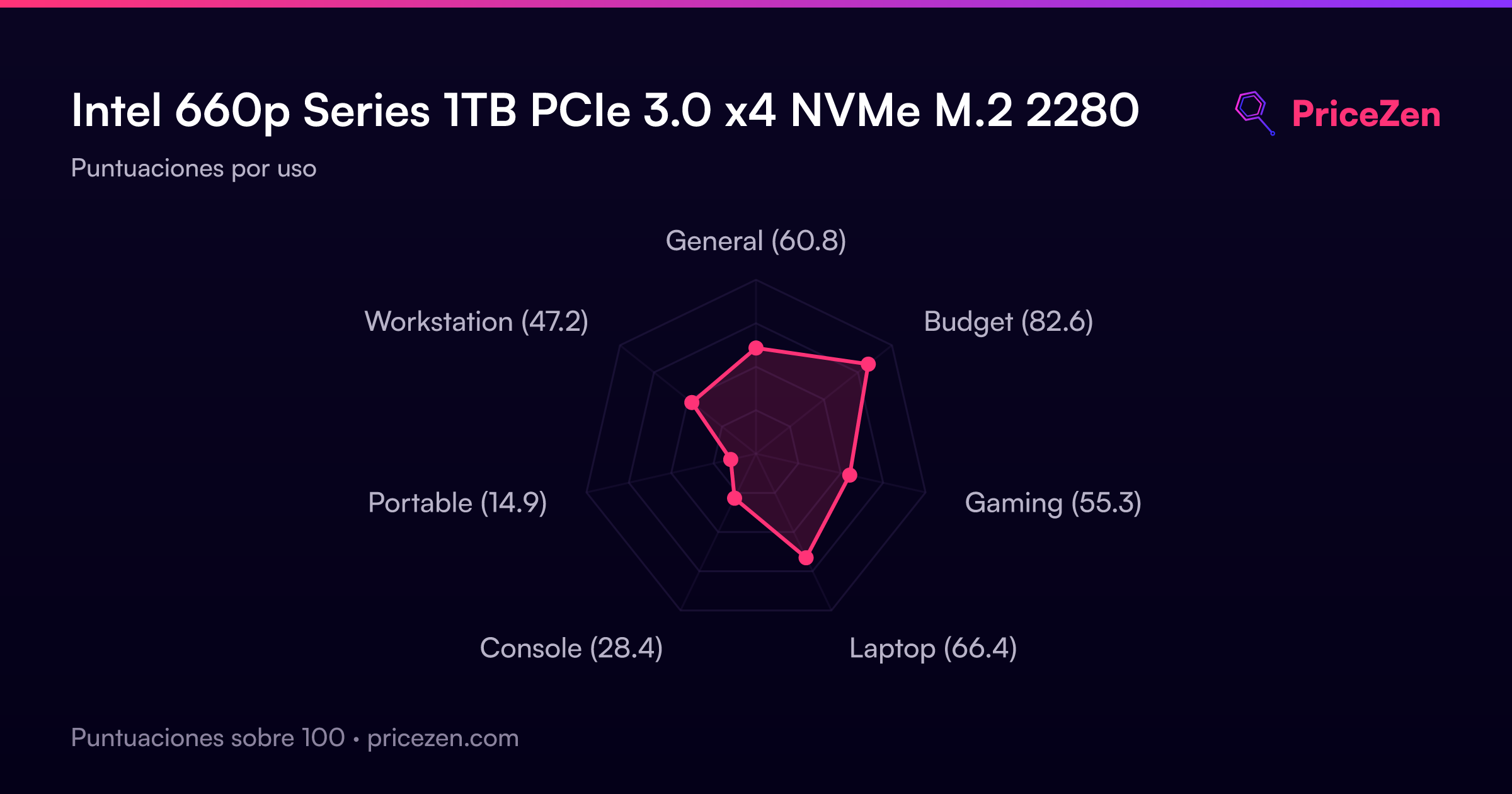
Intel 660p Series 1TB PCIe 3.0 x4 NVMe M.2 2280
The Intel 660p Series SSDPEKNW010T8X1 is a 1TB M.2 PCIe 3.0 x4 NVMe drive with QLC NAND, delivering 1800 MB/s read and write speeds and 220K random write IOPS. Its DRAM-less design and 200 TBW endurance make it a cost-effective option for high-capacity storage, backed by a 5-year warranty and 1.6 million hours MTBF. Best for budget-conscious builders upgrading from SATA SSDs for everyday computing and gaming, where capacity matters more than sustained write performance.


Resumen
The 30-Second Version
The Intel 660p 1TB nails read-heavy workloads with 1800 MB/s sequential reads and random performance in the 78th percentile. But sustained writes fall apart once the SLC cache fills, and overall speed sits at just the 47th percentile. At $173 to $189, it's a decent budget boot drive, but not a workhorse.
Pros & Cons
Ventajas
- Strong social proof, 87th percentile with a 4.7-star average from 3,956 reviews 86th
- Random read performance lands at the 78th percentile, well above average 78th
- Endurance rating of 200 TBW puts it at the 71st percentile, solid for QLC 70th
- 5-year warranty backs the drive, longer than many budget competitors
- Includes Intel Data Migration Software for easy cloning
Desventajas
- Overall speed sits at just the 47th percentile, middle of the pack
- Sustained write speeds drop significantly once the SLC cache fills
- DRAM-less design hurts performance under heavy write workloads
- Feature set ranks at only the 33rd percentile, bare bones compared to rivals
- No mounting screw included, a common complaint from builders
Opinión de los propietarios
The Word on the Street
Cómo cambió la opinión de los propietarios con el tiempo
ExclusivaSegún cuándo escribieron realmente sus opiniones los clientes, para ver si los elogios iniciales se mantuvieron.
16 opiniones escritas, ene 2019 – feb 2020: 16 satisfechos
En las 3956 valoraciones de tiendas: 4,7★. La mayoría de los propietarios valora sin escribir una opinión. El gráfico cuenta las 16 opiniones escritas.
- abr–jun 20197 de 7 satisfechos
Buyers in this period praised the drive's speed and reliability, noting it excels in normal use but slows on large writes. They also defended its lifespan against YouTuber criticism.
- Drive is fast and reliable, with stress tests and health checks showing perfect performance.
- Performance drops on large writes like cloning or benchmarks due to cache overflow, but fine for normal use.
- Lifespan is adequate for typical usage; 5-year guarantee assumes heavy daily writes, not normal use.
- Easy installation and fast boot times, with a humorous note about not having time for water.
- ene–mar 20194 de 4 satisfechos
All three reviews are positive, praising the drive's read speeds and value. They emphasize that slow sustained writes are expected for QLC and not a defect, and advise proper testing methods.
- Fast read speeds and good value for storing large static libraries like games.
- Sustained write speeds drop after cache fills, but this is normal for QLC and acceptable for typical use.
- Real-world transfer speeds can be high (1.5GB/s) when copying between SSDs, contrary to some negative reviews.
- Cloning from an older SATA SSD to this NVMe drive is straightforward and noticeably improves system responsiveness.
Cada punto es una opinión escrita, en el mes en que se escribió. Satisfechos = 4-5★, neutrales = 3★, insatisfechos = 1-2★. Los resúmenes por periodo están en inglés.
Las pruebas
Performance
Let's talk numbers. Sequential reads hit 1800 MB/s and writes match at 1800 MB/s. That's PCIe 3.0 x4 territory, and it's fine for booting Windows or loading games. Random 4KB reads are rated at 220,000 IOPS, which is actually the stronger side of this drive. Random writes are also listed at 220,000 IOPS, but that's the SLC cache talking. Once you push past the cache, QLC NAND shows its true colors and write speeds drop hard. Owners confirm this. Multiple reviews mention that short bursts of writes are great, but sustained transfers slow down significantly.
The DRAM-less design doesn't help. Without a DRAM buffer, the controller has to work harder to manage the mapping tables. For a boot drive or game library, you won't notice. For video editing or large file transfers, you absolutely will. The 64-layer QLC NAND is the core trade-off here. Intel's SLC cache trick helps mask the QLC weakness, but it's a band-aid, not a cure. The drive is rated for 1.6 million hours MTBF, which sounds impressive until you remember that's a statistical measure, not a promise.
Specifications
Full Specifications
Drive
| Capacity | 1000 |
| Form Factor | M.2 2280 |
| Interface | PCIe 3.0 x4 |
| Protocol | NVMe |
| PCIe Generation | 3 |
| External | No |
Performance
| Sequential Read (MB/s) | 1800 |
| Sequential Write (MB/s) | 1800 |
| Random Read (IOPS) | 150000 |
| Random Write (IOPS) | 220000 |
Hardware
| NAND | QLC |
| DRAM Cache | No |
Reliability
| Endurance (TBW) | 200 |
| MTBF (hours) | 1600000 |
| Warranty (years) | 5 |
Features
| Hardware Encryption | Yes |
vs Competition
Stacked against the current heavyweights, the 660p looks dated. The Samsung 980 PRO and Western Digital Black SN850X are PCIe 4.0 drives with sequential reads in the 7000 MB/s range. That's nearly 4x what the 660p manages. The Crucial T700 and Corsair MP700 Elite push even further into PCIe 5.0 territory. But here's the thing. Those drives cost more, and for a boot drive or game library, the real-world difference is smaller than the spec sheets suggest. The 660p's 1800 MB/s reads are still fast enough for most everyday tasks. Where the 660p really loses is sustained writes. The SN850X and 980 PRO maintain write speeds far better under load thanks to TLC NAND and DRAM caches. If you're moving large files regularly, any of those competitors will embarrass the 660p. If you're just booting Windows and loading games, the 660p holds its own at a lower price.
| Spec | Intel 660p Series | Samsung 9100 PRO | Kingston Fury Renegade | Western Digital WD_BLACK SN850P | Crucial T700 | Team Group MP44 |
|---|---|---|---|---|---|---|
| Capacity | 1TB | 2TB | 2TB | 4TB | 2TB | 4TB |
| Form Factor | M.2 2280 | M.2 2280 | M.2 2280 | M.2 2280 | M.2 2280 | M.2 2280 |
| Interface | PCIe 3.0 x4 | PCIe 5.0 x4 | PCIe 4.0 x4 | PCIe 4.0 x4 | PCIe 5.0 x4 | PCIe 4.0 x4 |
| Seq Read | 1,800 MB/s | 14,700 MB/s | 7,300 MB/s | 7,300 MB/s | 12,400 MB/s | 7,400 MB/s |
| Nand Type | QLC | TLC | TLC | - | TLC | TLC |
| Dram Cache | false | true | true | true | true | false |
| Endurance | 200 TBW | 1200 TBW | 2000 TBW | 2400 TBW | 1200 TBW | 2000 TBW |
| Compare | Compare | Compare | Compare | Compare |
| Producto | Speed | Random | Feature | Capacity | User Sentiment | Endurance | Valoración social | Affordability |
|---|---|---|---|---|---|---|---|---|
| Intel 660p Series | 47.2 | 78.2 | 32.9 | 55.4 | 57.2 | 70.3 | 85.8 | 52.4 |
| Samsung 9100 PRO Compare | 98.9 | 99.8 | 99.7 | 78.6 | 57.2 | 85.6 | 94.9 | 21.4 |
| Kingston Fury Renegade Compare | 93.3 | 94.4 | 93.9 | 78.6 | 67.5 | 94 | 94.9 | 23.7 |
| Western Digital WD_BLACK SN850P Compare | 89 | 95.7 | 84.7 | 92.5 | 57.2 | 88.1 | 99.6 | 10.3 |
| Crucial T700 Compare | 96.7 | 97.7 | 97.5 | 78.6 | 79.3 | 82.5 | 75.1 | 22.2 |
| Team Group MP44 Compare | 93.6 | 88.7 | 52.8 | 92.5 | 79.3 | 76.6 | 85.8 | 16.2 |
Precio
Value & Pricing
Pricing is all over the map depending on where you shop. In the US, you're looking at $173 to $189 across two listings. European buyers see a wider spread, EUR 190 to EUR 223 across four listings in Germany, Spain, France, and Italy. That EUR 33 gap is worth paying attention to. If you're in Europe, shop around before clicking buy. The value proposition here is tricky. At the 53rd percentile for affordability, this drive isn't the bargain it once was. When it launched, it undercut TLC drives significantly. Now, with PCIe 4.0 drives dropping in price, the 660p's value depends entirely on finding it at the low end of that price range. At $173, it's a decent budget option. At $189, you're getting close to territory where faster TLC drives start looking tempting.
Amazon 1 oferta Desde 189 US$
Historial de precios
Leer más
Overview
The Intel 660p 1TB sits in a weird spot in our database. Its social proof is strong, landing in the 87th percentile, and random performance is well above average at the 78th percentile. But speed overall? 47th percentile. Middle of the pack. That's the QLC story in one sentence. This drive was one of the first QLC-based client PCIe SSDs, and it shows. The 1800 MB/s sequential read and write numbers were fine for 2018, but they're not turning heads anymore. Still, with a 4.7-star rating across nearly 4,000 reviews, owners clearly like what they got for the money.
The endurance story is more interesting than the speed story. Intel rates this at 200 TBW, which lands at the 71st percentile for endurance. That's actually respectable for a QLC drive from this era. The 5-year warranty helps too. But the DRAM-less design and QLC NAND mean sustained writes fall off a cliff once the SLC cache fills. For read-heavy workloads and everyday computing, it's fine. For anything write-intensive, you'll feel the pain quickly.
Common Questions
Q: Does this drive come with cloning software?
Yes. Intel includes their Data Migration Software, which is based on Acronis. It makes moving your OS and files from an old drive pretty painless.
Q: Can I use this alongside my existing SATA drives?
Yes, as long as your motherboard's M.2 slot supports PCIe NVMe drives. The 660p uses PCIe 3.0 x4, not SATA. Your SATA ports remain free for other drives.
Q: Will this work with my Gigabyte AB350 Gaming 3 motherboard?
It should. The AB350 Gaming 3 has an M.2 slot that supports PCIe 3.0 x4 NVMe drives, which is exactly what the 660p needs. Just make sure the slot isn't set to SATA mode in the BIOS.
Who Should Skip This
Skip this drive if you do any serious write-heavy work. Video editors, anyone running VMs, people who regularly move large files between drives. The QLC NAND and DRAM-less design mean sustained writes will frustrate you. The 47th percentile overall speed ranking isn't a fluke. If you're building a new system in 2024 or 2025, you can find PCIe 4.0 TLC drives with dramatically better write performance for not much more money. The 660p made sense when it launched as a budget QLC pioneer. Now it's a niche pick for read-focused budget builds only.
Verdict
The Intel 660p 1TB is a drive you buy for a specific purpose. Read-heavy workloads, boot drives, game libraries. That's where it shines. The 87th percentile social proof and 78th percentile random performance back that up. But the 47th percentile overall speed and 33rd percentile feature set tell the other half of the story. This is not a drive for content creators or anyone who moves large files regularly. The 200 TBW endurance rating and 5-year warranty provide some peace of mind, but the QLC NAND and DRAM-less design are real limitations. If you find it at the low end of the price range and your workload is read-focused, it's a solid buy. Otherwise, save up for a TLC drive.
Usage Scores
- General60.8
- Budget82.6
- Gaming55.3
- Laptop66.4
- Console28.4
- Portable14.9
- Workstation47.2