Lightdow RF 420-800mm f/8.3
The 420-800mm zoom range reaches distant subjects without an adapter, but the fully manual operation requires setting 'Release shutter w/o lens' and adjusting focus, ISO, and shutter speed manually. With no autofocus or stabilization, a tripod or shutter release cable is essential, and the aperture varies with focal length from f/8.3 to f/16. This lens suits budget-conscious Canon RF shooters who prioritize reach for wildlife, birds, or the moon and are comfortable with manual settings.



Resumen
The 30-Second Version
The ZLY Technology 420-800mm is a CAD 169 fully manual super telephoto for Canon RF cameras. It delivers 97th percentile reach with zero autofocus, zero stabilization, and a slow f/8.3-16 aperture. You'll need a tripod and patience, but for moon shots and stationary wildlife it's a genuinely fun budget option. If you need to track moving subjects, look elsewhere.
Pros & Cons
Ventajas
- Incredible 420-800mm reach at 97th percentile 97th
- CAD 169 price is absurdly affordable 95th
- Direct RF mount with no adapter needed 86th
- Simple mechanical design with zoom lock 68th
- Great for moon shots and stationary wildlife
Desventajas
- No autofocus, fully manual focusing only
- No image stabilization at all
- Slow f/8.3-16 aperture limits low light use
- Build quality ranks in the 31st percentile
- Useless for video, 29th percentile
Las pruebas
Performance
Let's talk about what 420-800mm actually means. In our database, this lens sits in the 97th percentile for reach. That's genuinely wild. You're getting more focal length than most photographers will ever own, and at 800mm you can fill the frame with the moon or pull a distant bird into view. The minimum focus distance is 3 meters, which is fine for wildlife but means you won't be shooting close-up details of a butterfly on a flower. This is a distance lens, through and through.
The aperture is where reality sets in. At f/8.3 at the wide end and f/16 at the long end, this is a slow lens. On a sunny day, you can make it work. At 800mm and f/16, you'll need either bright light or a high ISO, and on most Canon RF bodies that means noise. The lack of stabilization compounds this. Our data puts stabilization in the 36th percentile, which is generous given there is literally no stabilization. Any camera shake at 800mm is magnified enormously. The manufacturer's own advice is to use a tripod, time-lapse shooting, or a shutter release cable. That's not a suggestion, it's a requirement. Handholding this lens at 800mm is a recipe for blurry disappointment.
Specifications
Full Specifications
Optics
| Type | Telephoto |
| Focal Length Min | 420 |
| Focal Length Max | 800 |
| Coating | UMC |
Aperture
| Max Aperture | f/8.3 |
| Min Aperture | f/16 |
| Constant | No |
Build
| Mount | Canon RF |
| Filter Thread | 62 |
AF & Stabilization
| AF Type | manual focus only |
| Stabilization | No |
vs Competition
The competitors listed in our database are a bit odd for this lens. The Sigma Art 28mm f/1.4, Viltrox 85mm f/1.4, Nikon 24-120mm f/4, and Canon RF 24-105mm f/4L are all completely different animals. They're fast, sharp, autofocusing lenses designed for general photography. Comparing the ZLY to a Canon RF 24-105mm f/4L is like comparing a telescope to a Swiss Army knife. The Canon is better at almost everything except one thing: it can't reach 800mm. Not even close.
The real comparison for this lens is against other budget super telephoto options. A used mirror lens, an old manual focus 500mm f/8, or a cheap telescope adapter. Against those, the ZLY holds up reasonably well. It has more reach than most budget options and mounts directly to RF cameras. The Meike 85mm f/1.4 in our database is a better lens by almost every quality metric, but it's a portrait lens. If you need 800mm, the ZLY is in a class of one at this price point.
| Spec | Lightdow RF 420-800mm f/8.3 | Sony Distagon T FE 35mm f/1.4 | Tamron SP 70-200mm f/2.8 Di VC USD | Viltrox AF 50mm f/2 Air FE | Yongnuo YN 35mm f/1.8 DA ART | Nikon AF-S DX NIKKOR 18-140mm f/3.5-5.6G ED VR |
|---|---|---|---|---|---|---|
| Focal Length | 420-800mm | 35mm | 70-200mm | 50mm | 35mm | 18-140mm |
| Max Aperture | f/8.3 | f/1.4 | f/2.8 | f/2 | f/1.8 | f/3.5-5.6 |
| Mount | Canon RF | Sony E | Canon EF | Sony E | Sony E | Nikon F |
| Format Coverage | - | full-frame | full-frame | full-frame | APS-C | APS-C |
| Stabilization | No | No | Yes | No | No | Yes |
| Weather Sealed | No | Yes | Yes | Yes | Yes | No |
| Weight (g) | - | 630 | 1500 | 205 | 179 | 490 |
| AF Type | manual focus only | Direct Drive Super Sonic Wave AF motor | USD | STM | STM | Silent Wave Motor |
| Lens Type | telephoto | prime | telephoto | prime | prime | zoom |
| Compare | Compare | Compare | Compare | Compare |
| Producto | AF | Bokeh | Build | Reach | Video | Optical | Aperture | Wide Angle | Versatility | Valoración social | Affordability | Stabilization |
|---|---|---|---|---|---|---|---|---|---|---|---|---|
| Lightdow RF 420-800mm f/8.3 | 21.8 | 86 | 63.9 | 97.4 | 61.3 | 4.6 | 1 | 3.7 | 68.2 | 12.3 | 95.4 | 41.4 |
| Sony Distagon T FE 35mm f/1.4 Compare | 89.9 | 56.4 | 77 | 28.9 | 27.4 | 68.3 | 89.2 | 52.8 | 32.6 | 79.2 | 34.8 | 41.4 |
| Tamron SP 70-200mm f/2.8 Di VC USD Compare | 83.6 | 86 | 77 | 83.6 | 57.5 | 48.7 | 43.4 | 28.8 | 78.5 | 79.2 | 42.8 | 97.3 |
| Viltrox AF 50mm f/2 Air FE Compare | 68.9 | 56.4 | 77 | 43.2 | 70.1 | 65.7 | 64.5 | 39.5 | 32.6 | 79.2 | 85.4 | 41.4 |
| Yongnuo YN 35mm f/1.8 DA ART Compare | 68.9 | 45.4 | 77 | 48.7 | 70.1 | 60.8 | 74.8 | 34.5 | 32.6 | 86.1 | 91.5 | 41.4 |
| Nikon AF-S DX NIKKOR 18-140mm f/3.5-5.6G ED VR Compare | 83.6 | 42.1 | 63.9 | 85.7 | 61.3 | 55.6 | 25.2 | 66.1 | 95.9 | 86.1 | 65.8 | 94.6 |
Precio
Value & Pricing
At CAD 169, this lens is in the 92nd percentile for affordability. That's the whole pitch. A Canon RF 800mm f/11 costs around CAD 1,300. A used Sigma or Tamron 150-600mm with an adapter will run you several hundred more. This ZLY lens costs less than a nice dinner for two. For that price, you're getting a functional super telephoto that can produce sharp images if you do everything right: tripod, remote shutter, careful manual focus, and good light.
The value question isn't whether it's worth CAD 169. It absolutely is, if you understand what you're buying. The question is whether you'll actually use it. A cheap lens that sits on a shelf because it's frustrating to use isn't a bargain. But if you're the kind of person who enjoys the slow, deliberate process of manual telephoto photography, this is one of the cheapest ways to get genuine 800mm reach on an RF body.
Amazon 2 ofertas Desde 68 US$
Historial de precios
Leer más
Overview
The ZLY Technology 420-800mm is a lens that makes a very specific promise: extreme reach for almost no money. At CAD 169, it's priced like a decent UV filter, not a super telephoto. And that's the whole story here. This is a fully manual, no-frills telescope-style lens designed to get you close to birds, the moon, and distant wildlife without selling a kidney. It's not trying to compete with Canon's L glass, and it doesn't pretend to.
Who is this for? Someone with an RF-mount Canon mirrorless body who wants to dip a toe into super telephoto photography without spending four figures. Maybe you want to shoot the moon, maybe you're curious about birding, or maybe you just want the longest lens at the neighborhood BBQ for bragging rights. The lens mounts directly to RF cameras with no adapter, which is genuinely convenient. But you'll need to enable 'Release shutter w/o lens' in your camera menu since there's no electronic communication between lens and body.
The trade-off is obvious and total. No autofocus, no image stabilization, no electronic aperture control, and a slow f/8.3-16 aperture range. This is a lens that demands a tripod, patience, and a willingness to work for every shot. If that sounds like a fun challenge, keep reading. If you want to handhold a 600mm lens while tracking a flying bird, this isn't that.
Common Questions
Q: Will this lens work on my Canon RF camera?
It mounts directly to Canon RF bodies including the R, RP, R3, R5, R6, R7, R8, R10, R50, and R100. Since there's no electronic communication, you'll need to enable 'Release shutter w/o lens' in your camera's menu. After that, switch to manual mode and you're ready to shoot.
Q: Can I handhold this lens?
Technically yes, but you shouldn't. At 800mm, even tiny hand movements are magnified dramatically, and this lens has no image stabilization. The manufacturer recommends a tripod, remote shutter, or time-lapse shooting. If you must handhold, stick to the 420mm end and use a fast shutter speed.
Q: Why is the aperture listed as f/8.3-16?
The aperture is fixed and changes with focal length. At 420mm it's f/8.3, and as you zoom toward 800mm it narrows to f/16. You can't adjust it independently. This means less light reaches the sensor at longer focal lengths, so you'll need brighter conditions or higher ISO settings.
Q: Is this lens good for bird photography?
It depends on the bird. For perched or stationary birds, yes, the 800mm reach lets you fill the frame from a distance. For birds in flight, no. Manual focus at 800mm on a moving subject is extremely difficult, and the lack of stabilization makes tracking nearly impossible. Serious bird photographers should look at autofocus telephoto options.
Who Should Skip This
Skip this lens if you shoot video. Our data puts it in the 29th percentile for video, and that's being kind. Manual focus, no stabilization, and a slow variable aperture make it a nightmare for any kind of motion work. You'll get shaky, dark footage that's hard to focus. For video, look at something like the Canon RF 24-105mm f/4L IS USM, which has stabilization and autofocus.
Also skip it if you need to shoot in low light or capture fast action. The f/16 aperture at 800mm means you'll be cranking ISO in anything but bright daylight, and the lack of autofocus rules out sports or wildlife in motion. If you're a beginner expecting point-and-shoot simplicity, this lens will frustrate you. It's a manual tool for patient shooters, not a convenience product.
Verdict
If you want to photograph the moon, this lens will do it. Set up a tripod, lock the zoom at 800mm, focus carefully, and you'll get crater detail that will genuinely impress your friends. The same goes for stationary wildlife like perched birds or distant animals. The 97th percentile reach is real, and with good technique the images can be surprisingly decent. Just don't expect to track a bird in flight. Manual focus at 800mm on a moving subject is an exercise in frustration.
For anyone who wants to shoot wildlife seriously, save up for something with autofocus and stabilization. The Canon RF 800mm f/11 is the obvious step up, or a used 150-600mm zoom with an adapter. The ZLY is a specialty tool for patient photographers on a tight budget. It's not a replacement for a real telephoto lens, and it doesn't try to be. But as a gateway into super telephoto photography, it's hard to argue with the price.
Usage Scores
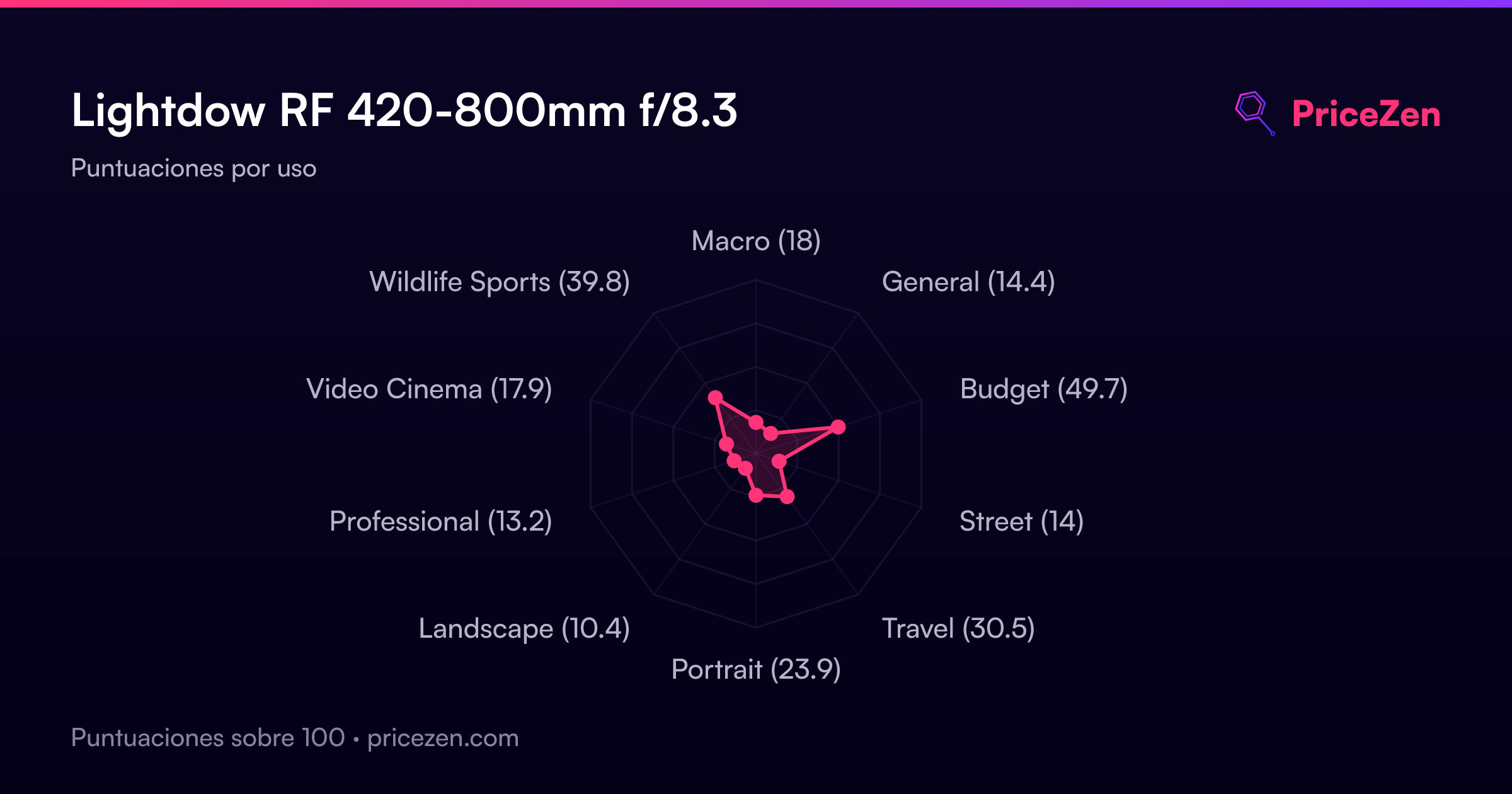
- Macro18.2
- General14.6
- Budget51
- Street15.2
- Travel31.6
- Portrait24.2
- Landscape10.9
- Professional13.5
- Video Cinema18.4
- Wildlife Sports40.2