MSI GeForce GT 1030 OC 2GB DDR4 Black
The passive cooling and 30W TDP make this a silent, low-profile card that fits into slim OEM systems without a PSU upgrade. Its 2GB of DDR4 memory and 1430MHz boost clock provide basic display output and hardware decoding for modern codecs. This is best for office users needing multi-monitor support or a simple upgrade for older PCs lacking integrated graphics.












Resumen
The 30-Second Version
The MSI GeForce GT 1030 2GHD4 LP OC is a silent, low profile graphics card that works fine as a display adapter but falls flat for gaming. The DDR4 memory cripples performance compared to the GDDR5 version. Only worth buying if you find it cheap and just need video output.
Pros & Cons
Ventajas
- Passive cooling means zero noise 92nd
- 30W TDP works in almost any system
- Low profile bracket fits slim cases
- Affordable at the low end of pricing
- Easy drop-in upgrade for old office PCs
Desventajas
- DDR4 memory cripples performance
- 2GB VRAM is barely enough for desktop use
- PCIe x4 link limits bandwidth
- 1080p gaming is basically off the table
- Price swings from reasonable to absurd
Las pruebas
Performance
PassMark G3D comes in at 2400, which puts this card near the bottom of our database for raster performance. For context, that's roughly on par with integrated graphics on a modern mid-range CPU. The 384 CUDA cores and 1430MHz boost clock sound okay on paper, but the 64-bit DDR4 memory bus is the bottleneck. We're talking 16GB/s of bandwidth versus 48GB/s on the GDDR5 version of the same chip. That's a massive hit.
In practice, you're looking at maybe 30-40 fps in older esports titles like CS:GO or League of Legends at 720p with settings turned down. Anything newer or more demanding and you'll be fighting for playable frame rates. The card's efficiency score is mediocre too, which is surprising for a 30W part, but the performance per watt just isn't there when the memory chokes the GPU. Connectivity is limited to one HDMI and one DisplayPort, and the x4 PCIe link means it's not even using the full x16 slot. For a display adapter, that's fine. For anything else, it's a weak spot.
Specifications
Full Specifications
Chipset
| GPU Chipset | GeForce GT 1030 |
| Brand | NVIDIA |
| Architecture | Pascal |
| Class | consumer |
Memory
| VRAM | 2 GB |
| Memory Type | DDR4 |
| Memory Bus | 64 |
Compute
| CUDA Cores | 384 |
| Base Clock | 1189 |
| Boost Clock | 1430 |
Performance
| PassMark G3D | 2400 |
| GPU Compute | 1251 |
Power & Cooling
| TDP | 30 |
| Recommended PSU | 300 |
| Cooler | Passive |
| Fans | 0 |
Connectivity
| Interface | PCI Express 3.0 x16 (Uses x4) |
| DisplayPort | 1 |
| HDMI | 1 |
| Max Displays | 2 |
Physical
| Length | 150 |
| Slot Width | 2 |
| Form Factor | Low Profile |
| Weight | 0.5 kg / 1.1 lbs |
Features
| Ray Tracing | No |
| DirectX | 12 |
vs Competition
The GT 1030's biggest competition isn't other discrete GPUs, it's integrated graphics. A Ryzen 5 5600G or Intel Core i5 with Iris Xe will match or beat this card in most tasks while costing nothing extra if you already have the CPU. Against actual discrete cards, the HP 20X24AA and NVIDIA Quadro VCQP2200-SB are both older workstation parts that trade blows depending on the workload, but neither is a compelling alternative for gaming. The Gigabyte WINDFORCE GTX 1080 and EVGA GTX 1070 SC are in a completely different league, but used prices on those have dropped enough that they're worth considering if you can stretch your budget. The ZOTAC GTX 1660 is probably the sweet spot for budget 1080p gaming if you can find one cheap.
If you're specifically looking at the GT 1030 because it's low profile and passive, your options are limited. The GDDR5 version of this exact card is the obvious upgrade and usually costs about the same on the used market. That's the one to hunt for. The DDR4 version here is the card you settle for when nothing else fits.
| Spec | MSI GeForce GT 1030 OC | ASUS DUAL-RTX4060-O8G-V2 | ASRock Radeon RX 7600 Challenger | XFX Radeon RX 9060 XT Swift | PNY GeForce RTX 5060 | Gigabyte GeForce RTX 3060 Gaming OC |
|---|---|---|---|---|---|---|
| Chipset | GeForce GT 1030 | GeForce RTX 4060 | Radeon RX 7600 | Radeon RX 9060 XT | GeForce RTX 5060 | GeForce RTX 3060 |
| Vram | 2GB DDR4 | 8GB GDDR6 | 8GB GDDR6 | 8GB GDDR6 | 8GB GDDR7 | 12GB GDDR6 |
| Boost Clock Mhz | 1430 | 2535 | 2695 | 3320 | 2535 | 1837 |
| Tdp W | 30 | 115 | 165 | 182 | 145 | 195 |
| Memory Bus Bits | 64 | 128 | 128 | 128 | 128 | 192 |
| Ray Tracing | No | Yes | Yes | Yes | Yes | Yes |
| GPU Class | consumer | consumer | consumer | consumer | consumer | consumer |
| Compare | Compare | Compare | Compare | Compare |
| Producto | AI | Rt | Vram | Raster | Compute | Feature | Thermal | Efficiency | Connectivity | Affordability |
|---|---|---|---|---|---|---|---|---|---|---|
| MSI GeForce GT 1030 OC | 7.8 | 12 | 6.2 | 12.1 | 6.7 | 10.7 | 19.5 | 32.7 | 24 | 92.3 |
| ASUS DUAL-RTX4060-O8G-V2 Compare | 32.2 | 44.1 | 31.7 | 42.5 | 37 | 88.7 | 54.7 | 97.6 | 68.9 | 69 |
| ASRock Radeon RX 7600 Challenger Compare | 45.9 | 45 | 33.9 | 35.3 | 52.2 | 95.8 | 54.7 | 59.7 | 68.9 | 76.6 |
| XFX Radeon RX 9060 XT Swift Compare | 47 | 56 | 35.5 | 46.4 | 57.8 | 65.8 | 31.4 | 73.9 | 62.3 | 71 |
| PNY GeForce RTX 5060 Compare | 39.6 | 50.2 | 46.5 | 50 | 46.3 | 52.4 | 31.4 | 95.3 | 81.5 | 75.8 |
| Gigabyte GeForce RTX 3060 Gaming OC Compare | 50.1 | 43.6 | 51 | 36.5 | 34 | 95.8 | 72.1 | 41.5 | 63.9 | 69.2 |
Precio
Value & Pricing
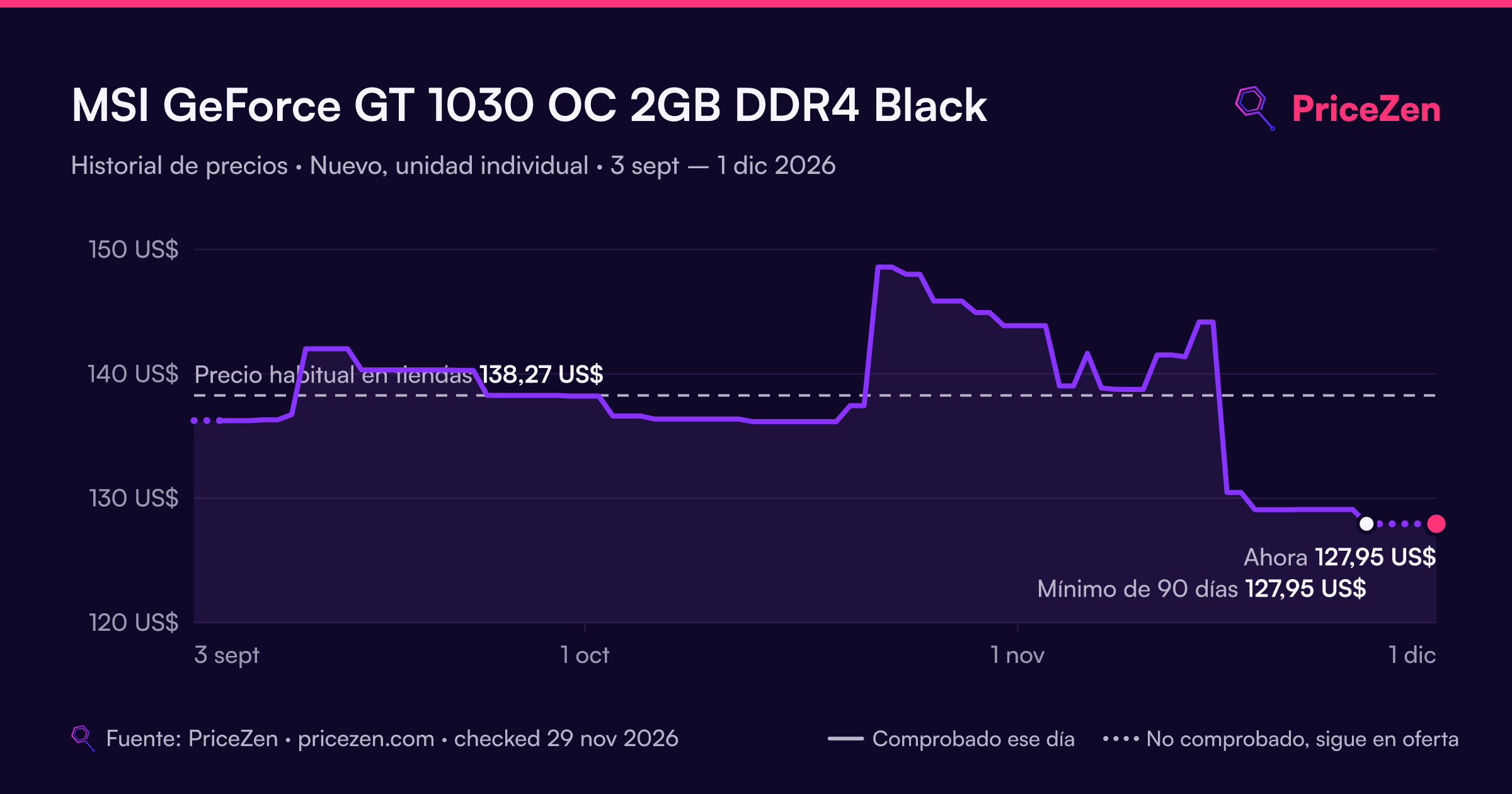
Value here depends entirely on what you pay. At USD 65 from Newegg's refurbished listing, this is a passable display adapter for a machine that just needs to push pixels to a monitor or two. At USD 141, you're in used RX 570 or GTX 1050 Ti territory, and those cards will run circles around this thing. The EUR 96 Italian listing and MXN 2,345 Mexican listing both feel overpriced for what you get. If you need a low profile, silent card for an HTPC or office box, the GT 1030 makes sense at the right price. If you have any gaming ambitions at all, save your money for something with GDDR5 or better.
Amazon 1 oferta Desde 129 US$
Historial de precios
Leer más
Overview
The MSI GeForce GT 1030 2GHD4 LP OC sits in the budget GPU bracket, the kind of card you grab when you just need video output or a tiny upgrade for an old office PC. It's a low profile, passively cooled Pascal card with 2GB of DDR4 memory on a 64-bit bus, 384 CUDA cores, and a 1430MHz boost clock. At 30W TDP, it sips power and doesn't even need a fan, which is nice if you're building a silent HTPC or reviving a slim prebuilt.
But here's the thing people searching for this card need to know: this is the DDR4 version of the GT 1030, not the GDDR5 one. That memory choice kneecaps it hard. The GDDR5 GT 1030 was already a borderline card for anything beyond esports titles, and the DDR4 variant cuts bandwidth roughly in half. If you're asking whether the GT 1030 is good for gaming, the honest answer is barely. It'll handle desktop work, video playback, and very light indie games, but 1080p gaming is mostly off the table.
Pricing is all over the place. US listings run from USD 65 to USD 141, which is wild for a card this old and this limited. At the low end it's a reasonable display adapter. At the high end, you're getting fleeced. Newegg has the best deal on the refurbished unit, and that's the only version we'd even consider at this point.
Common Questions
Q: Is the MSI GT 1030 good for gaming?
Not really. The DDR4 version struggles with anything beyond older esports titles at 720p. If you want to game at 1080p, look for a used GTX 1050 Ti or RX 570 instead.
Q: Can the GT 1030 run without a power connector?
Yes. The GT 1030 draws all its power from the PCIe slot and has a 30W TDP, so it works in systems with a basic 300W power supply and no extra cables.
Q: What's the difference between the DDR4 and GDDR5 GT 1030?
The GDDR5 version has roughly three times the memory bandwidth, which translates to significantly better performance in games and GPU-accelerated tasks. The DDR4 version is noticeably slower.
Q: Will the GT 1030 fit in a small form factor PC?
This MSI model is low profile and comes with a low profile bracket, so it fits in slim cases. The card is 150mm long and takes up two slots, so check your case clearance first.
Who Should Skip This
Skip this card if you plan to play any modern games, even at low settings. The 2GB of DDR4 memory and x4 PCIe link make it a poor choice for anything beyond desktop use. If you need a low profile card for gaming, hunt down the GDDR5 version of the GT 1030 or a low profile GTX 1650. If you're building a new budget system, a CPU with decent integrated graphics like the Ryzen 5 5600G will serve you better and cost about the same as this card at its higher price points. Also skip it if you see it listed above USD 80, that's just bad value for a card this old.
Verdict
Should you buy the MSI GT 1030 2GHD4 LP OC? Only if you need a silent, low profile display adapter and you find it for under USD 70. As a way to add HDMI or DisplayPort output to an old office PC or build a fanless HTPC, it does the job. As a gaming card, even a budget one, it's a disappointment. The DDR4 memory is the killer. MSI made a GDDR5 version of this card that's dramatically better, and there's no reason to pick this one over that unless the price difference is significant.
For anyone hoping to play games at 1080p, look elsewhere. A used GTX 1050 Ti, RX 570, or even a GTX 1650 will cost a bit more but deliver several times the performance. This card is a niche product for a niche use case, and that's about the nicest thing we can say.
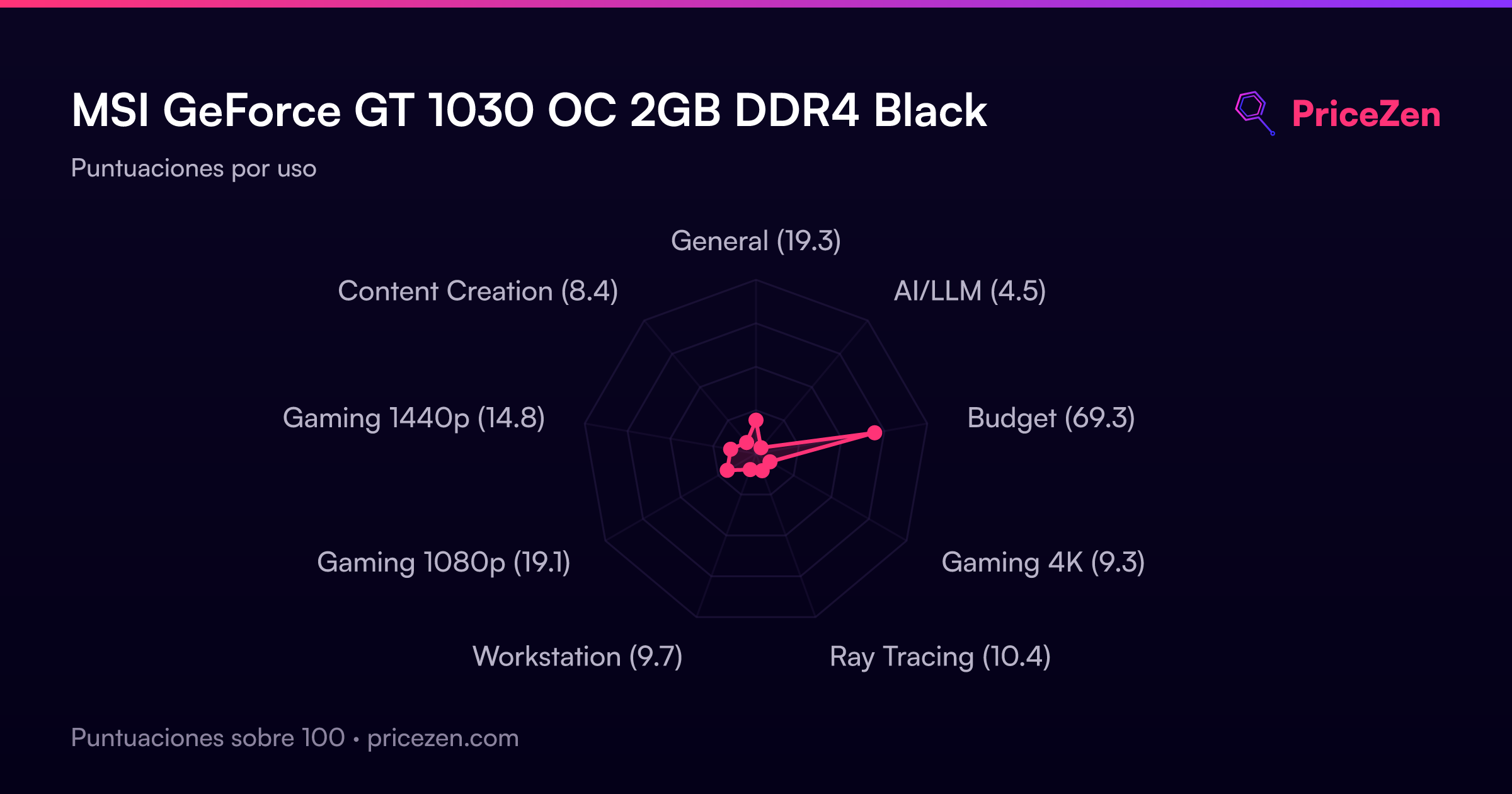
Usage Scores
- General19.3
- AI/LLM4.5
- Budget69.3
- Gaming 4K9.3
- Ray Tracing10.4
- Workstation9.7
- Gaming 1080p19.1
- Gaming 1440p14.8
- Content Creation8.4