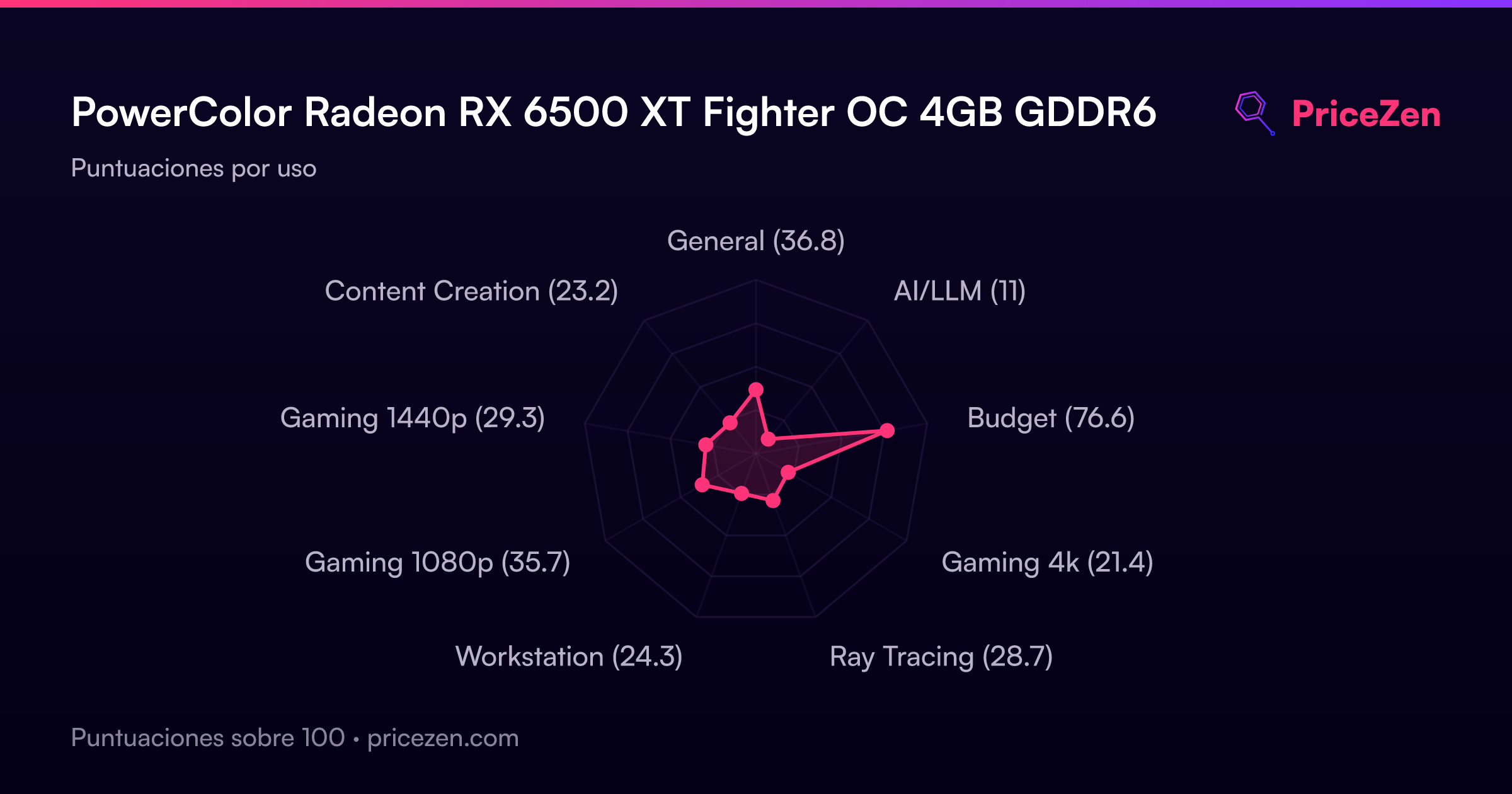
PowerColor Radeon RX 6500 XT Fighter OC 4GB GDDR6
The 6nm RDNA 2 chip with 1024 stream processors and a 2820MHz boost clock delivers 5.76 FP32 TFLOPS, making it a compact dual-fan card that fits easily in small builds. Its 4GB GDDR6 memory on a 64-bit bus with 144 GB/s bandwidth, plus ray tracing and FSR support, targets entry-level 1080p gaming at a budget price point. This card suits budget-conscious gamers building a new system who prioritize low cost and low power draw over high-end performance.












Resumen
The 30-Second Version
The RX 6500 XT Fighter scores 37.7 out of 100 for 1080p gaming, with a PassMark G3D of 9626 landing at 23rd percentile. The 4GB VRAM on a 64-bit bus is the main bottleneck, sitting at 18th percentile with just 144 GB/s of bandwidth. It's cheap at USD 299 and scores 76.1 for budget, but you're buying into a memory ceiling that's already a problem.
Pros & Cons
Ventajas
- 76.1 out of 100 budget score makes it a genuinely cheap entry point 79th
- 107W TDP means it'll run on a modest 300W power supply 75th
- 2820MHz boost clock is solid for this tier
- Dual fan cooler keeps thermals at 56th percentile, about average
- FSR support helps stretch the 4GB VRAM further in supported games
Desventajas
- 9626 PassMark G3D score lands at 23rd percentile for raster
- 4GB VRAM on a 64-bit bus is 18th percentile, a real bottleneck
- 144 GB/s memory bandwidth chokes modern 1080p titles
- Ray tracing at 30th percentile is basically decorative
- AI and compute workloads score 16th and 21st percentile respectively
Opinión de los propietarios
The Word on the Street
Las pruebas
Performance
Let's talk numbers. The PassMark G3D score of 9626 is the headline, and it's not pretty. That's 23rd percentile for raster performance, which means this card gets walked by most of what's in our database. FP32 compute lands at 5.76 TFLOPS, good for 21st percentile. The 4GB VRAM buffer on a 64-bit bus is the real killer here. 144 GB/s of bandwidth is 18th percentile, and modern games at 1080p routinely want more than 4GB. You'll be dropping textures to low and praying in anything released after 2022.
The 2820MHz boost clock is actually decent for this tier, and the 6nm process keeps power draw at a reasonable 107W. But clock speed can't save a card that's starved for memory bandwidth. FSR helps in supported titles, and that's genuinely useful at this performance level. Just don't expect ray tracing to be anything more than a slideshow. The 16 RT cores are there, but at 30th percentile for RT performance, enabling it means watching your frame rate collapse.
Specifications
Full Specifications
Chipset
| GPU Chipset | Radeon RX 6500 XT |
| Brand | AMD |
| Architecture | RDNA 2 |
| Class | consumer |
| Process | 6 |
Memory
| VRAM | 4 GB |
| Memory Type | GDDR6 |
| Memory Bus | 64 |
| Bandwidth | 143.9 |
Compute
| Stream Processors | 1024 |
| RT Cores | 16 |
| Base Clock | 2650 |
| Boost Clock | 2820 |
| FP16 TFLOPS | 11.53 |
| FP32 TFLOPS | 5.765 |
Performance
| PassMark G3D | 9626 |
| GPU Compute | 4356 |
Power & Cooling
| TDP | 107 |
| Recommended PSU | 300 |
| Cooler | Dual Fan |
| Fans | 2 |
Connectivity
| Interface | PCI Express |
| DisplayPort | 1 |
| HDMI | 1 |
| Max Resolution | 7680 x 4320 |
Physical
| Weight | 0.7 kg / 1.4 lbs |
Features
| Ray Tracing | Yes |
| Upscaling | FSR |
| DirectX | 12 Ultimate |
vs Competition
Stacked against the competition in our database, the Fighter is fighting uphill. The PNY OC VCG5070T16TFXPB1-O and ASUS PRIME RTX 5070 both obliterate it in raster and compute, though they cost significantly more. The XFX Mercury RX-97TRGBBB9 and Gigabyte Gaming RX 9070 XT are in a completely different performance class. Even among budget cards, the 4GB VRAM and 64-bit bus put the Fighter at a disadvantage. The 23rd percentile raster score means most cards in our database, including some older used options, will outperform it. The one area where it holds its own is power draw. 107W TDP is genuinely modest, and the 56th percentile thermal performance means the dual fan cooler does its job without drama.
| Spec | PowerColor Radeon RX 6500 XT Fighter OC | MSI GeForce RTX 5070 Gaming Trio | ASUS GeForce RTX 5070 PRIME | Sapphire Radeon RX 9070 XT PULSE | XFX Radeon RX 9070 XT Mercury | Gigabyte Radeon RX 9070 XT Gaming |
|---|---|---|---|---|---|---|
| Chipset | Radeon RX 6500 XT | GeForce RTX 5070 | GeForce RTX 5070 | Radeon RX 9070 XT | Radeon RX 9070 XT | Radeon RX 9070 XT |
| Vram | 4GB GDDR6 | 12GB GDDR7 | 12GB GDDR7 | 16GB GDDR6 | 16GB GDDR6 | 16GB GDDR6 |
| Boost Clock Mhz | 2820 | 2610 | 2512 | 2970 | 3100 | 2970 |
| Tdp W | 107 | 250 | 250 | 304 | 304 | 304 |
| Memory Bus Bits | 64 | 192 | 192 | 256 | 256 | 256 |
| Ray Tracing | true | true | true | true | true | true |
| GPU Class | consumer | consumer | consumer | consumer | consumer | consumer |
| Compare | Compare | Compare | Compare | Compare |
| Producto | AI | Rt | Vram | Raster | Compute | Feature | Thermal | Efficiency | Connectivity | Valoración social | Affordability |
|---|---|---|---|---|---|---|---|---|---|---|---|
| PowerColor Radeon RX 6500 XT Fighter OC | 16.4 | 29.2 | 16.9 | 21.9 | 21.4 | 52.3 | 54.7 | 47.6 | 27 | 74.8 | 79 |
| MSI GeForce RTX 5070 Gaming Trio Compare | 61 | 82.9 | 65.1 | 79 | 70.9 | 95.8 | 91.8 | 78.8 | 94.2 | 93.3 | 31.2 |
| ASUS GeForce RTX 5070 PRIME Compare | 61 | 82.9 | 65.1 | 79 | 70.9 | 95.8 | 91.8 | 78.8 | 94.2 | 93.3 | 44.7 |
| Sapphire Radeon RX 9070 XT PULSE Compare | 89.3 | 84.8 | 73.5 | 74.9 | 90 | 95.8 | 72.1 | 44.9 | 88.9 | 93.3 | 43.7 |
| XFX Radeon RX 9070 XT Mercury Compare | 89.4 | 84.8 | 75.1 | 74.9 | 91 | 95.8 | 72.1 | 44.9 | 94.2 | 93.3 | 43.2 |
| Gigabyte Radeon RX 9070 XT Gaming Compare | 89.5 | 78 | 73.5 | 74.9 | 90 | 95.8 | 91.8 | 44.9 | 88.9 | 74.8 | 27.2 |
Precio
Value & Pricing
At USD 299 on Amazon US, the Fighter is priced like a budget card and performs like one. The 76.1 out of 100 budget score reflects that it's cheap, but cheap doesn't always mean good value. European listings run EUR 254 to 259, and CAD 452 in Canada. The problem is what else that money gets you. For not much more, you can find cards with 8GB of VRAM that won't choke on modern titles. The 4GB buffer means this card has a shorter useful life than its price tag suggests. It's affordable at 79th percentile, but you're buying into a memory ceiling that's already being hit by current games.
Amazon 1 oferta Desde 299 US$
Seguimos los precios de este producto desde el 5 nov 2026. El gráfico aparecerá cuando tengamos más datos.
Leer más
Overview
The PowerColor RX 6500 XT Fighter lands at 37.7 out of 100 in our gaming_1080p scoring, which tells you most of the story before we even get into the benchmarks. Its PassMark G3D score of 9626 puts it in the 23rd percentile for raster performance, meaning roughly three quarters of the cards in our database outrun it. But here's the twist: it scores 76.1 out of 100 for budget, and that's where this card actually makes sense. If you're building a cheap rig and know exactly what you're getting into, the Fighter is a legitimate option. If you're expecting modern AAA gaming at high settings, keep scrolling.
The card runs on RDNA 2 at 6nm with 1024 stream processors and a 2820MHz boost clock. Memory is the real bottleneck: 4GB of GDDR6 on a 64-bit bus, good for 144 GB/s of bandwidth. That's 18th percentile for VRAM in our database. The 107W TDP is modest and the dual fan cooler keeps thermals at a middle of the pack 56th percentile. Ray tracing hardware exists but sits at 30th percentile, so it's more of a checkbox than a feature you'll actually want to use.
Common Questions
Q: Can the RX 6500 XT handle modern AAA games at 1080p?
It depends on the game and settings. With a PassMark G3D score of 9626 at 23rd percentile and only 4GB of VRAM, you'll need to run most modern titles at low to medium settings. Games released after 2022 that want more than 4GB of VRAM will struggle, and you may need FSR enabled to maintain playable frame rates.
Q: Is the 4GB VRAM enough for 1080p gaming?
It's the card's biggest weakness. The 4GB GDDR6 buffer on a 64-bit bus delivers 144 GB/s of bandwidth, which sits at 18th percentile in our database. For esports titles and older games, it's fine. For modern AAA games, you'll hit the memory ceiling quickly and need to drop texture quality significantly.
Q: What power supply do I need for the RX 6500 XT?
The card has a 107W TDP and PowerColor recommends a 300W power supply. That's a genuinely modest requirement, and the dual fan cooler keeps thermals at 56th percentile, so it runs cool and quiet without needing a beefy PSU.
Who Should Skip This
Skip this card if you plan to play anything released in the last few years at decent settings. The 4GB VRAM at 18th percentile and 144 GB/s bandwidth will have you staring at low-res textures and stuttering frame times. If you care about ray tracing, the 30th percentile RT performance means you'll never actually use it. And if you do any AI or compute work, the 11.6 out of 100 AI score and 21st percentile compute performance make this a terrible choice. Anyone building a system for modern gaming should save up for at least an 8GB card.
Verdict
The PowerColor RX 6500 XT Fighter is a budget card with budget compromises baked in. The 76.1 out of 100 budget score is the reason to consider it, but the 37.7 out of 100 gaming_1080p score is the reason to think twice. If you're building a basic office PC that occasionally plays older or esports titles, it'll do the job. If you want to play modern AAA games at 1080p, the 4GB VRAM and 144 GB/s bandwidth will frustrate you within months. The 4.5 out of 5 customer rating from 268 reviews suggests owners are happy, but that's likely because they knew what they were buying. At this price, we'd recommend saving a bit longer for something with 8GB of VRAM.
Usage Scores
- General36.8
- AI/LLM11
- Budget76.6
- Gaming 4k21.4
- Ray Tracing28.7
- Workstation24.3
- Gaming 1080p35.7
- Gaming 1440p29.3
- Content Creation23.2