NVIDIA RTX PRO 6000 Blackwell Server Edition 96GB GDDR7 workstation
Equipped with 96GB of GDDR7 ECC memory and 24,064 CUDA cores on the Blackwell architecture, this card delivers a massive 1.8 TB/s bandwidth for error-free, large-scale computation. Its 5th Gen Tensor Cores with FP4 precision and DLSS 4 support accelerate neural shader workloads, while the 600W TDP is managed within a standard 305mm dual-slot form factor. This GPU is best for data scientists and AI researchers deploying multi-billion-parameter LLMs in server environments where memory integrity and capacity are critical.

Sin precio actual de tiendas
Resumen
The 30-Second Version
The RTX PRO 6000 Blackwell Server Edition is an AI monster with 96GB of ECC GDDR7 and top-tier LLM performance. It also costs around CAD 60,000 to CAD 67,000 and pulls 600W. Worth it only if your work literally requires this much VRAM.
Pros & Cons
Ventajas
- 96GB of ECC GDDR7 is the best VRAM capacity we've seen 100th
- AI performance tops our entire database 100th
- 1.8 TB/s memory bandwidth is absurd 85th
- DLSS 4 and FP4 Tensor Core support for modern workloads 78th
Desventajas
- 600W TDP will heat your server room like a sauna
- Pricing starts around CAD 60,000
- Thermals rank near the bottom of our charts
- Connectivity options are limited for a card this expensive
Las pruebas
Performance
The headline numbers are wild. 24,064 CUDA cores, 96GB of GDDR7 on a 512-bit bus, and 1.8 TB/s of memory bandwidth. In our database, the AI score lands at the absolute top of the charts, best-in-class for LLM work. VRAM capacity is also maxed out at the 100th percentile. Raster performance is strong, well above average, but not the reason you buy this card. Ray tracing sits around the middle of the pack, which is fine for a server part. The real weak spots are efficiency and thermals. A 600W TDP means you need serious cooling and a power supply that won't flinch. Connectivity is also a letdown, just PCIe 5.0 x16 with no fancy display outputs to speak of.
Specifications
Full Specifications
Chipset
| GPU Chipset | NVIDIA RTX PRO 6000 Blackwell Server Edition |
| Brand | NVIDIA |
| Architecture | Blackwell |
| Class | workstation |
Memory
| VRAM | 96 GB |
| Memory Type | GDDR7 |
| Memory Bus | 512 |
| ECC | Yes |
Compute
| CUDA Cores | 24064 |
| Tensor Cores | 5 |
| RT Cores | 4 |
Performance
| PassMark G3D | 27523 |
| GPU Compute | 20029 |
Power & Cooling
| TDP | 600 |
Connectivity
| Interface | PCI Express 5.0 x16 |
| Max Resolution | 7680 x 4320 |
Physical
| Length | 305 |
Features
| Ray Tracing | Yes |
| Upscaling | DLSS 4 |
| AV1 Encode | Yes |
| DirectX | 12 |
vs Competition
Compared to the ASUS PRIME RTX 5080, MSI Ventus RTX 5070 Ti, or Gigabyte AERO 5070 Ti, the RTX PRO 6000 Blackwell is playing a different sport. Those cards are great for gaming and light content creation, and they cost a fraction of the price. But none of them can touch 96GB of VRAM or the AI throughput this thing delivers. The PNY ARGB OC 5080 and ZOTAC SOLID SFF 5070 Ti are also solid consumer options, but they'd choke on the large model workloads this card handles without breaking a sweat. If you need raw AI compute and memory capacity, there's no real competition here. If you need to play Cyberpunk at 4K, buy one of the others and keep the CAD 55,000 you'll save.
| Spec | NVIDIA RTX PRO 6000 Blackwell Server Edition | ASUS GeForce RTX 5090 TUF Gaming | Gigabyte GeForce RTX 5070 Ti Eagle Ice | MSI GeForce RTX 5070 Ti Ventus 3X OC | ZOTAC GeForce RTX 5080 APOCALYPSE | PNY GeForce RTX 5080 ARGB OC |
|---|---|---|---|---|---|---|
| Chipset | NVIDIA RTX PRO 6000 Blackwell Server Edition | GeForce RTX 5090 | GeForce RTX 5070 Ti | GeForce RTX 5070 Ti | GeForce RTX 5080 | GeForce RTX 5080 |
| Vram | 96GB GDDR7 | 32GB GDDR7 | 16GB GDDR7 | 16GB GDDR7 | 16GB GDDR7 | 16GB GDDR7 |
| Boost Clock Mhz | - | 2407 | 2542 | 2482 | 2730 | 2620 |
| Tdp W | 600 | 575 | 300 | 300 | 360 | 360 |
| Memory Bus Bits | 512 | 512 | 256 | 256 | 256 | 256 |
| Ray Tracing | true | true | true | true | true | true |
| GPU Class | workstation | consumer | consumer | consumer | consumer | consumer |
| Compare | Compare | Compare | Compare | Compare |
| Producto | AI | Rt | Vram | Raster | Compute | Feature | Thermal | Efficiency | Connectivity | Affordability |
|---|---|---|---|---|---|---|---|---|---|---|
| NVIDIA RTX PRO 6000 Blackwell Server Edition | 99.7 | 62.8 | 99.7 | 77.5 | 64.7 | 85.4 | 6.5 | 15.5 | 18.5 | 0.1 |
| ASUS GeForce RTX 5090 TUF Gaming Compare | 97.1 | 90.5 | 97.7 | 98.8 | 97.7 | 96 | 72.3 | 24.2 | 99.3 | 2.3 |
| Gigabyte GeForce RTX 5070 Ti Eagle Ice Compare | 79.6 | 88.6 | 86 | 89 | 88.2 | 96 | 91.6 | 72.2 | 94.1 | 26.8 |
| MSI GeForce RTX 5070 Ti Ventus 3X OC Compare | 79.6 | 92.4 | 86 | 89 | 88.2 | 96 | 91.6 | 72.2 | 94.1 | 23 |
| ZOTAC GeForce RTX 5080 APOCALYPSE Compare | 85.7 | 97.5 | 89 | 94.5 | 93.5 | 96 | 91.6 | 57.1 | 94.1 | 20.2 |
| PNY GeForce RTX 5080 ARGB OC Compare | 85.7 | 97.5 | 89 | 94.5 | 93.5 | 96 | 91.6 | 57.1 | 94.1 | 14.4 |
Precio
Value & Pricing
Let's be real, the value score is a 35 out of 100 and the affordability percentile is dead last. That's not a surprise. This card costs between CAD 60,000 and CAD 67,000 depending on the vendor, and both Canadian listings are in the same ballpark. If you're a business buying this for AI workloads, the math is about uptime, memory capacity, and not having to split models across four consumer cards. If you're a gamer or a hobbyist, this is a terrible purchase. The cheapest listing we found is at the lower end of that range, but even then, you need a very specific reason to spend this kind of money.
Leer más
Overview
The RTX PRO 6000 Blackwell Server Edition is not a graphics card you buy on a whim. It's a 600W slab of silicon built for AI work, with 96GB of GDDR7 and ECC to back it up. If you're training large models or running inference on datasets that would choke a consumer card, this is the kind of hardware that makes your job possible.
It's also priced like a small car. We're seeing CAD 60,000 to CAD 67,000 across Canadian listings. That's not a typo. This thing sits in a completely different universe from the RTX 5080s and 5070 Tis most people are shopping for.
Common Questions
Q: Is this card good for gaming?
Technically it can run games, but that's like using a freight train to pick up groceries. The raster score is strong, but you'd be paying CAD 60,000 plus for performance a CAD 1,500 RTX 5080 can mostly match in games.
Q: What power supply do I need for this?
The card has a 600W TDP, so you'll want at least a 1000W power supply with headroom for the rest of your system. In a server chassis, make sure your cooling can handle the heat output too.
Q: Why is the VRAM so important for AI work?
Large language models need to fit entirely in memory to run efficiently. 96GB of ECC GDDR7 lets you load models that would crash or crawl on cards with 16GB or 24GB, and ECC helps prevent silent data corruption during long training runs.
Who Should Skip This
Skip this if you're a gamer, streamer, or content creator. The RTX 5080 and 5070 Ti options from ASUS, MSI, and Gigabyte will handle your workload for a tiny fraction of the price. Also skip it if your server room can't handle 600W of heat per card, because the thermal performance here is rough. And if you're on any kind of budget, this card will laugh at your spreadsheet.
Verdict
This is a purpose-built tool for AI researchers, data centers, and enterprises running large language models. The 96GB of ECC memory alone makes it worth considering if you're constantly hitting VRAM limits. But the 600W power draw and brutal price tag mean it's not for casual users or even most professionals. Buy it if your workload demands it, not because it's cool.
Usage Scores
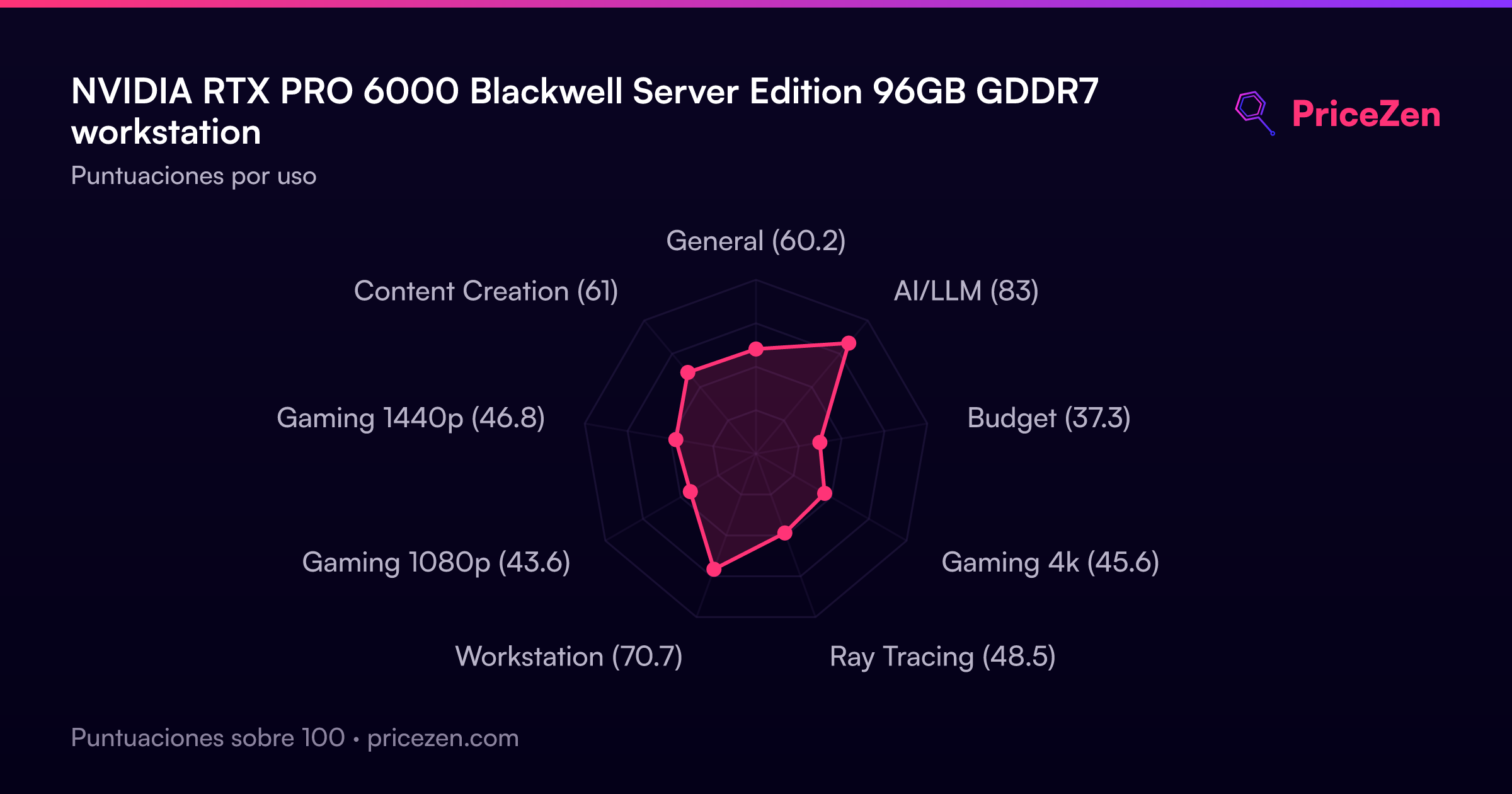
- General60.2
- AI/LLM83
- Budget37.3
- Gaming 4k45.6
- Ray Tracing48.5
- Workstation70.7
- Gaming 1080p43.6
- Gaming 1440p46.8
- Content Creation61