ZOTAC GeForce RTX 5060 Ti Twin Edge OC 8GB GDDR7 White

DLSS 4 para más fotogramas por segundo verificado el 28 nov
62/100 puntuación global 4,9 media de 10 valoraciones de propietarios
La tienda muestra un precio «antes», pero 469,99 US$ no está por debajo del precio habitual de 469,99 US$.
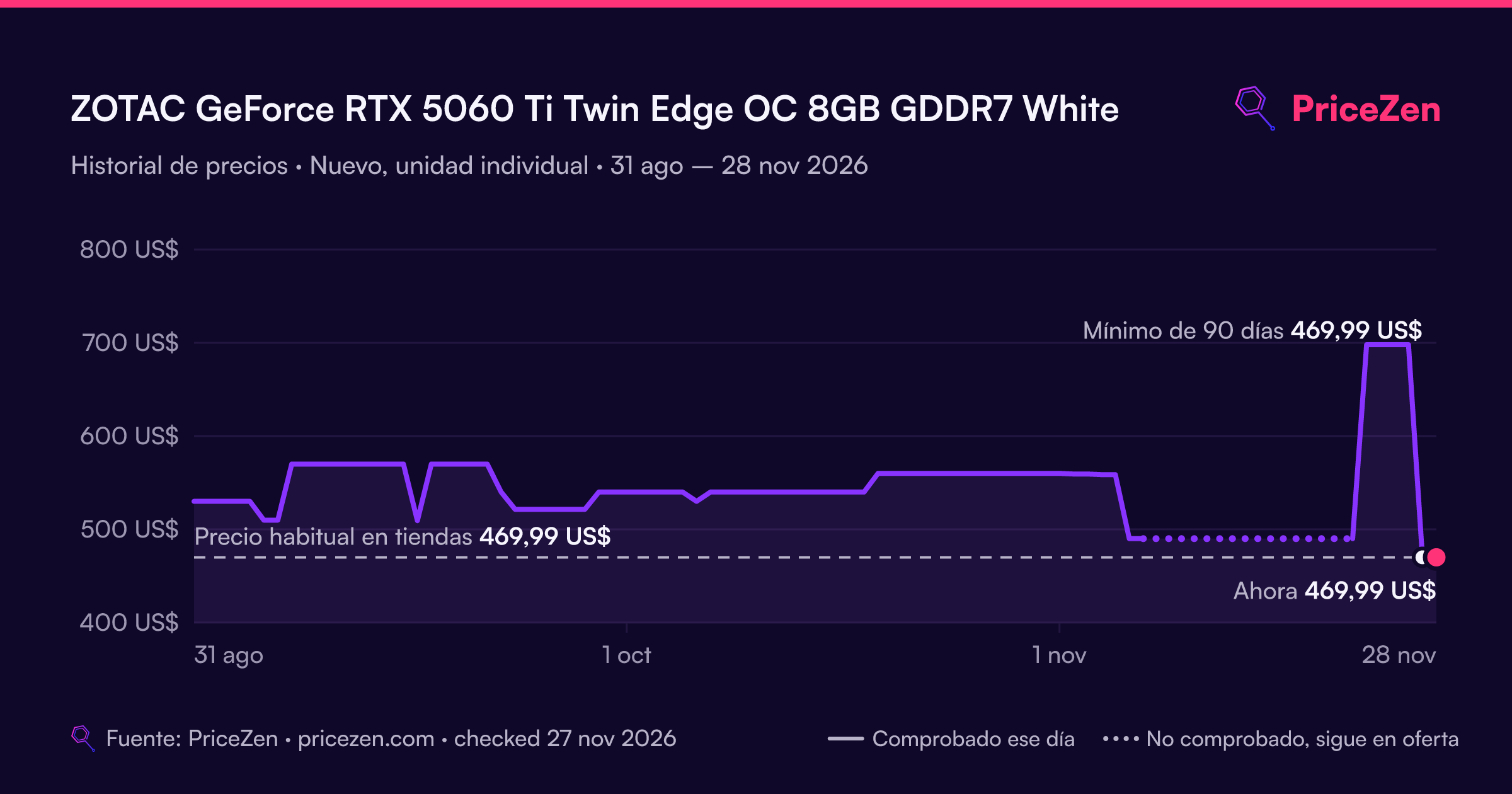
Habitual 469,99 US$Precio «antes» de la tienda 559,99 US$Máximo 698,00 US$
Habitual 469,99 US$Precio «antes» de la tienda 559,99 US$Máximo 698,00 US$
Precio en los últimos 90 días: mínimo 469,99 US$ el 27 nov, máximo 698,00 US$. Precio habitual 469,99 US$. El precio «antes» de la tienda 559,99 US$. Hoy 469,99 US$.
- GPU
- GeForce RTX 5060 Ti
- VRAM
- 8GB GDDR7
- Boost clock
- 2602 MHz
- TDP
- 180 W
- Memory bus
- 128 bit
- Ray tracing
- Sí
- Class
- consumer
Compara precios en 3 tiendas
De la más barata a la más cara. Las ofertas nuevas, reacondicionadas y en pack se mantienen separadas para que compares lo comparable.
| Tienda | Vendido por | Color y estado | Precio | vs. el más bajo | Última comprobación | Enlace |
|---|---|---|---|---|---|---|
| Nuevo3 ofertasUnidad individual | ||||||
| Micro Center | Micro Center | White | 469,99 US$ | Precio más bajo | Ayer | Ir a la tienda |
| Amazon | Desconocido | No indicado | 698,00 US$ | +228,01 US$ | Ayer | Ir a la tienda |
| No comprobados en los últimos 7 días, por lo que estos precios pueden haber cambiado | ||||||
| Newegg | Newegg | White | Precio sin confirmar | Desconocido | Ir a la tienda | |
 Fuente: PriceZen, comprobado el 27 nov 2026
4 anuncios; 1 de ellos repiten otra oferta exactamente (misma tienda, vendedor, estado, color y precio), por lo que se muestran una sola vez. Un precio se considera vigente si lo comprobamos en los últimos 7 días. «Vendedor externo» significa un vendedor de terceros en esa tienda, no la propia tienda.
Historial de precios
El precio habitual en tiendas es 469,99 US$ y el más bajo de los últimos 90 días fue 469,99 US$.
Comprobado ese díaNo comprobado ese día, sigue en oferta
Fuente: PriceZen, checked 27 nov 2026


Resumen
The 30-Second Version
A 20,798 PassMark score in a 221mm, 180W card is a neat trick, and at USD 430 from Newegg it's a strong compact-build pick. The 8GB of GDDR7 is the compromise, dragging AI work down to 34.8/100. And whatever you do, don't pay Amazon's USD 698.
Pros & Cons
Ventajas
- Compact 221mm, 2-slot design fits SFF builds 94th
- 180W TDP with a single 8-pin, well above average efficiency 88th
- Top-tier connectivity: 3x DP 2.1b and HDMI 2.1b 82nd
- DLSS 4 and AV1 encode put features among the best in class
- Strong budget score of 84.1/100 in our rankings
Desventajas
- 8GB VRAM is only middle of the pack and limits future headroom
- AI/LLM score of 34.8/100 falls behind most of the field
- Ray tracing at 63.7/100 is solid but not leading
- PCIe 5.0 x8 interface instead of full x16
- Only 10 owner reviews so far, so social proof is thin
Opinión de los propietarios
The Word on the Street
- Owners are broadly happy, reflected in a 4.9/5 average across 10 reviews, praising it as a solid card for the money.
- At least one buyer sees it as a step below ASUS-built cards while still comfortably ahead of the cheapest Gigabyte and MSI options, so brand-tier expectations matter.
Cómo cambió la opinión de los propietarios con el tiempo
ExclusivaSegún cuándo escribieron realmente sus opiniones los clientes, para ver si los elogios iniciales se mantuvieron.
1 opinión escrita, oct 2026: 1 satisfecho
En las 10 valoraciones de tiendas: 4,9★. La mayoría de los propietarios valora sin escribir una opinión. El gráfico cuenta 1 opinión escrita.
Cada punto es una opinión escrita, en el mes en que se escribió. Satisfechos = 4-5★, neutrales = 3★, insatisfechos = 1-2★.
Las pruebas
Performance
The headline number is that 20,798 G3D benchmark score, backed by 19.18 TFLOPS of both FP16 and FP32 compute from those 4608 CUDA cores. That puts raster performance right in the middle of the pack among graphics cards we track, which is exactly where a 5060 Ti should sit. The factory OC pushes the boost clock to 2602MHz, and the GDDR7 memory running at 28 Gbps gives it 448 GB/s of bandwidth despite the narrow 128-bit bus. For 1080p gaming, our model gives it a strong 68.4/100, and DLSS 4 support helps stretch those frames further in supported titles.
Efficiency is a genuine strength here: at 180W with a single 8-pin connector and a 600W PSU recommendation, it ranks well above average for power draw. You don't need a new power supply or a case the size of a mini fridge. The dual-fan IceStorm 2.0 cooler keeps things about average thermally in our rankings, and the 221mm length means it fits small-form-factor builds. Ray tracing from the 36 RT cores is decent but not a standout at 63.7/100, and the 144 Tensor cores can't rescue AI workloads when you're capped at 8GB. That 34.8/100 AI score is the one number that should give pause if you're eyeing local LLMs.
Specifications
Full Specifications
Chipset
| GPU Chipset | GeForce RTX 5060 Ti |
| Brand | NVIDIA |
| Architecture | Blackwell |
| Class | consumer |
| Process | 5 |
Memory
| VRAM | 8 GB |
| Memory Type | GDDR7 |
| Memory Bus | 128 |
| Bandwidth | 448 |
Compute
| CUDA Cores | 4608 |
| Tensor Cores | 144 |
| RT Cores | 36 |
| Base Clock | 2602 |
| Boost Clock | 2602 |
| FP16 TFLOPS | 19.18 |
| FP32 TFLOPS | 19.18 |
Performance
| PassMark G3D | 20798 |
| GPU Compute | 10484 |
Power & Cooling
| TDP | 180 |
| Recommended PSU | 600 |
| Power Connectors | 8-Pin |
| Cooler | Dual Fan |
| Fans | 2 |
Connectivity
| Interface | PCI Express 5.0 x8 |
| DisplayPort | 3 |
| HDMI | 1 |
| Max Displays | 4 |
| Max Resolution | 7680 x 4320 |
Physical
| Length | 221 |
| Slot Width | 2 |
| Form Factor | ATX |
| Weight | 1.2 kg / 2.6 lbs |
Features
| Ray Tracing | Yes |
| Upscaling | DLSS 4.0 |
| AV1 Encode | Yes |
| VR Ready | Yes |
| DirectX | 12 Ultimate |
| RGB | No |
vs Competition
Against the competition in our data, the Gigabyte RTX 5070 Ti Eagle Ice, ASUS RTX 5070 Ti TUF Gaming, and PNY RTX 5070 Ti OC all sit a tier above on paper, and the MSI RTX 5070 Gaming Trio and Sapphire RX 9070 XT PULSE are worth cross-shopping too. This ZOTAC's argument isn't raw speed, its raster ranking is middle of the pack, it's the combination of a 180W draw, 221mm length, and near-top connectivity that those bigger cards can't match in a small build. If your case and PSU have room and your wallet stretches, the 5070 Ti options deserve a look. If you're building compact on a budget, this card's efficiency and feature rankings are among the better ones we track, and the 8GB buffer is the trade-off you're accepting.
| Spec | ZOTAC GeForce RTX 5060 Ti Twin Edge OC | Gigabyte GeForce RTX 5070 Ti Eagle Ice | ASUS GeForce RTX 5070 Ti TUF Gaming | PNY GeForce RTX 5070 Ti OC | MSI GeForce RTX 5070 Gaming Trio | Sapphire Radeon RX 9070 XT PULSE |
|---|---|---|---|---|---|---|
| Chipset | GeForce RTX 5060 Ti | GeForce RTX 5070 Ti | GeForce RTX 5070 Ti | GeForce RTX 5070 Ti | GeForce RTX 5070 | Radeon RX 9070 XT |
| Vram | 8GB GDDR7 | 16GB GDDR7 | 16GB GDDR7 | 16GB GDDR7 | 12GB GDDR7 | 16GB GDDR6 |
| Boost Clock Mhz | 2602 | 2542 | 2650 | 2450 | 2610 | 2970 |
| Tdp W | 180 | 300 | 300 | 300 | 250 | 304 |
| Memory Bus Bits | 128 | 256 | 256 | 256 | 192 | 256 |
| Ray Tracing | Yes | Yes | Yes | Yes | Yes | Yes |
| GPU Class | consumer | consumer | consumer | consumer | consumer | consumer |
| Compare | Compare | Compare | Compare | Compare |
| Producto | AI | Rt | Vram | Raster | Compute | Feature | Thermal | Efficiency | Connectivity | Valoración social | Affordability |
|---|---|---|---|---|---|---|---|---|---|---|---|
| ZOTAC GeForce RTX 5060 Ti Twin Edge OC | 41.8 | 62.8 | 46 | 51.1 | 49.6 | 88.4 | 54.3 | 81.5 | 94.2 | 43.3 | 61.9 |
| Gigabyte GeForce RTX 5070 Ti Eagle Ice Compare | 78.9 | 88.6 | 86 | 88.9 | 87.9 | 95.7 | 91.8 | 71.6 | 94.2 | 93.4 | 23 |
| ASUS GeForce RTX 5070 Ti TUF Gaming Compare | 78.9 | 92.4 | 86 | 88.9 | 87.9 | 82.8 | 49.6 | 71.6 | 99.3 | 93.4 | 22.5 |
| PNY GeForce RTX 5070 Ti OC Compare | 78.9 | 92.4 | 86 | 88.9 | 87.9 | 65.6 | 91.8 | 71.6 | 81.3 | 93.4 | 26.4 |
| MSI GeForce RTX 5070 Gaming Trio Compare | 60.7 | 82.9 | 65.2 | 78.8 | 70.5 | 95.7 | 91.8 | 78.7 | 94.2 | 93.4 | 32 |
| Sapphire Radeon RX 9070 XT PULSE Compare | 89.4 | 84.7 | 73.6 | 74.6 | 89.9 | 95.7 | 71.8 | 44.6 | 89 | 93.4 | 41.2 |
Precio
Value & Pricing
At Newegg's USD 430, this is a genuinely good deal for a current-gen card with GDDR7 and DLSS 4. But shop carefully: Micro Center lists it at USD 470 and Amazon wants a painful USD 698. That's a USD 268 spread across stores for the exact same card, which is frankly absurd. Our affordability ranking puts it at about average overall, but at the Newegg price the 84.1/100 budget score makes a lot more sense. If your only option is the Amazon listing, walk away and wait.
Leer más
Overview
A 20,798 PassMark G3D score and a 180W TDP tell you most of what this card is about: solid mid-range grunt in a 221mm, two-slot package that sips power. The ZOTAC RTX 5060 Ti Twin Edge OC packs 4608 CUDA cores boosting to 2602MHz, 8GB of GDDR7 on a 128-bit bus pushing 448 GB/s, and DLSS 4 support on NVIDIA's Blackwell architecture. Our scoring model rates it 84.1/100 for budget builds, which is well above average, and 68.4/100 for 1080p gaming.
The catch is the memory. 8GB puts it around the middle of the pack for VRAM in our rankings, and that shows up in the weak spots: ray tracing scores 63.7/100 and AI/LLM work lands at just 34.8/100. This is a compact 1080p card with excellent connectivity (three DisplayPort 2.1b plus HDMI 2.1b) and AV1 encoding, not a do-everything GPU. Owners seem happy though, with a 4.9/5 rating across 10 reviews.
Common Questions
Q: Is 8GB of VRAM enough for gaming right now?
For 1080p, mostly yes. Our model scores it 68.4/100 for 1080p gaming, and the GDDR7 runs at 448 GB/s, which helps. But 8GB sits around the middle of the pack in our VRAM rankings, so cranked-up textures and heavy ray tracing (63.7/100) will bump against that ceiling sooner than you'd like.
Q: What power supply do I need?
ZOTAC specs a 600W PSU and a single 8-pin connector for the 180W TDP. That's well above average efficiency in our rankings, so most existing mid-range systems won't need a PSU upgrade.
Q: Will it fit a small case?
Very likely. At 221mm long and 2 slots thick with a dual-fan cooler, it's one of the more compact options in our data, and thermal performance ranks about average, so it's not sacrificing much cooling for the size.
Who Should Skip This
Skip this if you want to run local LLMs or AI workloads: the 34.8/100 AI score and 8GB buffer put it behind most of the field. Serious ray tracing fans should also look elsewhere, since 63.7/100 is solid but not leading, and 1440p-or-higher ambitions will strain that middle-of-the-pack VRAM. And if you're stuck with the USD 698 Amazon listing, the value math simply doesn't work when the same card is USD 430 at Newegg.
Verdict
We'd recommend this card for compact 1080p builds at the USD 430 Newegg price, full stop. The 20,798 G3D score, 180W efficiency, and best-in-class port selection make it a smart pick when space and power are tight. Just go in knowing the 8GB ceiling is real: the 34.8/100 AI score and middling VRAM ranking mean heavy ray tracing and local AI work will frustrate you. Buy it for what it is, a tidy, efficient 1080p gamer, and skip the USD 698 listings entirely.
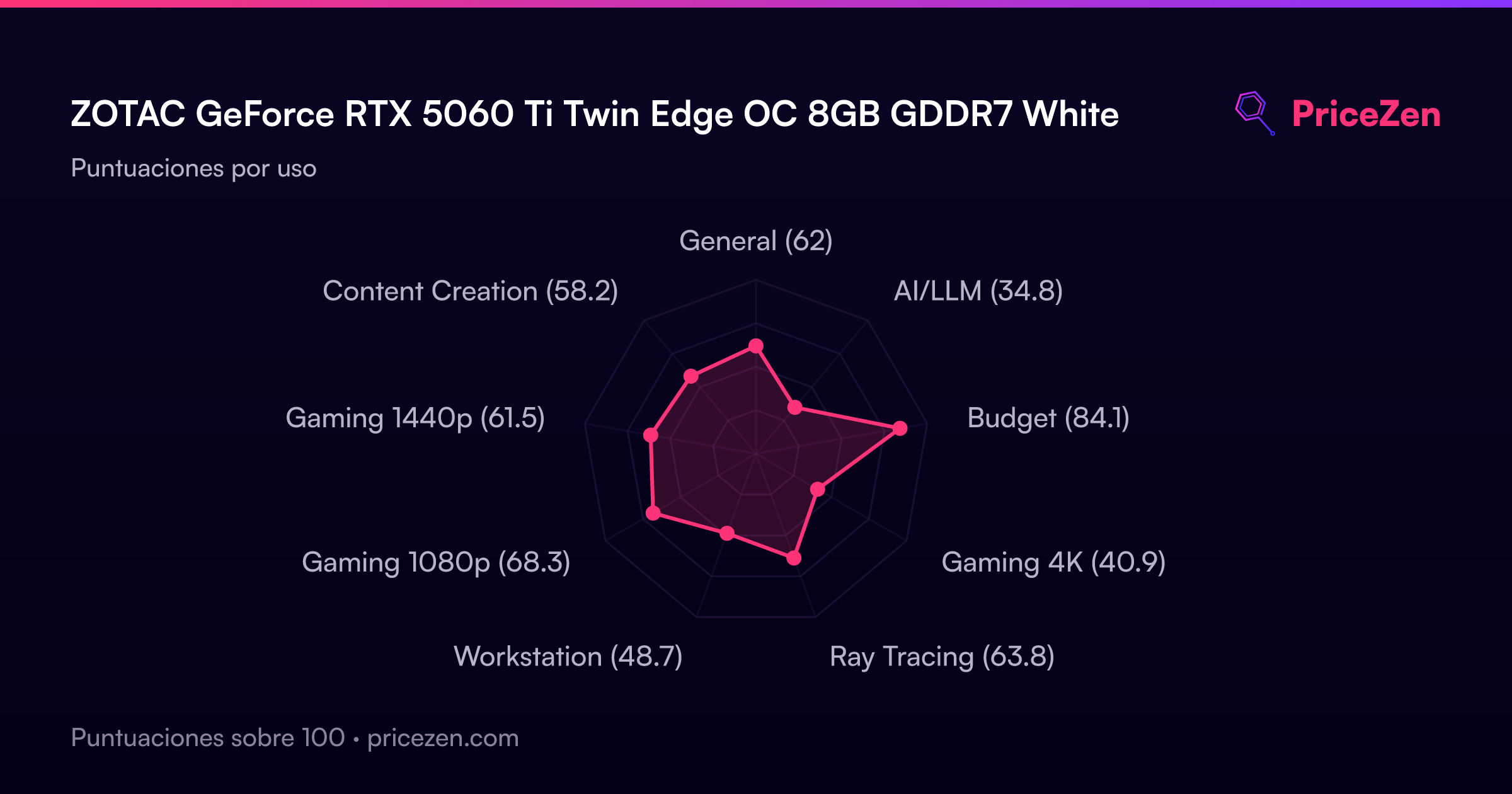
Usage Scores
- General62
- AI/LLM34.8
- Budget84.1
- Gaming 4K40.9
- Ray Tracing63.8
- Workstation48.7
- Gaming 1080p68.3
- Gaming 1440p61.5
- Content Creation58.2