MSI GeForce RTX 3090 Gaming X Trio 24GB GDDR6X

24 GB de VRAM para IA y trabajo en 3D verificado el 29 nov
74/100 puntuación global 4,2 media de 276 valoraciones de propietarios
Precios comprobados en 85 días hasta ahora, muy pocos para saber cuál es el habitual.
- GPU
- GeForce RTX 3090
- VRAM
- 24GB GDDR6X
- Boost clock
- 1785 MHz
- TDP
- 370 W
- Memory bus
- 384 bit
- Ray tracing
- Sí
- Class
- consumer
Compara precios en 2 tiendas
De la más barata a la más cara. Las ofertas nuevas, reacondicionadas y en pack se mantienen separadas para que compares lo comparable.
| Tienda | Vendido por | Color y estado | Precio | vs. el más bajo | Última comprobación | Enlace |
|---|---|---|---|---|---|---|
| Nuevo3 ofertasUnidad individual | ||||||
| Agotado en la última comprobación | ||||||
| Newegg | Newegg | No indicado | Sin precio | Agotado | 30 oct | Ir a la tienda |
| Newegg | Vendedor externo | No indicado | Sin precio | Agotado | 30 oct | Ir a la tienda |
| Amazon | Desconocido | No indicado | Sin precio | Agotado | Anteayer | Ir a la tienda |
| Reacondicionado y renovado1 ofertaNo es nuevo: el estado y la garantía varían según el vendedor | ||||||
| Amazon | Vendedor externo | Renovado | 2199,99 US$ | Precio más bajo | Anteayer | Ir a la tienda |
 Fuente: PriceZen, comprobado el 27 nov 2026
Un precio se considera vigente si lo comprobamos en los últimos 7 días. «Vendedor externo» significa un vendedor de terceros en esa tienda, no la propia tienda.
Historial de precios
Comprobado ese díaNo comprobado ese día, sigue en oferta
Fuente: PriceZen, checked 27 nov 2026


Resumen
The 30-Second Version
The MSI RTX 3090 Gaming X Trio is a beast of a card with 24GB of VRAM and a PassMark score of 26,521, making it still relevant for 4K gaming and AI work in 2025. Prices range from $1,262 to $2,200 in the US, so shop around if you're buying. The big caveats are reliability concerns and MSI's weak warranty support, with multiple owners reporting failures within months. It's a great card for memory-hungry workloads, but newer RTX 5080 cards are better for pure gaming efficiency.
Pros & Cons
Ventajas
- 24GB of VRAM is still massive and future-proof for 4K and AI workloads 96th
- PassMark score of 26,521 puts it in the top tier of our database 95th
- Quiet operation thanks to the Tri-Frozr 2 triple-fan cooler 94th
- Strong ray tracing and DLSS support for modern games 92nd
- 936 GB/s memory bandwidth handles heavy textures and large models easily
Desventajas
- Reliability concerns, multiple owners report failures within months
- MSI's warranty and RMA process gets consistent criticism
- 370W TDP means you need a beefy power supply and good airflow
- Limited overclocking headroom due to VRM design
- 3.5-slot design won't fit in smaller cases
Opinión de los propietarios
The Word on the Street
- A recurring theme is that the raw performance is outstanding, with many owners praising how well it handles 4K gaming and demanding workloads without breaking a sweat.
- Multiple buyers mention how quiet the card runs under load, which is impressive given the 370W TDP and the amount of heat this thing generates.
- A common complaint is poor reliability, with several owners reporting that their cards failed within months of purchase, often with little warning.
- MSI's warranty and RMA process draws consistent criticism, with users describing slow responses and unhelpful support when trying to get defective cards replaced.
Cómo cambió la opinión de los propietarios con el tiempo
ExclusivaSegún cuándo escribieron realmente sus opiniones los clientes, para ver si los elogios iniciales se mantuvieron.
Propietarios satisfechos: 73 % últimamente, 83 % en oct 2020 – jun 2022
Muy pocas opiniones para hablar de un cambio.
En las 276 valoraciones de tiendas: 4,2★. La mayoría de los propietarios valora sin escribir una opinión. El gráfico cuenta las 23 opiniones escritas con estrellas y fecha propia.
30 opiniones de meses con fechas aproximadas (el día en que las vimos por primera vez) quedan fuera de la tendencia.
2 opiniones escritas sin estrellas quedan fuera de la tendencia.
Ver las cifras
| Periodo | Opiniones | Satisfechos | Neutrales | Insatisfechos | Proporción satisfechos |
|---|---|---|---|---|---|
| oct 2020 – jun 2022 | 12 | 10 | 1 | 1 | 83 % |
| jul 2022 – may 2026 | 11 | 8 | 0 | 3 | 73 % |
- abr–jun 20261 de 2 satisfechos · 2 sin estrellas
One buyer praised performance and value, while another reported the card broke after three months. Two generic MSI responses add no user sentiment.
- Runs smoothly under stress, delivers high FPS at 4K and 1080p with a 7800x3d.
- Card broke after three months, though it works when not falling apart.
- oct–dic 20205 de 5 satisfechos
Buyers praise the GPU's speed, looks, and quiet operation, but note the high price and poor VRM design limit overclocking. Availability was a major hurdle.
- Fast, quiet, and looks great in a case; overall performance is excellent.
- VRM design is poor, limiting overclocking potential compared to other cards.
- High price tag is justified by performance but falls short of elite expectations.
- Extremely hard to purchase due to stock shortages and checkout issues.
Cada columna une trimestres hasta reunir al menos 10 opiniones con estrellas y fecha propia. Satisfechos = 4-5★, neutrales = 3★, insatisfechos = 1-2★. Los resúmenes por periodo están en inglés.
Las pruebas
Performance
Let's talk raw numbers. This card puts up a PassMark G3D score of 26,521, which puts it in the top tier of our database. For context, that's enough to push 4K gaming at high refresh rates in most titles, and it absolutely crushes anything from the previous generation. The 10,496 CUDA cores and 1785MHz boost clock mean this thing chews through rasterization workloads without breaking a sweat. Ray tracing performance is strong too, landing around the 80th percentile in our rankings. Not the absolute best anymore, but still very capable.
The 24GB of GDDR6X on a 384-bit bus gives you 936 GB/s of memory bandwidth. That's the kind of number that matters when you're pushing 4K textures or working with large AI models. In our database, the VRAM capacity sits at the 94th percentile, which is genuinely impressive even by today's standards. The compute side is no slouch either, with 35.58 TFLOPS of FP32 performance. That's enough to make this card a legitimate option for machine learning work, not just gaming. The AI score of 80.6 out of 100 reflects that. It's not going to replace a dedicated workstation card, but for hobbyists and small studios, it's a serious tool.
Specifications
Full Specifications
Chipset
| GPU Chipset | GeForce RTX 3090 |
| Brand | NVIDIA |
| Architecture | Ampere |
| Class | consumer |
| Process | 8 |
Memory
| VRAM | 24 GB |
| Memory Type | GDDR6X |
| Memory Bus | 384 |
| Bandwidth | 936.2 |
Compute
| CUDA Cores | 10496 |
| Tensor Cores | 328 |
| RT Cores | 82 |
| Base Clock | 1785 |
| Boost Clock | 1785 |
| FP16 TFLOPS | 35.58 |
| FP32 TFLOPS | 35.58 |
Performance
| PassMark G3D | 26521 |
| GPU Compute | 15150 |
Power & Cooling
| TDP | 370 |
| Recommended PSU | 750 |
| Power Connectors | 3 x 8-Pin |
| Cooler | Triple Fan |
| Fans | 3 |
Connectivity
| Interface | PCI Express 4.0 |
| DisplayPort | 3 |
| HDMI | 1 |
| Max Displays | 4 |
| Max Resolution | 7680 x 4320 |
Physical
| Length | 323 |
| Slot Width | 3.5 |
| Form Factor | Full Height |
| Weight | 0.3 kg / 0.7 lbs |
Features
| Ray Tracing | Yes |
| Upscaling | DLSS |
| AV1 Encode | Yes |
| VR Ready | Yes |
| DirectX | 12 |
| RGB | Yes |
vs Competition
The competitive landscape has shifted a lot since this card launched. The ASUS PRIME RTX 5080 and Gigabyte AORUS RTX 5080 are both newer cards that beat this 3090 in efficiency and ray tracing performance. The 5080 cards are more power-efficient and have better RT cores, but they typically come with 16GB of VRAM. If you're doing AI work or heavy 4K content creation, that 24GB on the 3090 still gives it an edge in specific workloads. The ZOTAC APOCALYPSE 5080 is another strong option with better thermals and newer architecture, but again, less VRAM.
The Sapphire NITRO+ is an interesting comparison because it's an AMD card, which means different driver ecosystem and different feature set. If you're deep in the NVIDIA ecosystem with DLSS and CUDA, the 3090 makes more sense. The PNY ARGB OC 5080 is probably the closest competitor in terms of price-to-performance for gaming, but it can't touch the 3090's memory capacity. The bottom line is that the 3090 is still competitive for memory-hungry workloads, but for pure gaming, the newer 5080 cards are better buys in most cases.
| Spec | MSI GeForce RTX 3090 Gaming X Trio | Gigabyte GeForce RTX 5070 Ti Eagle Ice | ASUS GeForce RTX 5080 PRIME EVO OC | ZOTAC GeForce RTX 5080 APOCALYPSE | PNY GeForce RTX 5080 ARGB OC | Sapphire Radeon RX 7900 XTX NITRO+ |
|---|---|---|---|---|---|---|
| Chipset | GeForce RTX 3090 | GeForce RTX 5070 Ti | GeForce RTX 5080 | GeForce RTX 5080 | GeForce RTX 5080 | Radeon RX 7900 XTX |
| Vram | 24GB GDDR6X | 16GB GDDR7 | 16GB GDDR7 | 16GB GDDR7 | 16GB GDDR7 | 24GB GDDR6 |
| Boost Clock Mhz | 1785 | 2542 | 2685 | 2730 | 2620 | 2680 |
| Tdp W | 370 | 300 | 360 | 360 | 360 | 339 |
| Memory Bus Bits | 384 | 256 | 256 | 256 | 256 | 384 |
| Ray Tracing | Yes | Yes | Yes | Yes | Yes | Yes |
| GPU Class | consumer | consumer | consumer | consumer | consumer | consumer |
| Compare | Compare | Compare | Compare | Compare |
| Producto | AI | Rt | Vram | Raster | Compute | Feature | User Sentiment | Efficiency | Connectivity | Valoración social | Affordability |
|---|---|---|---|---|---|---|---|---|---|---|---|
| MSI GeForce RTX 3090 Gaming X Trio | 94.1 | 80.9 | 94.7 | 68.6 | 82.4 | 95.7 | 10.8 | 24.9 | 68.6 | 62.8 | 9.8 |
| Gigabyte GeForce RTX 5070 Ti Eagle Ice Compare | 78.9 | 88.7 | 86 | 89 | 87.9 | 95.7 | 85 | 71.6 | 94.3 | 93.7 | 22.9 |
| ASUS GeForce RTX 5080 PRIME EVO OC Compare | 85.5 | 97.7 | 89.1 | 94.5 | 93.3 | 88.4 | 71.1 | 56.5 | 94.3 | 93.7 | 19.3 |
| ZOTAC GeForce RTX 5080 APOCALYPSE Compare | 85.5 | 97.7 | 89.1 | 94.5 | 93.3 | 95.7 | 99.5 | 56.5 | 94.3 | 98.8 | 23.6 |
| PNY GeForce RTX 5080 ARGB OC Compare | 85.5 | 97.7 | 89.1 | 94.5 | 93.3 | 95.7 | 71.1 | 56.5 | 94.3 | 75.2 | 16.1 |
| Sapphire Radeon RX 7900 XTX NITRO+ Compare | 95.3 | 96.5 | 92.1 | 83.4 | 95.6 | 95.7 | 85 | 51.2 | 98.8 | 69.6 | 13.6 |
Precio
Value & Pricing
Here's where things get interesting. The price on this card is all over the place. In the US, we're seeing listings from $1,262 to $2,200, which is a spread of $938 for essentially the same product. That's wild. If you're shopping for one of these, you absolutely need to compare vendors. The best deal in our database comes from Newegg, where you can find it at the lower end of that range. The CAD listing at $900 is a different market entirely, so don't try to compare those directly.
But let's be real about value. The affordability score in our database is 56.3 out of 100, which is the weakest area for this card. It sits at the 8th percentile for affordability, meaning it's one of the most expensive options out there. You're paying a premium for that 24GB of VRAM and the raw compute power. If you're just gaming at 1440p, this is overkill and you're wasting money. But if you need the memory for AI work or 4K content creation, the value proposition shifts. Compared to workstation cards with similar VRAM, this is actually a bargain. It all depends on what you're actually going to do with it.
Leer más
Overview
The MSI RTX 3090 Gaming X Trio 24G is a card that refuses to be subtle. It's huge, it's hungry, and it packs 24GB of GDDR6X memory, which was frankly absurd when this thing launched and still feels like overkill for most people today. This is the kind of GPU you buy when you want to stop thinking about whether your card can handle something and just crank the settings. The Ampere architecture under the hood brings serious ray tracing and AI chops, and MSI's Tri-Frozr 2 cooler is supposed to keep all that silicon from melting through your case floor.
Who's this for? Honestly, it's a weird mix. Gamers who want 4K performance without compromise, sure. But also people doing AI work, 3D rendering, or video editing who need a ton of VRAM without paying Quadro prices. The 24GB frame buffer is the real headline here. You can load massive models, work with huge textures, and not worry about hitting a memory wall. That's a big deal for creative pros on a budget.
But here's the thing. This card sits in a strange spot in 2025. It's not the newest thing on the block, and the used market is flooded with ex-mining cards that may have been run hard. The price varies wildly depending on where you look, and the reliability story from actual owners is... mixed. Some people love this card. Others watched it die within months. We'll dig into all of that below.
Common Questions
Q: Will this card fit in my case?
This is a big card. It's 323mm long and takes up 3.5 slots, so you need a case with plenty of clearance and good airflow. Measure your case before buying, and make sure you have at least 750W from a quality power supply with three 8-pin PCIe connectors available.
Q: Is the 24GB of VRAM worth it for gaming?
For most games at 1440p or even 4K, 24GB is overkill right now. Games rarely use more than 10-12GB even at 4K with max settings. The extra VRAM really shines for AI work, 3D rendering, and video editing where large models and textures can eat through memory quickly. If you're purely gaming, you could save money with a card that has less VRAM.
Q: How does this compare to the RTX 5080?
The RTX 5080 cards are newer, more power-efficient, and have better ray tracing performance. However, they typically come with 16GB of VRAM compared to this card's 24GB. For gaming, the 5080 is generally the better buy. For memory-hungry workloads like AI training or 8K video editing, the 3090's extra VRAM still gives it an advantage.
Q: Should I worry about buying a used 3090?
Yes, you should be cautious. Many 3090s were used for cryptocurrency mining, which means they may have been run at high temperatures for extended periods. The reliability concerns from owners are real, with multiple reports of failures within months. If buying used, test the card thoroughly, check for artifacts under load, and consider buying from a seller with a return policy.
Who Should Skip This
If you're building a new gaming PC and don't need 24GB of VRAM, skip this card. The RTX 5080 cards from ASUS, Gigabyte, and ZOTAC offer better ray tracing, much better power efficiency, and newer features like DLSS 4 support. You'll get better gaming performance per watt and a card that runs cooler and quieter. The 3090's 370W TDP means more heat, more noise from your case fans, and higher electricity bills.
Also skip this if you have a smaller case or a power supply under 750W. The 3.5-slot design and 323mm length won't fit in compact builds, and the power requirements are non-negotiable. If you're on a budget, this card's affordability score of 56.3 out of 100 tells the story. You can get 80-90% of the gaming performance for significantly less money with a mid-range card. The 3090 only makes sense if you specifically need the VRAM capacity for professional or AI workloads.
Verdict
If you're a gamer looking for the best 4K experience, this card still delivers. The raw performance is there, and the 24GB of VRAM means you won't hit memory limits in any current game. But you should know that newer cards like the RTX 5080 offer better ray tracing and much better efficiency. The 370W TDP on this 3090 means higher power bills and more heat in your room. If you're building a new gaming rig from scratch, I'd probably steer you toward a 5080 unless you find a killer deal on a used 3090.
For AI hobbyists, 3D artists, and video editors, this card is a different story. The 24GB of VRAM is the killer feature here, and it's hard to find that much memory at this price point anywhere else. The AI score of 80.6 in our database reflects solid performance for machine learning workloads. Just be aware of the reliability concerns. Multiple owners report failures within months, and MSI's support doesn't inspire confidence. If you're buying used, make sure you can test it thoroughly before committing. If you're buying new, consider an extended warranty from the retailer.
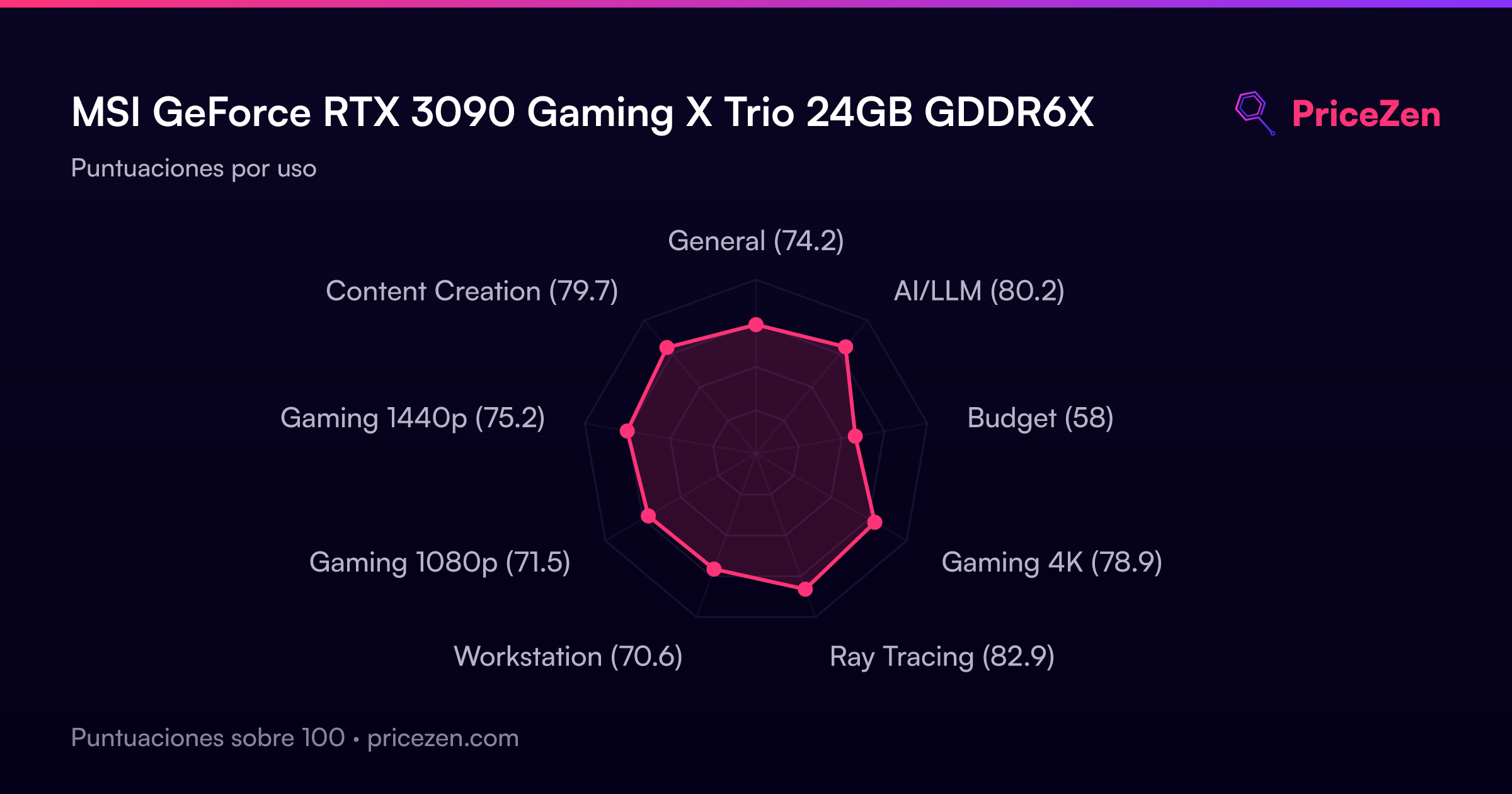
Usage Scores
- General74.2
- AI/LLM80.2
- Budget58
- Gaming 4K78.9
- Ray Tracing82.9
- Workstation70.6
- Gaming 1080p71.5
- Gaming 1440p75.2
- Content Creation79.7