NVIDIA GeForce RTX 3060 Ti 30 Series 8GB GDDR6
The Ampere-based RTX 3060 Ti delivers strong 1080p and capable 1440p gaming via 4864 CUDA cores and 8GB of 256-bit GDDR6 memory. Its compact dual-fan, 2-slot design at 242mm fits easily into smaller builds while still supporting ray tracing and DLSS. This card is best for 1080p gamers wanting high refresh rates in a power-efficient 200W package.












Resumen
The 30-Second Version
The NVIDIA GeForce RTX 3060 Ti Founders Edition remains a solid 1080p gaming card with strong ray tracing and DLSS support. Its 8GB VRAM is the main limitation, and pricing varies widely since it's no longer in production. Buy it if you find a good deal and game at 1080p, skip it if you're aiming for 1440p or 4K.
Pros & Cons
Ventajas
- Excellent 1080p gaming performance for the price 84th
- DLSS support extends the card's lifespan significantly 66th
- Compact 242mm dual-slot design fits most cases
- Ray tracing works well at 1080p with DLSS enabled
- Strong social proof with a 4.6/5 rating from 265 reviews
Desventajas
- 8GB VRAM is starting to feel tight for 1440p and newer titles
- Requires a 600W PSU and 8-pin connector, no cables included
- AI and compute performance is underwhelming
- Thermals are just average for a dual-fan card
- No longer in production, so pricing varies wildly by region
Opinión de los propietarios
The Word on the Street
Cómo cambió la opinión de los propietarios con el tiempo
ExclusivaSegún cuándo escribieron realmente sus opiniones los clientes, para ver si los elogios iniciales se mantuvieron.
12 opiniones escritas, mar 2022 – dic 2025: 11 satisfechos, 1 insatisfecho
En las 261 valoraciones de tiendas: 4,6★. La mayoría de los propietarios valora sin escribir una opinión. El gráfico cuenta las 12 opiniones escritas.
Cada punto es una opinión escrita, en el mes en que se escribió. Satisfechos = 4-5★, neutrales = 3★, insatisfechos = 1-2★.
Las pruebas
Performance
The PassMark G3D score of 20,241 puts this card in the middle of the pack compared to everything we track, which sounds worse than it is. For its generation, the 3060 Ti punches way above its weight class. The 4864 CUDA cores and 608 GB/s of memory bandwidth mean 1080p gaming is smooth, and even 1440p is doable if you're willing to dial back a few settings. FP32 compute lands at 16.2 TFLOPS, which is respectable for an Ampere card at this price point.
Ray tracing performance is where things get interesting. The 38 RT cores handle ray tracing at 1080p reasonably well, and DLSS is the secret weapon here. Turn on DLSS Quality mode in supported titles and you'll claw back a lot of the performance ray tracing eats up. Our ray tracing score of 56.5 out of 100 reflects that this is a first-gen RT card, not a 40 or 50 series monster. It works, but you'll need DLSS to keep frame rates playable in demanding RT titles. The weakest area is AI workloads at 30.3 out of 100, which makes sense given the 8GB VRAM ceiling. Don't buy this for local LLM inference.
Specifications
Full Specifications
Chipset
| GPU Chipset | GeForce RTX 3060 Ti |
| Brand | NVIDIA |
| Architecture | Ampere |
| Class | consumer |
| Process | 8 |
Memory
| VRAM | 8 GB |
| Memory Type | GDDR6 |
| Memory Bus | 256 |
| Bandwidth | 608.3 |
Compute
| CUDA Cores | 4864 |
| Tensor Cores | 152 |
| RT Cores | 38 |
| Base Clock | 1410 |
| Boost Clock | 1670 |
| FP16 TFLOPS | 16.2 |
| FP32 TFLOPS | 16.2 |
Performance
| PassMark G3D | 20241 |
| GPU Compute | 9920 |
Power & Cooling
| TDP | 200 |
| Recommended PSU | 600 |
| Power Connectors | 8-Pin |
| Cooler | Dual Fan |
| Fans | 2 |
Connectivity
| Interface | PCI Express 4.0 |
| DisplayPort | 3 |
| HDMI | 1 |
| Max Displays | 4 |
| Max Resolution | 7680 x 4320 |
Physical
| Length | 242 |
| Slot Width | 2 |
| Form Factor | Full Height |
Features
| Ray Tracing | Yes |
| Upscaling | DLSS |
| VR Ready | Yes |
| DirectX | 12 Ultimate |
vs Competition
Stacked against the newer RTX 5070 Ti and RTX 5080 cards from ASUS, MSI, Gigabyte, and ZOTAC, the 3060 Ti obviously can't compete on raw performance. Those cards are in a completely different league, with 16GB of VRAM and much higher compute throughput. But they also cost significantly more. The MSI Ventus RTX 5070 Ti and ASUS PRIME RTX 5080 are aimed at 1440p and 4K gaming, while the 3060 Ti is happiest at 1080p.
The real comparison is against other used midrange cards. Against an RTX 3060, the Ti variant is roughly 30% faster in raster workloads, which is a meaningful jump. Against AMD's RX 6700 XT, the 3060 Ti trades blows depending on the title, with the AMD card having more VRAM but weaker ray tracing. If you're deciding between a used 3060 Ti and a new budget card like an RTX 4060, the 3060 Ti often wins on raw performance but loses on features like DLSS 3 frame generation.
| Spec | NVIDIA GeForce RTX 3060 Ti 30 Series | Gigabyte GeForce RTX 5070 Ti Eagle Ice | MSI GeForce RTX 5070 Ti Ventus 3X OC | ASUS GeForce RTX 5070 Ti ROG Strix OC | ZOTAC GeForce RTX 5080 APOCALYPSE | PNY GeForce RTX 5070 Ti OC |
|---|---|---|---|---|---|---|
| Chipset | GeForce RTX 3060 Ti | GeForce RTX 5070 Ti | GeForce RTX 5070 Ti | GeForce RTX 5070 Ti | GeForce RTX 5080 | GeForce RTX 5070 Ti |
| Vram | 8GB GDDR6 | 16GB GDDR7 | 16GB GDDR7 | 16GB GDDR7 | 16GB GDDR7 | 16GB GDDR7 |
| Boost Clock Mhz | 1670 | 2542 | 2482 | 2625 | 2730 | 2450 |
| Tdp W | 200 | 300 | 300 | 300 | 360 | 300 |
| Memory Bus Bits | 256 | 256 | 256 | 256 | 256 | 256 |
| Ray Tracing | Yes | Yes | Yes | Yes | Yes | Yes |
| GPU Class | consumer | consumer | consumer | consumer | consumer | consumer |
| Compare | Compare | Compare | Compare | Compare |
| Producto | AI | Rt | Vram | Raster | Compute | Feature | Thermal | User Sentiment | Efficiency | Connectivity | Valoración social | Affordability |
|---|---|---|---|---|---|---|---|---|---|---|---|---|
| NVIDIA GeForce RTX 3060 Ti 30 Series | 42.8 | 62.3 | 40.5 | 47.3 | 41.9 | 65.7 | 41.8 | 50.9 | 62.8 | 54.9 | 83.9 | 55 |
| Gigabyte GeForce RTX 5070 Ti Eagle Ice Compare | 78.9 | 88.6 | 85.9 | 88.9 | 87.9 | 95.7 | 91.8 | 85.1 | 71.8 | 94.2 | 93.4 | 22.9 |
| MSI GeForce RTX 5070 Ti Ventus 3X OC Compare | 78.9 | 92.3 | 85.9 | 88.9 | 87.9 | 95.7 | 91.8 | 85.1 | 71.8 | 94.2 | 83.9 | 22.2 |
| ASUS GeForce RTX 5070 Ti ROG Strix OC Compare | 78.9 | 92.3 | 85.9 | 88.9 | 87.9 | 95.7 | 91.8 | 57.7 | 71.8 | 99.3 | 93.4 | 15.6 |
| ZOTAC GeForce RTX 5080 APOCALYPSE Compare | 85.5 | 97.6 | 89.1 | 94.5 | 93.3 | 95.7 | 91.8 | 99.5 | 56.7 | 94.2 | 98.7 | 22.9 |
| PNY GeForce RTX 5070 Ti OC Compare | 78.9 | 92.3 | 85.9 | 88.9 | 87.9 | 65.7 | 91.8 | 57.7 | 71.8 | 81.4 | 93.4 | 26.1 |
Precio
Value & Pricing
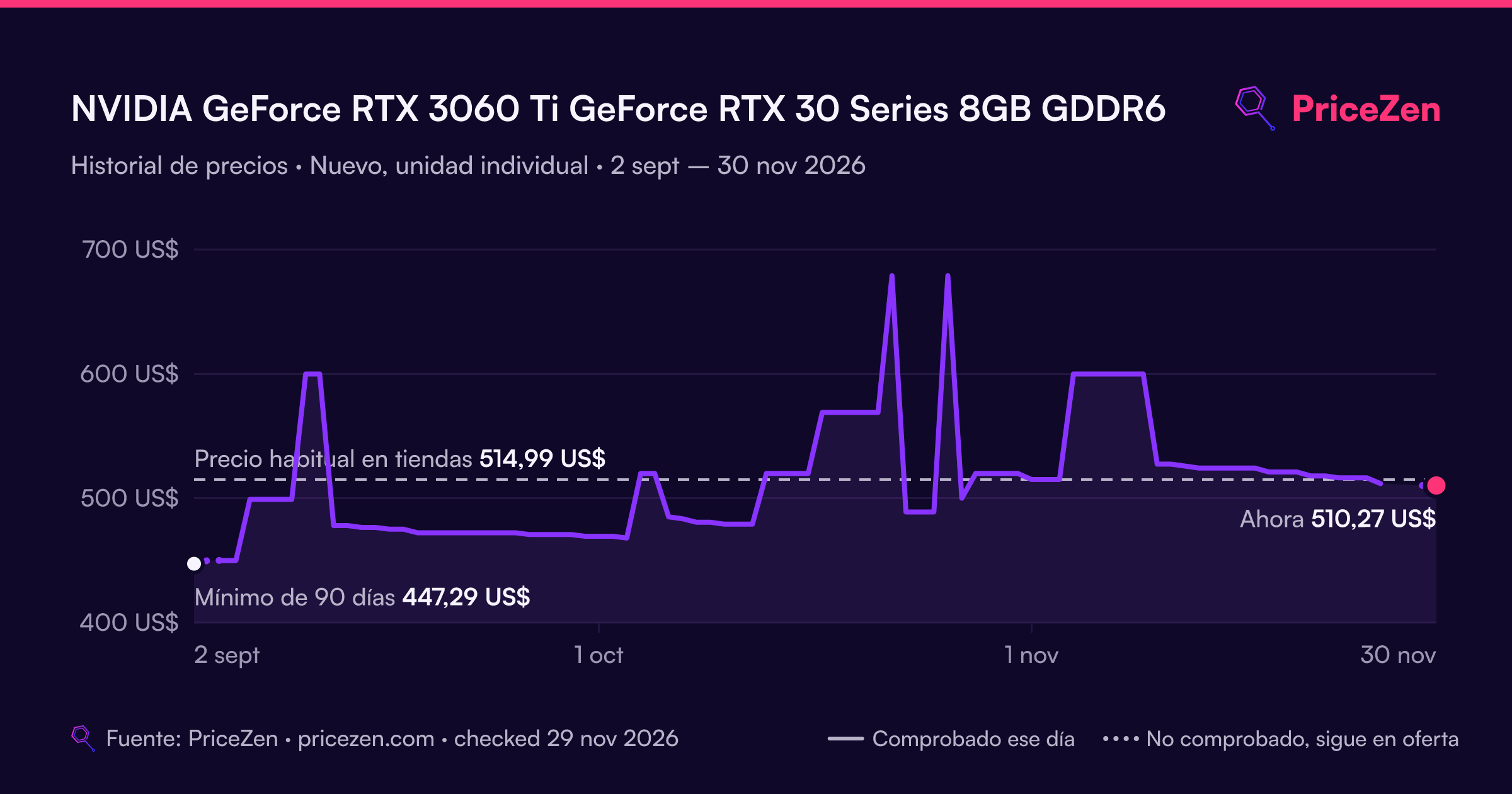
At $599 to $600 USD, the RTX 3060 Ti Founders Edition is in a weird spot. It's no longer being manufactured, so you're buying remaining stock or used cards. For that money, you could look at newer options, but the 3060 Ti still holds its own in raster performance. The value proposition really depends on what you can find it for. If you spot one around $300 to $400 used, it's a steal. At full retail, you're paying a premium for a card that's two generations old. The efficiency score of 64th percentile means it's not terrible on power draw, but it's not a efficiency champion either.
Amazon 1 oferta Desde 512 US$
Historial de precios
Leer más
Overview
The RTX 3060 Ti Founders Edition sits in that sweet spot where 1080p gaming gets seriously good without completely wrecking your wallet. It's an Ampere card built on Samsung's 8nm process, packing 4864 CUDA cores, 8GB of GDDR6 on a 256-bit bus, and a 1670MHz boost clock. We're looking at roughly $599 to $600 USD on the used and remaining retail market, though European and Canadian listings run much higher in their local currencies. This is the card people search for when they want ray tracing and DLSS without jumping to a 40 or 50 series price tag.
Is the RTX 3060 Ti good for 1080p gaming? Yeah, it's still one of the better options out there. Our database puts its 1080p gaming score at 61.1 out of 100, which sounds modest until you remember this thing launched as a midrange champion. It handles esports titles at high refresh rates and most AAA games at high settings without breaking a sweat. The 8GB of VRAM is the main limiting factor these days, especially if you're eyeing 1440p or heavy texture packs.
One thing that stands out from the spec sheet: this Founders Edition is compact. At 242mm long and 2 slots thick, it fits in standard ATX cases without the clearance headaches that plague modern triple-fan behemoths. Buyers consistently mention that in reviews, and it's a real advantage if you're building in a smaller case.
Common Questions
Q: Is the RTX 3060 Ti good for 1080p gaming?
Yes, the RTX 3060 Ti is excellent for 1080p gaming. It handles most AAA titles at high settings with smooth frame rates, and DLSS helps push performance even further in supported games.
Q: What power supply do I need for the RTX 3060 Ti?
NVIDIA recommends a 600W power supply for the RTX 3060 Ti Founders Edition. The card has a 200W TDP and requires a single 8-pin power connector.
Q: Does the RTX 3060 Ti support ray tracing?
Yes, the RTX 3060 Ti supports ray tracing with its 38 dedicated RT cores. Performance is best at 1080p with DLSS enabled to offset the ray tracing performance hit.
Q: Is the RTX 3060 Ti still worth buying in 2025?
It depends on the price and your resolution. For 1080p gaming at a good used price, it's still a strong performer. For 1440p or future-proofing, the 8GB VRAM makes newer cards a better investment.
Who Should Skip This
Skip the RTX 3060 Ti if you're planning to game at 1440p or 4K, since the 8GB VRAM will hold you back in newer titles. AI enthusiasts and anyone doing local LLM work should look elsewhere, as the 30.3 out of 100 AI score makes this a poor choice for that workload. If you're building a new system from scratch and want something that'll last several years without upgrades, consider saving for an RTX 4070 or 5070 Ti instead. And if you don't have a 600W PSU already, factor that upgrade cost into your decision.
Verdict
Should you buy the RTX 3060 Ti Founders Edition in 2025? If you're building a 1080p gaming rig and can find one at a reasonable price, absolutely. It's still a capable card that handles modern games well, especially with DLSS in your back pocket. The 4.6 out of 5 rating from 265 reviews tells you owners are generally happy with their purchase.
But be realistic about what you're getting. The 8GB VRAM is the elephant in the room, and it's only going to become more of a constraint as games get more demanding. If you're planning to game at 1440p or want to future-proof for the next few years, save up for something with more memory. For 1080p esports and AAA gaming at high settings, this card still delivers.
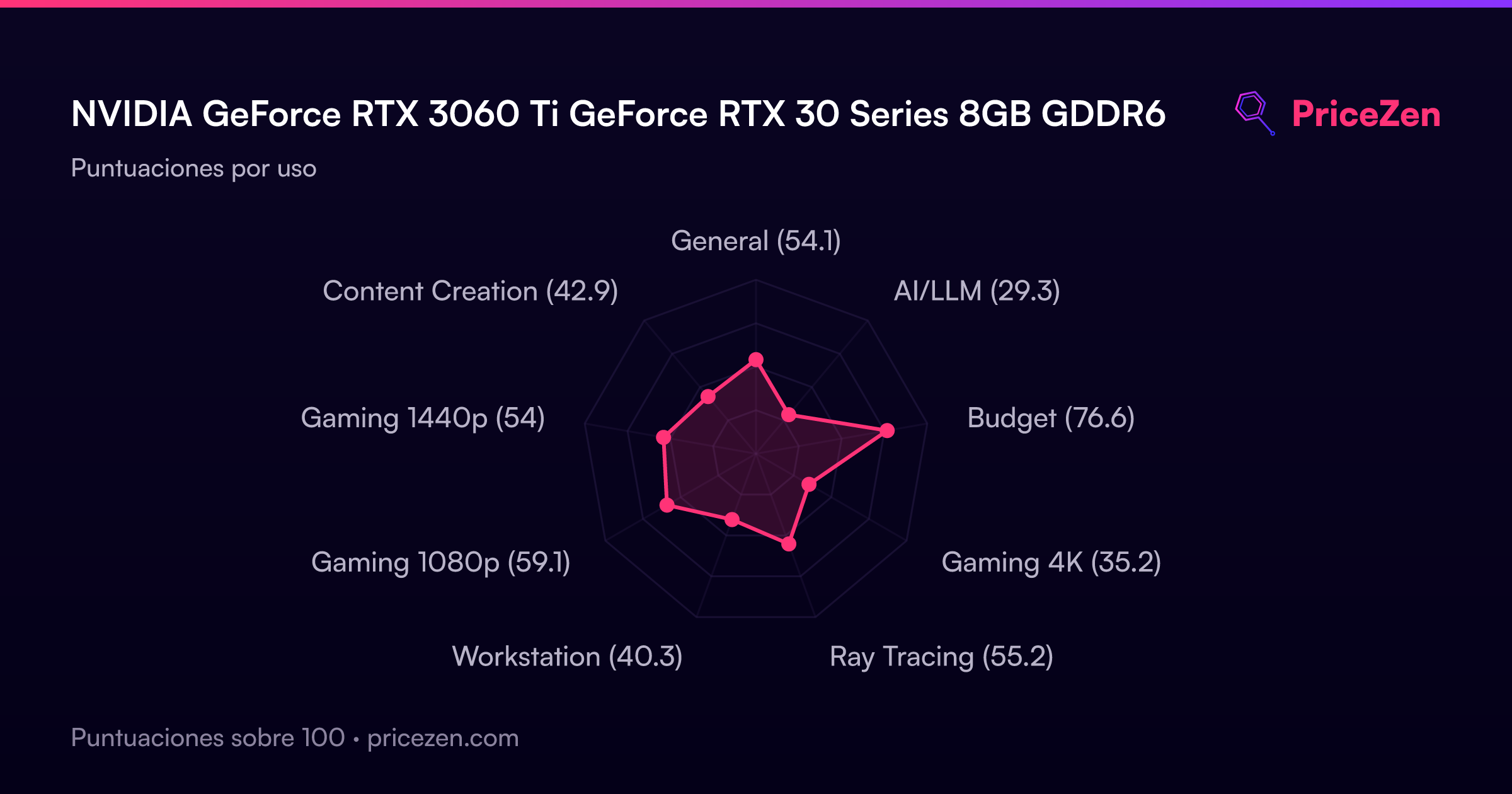
Usage Scores
- General54.1
- AI/LLM29.3
- Budget76.6
- Gaming 4K35.2
- Ray Tracing55.2
- Workstation40.3
- Gaming 1080p59.1
- Gaming 1440p54
- Content Creation42.9