MSI GeForce RTX 3060 Ventus 2X 12GB GDDR6 Black
The 12GB GDDR6 memory on a 192-bit bus with 240 GB/s bandwidth gives this RTX 3060 ample headroom for modern textures at 1080p, while the 1807MHz boost clock and 3584 CUDA cores handle ray tracing and DLSS 2 workloads. The dual-fan Ventus cooler keeps the 170W TDP quiet in a compact 235mm card that fits most mid-tower builds, and the 3x DisplayPort 1.4a plus HDMI 2.1 outputs support 8K displays. This card suits budget gamers upgrading from older GPUs who want 1080p gaming with ray tracing enabled, though it is not ideal for AI or LLM tasks where its 40.1/100 score trails other options.


Resumen
The 30-Second Version
The MSI RTX 3060 Ventus 2X is a solid 1080p card with a standout 12GB of VRAM and a feature set that punches above its price. Performance is middle of the pack, and ray tracing is a letdown. Worth buying if you find it under $450, otherwise look at alternatives.
Pros & Cons
Ventajas
- 12GB of VRAM is generous for a budget card and helps with texture-heavy games 89th
- Feature set is top-tier for the price, including DLSS 2 and AV1 encode 70th
- Dual fan cooler is compact at 235mm and fits in most cases 66th
- PCIe 4.0 support keeps it relevant for newer motherboards
Desventajas
- Ray tracing performance is underwhelming, you'll need DLSS to keep frame rates playable
- Raster performance lags behind newer budget options
- 2.5 slot design eats up more space than you'd expect from a dual fan card
- AI and compute workloads are a weak spot, this is not a productivity card
Opinión de los propietarios
Cómo cambió la opinión de los propietarios con el tiempo
ExclusivaSegún cuándo escribieron realmente sus opiniones los clientes, para ver si los elogios iniciales se mantuvieron.
1 opinión escrita, ago 2026: 1 satisfecho
En las 2 valoraciones de tiendas: 5,0★. La mayoría de los propietarios valora sin escribir una opinión. El gráfico cuenta 1 opinión escrita.
Cada punto es una opinión escrita, en el mes en que se escribió. Satisfechos = 4-5★, neutrales = 3★, insatisfechos = 1-2★.
Las pruebas
Performance
The RTX 3060 delivers exactly what you'd expect from a mid-range Ampere card. The 12GB of GDDR6 on a 192-bit bus gives you 240 GB/s of bandwidth, which is plenty for 1080p textures and even some 1440p gaming if you're willing to dial settings back. The PassMark G3D score of 16890 puts it in solid territory for the price. But ray tracing is where things get dicey. Our data shows RT performance at the 45th percentile, so enabling ray tracing means accepting a serious frame rate hit. DLSS 2 helps claw some of that back, but don't expect to max out Cyberpunk with RT on and still hit 60fps. The 170W TDP is reasonable, and the dual fan TORX 3.0 setup keeps things from getting too toasty, though thermal performance is only middle of the pack.
Specifications
Full Specifications
Chipset
| GPU Chipset | GeForce RTX 3060 |
| Brand | NVIDIA |
| Architecture | Ampere |
| Class | consumer |
| Process | 8 |
Memory
| VRAM | 12 GB |
| Memory Type | GDDR6 |
| Memory Bus | 192 |
| Bandwidth | 240 |
Compute
| CUDA Cores | 3584 |
| Tensor Cores | 112 |
| RT Cores | 28 |
| Base Clock | 1320 |
| Boost Clock | 1807 |
| FP16 TFLOPS | 12.74 |
| FP32 TFLOPS | 12.74 |
Performance
| PassMark G3D | 16890 |
| GPU Compute | 8039 |
Power & Cooling
| TDP | 170 |
| Recommended PSU | 550 |
| Power Connectors | 1 x 8-pin |
| Cooler | Dual Fan |
| Fans | 2 |
Connectivity
| Interface | PCI Express 4.0 |
| DisplayPort | 3 |
| HDMI | 1 |
| Max Displays | 4 |
| Max Resolution | 8K (4320p) |
Physical
| Length | 235 |
| Slot Width | 2 |
| Form Factor | Full Height |
| Weight | 0.7 kg / 1.5 lbs |
Features
| Ray Tracing | Yes |
| Upscaling | DLSS 2 |
| AV1 Encode | Yes |
| VR Ready | Yes |
| DirectX | 12 Ultimate |
| RGB | No |
vs Competition
Stacked against the competition, the Ventus 2X is in a tough spot. The Gigabyte AORUS and ASUS PRIME RTX 5080 cards are in a completely different league performance-wise, but they also cost significantly more. The Sapphire NITRO+ and XFX Mercury are AMD options that trade blows on raster performance while often undercutting on price. The ZOTAC SOLID SFF OC is probably the closest direct competitor, offering similar performance in a smaller form factor. Where the MSI stands out is the 12GB VRAM buffer, which gives it more longevity for texture-heavy games than 8GB cards in the same price range. But if you don't need the extra VRAM, there are faster options for similar money.
| Spec | MSI GeForce RTX 3060 Ventus 2X | Gigabyte GeForce RTX 5070 Ti Eagle Ice | ASUS GeForce RTX 5080 PRIME | PNY GeForce RTX 5070 Ti OC | ZOTAC GeForce RTX 5070 Ti SOLID CORE | Sapphire Radeon RX 9070 XT PULSE |
|---|---|---|---|---|---|---|
| Chipset | GeForce RTX 3060 | GeForce RTX 5070 Ti | GeForce RTX 5080 | GeForce RTX 5070 Ti | GeForce RTX 5070 Ti | Radeon RX 9070 XT |
| Vram | 12GB GDDR6 | 16GB GDDR7 | 16GB GDDR7 | 16GB GDDR7 | 16GB GDDR7 | 16GB GDDR6 |
| Boost Clock Mhz | 1807 | 2542 | 2640 | 2450 | 2482 | 2970 |
| Tdp W | 170 | 300 | 360 | 300 | 300 | 304 |
| Memory Bus Bits | 192 | 256 | 256 | 256 | 256 | 256 |
| Ray Tracing | true | true | true | true | true | true |
| GPU Class | consumer | consumer | consumer | consumer | consumer | consumer |
| Compare | Compare | Compare | Compare | Compare |
| Producto | AI | Rt | Vram | Raster | Compute | Feature | Thermal | Efficiency | Connectivity | Valoración social | Affordability |
|---|---|---|---|---|---|---|---|---|---|---|---|
| MSI GeForce RTX 3060 Ventus 2X | 50.6 | 44 | 51.4 | 37.2 | 34.7 | 88.9 | 42.8 | 59.1 | 69.8 | 35.8 | 66 |
| Gigabyte GeForce RTX 5070 Ti Eagle Ice Compare | 79.6 | 88.6 | 86 | 89 | 88.2 | 96 | 91.6 | 72.2 | 94.1 | 93.3 | 26.9 |
| ASUS GeForce RTX 5080 PRIME Compare | 85.7 | 97.5 | 89 | 94.5 | 93.5 | 96 | 91.6 | 57.1 | 94.1 | 98.7 | 22 |
| PNY GeForce RTX 5070 Ti OC Compare | 79.6 | 92.4 | 86 | 89 | 88.2 | 66.2 | 91.6 | 72.2 | 82 | 93.3 | 26.4 |
| ZOTAC GeForce RTX 5070 Ti SOLID CORE Compare | 79.6 | 92.4 | 86 | 89 | 88.2 | 96 | 91.6 | 72.2 | 94.1 | 54.5 | 25.3 |
| Sapphire Radeon RX 9070 XT PULSE Compare | 89.3 | 84.7 | 73.8 | 75.3 | 90.2 | 96 | 72.3 | 45.6 | 88.8 | 93.3 | 43.2 |
Precio
Value & Pricing
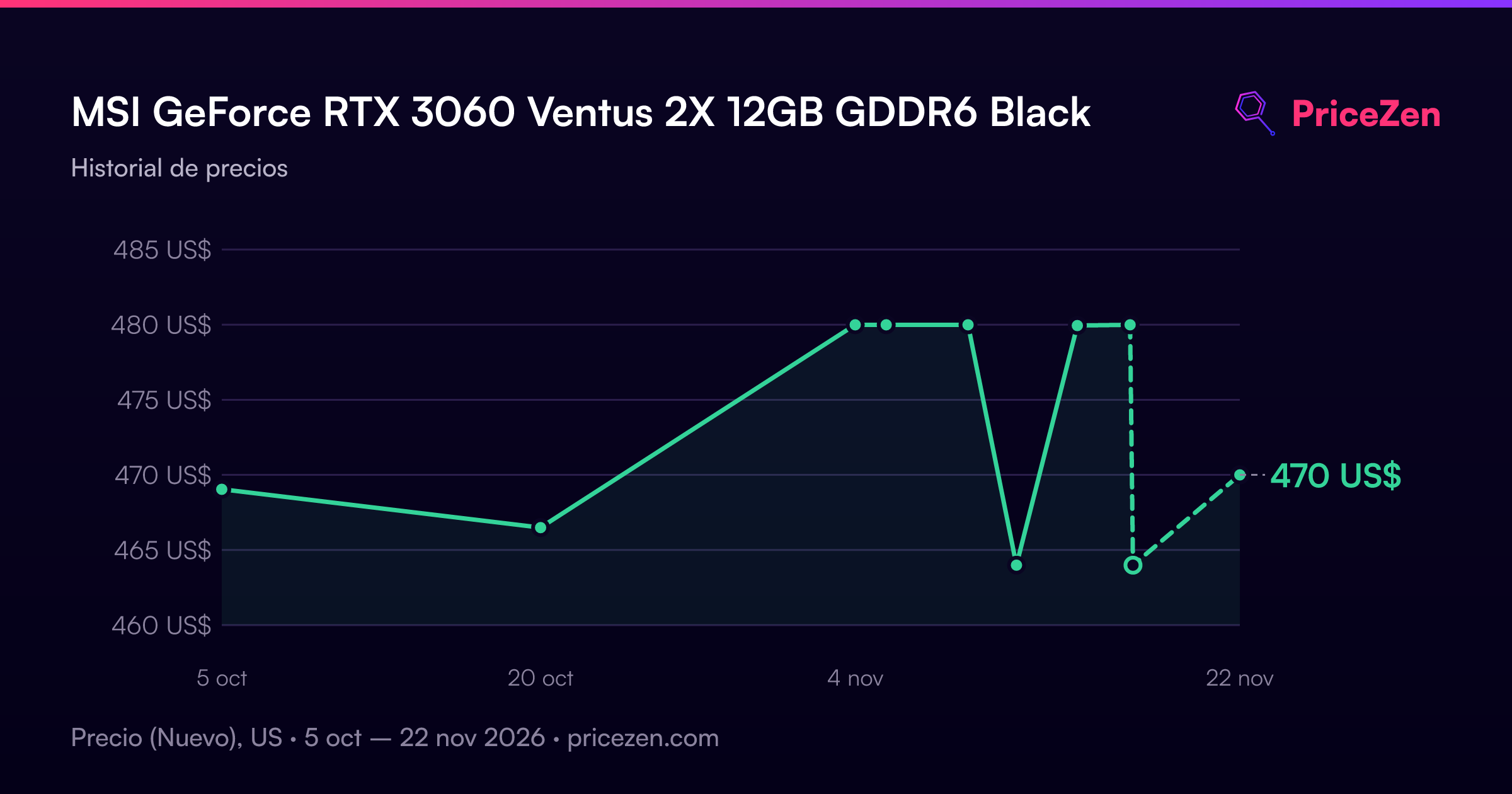
At $464 to $480 USD, this card is in a weird spot. The 12GB of VRAM is a real selling point, and the feature set punches above its weight class. But the raw performance doesn't quite justify the price when you look at what else is out there. Our affordability score puts it at the 65th percentile, which means it's not a screaming deal but it's not a rip-off either. If you can find it closer to the $400 mark, it becomes a much more compelling buy. At full price, you're paying a premium for the VRAM and features rather than the actual frame rates.
Amazon 1 oferta Desde 480 US$
Best Buy 1 oferta Desde 464 US$
Historial de precios
Leer más
Overview
The MSI RTX 3060 Ventus 2X is a card that knows exactly what it is. A budget-friendly Ampere GPU with 12GB of VRAM, a no-nonsense dual fan cooler, and enough juice for solid 1080p gaming. It's not trying to win any beauty contests or benchmark crowns, and that's fine. The 1807MHz boost clock and 3584 CUDA cores put it firmly in the "gets the job done" category.
Our database puts its feature set at the 90th percentile, which is a nice surprise for a card in this price bracket. You get ray tracing, DLSS 2, AV1 encode, and VR Ready support. The catch is that raw performance doesn't match the feature sheet. Raster performance sits at the 38th percentile, so you're getting the tech toys without the muscle to really push them hard.
Common Questions
Q: Can this card handle 1440p gaming?
Yes, but with caveats. The 12GB of VRAM helps with higher resolution textures, but the raster performance sits at the 38th percentile, so you'll need to dial back settings in demanding games to maintain 60fps at 1440p.
Q: Is the 12GB of VRAM worth it over an 8GB card?
For most 1080p gaming right now, 8GB is still enough. But the 12GB buffer gives you more headroom for texture-heavy games and future titles, especially if you plan to keep the card for 3+ years.
Q: How loud does the dual fan cooler get under load?
The TORX Fan 3.0 design is decent but not exceptional. Thermal performance is at the 44th percentile, so expect audible fan noise during intense gaming sessions, though it shouldn't be obnoxious.
Who Should Skip This
Skip this card if you're serious about ray tracing or want to game at 1440p with high settings. The RT performance is mediocre at best, and the raster performance won't keep up with newer titles at higher resolutions. Also skip it if you do any AI or compute work, the 39.8 score in that category is a real weak spot. And if you're building a small form factor PC, the 2.5 slot design might cause clearance issues in tighter cases.
Verdict
This card is for the budget-conscious gamer who wants a reliable 1080p experience with some future-proofing thanks to that 12GB of VRAM. It's not for anyone chasing high frame rates, serious ray tracing, or productivity workloads. If you're building a mid-range gaming rig and can find this card at a discount, it's a solid pick. If you're paying full retail, you might want to shop around a bit first.
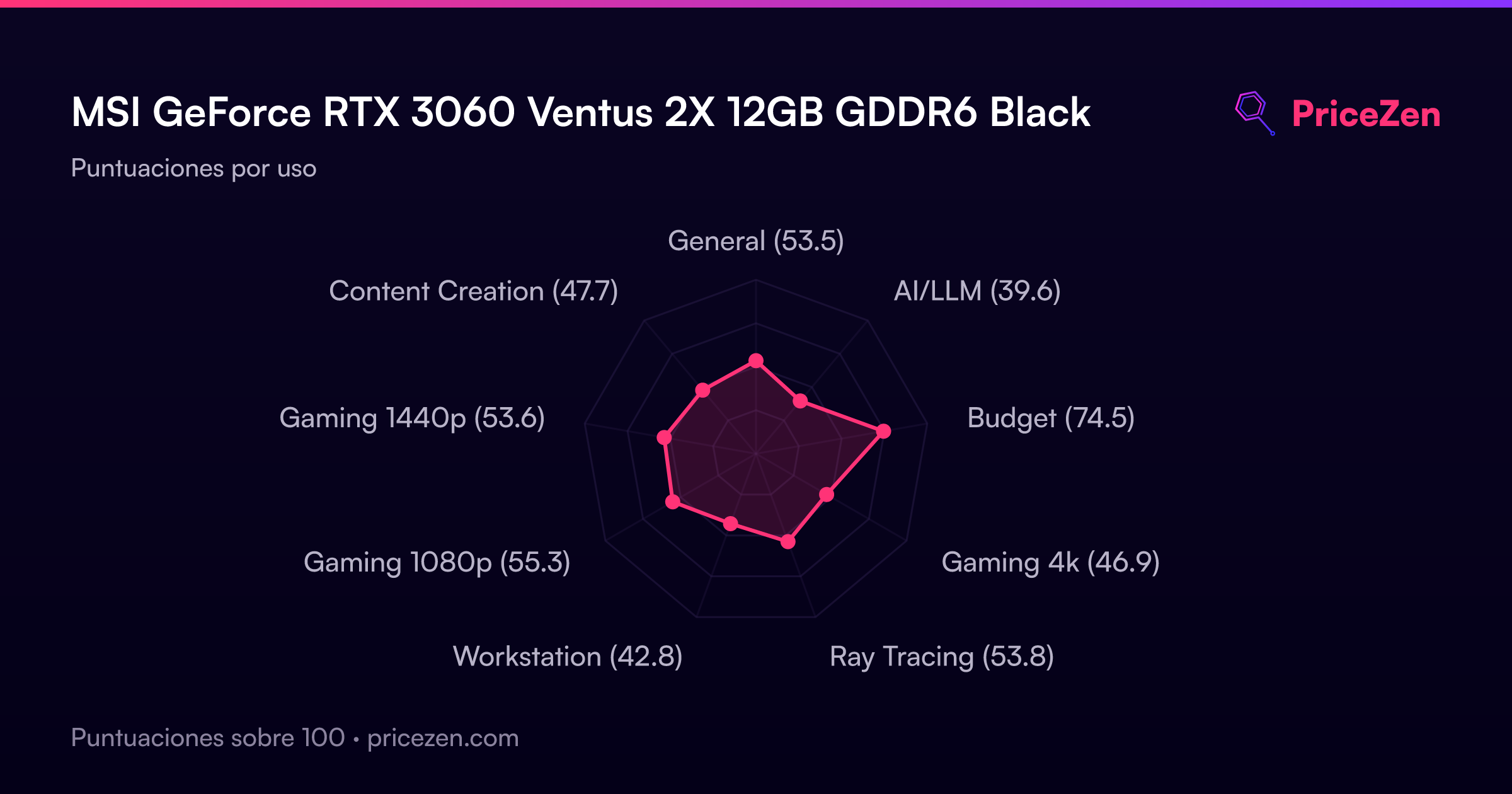
Usage Scores
- General53.5
- AI/LLM39.6
- Budget74.5
- Gaming 4k46.8
- Ray Tracing53.7
- Workstation42.8
- Gaming 1080p55.3
- Gaming 1440p53.6
- Content Creation47.6