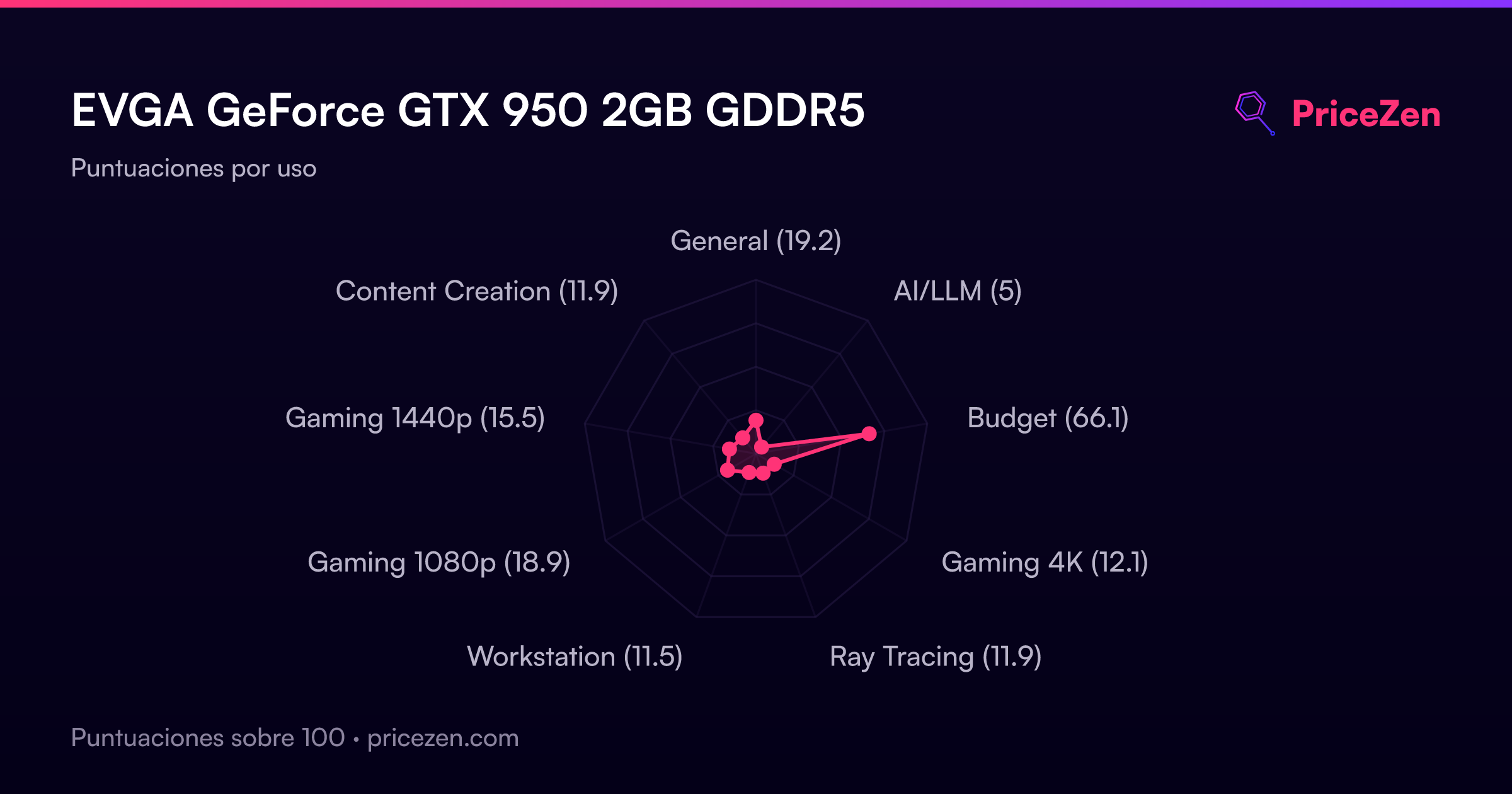
EVGA GeForce GTX 950 2GB GDDR5
A 1393MHz boost clock on the Maxwell architecture and 90W TDP make this a power-efficient card for basic systems without demanding a high-wattage PSU. Its factory overclock and EVGA’s silent cooling design deliver reliable 1080p performance in a compact, dual-slot form factor. This GPU is best for budget-conscious builders assembling an entry-level PC for esports titles like CS:GO or League of Legends.

Sin precio actual de tiendas
Dónde lo vimos antes. Consulta el precio de hoy en la tienda.











Resumen
The 30-Second Version
The EVGA GTX 950 SSC is a quiet, well-built budget card that still handles older 1080p games surprisingly well. Its 2GB VRAM is the biggest limitation, making it a poor choice for modern titles. At around $98 used, it's a solid drop-in upgrade for older systems with 350W power supplies. If you're building new, stretch your budget for something with more memory.
Pros & Cons
Ventajas
- Excellent price-to-performance at around $98 used 93rd
- Very quiet operation thanks to the ACX 2.0 dual-fan cooler 65th
- Low 90W TDP means it works in almost any system with a 350W PSU
- Solid build quality with EVGA's reputation behind it
- Includes HDMI 2.0 and three DisplayPort 1.2 outputs
Desventajas
- 2GB VRAM is a serious limitation for modern games
- Requires an 8-pin power connector despite the low TDP
- No driver disk included, you'll need to download drivers
- Some units have reportedly failed prematurely
- Raster performance sits in the bottom 16% of all GPUs
Opinión de los propietarios
The Word on the Street
Cómo cambió la opinión de los propietarios con el tiempo
ExclusivaSegún cuándo escribieron realmente sus opiniones los clientes, para ver si los elogios iniciales se mantuvieron.
34 opiniones escritas, sept 2015 – mar 2026: 32 satisfechos, 1 insatisfecho, 1 sin estrellas
En las 832 valoraciones de tiendas: 4,3★. La mayoría de los propietarios valora sin escribir una opinión. El gráfico cuenta las 34 opiniones escritas.
Cada punto es una opinión escrita, en el mes en que se escribió. Satisfechos = 4-5★, neutrales = 3★, insatisfechos = 1-2★.
Las pruebas
Performance
Let's talk numbers. The PassMark G3D score of 5353 puts this card in the 16th percentile for raster performance across all GPUs in our database. That sounds rough, and against modern cards it is. But context matters. This card was designed for 1080p gaming in 2015, and for that specific job it still holds up better than you'd expect. Esports titles like CS2, Valorant, and League of Legends will run fine at 1080p with settings dialed in. Older AAA games from the 2013-2017 era are where this card feels most at home.
The 2GB VRAM buffer is the real bottleneck. At 8th percentile for VRAM capacity, this card sits near the bottom of our entire database. Modern games want 6GB minimum, often 8GB or more. That means texture quality takes a hit, and some newer titles simply won't run well no matter what you do with the settings. The 1.825 TFLOPS of FP32 compute is similarly modest, landing in the bottom 10% of cards we track. For AI workloads or any kind of compute task, this card is a non-starter. But for its intended purpose, light 1080p gaming, the numbers tell a more forgiving story.
Specifications
Full Specifications
Chipset
| GPU Chipset | GeForce GTX 950 |
| Brand | NVIDIA |
| Architecture | Maxwell |
| Class | consumer |
Memory
| VRAM | 2 GB |
| Memory Type | GDDR5 |
| Memory Bus | 128 |
Compute
| CUDA Cores | 768 |
| Stream Processors | 768 |
| Base Clock | 1190 |
| Boost Clock | 1393 |
| FP32 TFLOPS | 1.825 |
Performance
| PassMark G3D | 5353 |
| GPU Compute | 2264 |
Power & Cooling
| TDP | 90 |
| Recommended PSU | 350 |
| Power Connectors | 8-Pin |
| Cooler | Dual Fan |
| Fans | 2 |
Connectivity
| Interface | PCI Express 3.0 x16 |
| DisplayPort | 3 |
| HDMI | 1 |
| Max Displays | 4 |
| Max Resolution | 4096 x 2160 |
Physical
| Length | 257 |
| Slot Width | 2 |
| Form Factor | Full Height |
| Weight | 0.5 kg / 1.1 lbs |
Features
| Ray Tracing | No |
| DirectX | 12 |
vs Competition
The GTX 950 sits in an awkward spot compared to its competitors. The ASUS Dual RTX 4060 and ASRock Challenger B570 are in a completely different universe, modern cards with 8GB and 10GB of VRAM respectively that cost several times more. They're not really competitors in the traditional sense, but they highlight just how far behind this card is on features and memory capacity. The MSI GTX 1080 Ti is an interesting comparison point, offering roughly triple the performance with 11GB of VRAM, though it also costs significantly more and draws nearly three times the power.
Closer to home, the XFX RX 6700 XL and Sapphire Pulse cards both offer dramatically better performance per dollar if you can stretch your budget. The RX 6700 XL in particular has 12GB of VRAM and modern feature support that makes the GTX 950 look ancient. But here's the thing: none of those cards will run on a 350W power supply, and none of them cost $98. The GTX 950's niche is being the card you can actually afford and actually power. In that narrow lane, it's still competitive. Step outside that lane and it falls apart quickly.
| Spec | EVGA GeForce GTX 950 | ASRock Arc B570 Challenger | XFX RX-67XLKWFDV | ASUS GeForce RTX 3070 Dual | MSI GeForce RTX 3050 Gaming X | HP RTX A4000 |
|---|---|---|---|---|---|---|
| Chipset | GeForce GTX 950 | Arc B570 | Radeon RX 6700 | GeForce RTX 3070 | GeForce RTX 3050 | RTX A4000 |
| Vram | 2GB GDDR5 | 10GB GDDR6 | 10GB GDDR6 | 8GB GDDR6 | 6GB GDDR6 | 16GB GDDR6 |
| Boost Clock Mhz | 1393 | 2600 | 2425 | 1725 | 1507 | - |
| Tdp W | 90 | 150 | 175 | 220 | 70 | 140 |
| Memory Bus Bits | 128 | 192 | 160 | 256 | 96 | - |
| Ray Tracing | No | Yes | Yes | Yes | Yes | Yes |
| GPU Class | consumer | consumer | consumer | consumer | consumer | workstation |
| Compare | Compare | Compare | Compare | Compare |
| Producto | AI | Rt | Vram | Raster | Compute | Feature | Thermal | User Sentiment | Efficiency | Connectivity | Valoración social | Affordability |
|---|---|---|---|---|---|---|---|---|---|---|---|---|
| EVGA GeForce GTX 950 | 8.7 | 15.4 | 9 | 15.4 | 9.1 | 10.7 | 54.7 | 45 | 19.5 | 43.7 | 65 | 93 |
| ASRock Arc B570 Challenger Compare | 45.5 | 32.4 | 44.5 | 30 | 9.9 | 83 | 54.7 | 45 | 52.9 | 87.3 | 83.8 | 78.3 |
| XFX RX-67XLKWFDV Compare | 44.1 | 40.3 | 43.6 | 41 | 27.6 | 65.8 | 72.1 | 0 | 73.2 | 55.1 | 83.8 | 80.4 |
| ASUS GeForce RTX 3070 Dual Compare | 36.5 | 61.1 | 37.9 | 55.8 | 44.4 | 65.8 | 42.1 | 0 | 61.1 | 55.1 | 0 | 78.9 |
| MSI GeForce RTX 3050 Gaming X Compare | 18.2 | 28.8 | 21.7 | 21.5 | 19.8 | 71.6 | 42.1 | 57.7 | 90.9 | 50 | 93.3 | 81.4 |
| HP RTX A4000 Compare | 66.2 | 34.4 | 62.5 | 41.2 | 35.3 | 32.9 | 16.2 | 0 | 92.1 | 35.4 | 0 | 20.3 |
Precio
Value & Pricing
At $98 on the used market, this card is a weird value proposition. On one hand, you're getting a card that was built well, runs cool and quiet, and can still handle a surprising amount of older games. On the other hand, that same $98 can sometimes get you into a used GTX 1050 Ti or even an RX 570 if you're patient, both of which offer meaningfully better performance and more VRAM. The GTX 950's 93rd percentile affordability ranking reflects its low absolute price, but value is about more than just being cheap.
The real question is what you're pairing it with. If you have an older office PC with a 350W power supply and no GPU, this card is a drop-in upgrade that transforms it into a capable 1080p gaming machine for older titles. In that specific scenario, the value is genuinely good. But if you're building something from scratch, even on a tight budget, you should probably stretch for something with more VRAM. The 2GB buffer is going to age this card out of relevance faster than its raw performance would suggest.
Historial de precios
Leer más
Overview
The EVGA GeForce GTX 950 SSC is a card from a different era, and that's exactly why it still shows up in budget builds. This is a Maxwell-based GPU with 768 CUDA cores, a 1393MHz boost clock, and 2GB of GDDR5 on a 128-bit bus. It's not going to impress anyone with its spec sheet in 2025, but it was never meant to. This was the card you bought when you wanted real 1080p gaming without selling a kidney.
Who is this for right now? Mostly people resurrecting older systems, building a cheap emulation box, or just trying to get a display output with some actual gaming chops on a tight budget. At around $98 used, it sits in that weird space where it's cheaper than most new cards but still capable enough to run older titles and esports games without falling over. The 90W TDP means it'll slot into almost any prebuilt with a spare PCIe slot and a 350W power supply.
What makes it interesting is the cooling setup. EVGA slapped their ACX 2.0 dual-fan cooler on this thing, which is honestly overkill for a 90W card. That means it runs quiet, and in many cases the fans don't even spin at idle. For a card this old, that's a genuinely nice quality-of-life feature that budget buyers don't usually get.
Common Questions
Q: Is this card still worth buying in 2025?
It depends entirely on your use case. For older games, esports titles, and emulation at 1080p, it's still a capable card at around $98. But the 2GB VRAM buffer means modern AAA games will struggle or refuse to run. If you're building a new system, you're better off saving for something with at least 4GB of VRAM.
Q: What power supply do I need for this card?
EVGA recommends a 350W power supply minimum. The card itself draws 90W at most, but it does require an 8-pin PCIe power connector, so make sure your PSU has one available. Most prebuilt office PCs with 350W units should handle it fine.
Q: Does this card come with a driver disk?
No, there's no driver disk in the box. You'll need to download drivers directly from EVGA's website or use NVIDIA's GeForce Experience software. This is pretty standard for modern GPUs, but it catches some buyers off guard.
Q: Can this card run modern games at 1080p?
It can run some modern games at 1080p, but you'll need to lower settings significantly and some titles simply won't work well due to the 2GB VRAM limit. Games from 2017 and earlier are where this card feels most comfortable. For anything newer, expect compromises or look for a card with more memory.
Who Should Skip This
Skip this card if you're building a new system or want to play anything released in the last few years. The 2GB VRAM buffer is a hard ceiling that modern games slam into immediately. You'll be stuck at low settings with texture pop-in, and some titles will refuse to run at all. If you're in this boat, look for a used GTX 1050 Ti, RX 570, or GTX 1060 instead. They cost a bit more but offer meaningfully better performance and more memory headroom.
Also skip it if you're interested in any kind of content creation, AI experimentation, or compute workloads. The 1.825 TFLOPS of FP32 compute and 8th percentile AI ranking make this card useless for those tasks. Even a modern integrated GPU will outperform it in some compute scenarios. This is a gaming card from 2015, and it should be treated as such.
Verdict
If you're resurrecting an old Dell or HP office machine and want to play games from the 2013-2017 era at 1080p, the EVGA GTX 950 SSC is a genuinely good choice. The low power draw, quiet cooler, and solid build quality make it a painless upgrade. You'll be limited to older titles and esports games, but within that scope it delivers a smooth experience that owners consistently praise. The 4.3-star average across 836 reviews backs that up.
But if you're building a new system, even a budget one, look elsewhere. The 2GB VRAM ceiling is a hard wall you'll hit constantly with modern games. A used GTX 1050 Ti, RX 570, or even a GTX 1060 3GB would serve you better for not much more money. The GTX 950 is a card for a specific rescue mission, not a foundation for a new build. Know which one you're doing before you buy.
Usage Scores
- General19.2
- AI/LLM5
- Budget66.1
- Gaming 4K12.1
- Ray Tracing11.9
- Workstation11.5
- Gaming 1080p18.9
- Gaming 1440p15.5
- Content Creation11.9