NVIDIA GeForce RTX 3070 Founders Edition 8GB GDDR6
The Ampere architecture with 5120 CUDA cores and 8GB of GDDR6 memory delivers a 15.97 TFLOPS FP32 compute throughput, making it a strong performer for 1440p gaming. The Founders Edition design offers a premium dual-fan cooler and a 1695MHz boost clock in a clean, compact build that fits easily into most systems. This card is best for gamers upgrading from a 10-series or 20-series GPU who want high-refresh 1440p performance without stepping up to a 3080-class power draw.


Resumen
The 30-Second Version
The RTX 3070 is still a solid 1080p and 1440p gaming card in 2025, but its 8GB VRAM is starting to show its age. PassMark G3D of 22,099 puts it mid-pack against newer GPUs, and ray tracing performance is just average. At $630, it's hard to recommend over newer options, but a used one at $300 to $350 is still a decent deal for budget builders.
Pros & Cons
Ventajas
- Still delivers solid 1080p and 1440p gaming performance 75th
- DLSS support extends the card's useful life significantly
- 220W TDP is manageable for most power supplies
- PCI Express 4.0 support with backward compatibility
- Strong customer satisfaction with a 4.5/5 rating across 172 reviews
Desventajas
- 8GB VRAM is a real limitation in newer AAA titles
- Ray tracing performance is only average by current standards
- Thermal performance ranks near the bottom of our database
- Only 1 DisplayPort and 1 HDMI output limits multi-monitor setups
- Connectivity options are sparse compared to newer cards
Opinión de los propietarios
The Word on the Street
Cómo cambió la opinión de los propietarios con el tiempo
ExclusivaSegún cuándo escribieron realmente sus opiniones los clientes, para ver si los elogios iniciales se mantuvieron.
12 opiniones escritas, ago 2021 – dic 2025: 11 satisfechos, 1 insatisfecho
En las 172 valoraciones de tiendas: 4,5★. La mayoría de los propietarios valora sin escribir una opinión. El gráfico cuenta las 12 opiniones escritas.
Cada punto es una opinión escrita, en el mes en que se escribió. Satisfechos = 4-5★, neutrales = 3★, insatisfechos = 1-2★.
Las pruebas
Performance
The raw numbers tell an interesting story. PassMark G3D comes in at 22,099, which puts this card in the middle of the pack compared to everything in our database right now. That's not a knock, it's just reality. The RTX 3070 was a beast in 2020, but cards like the RTX 5070 Ti and RTX 5080 have moved the goalposts significantly. FP32 compute sits at 15.97 TFLOPS, which is solid but again, mid-tier by today's standards.
For real-world gaming, the 8GB of VRAM is the biggest constraint. At 1080p, you'll rarely hit that limit, and the card delivers strong frame rates in most titles. At 1440p, you'll need to start making compromises in newer games, especially ones with high-resolution texture packs. The 448 GB/s memory bandwidth helps, but it can't fully compensate for the capacity ceiling. Ray tracing performance lands right around average for current GPUs, which means you'll want DLSS enabled for anything with heavy RT effects.
Specifications
Full Specifications
Chipset
| GPU Chipset | GeForce RTX 3070 |
| Brand | NVIDIA |
| Architecture | Ampere |
| Class | consumer |
| Process | 8 |
Memory
| VRAM | 8 GB |
| Memory Type | GDDR6 |
| Memory Bus | 256 |
| Bandwidth | 448 |
Compute
| CUDA Cores | 5888 |
| Tensor Cores | 160 |
| RT Cores | 40 |
| Base Clock | 1500 |
| Boost Clock | 1695 |
| FP16 TFLOPS | 15.97 |
| FP32 TFLOPS | 15.97 |
Performance
| PassMark G3D | 22099 |
| GPU Compute | 11026 |
Power & Cooling
| TDP | 220 |
| Power Connectors | 8-Pin PCI-E |
| Cooler | Fan |
| Fans | 1 |
Connectivity
| Interface | PCI Express 4.0 x16 |
| DisplayPort | 1 |
| HDMI | 1 |
Physical
| Weight | 1.0 kg / 2.2 lbs |
Features
| Ray Tracing | Yes |
| VR Ready | Yes |
| DirectX | 12 |
vs Competition
Against the newer RTX 5070 Ti and RTX 5080 cards in our database, the 3070 shows its age. The 5070 Ti offers 16GB of VRAM and significantly better ray tracing performance, which matters more and more as games ship with RT enabled by default. The 5080 is in a completely different performance class, though it also costs considerably more. If you're building a new system in 2025, those cards are the better long-term investment.
The more interesting comparison is against other used cards from the same era. The RX 6800 from AMD offers 16GB of VRAM and similar raster performance, often at a lower used price. The RTX 3080 gives you more raw performance for a modest price bump on the used market. The 3070's main advantage is its DLSS support, which AMD's older cards can't match, and its lower power draw compared to the 3080.
| Spec | NVIDIA GeForce RTX 3070 Founders Edition | Gigabyte GeForce RTX 5070 Ti Eagle Ice | ASUS GeForce RTX 5080 PRIME EVO OC | MSI GeForce RTX 5070 Ti Ventus 3X OC | ZOTAC GeForce RTX 5080 APOCALYPSE | PNY GeForce RTX 5070 Ti OC |
|---|---|---|---|---|---|---|
| Chipset | GeForce RTX 3070 | GeForce RTX 5070 Ti | GeForce RTX 5080 | GeForce RTX 5070 Ti | GeForce RTX 5080 | GeForce RTX 5070 Ti |
| Vram | 8GB GDDR6 | 16GB GDDR7 | 16GB GDDR7 | 16GB GDDR7 | 16GB GDDR7 | 16GB GDDR7 |
| Boost Clock Mhz | 1695 | 2542 | 2685 | 2482 | 2730 | 2450 |
| Tdp W | 220 | 300 | 360 | 300 | 360 | 300 |
| Memory Bus Bits | 256 | 256 | 256 | 256 | 256 | 256 |
| Ray Tracing | true | true | true | true | true | true |
| GPU Class | consumer | consumer | consumer | consumer | consumer | consumer |
| Compare | Compare | Compare | Compare | Compare |
| Producto | AI | Rt | Vram | Raster | Compute | Feature | Thermal | Efficiency | Connectivity | Valoración social | Affordability |
|---|---|---|---|---|---|---|---|---|---|---|---|
| NVIDIA GeForce RTX 3070 Founders Edition | 37.2 | 48.5 | 38.4 | 56.3 | 45.3 | 44.5 | 25.6 | 61.3 | 20.8 | 74.8 | 55.9 |
| Gigabyte GeForce RTX 5070 Ti Eagle Ice Compare | 79.5 | 88.7 | 86 | 89 | 88.1 | 95.9 | 91.7 | 72.1 | 94.1 | 93.3 | 26.6 |
| ASUS GeForce RTX 5080 PRIME EVO OC Compare | 85.6 | 97.6 | 89.1 | 94.5 | 93.5 | 88.8 | 91.7 | 57.1 | 94.1 | 93.3 | 17.7 |
| MSI GeForce RTX 5070 Ti Ventus 3X OC Compare | 79.5 | 92.5 | 86 | 89 | 88.1 | 95.9 | 91.7 | 72.1 | 94.1 | 83.8 | 23.1 |
| ZOTAC GeForce RTX 5080 APOCALYPSE Compare | 85.6 | 97.6 | 89.1 | 94.5 | 93.5 | 95.9 | 91.7 | 57.1 | 94.1 | 98.7 | 20.3 |
| PNY GeForce RTX 5070 Ti OC Compare | 79.5 | 92.5 | 86 | 89 | 88.1 | 66 | 91.7 | 72.1 | 81.9 | 93.3 | 26.3 |
Precio
Value & Pricing
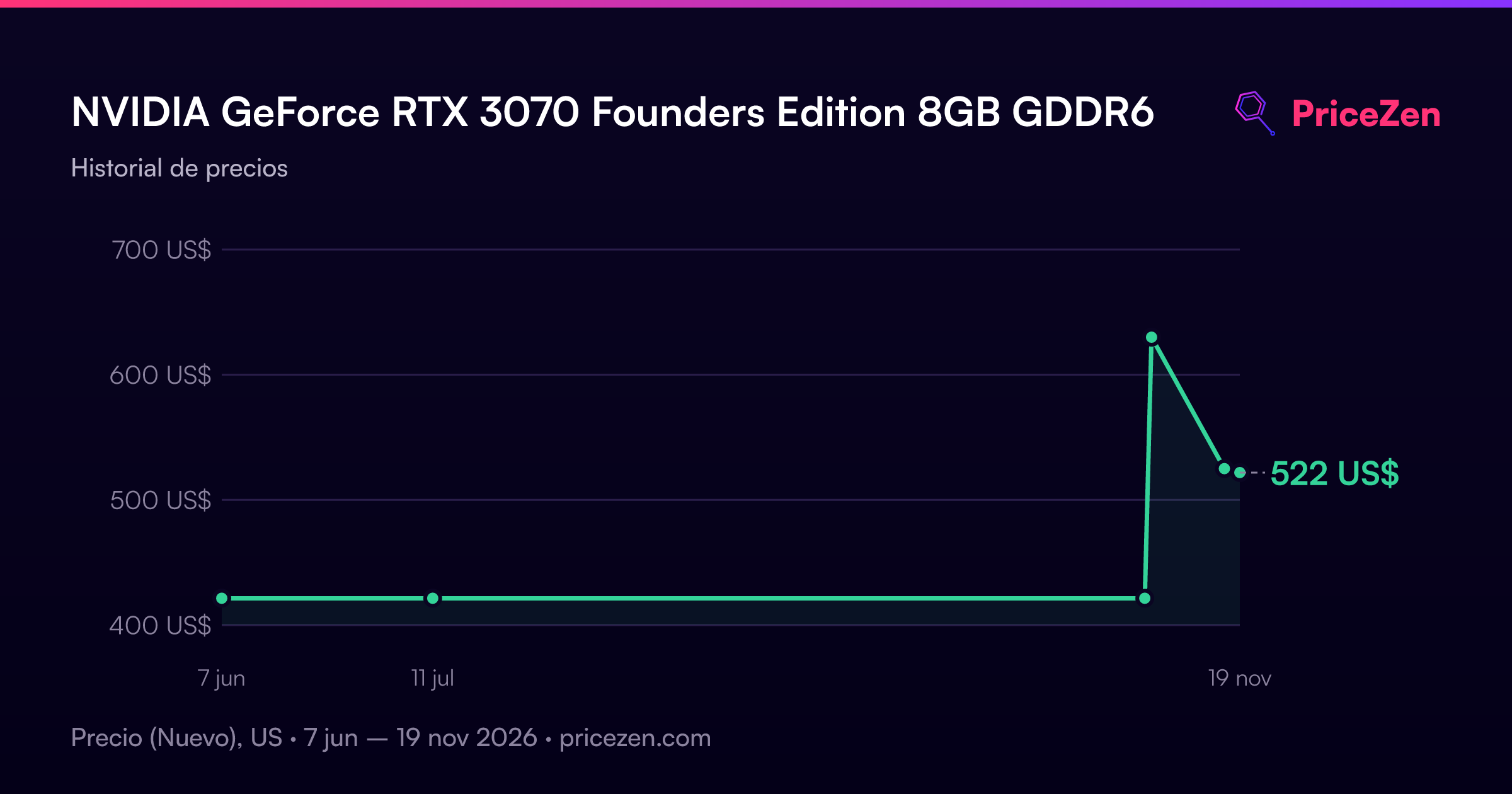
Pricing is tricky here because the card is no longer in production. The USD listing we track sits at $630, which is honestly hard to justify when newer cards offer more performance and double the VRAM for not much more. The INR listing at 85,000 is a different market entirely, and pricing there reflects local availability and import costs.
If you can find a used RTX 3070 for significantly less than $630, the value proposition changes completely. At $300 to $350, this card makes a lot of sense for a budget build. At $630, you're paying a premium for scarcity rather than performance. The affordability percentile ranking of 56th confirms this, it's not a cheap card by any stretch, but it's also not the most expensive option out there.
Amazon 1 oferta Desde 522 US$
Historial de precios
Leer más
Overview
The RTX 3070 sits in a weird spot in 2025. It was the value king when it launched back in 2020, and a lot of people still run one today. But the GPU market has moved fast, and this card now competes against newer options that offer more VRAM and better ray tracing for similar money. That said, for someone building a used system or upgrading from something much older, it still has plenty of life left.
This particular model is a reference-style design with a 1695MHz boost clock, 8GB of GDDR6 on a 256-bit bus, and 5120 CUDA cores. It pulls 220W, which is reasonable for the performance it delivers. The feature set includes ray tracing and DLSS support, though the 8GB frame buffer is starting to feel tight in newer AAA titles at higher resolutions.
Who is this for? Honestly, it's best suited to 1080p and 1440p gamers who don't need ultra settings in every new release. If you're on a 1080p monitor and want high refresh rates in esports titles or smooth 60fps in most single-player games, this card still gets the job done. Just don't expect it to crush 4K or handle heavy ray tracing without leaning on DLSS.
Common Questions
Q: Is 8GB of VRAM enough for gaming in 2025?
For 1080p gaming, 8GB is still mostly fine, though a few newer titles with ultra texture packs will push against the limit. At 1440p, you'll need to dial back texture settings in some recent AAA games. If you plan to keep the card for several years, the 8GB capacity is the biggest risk factor for future-proofing.
Q: Can the RTX 3070 handle ray tracing?
Yes, but with caveats. The 40 RT cores deliver average ray tracing performance by current standards, which means heavy RT effects will tank frame rates without DLSS enabled. With DLSS on, most ray-traced games are playable at 1080p and 1440p, but you won't be maxing out settings in demanding titles like Cyberpunk 2077.
Q: What power supply do I need for this card?
The RTX 3070 has a 220W TDP, so NVIDIA recommends a 650W power supply as a minimum. A quality 650W unit will handle the card fine in most systems, though if you're running a power-hungry CPU or lots of peripherals, a 750W unit gives you more headroom.
Q: Is the RTX 3070 good for 4K gaming?
Not really. The 8GB VRAM and mid-range compute performance make 4K gaming a stretch for this card. You can play older or less demanding titles at 4K with reduced settings, but newer AAA games will struggle. This card is best suited to 1080p and 1440p gaming.
Who Should Skip This
If you're building a new system in 2025 and have a budget that allows for a current-generation card, skip the RTX 3070. The 8GB VRAM will become a bottleneck sooner rather than later, and the thermal performance ranks near the bottom of our database, which means this reference design runs hot under load. You'd be better served by an RTX 5070 Ti or a current AMD card with more VRAM.
Also skip this if you're into 4K gaming or heavy ray tracing. The card just doesn't have the memory bandwidth or RT performance to deliver a good experience at that resolution. And if you need multiple monitor support, the single DisplayPort and single HDMI output will feel limiting. Look at cards with more robust connectivity options instead.
Verdict
If you already own an RTX 3070, keep it. It's still a capable card for 1080p and 1440p gaming, and DLSS will help it stay relevant for a while longer. The 8GB VRAM is the main thing that will push you toward an upgrade eventually, but for now, most games are still playable with reasonable settings.
If you're shopping for a card right now, the RTX 3070 only makes sense at a steep discount on the used market. At full retail pricing, you're better off saving a bit more for a 5070 Ti or looking at AMD's current offerings. The 3070 was a great card in its day, and it's still a decent performer, but it's no longer the value champion it once was.
Usage Scores
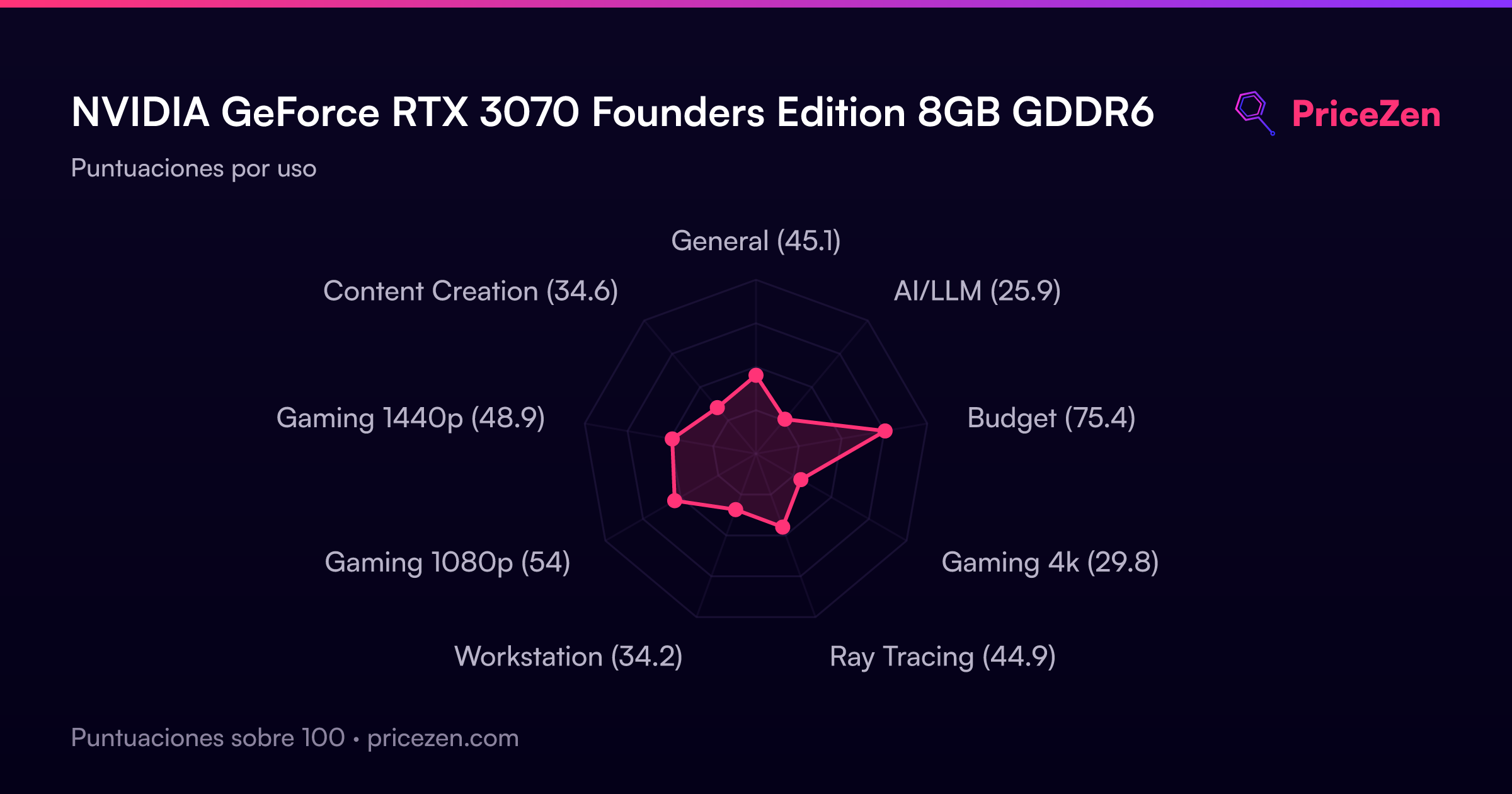
- General45.1
- AI/LLM25.9
- Budget75.4
- Gaming 4k29.8
- Ray Tracing44.9
- Workstation34.2
- Gaming 1080p54
- Gaming 1440p48.9
- Content Creation34.6