Yeston Radeon RX 9070 Sakura OC 16GB GDDR6

Reescalado FSR 4 para más fotogramas por segundo verificado el 28 nov
70/100 puntuación global
- GPU
- Radeon RX 9070
- VRAM
- 16GB GDDR6
- Boost clock
- 2700 MHz
- TDP
- 220 W
- Memory bus
- 256 bit
- Ray tracing
- Sí
- Class
- consumer
Compara precios en 2 tiendas
De la más barata a la más cara. Las ofertas nuevas, reacondicionadas y en pack se mantienen separadas para que compares lo comparable.
| Tienda | Vendido por | Color y estado | Precio | vs. el más bajo | Última comprobación | Enlace |
|---|---|---|---|---|---|---|
| Nuevo2 ofertasUnidad individual | ||||||
| No comprobados en los últimos 7 días, por lo que estos precios pueden haber cambiado | ||||||
| Newegg | Vendedor externo | No indicado | Precio sin confirmar | Desconocido | Ir a la tienda | |
| Agotado en la última comprobación | ||||||
| Amazon | Desconocido | No indicado | Sin precio | Agotado | Ayer | Ir a la tienda |
 Fuente: PriceZen, comprobado el 28 nov 2026
Un precio se considera vigente si lo comprobamos en los últimos 7 días. «Vendedor externo» significa un vendedor de terceros en esa tienda, no la propia tienda.
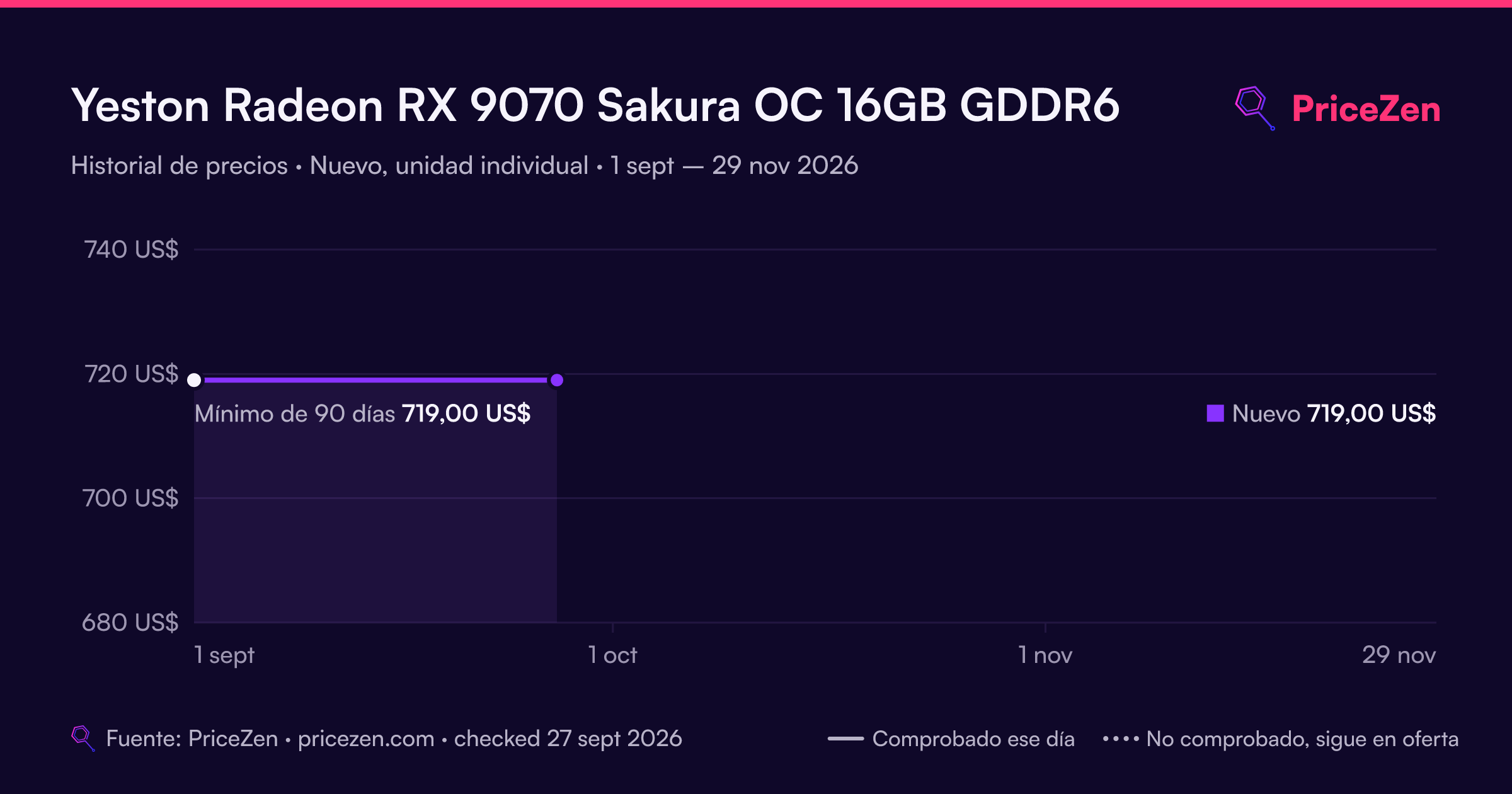
Historial de precios
Comprobado ese díaNo comprobado ese día, sigue en oferta
Fuente: PriceZen, checked 27 sept 2026






Resumen
The 30-Second Version
The Yeston Sakura RX 9070 scores 25,398 in PassMark, putting it in the top 31% of GPUs, with 16GB of GDDR6 and a 2,700MHz boost clock. It's a strong 1440p card with a unique Sakura design and dual BIOS, but ray tracing is only in the 72nd percentile and you're paying a premium for the looks. At $719 USD, it's a good card for people who want performance and personality.
Pros & Cons
Ventajas
- PassMark G3D score of 25,398 puts it in the top 31% of GPUs 83rd
- 16GB GDDR6 with 645 GB/s bandwidth handles 1440p textures easily 82nd
- Dual BIOS switch with 2,700MHz boost clock on VAR profile 81st
- 220W TDP is efficient for the performance level 81st
- PCIe 5.0 x16 and triple DisplayPort 2.1 outputs are future-proof
Desventajas
- Ray tracing performance only lands in the 72nd percentile
- Social proof is weak with just 4 customer reviews
- Affordability sits at the 40th percentile, you pay for the aesthetic
- 3.2 slot thickness and 332mm length won't fit smaller cases
- AI/LLM performance is the weakest area at 61.4/100
Las pruebas
Performance
The 25,398 PassMark score is the headline here. That's a strong result, well above average, and it translates to smooth 1440p gaming in most titles. The 16GB of GDDR6 running at 20Gbps gives you 645 GB/s of memory bandwidth, which is plenty for high-res textures and keeps the card from choking when games start eating VRAM. The 2,700MHz boost clock on the VAR BIOS is one of the higher factory clocks we've seen on an RX 9070, and the dual BIOS switch means you can drop back to the 2,520MHz STD profile if you want quieter fans or lower power draw.
Ray tracing is a bit of a mixed bag. The 56 RT cores put this card in the 72nd percentile for RT performance, which is decent but not going to scare an RTX 5070 Ti. FSR 4 helps close the gap in supported titles, and the AV1 encoder is a nice bonus for streamers. Compute-wise, 36.13 FP32 TFLOPS is a solid showing, landing in the 79th percentile. The 220W TDP is efficient for this class of card, and the 550W PSU recommendation is easy to meet. Just make sure your case has room for the 332mm length and 3.2 slot width, because this thing is chunky.
Specifications
Full Specifications
Chipset
| GPU Chipset | Radeon RX 9070 |
| Brand | AMD |
| Architecture | RDNA 4 |
| Class | consumer |
| Process | 4 |
Memory
| VRAM | 16 GB |
| Memory Type | GDDR6 |
| Memory Bus | 256 |
| Bandwidth | 644.6 |
Compute
| Stream Processors | 3584 |
| Tensor Cores | 112 |
| RT Cores | 56 |
| Base Clock | 2070 |
| Boost Clock | 2700 |
| FP16 TFLOPS | 72.25 |
| FP32 TFLOPS | 36.13 |
Performance
| PassMark G3D | 25398 |
| GPU Compute | 14794 |
Power & Cooling
| TDP | 220 |
| Recommended PSU | 550 |
| Power Connectors | 2 x 8-Pin |
| Cooler | Triple Fan |
| Fans | 3 |
Connectivity
| Interface | PCI Express 5.0 x16 |
| DisplayPort | 3 |
| HDMI | 1 |
| Max Resolution | 7680 x 4320 |
Physical
| Length | 332 |
| Slot Width | 3.2 |
Features
| Ray Tracing | Yes |
| Upscaling | FSR 4 |
| AV1 Encode | Yes |
| DirectX | 12 |
| RGB | Yes |
vs Competition
Against the MSI Ventus RTX 5070 Ti, the Sakura RX 9070 trades blows depending on the workload. The 5070 Ti generally pulls ahead in ray tracing, while the RX 9070's 16GB of VRAM and 645 GB/s bandwidth give it an edge in memory-heavy scenarios. The ASUS PRIME RTX 5080 and Gigabyte AORUS RTX 5080 are in a different price class entirely, and they'll beat the Sakura in raw performance, but you're paying hundreds more for that privilege. The Sapphire NITRO+ is probably the closest philosophical competitor, another premium RX 9070 variant, and it comes down to which cooler design and factory overclock you prefer. The ZOTAC APOCALYPSE RTX 5080 is also a step up in price and performance, but the Sakura holds its own in rasterization at 1440p.
| Spec | Yeston Radeon RX 9070 Sakura OC | Gigabyte GeForce RTX 5070 Ti Eagle Ice | MSI GeForce RTX 5070 Ti Ventus 3X OC | ASUS GeForce RTX 5070 Ti TUF Gaming OC | ZOTAC GeForce RTX 5080 APOCALYPSE | PNY GeForce RTX 5080 ARGB OC |
|---|---|---|---|---|---|---|
| Chipset | Radeon RX 9070 | GeForce RTX 5070 Ti | GeForce RTX 5070 Ti | GeForce RTX 5070 Ti | GeForce RTX 5080 | GeForce RTX 5080 |
| Vram | 16GB GDDR6 | 16GB GDDR7 | 16GB GDDR7 | 16GB GDDR7 | 16GB GDDR7 | 16GB GDDR7 |
| Boost Clock Mhz | 2700 | 2542 | 2482 | 2610 | 2730 | 2620 |
| Tdp W | 220 | 300 | 300 | 300 | 360 | 360 |
| Memory Bus Bits | 256 | 256 | 256 | 256 | 256 | 256 |
| Ray Tracing | Yes | Yes | Yes | Yes | Yes | Yes |
| GPU Class | consumer | consumer | consumer | consumer | consumer | consumer |
| Compare | Compare | Compare | Compare | Compare |
| Producto | AI | Rt | Vram | Raster | Compute | Feature | Thermal | Efficiency | Connectivity | Affordability |
|---|---|---|---|---|---|---|---|---|---|---|
| Yeston Radeon RX 9070 Sakura OC | 81.5 | 72.6 | 75.1 | 67.4 | 77.4 | 82.8 | 71.8 | 80.6 | 81.3 | 44 |
| Gigabyte GeForce RTX 5070 Ti Eagle Ice Compare | 78.9 | 88.6 | 85.9 | 88.9 | 87.8 | 95.7 | 91.8 | 71.6 | 94.2 | 23 |
| MSI GeForce RTX 5070 Ti Ventus 3X OC Compare | 78.9 | 92.4 | 85.9 | 88.9 | 87.8 | 95.7 | 91.8 | 71.6 | 94.2 | 21.1 |
| ASUS GeForce RTX 5070 Ti TUF Gaming OC Compare | 78.9 | 92.4 | 85.9 | 88.9 | 87.8 | 95.7 | 91.8 | 71.6 | 99.3 | 22.7 |
| ZOTAC GeForce RTX 5080 APOCALYPSE Compare | 85.5 | 97.7 | 89.1 | 94.5 | 93.3 | 95.7 | 91.8 | 56.5 | 94.2 | 23.6 |
| PNY GeForce RTX 5080 ARGB OC Compare | 85.5 | 97.7 | 89.1 | 94.5 | 93.3 | 95.7 | 91.8 | 56.5 | 94.2 | 15.9 |
Precio
Value & Pricing
At $719 USD, the Sakura RX 9070 is asking for a premium over baseline RX 9070 cards, and the affordability percentile of 40 confirms it. You're getting a well-built card with a unique design, dual BIOS, and solid performance, but the price per frame isn't the best in this segment. The 16GB of VRAM and PCIe 5.0 support add some longevity, and the 220W TDP means you won't need a massive PSU upgrade. If you value the Sakura aesthetic and the ARGB lighting, the premium might be worth it. If you're purely chasing frames per dollar, there are cheaper RX 9070 options that will give you nearly identical performance.
Leer más
Overview
The Yeston Sakura RX 9070 posts a PassMark G3D score of 25,398, which puts it in the top 31% of GPUs in our database for raw throughput. That's a serious number for a card that's also trying to win you over with pink shrouds and ARGB lighting. Under the hood you get the full Navi 48 die on TSMC's 4nm node, 16GB of GDDR6 on a 256-bit bus, and 3,584 stream processors. It's not just a pretty face, though the face is definitely pretty if you're into the Sakura aesthetic.
At $719 USD, this is a mid-to-upper tier RDNA 4 card that lands in a weird spot. It's not the cheapest RX 9070 you can find, and it's not trying to be. Yeston is charging a premium for the design and the dual BIOS switch, which lets you flip between a 2,520MHz standard clock and a 2,700MHz variable boost profile. The 220W TDP is reasonable for the performance on tap, and the triple fan cooler keeps things from getting silly. Just know that you're paying for looks as much as frames.
Common Questions
Q: Can this card handle 1440p gaming at high settings?
Yes. The 25,398 PassMark score and 16GB of GDDR6 with 645 GB/s bandwidth put it in a strong position for 1440p gaming. The gaming_1440p score of 70.8/100 confirms it's well suited for that resolution, and the 2,700MHz boost clock on the VAR BIOS helps push frame rates in demanding titles.
Q: Will this fit in my case?
Check your clearance carefully. The card is 332mm long and takes up 3.2 slots, so it needs a fairly spacious case. The triple fan cooler is substantial, and you'll need two 8-pin power connectors with at least a 550W PSU to run it safely.
Q: Is this card good for ray tracing?
It's decent but not class-leading. The 56 RT cores put it in the 72nd percentile for ray tracing performance, which means it can handle RT effects at 1080p and 1440p with FSR 4 enabled, but it won't match NVIDIA's RTX 5070 Ti or higher cards in heavy RT workloads.
Who Should Skip This
Skip this card if you're building a compact PC, because the 332mm length and 3.2 slot thickness will rule out most small form factor cases. Also skip it if you're primarily interested in AI workloads or heavy ray tracing, since the AI/LLM score of 61.4/100 is the weakest area and the 72nd percentile RT performance lags behind similarly priced NVIDIA options. And if you don't care about the Sakura aesthetic, you're paying a premium for a design you won't appreciate, the affordability percentile of 40 means there are cheaper RX 9070 cards with nearly identical performance.
Verdict
The Yeston Sakura RX 9070 is a solid performer wrapped in a very specific aesthetic. The 25,398 PassMark score and 16GB of VRAM make it a capable 1440p card, and the dual BIOS switch is a genuinely useful feature for tuning noise versus performance. The 72nd percentile ray tracing and weak AI performance are the main technical compromises, and the $719 USD price tag means you're paying a design tax. If you love the Sakura look and want a card that won't embarrass itself in modern games, this is a fine choice. If you're indifferent to aesthetics, there are better value options in the RX 9070 lineup.
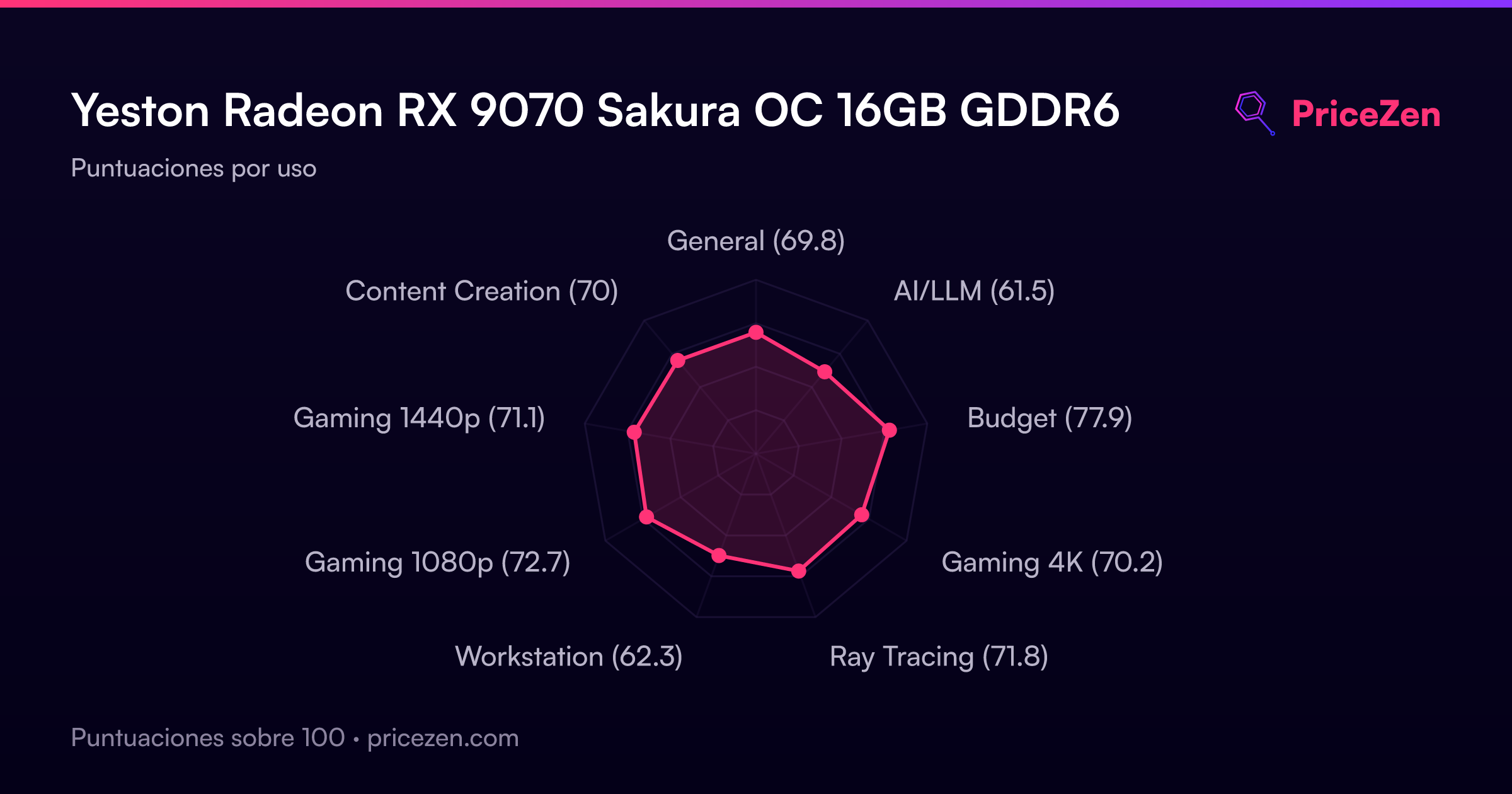
Usage Scores
- General69.8
- AI/LLM61.5
- Budget77.9
- Gaming 4K70.2
- Ray Tracing71.8
- Workstation62.3
- Gaming 1080p72.7
- Gaming 1440p71.1
- Content Creation70