ZOTAC GeForce RTX 5060 Ti Twin Edge 8GB GDDR7 Gray

DLSS 4 para más fotogramas por segundo verificado el 29 nov
59/100 puntuación global
- GPU
- GeForce RTX 5060 Ti
- VRAM
- 8GB GDDR7
- Boost clock
- 2572 MHz
- TDP
- 180 W
- Memory bus
- 128 bit
- Ray tracing
- Sí
- Class
- consumer
Compara precios en 2 tiendas
De la más barata a la más cara. Las ofertas nuevas, reacondicionadas y en pack se mantienen separadas para que compares lo comparable.
| Tienda | Vendido por | Color y estado | Precio | vs. el más bajo | Última comprobación | Enlace |
|---|---|---|---|---|---|---|
| Nuevo2 ofertasUnidad individual | ||||||
| No comprobados en los últimos 7 días, por lo que estos precios pueden haber cambiado | ||||||
| Newegg | Newegg | Gray | Precio sin confirmar | Desconocido | Ir a la tienda | |
| Agotado en la última comprobación | ||||||
| Amazon | Desconocido | No indicado | Sin precio | Agotado | Hace 5 días | Ir a la tienda |
 Fuente: PriceZen, comprobado el 24 nov 2026
Un precio se considera vigente si lo comprobamos en los últimos 7 días. «Vendedor externo» significa un vendedor de terceros en esa tienda, no la propia tienda.











Resumen
The 30-Second Version
Great little 1080p card with modern features, but that 8GB VRAM is a dealbreaker for anyone thinking about 1440p. Buy it for compact builds and 1080p, skip it if you want any headroom.
Pros & Cons
Ventajas
- Compact 221mm design fits in almost any case 96th
- DLSS 4 and Blackwell features at a lower price point 94th
- Top-tier connectivity with DP 2.1b and PCIe 5.0 82nd
- 180W TDP won't stress your power bill
Desventajas
- 8GB VRAM is already limiting at 1440p
- User sentiment is rough, bottom 19th percentile
- Ray tracing performance is just average
- 650W PSU requirement feels steep for a mid-range card
Opinión de los propietarios
Cómo cambió la opinión de los propietarios con el tiempo
ExclusivaSegún cuándo escribieron realmente sus opiniones los clientes, para ver si los elogios iniciales se mantuvieron.
Las pruebas
Performance
The 4608 CUDA cores and 2572MHz boost clock translate to a PassMark score of 20,798, which lands it right in the middle of the pack for raster performance. Nothing earth-shattering, but solid. What surprised us is the feature set at this tier. PCIe 5.0 x8, DisplayPort 2.1b, and AV1 encode are all here, and that connectivity suite ranks in the top 6% of all GPUs we track. The 448 GB/s memory bandwidth from GDDR7 is respectable, but 8GB is the bottleneck. At 1440p with ray tracing enabled, you'll hit that VRAM ceiling faster than you'd like. The 180W TDP is reasonable, and the dual-fan cooler keeps things in check, though thermals are just average.
Specifications
Full Specifications
Chipset
| GPU Chipset | GeForce RTX 5060 Ti |
| Brand | NVIDIA |
| Architecture | Blackwell |
| Class | consumer |
| Process | 5 |
Memory
| VRAM | 8 GB |
| Memory Type | GDDR7 |
| Memory Bus | 128 |
| Bandwidth | 448 |
Compute
| CUDA Cores | 4608 |
| Tensor Cores | 120 |
| RT Cores | 30 |
| Base Clock | 2572 |
| Boost Clock | 2572 |
| FP16 TFLOPS | 19.18 |
| FP32 TFLOPS | 19.18 |
Performance
| PassMark G3D | 20798 |
| GPU Compute | 10484 |
Power & Cooling
| TDP | 180 |
| Recommended PSU | 650 |
| Power Connectors | 8-Pin |
| Cooler | Dual Fan |
| Fans | 2 |
Connectivity
| Interface | PCI Express 5.0 x8 |
| DisplayPort | 3 |
| HDMI | 1 |
| Max Displays | 4 |
| Max Resolution | 8K 165Hz |
Physical
| Length | 221 |
| Slot Width | 2 |
| Form Factor | ATX |
| Weight | 1.2 kg / 2.6 lbs |
Features
| Ray Tracing | Yes |
| Upscaling | DLSS 4 |
| AV1 Encode | Yes |
| VR Ready | Yes |
| DirectX | 12 Ultimate |
| RGB | Yes |
vs Competition
Against the MSI Ventus RTX 5070 Ti, the ZOTAC gets absolutely smoked on raw performance and VRAM, but it should cost significantly less. The ASUS PRIME RTX 5080 and Gigabyte AORUS 5080 are in a completely different league, both in performance and price. The real competition here is the AMD side. The Sapphire NITRO+ and XFX Mercury are both strong alternatives if you don't care about DLSS 4 and want more VRAM for your money. For pure 1080p gaming with ray tracing, the 5060 Ti holds its own. For everything else, the 16GB cards from either camp are the smarter long-term play.
| Spec | ZOTAC GeForce RTX 5060 Ti Twin Edge | Gigabyte GeForce RTX 5070 Ti Eagle Ice | ASUS GeForce RTX 5080 PRIME EVO OC | MSI GeForce RTX 5070 Ti Ventus 3X OC | PNY GeForce RTX 5080 ARGB OC | Sapphire Radeon RX 7900 XTX NITRO+ |
|---|---|---|---|---|---|---|
| Chipset | GeForce RTX 5060 Ti | GeForce RTX 5070 Ti | GeForce RTX 5080 | GeForce RTX 5070 Ti | GeForce RTX 5080 | Radeon RX 7900 XTX |
| Vram | 8GB GDDR7 | 16GB GDDR7 | 16GB GDDR7 | 16GB GDDR7 | 16GB GDDR7 | 24GB GDDR6 |
| Boost Clock Mhz | 2572 | 2542 | 2685 | 2482 | 2620 | 2680 |
| Tdp W | 180 | 300 | 360 | 300 | 360 | 339 |
| Memory Bus Bits | 128 | 256 | 256 | 256 | 256 | 384 |
| Ray Tracing | Yes | Yes | Yes | Yes | Yes | Yes |
| GPU Class | consumer | consumer | consumer | consumer | consumer | consumer |
| Compare | Compare | Compare | Compare | Compare |
| Producto | AI | Rt | Vram | Raster | Compute | Feature | Thermal | User Sentiment | Efficiency | Connectivity | Affordability |
|---|---|---|---|---|---|---|---|---|---|---|---|
| ZOTAC GeForce RTX 5060 Ti Twin Edge | 39.1 | 59.6 | 46.1 | 51.1 | 49.6 | 95.7 | 54.2 | 18.5 | 81.5 | 94.2 | 7 |
| Gigabyte GeForce RTX 5070 Ti Eagle Ice Compare | 78.9 | 88.6 | 85.9 | 88.9 | 87.8 | 95.7 | 91.8 | 85.1 | 71.6 | 94.2 | 23 |
| ASUS GeForce RTX 5080 PRIME EVO OC Compare | 85.5 | 97.7 | 89.1 | 94.5 | 93.3 | 88.4 | 91.8 | 71.2 | 56.6 | 94.2 | 19.4 |
| MSI GeForce RTX 5070 Ti Ventus 3X OC Compare | 78.9 | 92.4 | 85.9 | 88.9 | 87.8 | 95.7 | 91.8 | 85.1 | 71.6 | 94.2 | 21.1 |
| PNY GeForce RTX 5080 ARGB OC Compare | 85.5 | 97.7 | 89.1 | 94.5 | 93.3 | 95.7 | 91.8 | 71.2 | 56.6 | 94.2 | 16.1 |
| Sapphire Radeon RX 7900 XTX NITRO+ Compare | 95.3 | 96.4 | 92 | 83.4 | 95.6 | 95.7 | 91.8 | 85.1 | 51.3 | 98.8 | 13.6 |
Precio
Value & Pricing
Here's the problem: we can't find a consistent price for this thing. One listing shows CAD 550, another shows JPY 488,800, and those aren't directly comparable. What we can say is that affordability ranks in the bottom 8% of all GPUs, which means you're paying a premium for the Blackwell name and DLSS 4. If you're gaming at 1080p and want the latest features, it's a reasonable buy. If you're hoping to future-proof for 1440p or beyond, the 8GB VRAM makes this a questionable investment.
Leer más
Overview
The ZOTAC RTX 5060 Ti Twin Edge is a compact little card that punches above its weight class for 1080p gaming. The headline here is DLSS 4 and Blackwell architecture in a 221mm package that'll actually fit in your case without a fight. But that 8GB of VRAM is the elephant in the room, and it's already feeling tight in 2025. This is a card for people who want modern features without a modern price tag, assuming you can actually find one at MSRP.
Common Questions
Q: Is 8GB of VRAM enough for 1440p gaming?
Not really. You'll get playable frame rates in most titles, but modern games at 1440p with high textures are already pushing past 8GB. If you're serious about 1440p, get a 16GB card.
Q: Will this fit in my small form factor case?
Probably. At 221mm long and 2 slots thick, it's one of the more compact RTX 5060 Ti options out there. Just make sure your case has at least 230mm of clearance and a 650W power supply.
Q: Does this card support ray tracing?
Yes, it has 30 RT cores and supports ray tracing, but performance is middle-of-the-road. With DLSS 4 enabled, you'll get playable frame rates at 1080p with ray tracing on. At 1440p, expect to dial settings back.
Who Should Skip This
If you're planning to game at 1440p or want to keep your GPU for more than two years, this isn't it. The 8GB VRAM will frustrate you sooner than you think. Go grab a 16GB card instead, either the RTX 5070 Ti or an AMD alternative like the Sapphire NITRO+. If you're on a tight budget and only play esports titles at 1080p, you could also save money with a previous-gen card and barely notice the difference.
Verdict
The ZOTAC RTX 5060 Ti Twin Edge is a good 1080p card with a VRAM problem. If you're building a compact system and you're committed to 1080p for the next couple years, it's a solid choice with excellent connectivity and modern features. But that 8GB of GDDR7 is a ticking clock, and the user sentiment score of 70/100 with bottom-tier percentile ranking tells us owners aren't thrilled. For most people, stepping up to a 16GB card or waiting for a price drop is the smarter move.
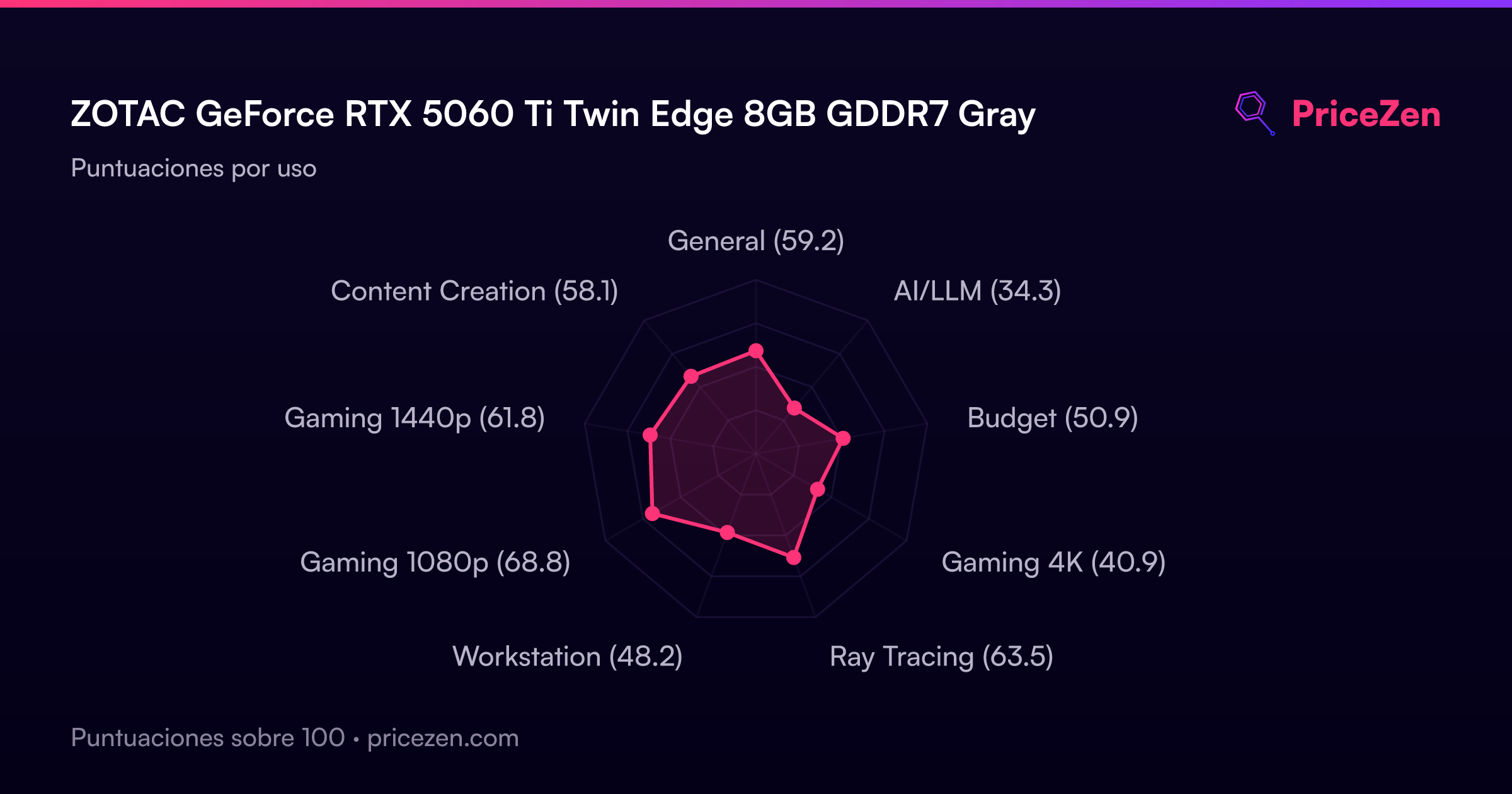
Usage Scores
- General59.2
- AI/LLM34.3
- Budget50.9
- Gaming 4K40.9
- Ray Tracing63.5
- Workstation48.2
- Gaming 1080p68.8
- Gaming 1440p61.8
- Content Creation58.1