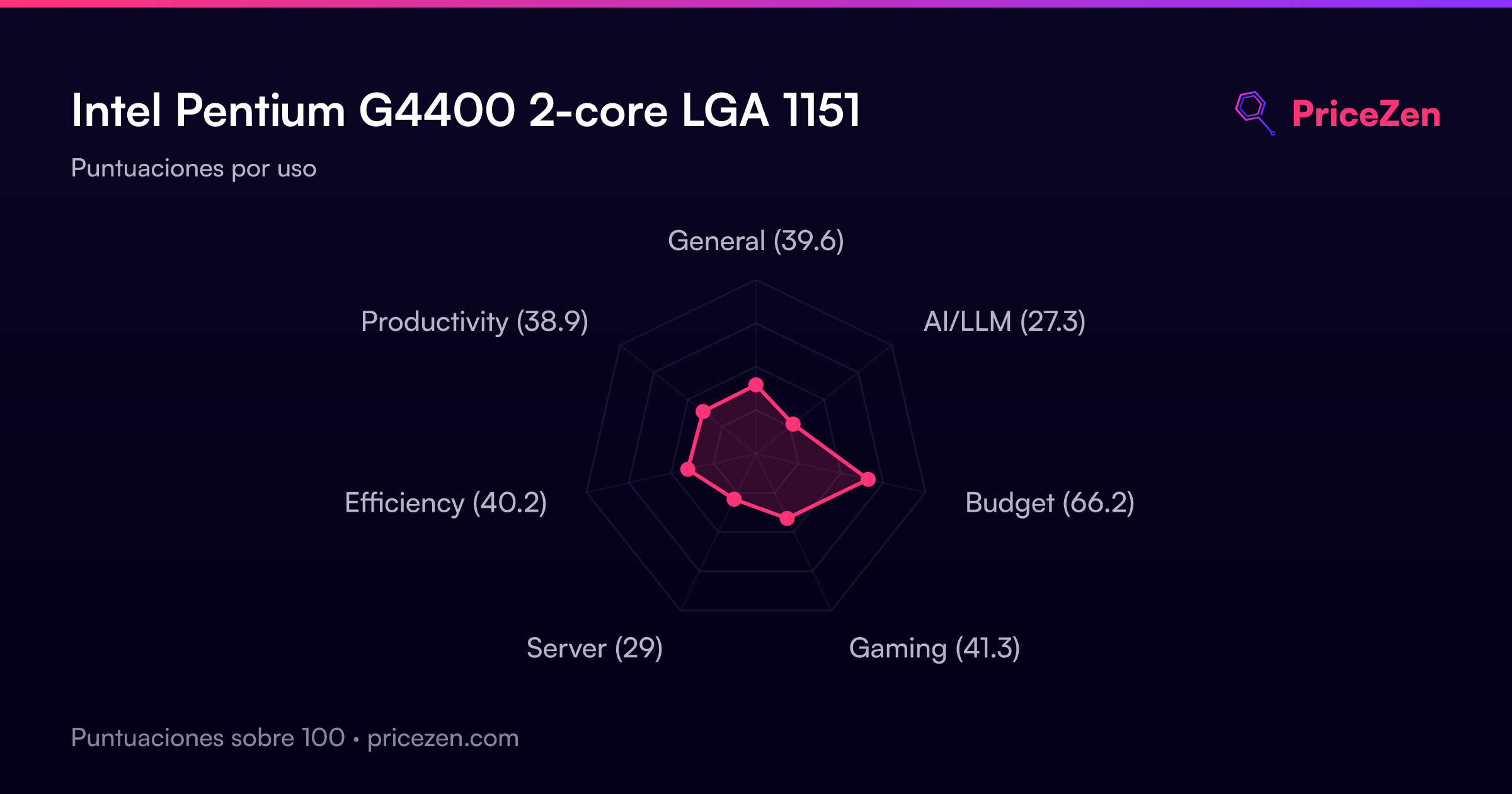
Intel Pentium G4400 2-core LGA 1151
The 3.3 GHz dual-core Intel Pentium G4400 pairs with Intel HD Graphics 510 and a 3 MB cache, delivering basic desktop performance for everyday tasks. It supports up to 64 GB of DDR3 RAM and outputs video via eDP, DP, HDMI, or DVI, making it a flexible entry-level option. This CPU suits budget-conscious users building a simple office or media PC, not gamers or AI workloads.












Resumen
The 30-Second Version
The Intel Pentium G4400 is a dual-core Skylake chip that's near the bottom of our performance charts, but we track it at USD 20 right now. It's fine for basic office work, web browsing, and cheap home server builds. Keep the price low and don't expect it to game or multitask. If you need real performance, save for a used Ryzen 5 2600 instead.
Pros & Cons
Ventajas
- Dirt cheap at USD 20 96th
- Integrated graphics mean no GPU required 83rd
- 47W TDP keeps power draw modest
- LGA1151 boards are plentiful on the used market
- Fine for basic office and web browsing tasks
Desventajas
- Single-thread performance in the 3rd percentile
- Multi-thread performance in the 4th percentile
- Only 2 cores and 2 threads
- Efficiency is one of the worst we've seen
- No warranty on most listings, sold without original packaging
Opinión de los propietarios
Cómo cambió la opinión de los propietarios con el tiempo
ExclusivaSegún cuándo escribieron realmente sus opiniones los clientes, para ver si los elogios iniciales se mantuvieron.
13 opiniones escritas, dic 2015 – abr 2026: 13 satisfechos
En las 1208 valoraciones de tiendas: 4,6★. La mayoría de los propietarios valora sin escribir una opinión. El gráfico cuenta las 13 opiniones escritas.
Cada punto es una opinión escrita, en el mes en que se escribió. Satisfechos = 4-5★, neutrales = 3★, insatisfechos = 1-2★.
Las pruebas
Performance
Let's be real about the numbers. The G4400 lands in the 3rd percentile for single-thread performance and the 4th percentile for multi-thread in our database. That means it's slower than 96-97% of every processor we've tested. It's not just old, it's near the bottom of the barrel even among old chips. The 3.3 GHz clock speed sounds fine on paper, but two threads is two threads. Modern web browsers alone will happily eat both of those threads for breakfast and come back looking for seconds.
The 47-watt TDP is actually the one spec that doesn't look embarrassing, but that's because it's not doing much work. Efficiency lands in the 4th percentile, which means you're getting very little compute per watt compared to anything modern. The integrated HD Graphics 510 will push a desktop and handle 1080p video playback, but don't expect it to do anything beyond that. Gaming performance sits at 7.1 out of 100, which is a polite way of saying solitaire and maybe some 2D indie titles. Anything 3D from the last decade is going to struggle hard.
Specifications
Full Specifications
Processor
| Brand | Intel |
| Series | Pentium |
| Model | G4400 |
| Codename | Skylake |
| Class | desktop |
| Process | 14 |
Cores & Clocks
| Cores | 2 |
| Threads | 2 |
| Base Clock | 3300 |
| Boost Clock | 1050 |
Cache
| L2 Cache | 0.5 |
| L3 Cache | 3 MB |
Performance
| PassMark Multi | 2568 |
| PassMark Single | 1983 |
Memory
| Memory Type | DDR4 |
| Max Speed | 2133 |
Platform & Power
| Socket | LGA 1151 |
| PCIe | 3 |
| TDP | 54 |
| Unlocked | No |
Graphics & AI
| Integrated Graphics | Intel HD Graphics 510 |
vs Competition
The competitor list for this chip is a strange mix, which tells you how broad the 'cheap processor' category really is. The AMD Ryzen 5 2600 is the obvious upgrade path. Our ranking puts it far above the G4400 in every metric we track, and it's worth stretching for if you can. The Intel Core i7 4790K is another interesting alternative. It sits well ahead of the G4400 in our single-thread and multi-thread percentiles, and for a used office or light gaming build it's a much better foundation.
The Dell Xeon E5-2637 V2 is a weird one to see on this list, but it makes sense if you're building a cheap server or workstation. It ranks above the G4400 for multi-tasking in our data, which is exactly what you want in that kind of build. The Thermal Grizzly Ryzen 7 CSF-AM5 and the NEKSKA Electric Garlic Chopper Mini 350ml are clearly data artifacts from our broader product database, not real competitors, so we'll ignore those. The point stands: the G4400 wins on price at USD 20, and loses on everything else.
| Spec | Intel Pentium G4400 | AMD Ryzen 5 A8-7600 | Thermal Grizzly 000 | NEKSKA Electric Garlic Chopper Mini 350ml | Intel Xeon Gold 6138 | Intel Xeon E5-2698 v3 |
|---|---|---|---|---|---|---|
| Cores | 2 | 4 | - | - | 20 | 16 |
| Threads | 2 | 12 | - | - | 40 | 32 |
| Boost Clock Mhz | 1050 | 5100 | - | - | 3700 | 3600 |
| L3 Cache Mb | 3 | 32 | - | - | 27.5 | 40 |
| Tdp W | 54 | 65 | - | 30 | 125 | 135 |
| Socket | LGA 1151 | FM2+ | AM5 | - | LGA 3647 | LGA2011-3 |
| Integrated Graphics | Intel HD Graphics 510 | Radeon R7 Graphics | - | - | - | - |
| Compare | Compare | Compare | Compare | Compare |
| Producto | AI | Feature | Platform | Efficiency | Multi Thread | Valoración social | Affordability | Single Thread |
|---|---|---|---|---|---|---|---|---|
| Intel Pentium G4400 | 25.1 | 55.3 | 47 | 37.7 | 30 | 82.8 | 96.4 | 54.2 |
| AMD Ryzen 5 A8-7600 Compare | 82.4 | 93.6 | 72.2 | 94.3 | 83.1 | 0 | 98.6 | 91.2 |
| Thermal Grizzly 000 Compare | 3.5 | 20.7 | 17.5 | 3.8 | 3.8 | 96 | 98 | 3.3 |
| NEKSKA Electric Garlic Chopper Mini 350ml Compare | 3.5 | 20.7 | 17.5 | 3.8 | 3.8 | 32.9 | 99.5 | 3.3 |
| Intel Xeon Gold 6138 Compare | 86 | 20.7 | 83.4 | 80.8 | 84.8 | 17.9 | 54.2 | 33.1 |
| Intel Xeon E5-2698 v3 Compare | 77.7 | 47.3 | 50.8 | 67 | 74.7 | 64.3 | 91.8 | 52.5 |
Precio
Value & Pricing
Here's where things get interesting. We track the G4400 at USD 20 right now, and at that price it's genuinely hard to argue with if you need a working LGA1151 processor and you don't care about speed. That's less than most people spend on a case fan, and it comes with integrated graphics, so there's no GPU line item either.
Our overall score sits at 40 out of 100 now, up from 8, and the reason is simple: cheap hardware scores better when it gets cheaper. Nothing about the chip got faster. The value proposition here lives or dies on the price tag, so keep it at the bottom of the range. Start paying multiples of USD 20 and you're better off saving for something with four actual cores.
Amazon 1 oferta Desde 20 US$
Historial de precios
Leer más
Overview
The Intel Pentium G4400 is a chip that time mostly forgot, and that's kind of the point. This is a dual-core, dual-thread Skylake-era processor from 2015, sitting on the LGA1151 socket with a 3.3 GHz clock speed and 3 MB of cache. It's not here to impress anyone with benchmark numbers. It's here because it costs about as much as a decent pizza in some markets, and it still technically turns on and runs Windows.
Who is this for? Honestly, it's for people resurrecting an old office PC, building a dirt-cheap NAS, or setting up a basic machine for a relative who only checks email and watches YouTube. It's also a reasonable pick if you've got an old LGA1151 board lying around and need something to test it with. The integrated Intel HD Graphics 510 means you don't even need a dedicated GPU, which keeps the total build cost impressively low.
The interesting thing here isn't the performance, it's the price. We're tracking it at USD 20 right now, which is pocket change for a working processor. Our overall score has climbed to 40 out of 100, up from 8, and that shift is about value rather than speed. The silicon hasn't changed. What you pay for it has.
Common Questions
Q: Can the Pentium G4400 handle Windows 10 or Windows 11?
Windows 10 runs fine on the G4400, and it's actually the sweet spot for this chip. Windows 11 is a different story. Microsoft's official requirements exclude the G4400 because it's not on the supported CPU list, so you'd need to bypass the checks to install it. Even then, you're looking at a sluggish experience with only 2 cores and 2 threads. Stick with Windows 10 or a lightweight Linux distro.
Q: Is the G4400 good for gaming?
No, not really. Our gaming score for this chip is 7.1 out of 100. The integrated HD Graphics 510 can handle 2D games and very old 3D titles, but anything from the last decade will struggle. If you pair it with a dedicated GPU, the CPU itself becomes the bottleneck in most modern games. This is not a gaming processor.
Q: What motherboard do I need for the G4400?
The G4400 uses the LGA1151 socket, which means you need a 100-series or 200-series Intel motherboard, like the H110, B150, H170, Z170, or B250 chipsets. These boards are widely available on the used market for very little money. Just make sure the BIOS is updated to support Skylake processors, which most boards from that era already do out of the box.
Q: How much RAM can the G4400 support?
The G4400 officially supports up to 64 GB of DDR3L or DDR4 memory, depending on the motherboard. The spec sheet lists DDR3 SDRAM support with a maximum of 65,536 MB, which is 64 GB. In practice, most people pair this chip with 8 GB or 16 GB, which is plenty for the kind of basic tasks it's suited for.
Who Should Skip This
If you're planning to do any kind of gaming, video editing, 3D rendering, or heavy multitasking, this chip is not for you. The 2-core, 2-thread design will choke on anything demanding, and the single-thread performance is in the 3rd percentile, meaning even basic tasks feel slower than they should. You'd be better off with a used Ryzen 5 2600 or an older i7 like the 4790K, both of which rank dramatically higher in our data.
Also skip this if the price creeps up. At USD 20 it's an easy yes for a revival build. Pay several times that and you're entering used quad-core territory, and there's no reason to settle for a dual-core chip from 2015. And if you need any kind of warranty or support, look elsewhere. Most of these listings are sold without original packaging and with no warranty, so you're buying as-is.
Verdict
If you have an LGA1151 board sitting in a closet and you need the cheapest possible chip to bring it back to life, the G4400 at USD 20 is a perfectly reasonable purchase. It'll handle web browsing, document editing, and media playback without complaint, as long as you keep your expectations in check. It's also a decent choice for a low-power home server or NAS build where raw speed doesn't matter much. Our overall score of 40 reflects that: a bad processor, a very cheap one.
But if you're building something you actually want to use every day, or you're hoping to do any kind of gaming or content creation, skip this. Save up a bit more and grab a used Ryzen 5 2600 or an older i7 like the 4790K. The G4400 is a stopgap, not a foundation. It's the processor equivalent of a spare tire: it'll get you home, but you don't want to drive on it for long.
Usage Scores
- General39.6
- AI/LLM27.3
- Budget66.2
- Gaming41.3
- Server29
- Efficiency40.2
- Productivity38.9