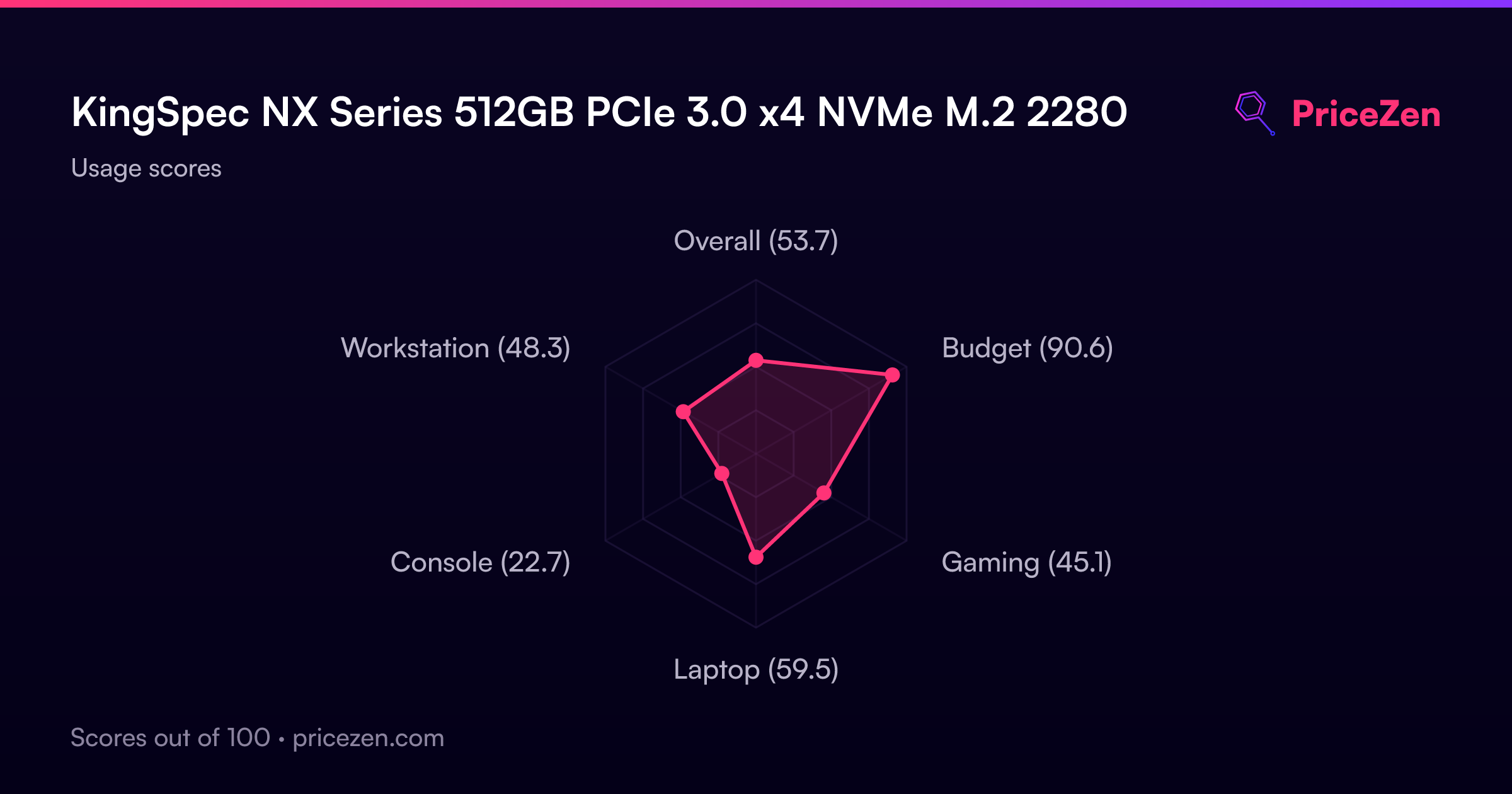
KingSpec NX Series 512GB PCIe 3.0 x4 NVMe M.2 2280
The 3500 MB/s read and 3000 MB/s write speeds over PCIe 3.0 x4 make this M.2 2280 NVMe drive a fast option for everyday tasks. Its DRAM-less TLC NAND design keeps costs low while supporting S.M.A.R.T, TRIM, and wear leveling for stable performance. Best for budget-conscious desktop builders who need a reliable boot drive for gaming and general use, not for portable or heavy write workloads.












Snapshot
The 30-Second Version
The KingSpec NX Series 512GB is a budget Gen3 NVMe drive that hits the 3500 MB/s read ceiling for PCIe 3.0. At 86 USD, it's one of the most affordable options in our database, and the 4.6-star rating from 1,400+ reviews backs up the value. The DRAM-less design and 512GB capacity are the main trade-offs. Buy it for older systems, skip it for new builds.
Pros & Cons
Pros
- Maxes out the Gen3 interface at 3500 MB/s read and 3000 MB/s write 84th
- Very affordable at 86 USD, with an 81st percentile affordability score 75th
- Strong customer rating of 4.6 out of 5 from over 1,400 reviews
- 3-year warranty with lifetime technical support
- Works well in older systems that can't use Gen4 drives anyway
Cons
- DRAM-less design hurts sustained and random write performance
- Endurance sits at just the 42nd percentile, below average for the category
- 512GB capacity is small by modern standards, 35th percentile
- Portable use is a weak spot at 12.9 out of 100
- No Gen4 support, so no future-proofing if you upgrade your motherboard
What owners think
The Word on the Street
How owner sentiment changed over time
ExclusiveBased on when customers actually wrote their reviews - so you can see whether early praise held up.
13 written reviews, Oct 2024 – Mar 2026: 13 happy
Across all 1,420 store ratings: 4.6★. Most owners rate without writing a review. The chart counts the 13 written reviews.
Each dot is one written review, in the month it was written. Happy = 4-5★, mixed = 3★, unhappy = 1-2★.
The proof
Performance
The headline numbers are solid for Gen3. 3500 MB/s sequential read and 3000 MB/s write are basically the maximum the PCIe 3.0 x4 interface allows, so KingSpec is squeezing everything they can out of the connection. In our database, that puts the drive's speed at the 64th percentile overall, which sounds middle of the pack until you remember it's competing against Gen4 and Gen5 drives that cost three times as much. For a Gen3 drive, those numbers are about as good as it gets.
Random performance is a bit more modest at the 62nd percentile. That's where the DRAM-less design starts to show. Without a dedicated cache chip, the controller has to work harder to manage the mapping tables, and that shows up in random reads and writes. For booting Windows, launching apps, and loading games, you'll still see a massive improvement over any SATA SSD or hard drive. But if you're comparing it to a DRAM-equipped Gen3 drive like the Samsung 970 EVO Plus, the NX Series will fall behind in heavy random workloads. For most people, the difference is academic. For power users, it's worth knowing.
Specifications
Full Specifications
Drive
| Capacity | 512 |
| Form Factor | M.2 2280 |
| Interface | PCIe 3.0 x4 |
| Protocol | NVMe |
| PCIe Generation | 3 |
| External | No |
Performance
| Sequential Read (MB/s) | 3500 |
| Sequential Write (MB/s) | 3000 |
Hardware
| NAND | TLC |
| DRAM Cache | No |
Reliability
| Warranty (years) | 3 |
Features
| Heatsink | No |
vs Competition
Stacked against the Crucial T500, the NX Series looks like a different species. The T500 is a Gen4 drive with DRAM, higher endurance, and speeds that double the NX Series. But it also costs significantly more. If you have a Gen4 slot and you're building a new system, the T500 is the obvious choice. The NX Series is for people who are constrained by their hardware or their budget.
The WD Black SN850X tells a similar story. It's one of the best Gen4 drives on the market, with top-tier random performance and endurance. But again, you're paying for that privilege. The MSI SPATIUM M480 PRO and Kingston KC3000 are also Gen4 competitors that outclass the NX Series in every performance metric. The Corsair MP700 Elite goes even further into Gen5 territory. The point is, the NX Series isn't trying to compete with those drives. It's competing with other budget Gen3 options, and in that arena, it holds its own. The 3500 MB/s read speed is right at the Gen3 ceiling, and the price undercuts most name-brand alternatives.
| Spec | KingSpec NX Series | Samsung 9100 PRO | Crucial T500 | Corsair MP700 Elite | MSI SPATIUM M480 PRO | Western Digital WD_BLACK SN7100 |
|---|---|---|---|---|---|---|
| Capacity | 512GB | 1TB | 1TB | 1TB | 1TB | 1TB |
| Form Factor | M.2 2280 | M.2 2280 | M.2 2280 | M.2 2280 | M.2 2280 | M.2 2280 |
| Interface | PCIe 3.0 x4 | PCIe 5.0 x4 | PCIe 4.0 x4 | PCIe 5.0 x4 | PCIe 4.0 x4 | PCIe 4.0 x4 |
| Seq Read | 3,500 MB/s | 14,700 MB/s | 7,300 MB/s | 10,000 MB/s | 7,400 MB/s | 7,250 MB/s |
| Nand Type | TLC | TLC | TLC | TLC | TLC | TLC |
| Dram Cache | No | Yes | Yes | No | Yes | No |
| Endurance | - | 600 TBW | 600 TBW | 600 TBW | 3000 TBW | 600 TBW |
| Compare | Compare | Compare | Compare | Compare |
| Product | Speed | Random | Feature | Capacity | Endurance | Social Proof | Affordability |
|---|---|---|---|---|---|---|---|
| KingSpec NX Series | 64.3 | 62.3 | 54.2 | 36.7 | 43.7 | 74.9 | 83.7 |
| Samsung 9100 PRO Compare | 98.8 | 99.8 | 99.8 | 56.5 | 86 | 99.6 | 42.4 |
| Crucial T500 Compare | 91.7 | 96.8 | 99 | 56.5 | 82.9 | 94.9 | 50.2 |
| Corsair MP700 Elite Compare | 95.2 | 97.2 | 86.4 | 56.5 | 87.3 | 94.9 | 45.6 |
| MSI SPATIUM M480 PRO Compare | 94.1 | 81.6 | 94.3 | 56.5 | 98.5 | 94.9 | 39.9 |
| Western Digital WD_BLACK SN7100 Compare | 92.1 | 96.6 | 54.2 | 56.5 | 80.7 | 94.9 | 55.1 |
Price
Value & Pricing
At 86 USD, the NX Series 512GB is aggressively priced. That's the kind of money people used to spend on a 256GB SATA drive a few years back. The affordability percentile of 81 means it's cheaper than most of the drives in our database, and when you factor in the Gen3-maxing speeds, the value proposition gets even better. You're getting near-flagship Gen3 performance for budget money.
The comparison gets trickier when you look at what a little more cash buys. The Crucial T500 and WD Black SN850X are Gen4 drives that cost more but deliver double the sequential speeds and much better random performance. If you have a Gen4 slot, spending the extra money makes sense. But if you're on an older board or just need a cheap boot drive, the NX Series is hard to beat. The 512GB capacity is the real limiting factor. At 35th percentile for capacity, you'll fill this thing up fast if you're installing modern games. The 1TB and 2TB versions of the NX Series exist, and for most buyers, those are probably the smarter long-term play.
Amazon 1 offer From $73
Price history
Read more
Overview
The KingSpec NX Series 512GB is one of those drives that makes you do a double take on the price tag. It's a PCIe 3.0 x4 NVMe M.2 2280 stick with TLC NAND and no DRAM cache, which is about as budget as the hardware gets these days. But the claimed numbers, 3500 MB/s read and 3000 MB/s write, put it right at the ceiling of what Gen3 can do. That's a fun combination: entry-level parts chasing flagship Gen3 speeds.
Who's this for? Mostly people trying to breathe life into an older machine. The 2013 Mac Pro crowd shows up in the reviews, and that makes sense. A lot of older desktops and laptops with Gen3 M.2 slots can't take advantage of Gen4 drives anyway, so spending extra on a Crucial T500 or WD Black SN850X would be wasted money. The NX Series slots into that niche perfectly. It's also a decent pick for a secondary game drive or a cheap upgrade for a family PC.
The catch is that DRAM-less design. Without a cache buffer, sustained writes and heavy multitasking can get choppy. For everyday boot drives and light gaming, you probably won't notice. But if you're moving huge files around all day or running a database off this thing, the lack of DRAM will show up. We'll dig into that more below.
Common Questions
Q: Will this work in my older laptop or desktop?
If your system has an M.2 2280 slot that supports PCIe 3.0 x4 NVMe, yes. The drive is backward compatible with Gen2 and Gen1 slots as well, though you'll see reduced speeds. It's also compatible with Windows 7 through 11 and Unix-based systems. Just make sure your motherboard or laptop supports NVMe, not just SATA M.2, because this drive won't work in a SATA-only M.2 slot.
Q: Is the DRAM-less design a problem?
For most everyday tasks, no. The drive uses HMB (Host Memory Buffer) technology to borrow a small amount of system RAM for cache duties, which helps offset the lack of onboard DRAM. You'll notice the difference in sustained heavy writes, like copying hundreds of gigabytes at once or running a database. For booting, gaming, and general use, the performance is still excellent for a Gen3 drive.
Q: How does this compare to a SATA SSD?
It's not even close. A typical SATA SSD maxes out around 550 MB/s read and 520 MB/s write. The NX Series hits 3500 MB/s read and 3000 MB/s write, which is roughly six times faster. Boot times, game loads, and file transfers will all feel dramatically snappier. If you're coming from a hard drive, the difference is night and day.
Q: Is 512GB enough for gaming?
It depends on what you play. Modern AAA titles routinely take up 50 to 150GB each, so you might fit three to five games comfortably. If you play a lot of big open-world games or keep a large media library, you'll fill this up fast. The NX Series is also available in 1TB and 2TB capacities, and for most gamers, those are the better long-term investment.
Who Should Skip This
If you're building a new PC with a Gen4 or Gen5 M.2 slot, this drive is not for you. You'd be leaving half the performance on the table by pairing a Gen3 drive with a modern motherboard. Spend the extra money on a Crucial T500 or WD Black SN850X and get double the sequential speeds plus better random performance and endurance. The NX Series is also a poor choice for anyone who needs a portable drive. The portable score of 12.9 out of 100 is one of the worst we've seen, so don't plan on throwing this in an external enclosure and expecting great things. And if you're a content creator working with large video files or a data hoarder with a massive game library, the 512GB capacity will feel cramped almost immediately. Look at the 1TB or 2TB versions, or step up to a higher-capacity Gen4 drive.
Verdict
For an older system that's stuck on Gen3, the KingSpec NX Series 512GB is a no-brainer. It maxes out the interface, costs less than most competitors, and has a solid track record with over 1,400 reviews averaging 4.6 stars. The 3-year warranty adds some peace of mind, and the fact that it works in a 2013 Mac Pro with an adapter tells you it's flexible enough for weird use cases. If you're upgrading an aging laptop or desktop and want the biggest speed bump for the least money, this is it.
For a new build, skip it. Gen4 drives have gotten cheap enough that buying a Gen3 drive for a new system is leaving performance on the table. The 512GB capacity is also a real constraint if you're installing modern games or working with large media files. If you're building new, spend the extra on a Crucial T500 or WD Black SN850X. If you're rescuing an old machine, the NX Series is exactly what you need.
Usage Scores
- Overall53.7
- Budget90.6
- Gaming45.1
- Laptop59.5
- Console22.7
- Workstation48.3