ADATA LEGEND 710 1TB PCIe 3.0 x4 NVMe M.2 2280
The ADATA Legend 710 hits 2,400 MB/s reads and 1,800 MB/s writes over PCIe Gen3 x4, with a heatsink that cuts temperatures by 15% for stable sustained loads. Its DRAM-less design uses HMB and SLC caching to keep costs low, while AES 256-bit encryption and LDPC protect data integrity. Best for budget-conscious desktop builders who need a reliable 1TB boot or game drive without paying for Gen4 speeds.


Snapshot
The 30-Second Version
The ADATA Legend 710 is a budget PCIe 3.0 drive that's a massive upgrade from an HDD. It's not fast by modern standards, but the heatsink, encryption, and low price make it a solid value pick. Endurance is the weak spot, so skip it if you write a lot of data.
Pros & Cons
Pros
- Heatsink included, which keeps temps down about 15% 87th
- Hardware encryption with AES 256-bit is a nice security bonus 78th
- Great value upgrade from an HDD or SATA SSD 68th
- HMB tech keeps everyday performance feeling responsive
Cons
- Endurance rating is one of the worst we've seen
- DRAM-less design limits sustained write performance
- PCIe 3.0 speeds are dated compared to Gen4 and Gen5 rivals
- No price listed, which makes value hard to pin down
What owners think
The Word on the Street
How owner sentiment changed over time
ExclusiveBased on when customers actually wrote their reviews - so you can see whether early praise held up.
7 written reviews, Apr 2023 – Apr 2026: 7 happy
Across all 59 store ratings: 4.7★. Most owners rate without writing a review. The chart counts the 7 written reviews.
Each dot is one written review, in the month it was written. Happy = 4-5★, mixed = 3★, unhappy = 1-2★.
The proof
Performance
Sequential reads hit 2,400 MB/s and writes land at 1,800 MB/s, which is about average for a PCIe 3.0 drive in our database. Random performance sits in the middle of the pack too. The SLC cache and HMB help mask the missing DRAM, so boot times and game loads feel quick in practice. But the endurance rating is rough, landing in the bottom 15% of drives we've tracked. If you're hammering this thing with constant writes, it won't last as long as pricier options. For typical desktop and laptop use, though, it's plenty.
Specifications
Full Specifications
Drive
| Capacity | 1000 |
| Form Factor | M.2 2280 |
| Interface | PCIe 3.0 x4 |
| Protocol | NVMe |
| PCIe Generation | 3 |
| External | No |
Performance
| Sequential Read (MB/s) | 2400 |
| Sequential Write (MB/s) | 1800 |
| Random Read (IOPS) | 180000 |
| Random Write (IOPS) | 150000 |
Hardware
| NAND | TLC |
| DRAM Cache | No |
| Controller | Realtek RTS5766DL |
Reliability
| Endurance (TBW) | 260 |
| MTBF (hours) | 1500000 |
Features
| Heatsink | Yes |
| Hardware Encryption | Yes |
vs Competition
Stacked against the Crucial T700, Samsung 980 PRO, and WD Black SN850X, the Legend 710 is in a different league entirely. Those are Gen4 and Gen5 drives with read speeds two to five times faster. The 980 PRO alone hits 7,000 MB/s reads. But they also cost significantly more. The Legend 710's real competition is other budget Gen3 drives, and there it holds its own thanks to the heatsink and encryption. If you need raw speed, skip this and grab a 980 PRO. If you need a cheap, reliable boot drive, this is a contender.
| Spec | ADATA LEGEND 710 | Samsung 9100 PRO | Kingston KC3000 | Crucial T700 | Western Digital WD_BLACK SN8100 | XPG GAMMIX S70 Blade |
|---|---|---|---|---|---|---|
| Capacity | 1TB | 2TB | 2TB | 2TB | 1TB | 2TB |
| Form Factor | M.2 2280 | M.2 2280 | M.2 2280 | M.2 2280 | M.2 2280 | M.2 2280 |
| Interface | PCIe 3.0 x4 | PCIe 5.0 x4 | PCIe 4.0 x4 | PCIe 5.0 x4 | PCIe 5.0 x4 | PCIe 4.0 x4 |
| Seq Read | 2,400 MB/s | 14,700 MB/s | 7,000 MB/s | 12,400 MB/s | 14,900 MB/s | 7,400 MB/s |
| Nand Type | TLC | TLC | TLC | TLC | TLC | TLC |
| Dram Cache | false | true | true | true | true | true |
| Endurance | 260 TBW | 1200 TBW | 1600 TBW | 1200 TBW | 600 TBW | 1480 TBW |
| Compare | Compare | Compare | Compare | Compare |
| Product | Speed | Random | Feature | Capacity | User Sentiment | Endurance | Social Proof | Affordability |
|---|---|---|---|---|---|---|---|---|
| ADATA LEGEND 710 | 55 | 77.7 | 87.3 | 55.6 | 68 | 51.2 | 44.8 | 63.5 |
| Samsung 9100 PRO Compare | 98.9 | 99.8 | 99.7 | 78.6 | 57.4 | 85.7 | 94.9 | 21.1 |
| Kingston KC3000 Compare | 88.5 | 94.4 | 93.9 | 78.6 | 95.2 | 92.9 | 85.8 | 26.3 |
| Crucial T700 Compare | 96.7 | 97.6 | 97.5 | 78.6 | 79.5 | 82.6 | 75.1 | 22 |
| Western Digital WD_BLACK SN8100 Compare | 97.8 | 98.6 | 99.7 | 55.6 | 95.2 | 80.4 | 94.9 | 38.9 |
| XPG GAMMIX S70 Blade Compare | 93 | 90.5 | 93.9 | 78.6 | 79.5 | 77.2 | 75.1 | 30.7 |
Price
Value & Pricing
At $148 USD, this drive is a solid budget pick. You're getting 1TB of TLC NAND, a heatsink, and encryption for less than most Gen4 drives with similar capacity. The CAD price of $290 is a different story, but that's a separate market. If you can find it on sale, it's an easy recommendation for anyone still booting from spinning rust. Just don't expect it to compete with pricier drives on endurance or sustained writes.
Amazon 1 offer From $148
Price history
Read more
Overview
The ADATA Legend 710 is a budget PCIe 3.0 drive that punches above its weight class for everyday use. You get 1TB of TLC NAND, a heatsink, and hardware encryption for not much money. It's DRAM-less, which usually makes us nervous, but ADATA leans on HMB to keep things snappy in real-world tasks.
This isn't a speed demon. 2,400 MB/s read and 1,800 MB/s write puts it firmly in Gen3 territory, and that's fine. Most people upgrading from an HDD or SATA SSD will feel like they've been teleported. The heatsink is a nice touch for a drive in this price bracket, and the endurance rating is the one real sore spot we'll get into below.
Common Questions
Q: Will this work in a laptop?
Yes, it's an M.2 2280 form factor, which fits most modern laptops that support PCIe 3.0 x4 NVMe drives. The heatsink adds a bit of thickness, so check your laptop's clearance if it's a slim model.
Q: Is the DRAM-less design a problem for gaming?
For most gaming, no. HMB uses your system RAM to handle the mapping tables, so game loads and level transitions feel quick. You'd only notice the missing DRAM during large sustained file transfers.
Q: How does this compare to a SATA SSD?
It's roughly four times faster on sequential reads than a typical SATA SSD, which tops out around 550 MB/s. Boot times and game loads will be noticeably quicker, though not as dramatic as jumping to a Gen4 drive.
Who Should Skip This
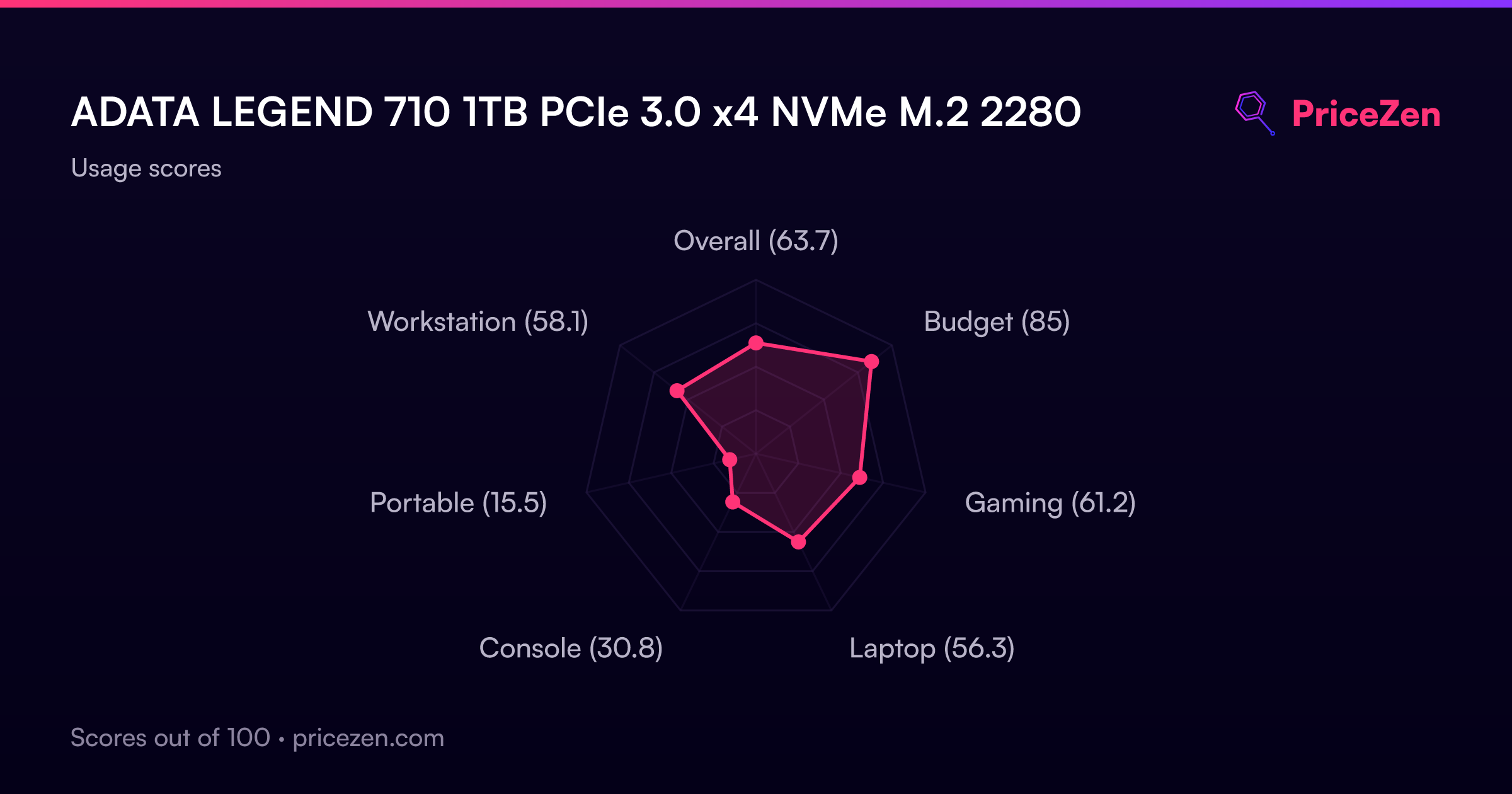
Skip this if you do heavy video editing, large file transfers, or anything that hammers the drive with constant writes. The endurance rating is bottom-tier, and the DRAM-less design will choke on sustained workloads. If you need a portable drive, look elsewhere too, because this scored terribly in our portable category. And if you're building a new system with a Gen4 or Gen5 motherboard, spend a bit more on a faster drive.
Verdict
Buy this if you're upgrading an older desktop or laptop from an HDD or SATA SSD and want a noticeable speed bump without spending much. It's also a decent pick for a NAS cache drive, which a few owners have done with good results. The heatsink and encryption are genuinely useful extras at this price. Just know that the endurance rating is weak, so heavy write workloads will wear it out faster than a more expensive drive.
Usage Scores
- Overall63.7
- Budget85
- Gaming61.2
- Laptop56.3
- Console30.8
- Portable15.5
- Workstation58.1