HP Pavilion 15-eg1000 2023, Core i3-1215U, 32GB, 1TB SSD, Natural silver
The Intel Core i3-1215U processor with 6 cores and up to 4.4GHz turbo speed handles everyday tasks efficiently, paired with 32GB DDR4 RAM and a 1TB SSD for smooth multitasking and fast storage. The 15.6-inch HD touchscreen adds intuitive navigation, while the lightweight 1.70kg build and Windows 11 Home make it portable and user-friendly. Best for students who need a reliable laptop for note-taking, web browsing, and light productivity without gaming demands.


Snapshot
The 30-Second Version
The HP Pavilion 15-eg1000 pairs a modest Core i3-1215U with a genuinely generous 32GB of DDR4 and a 1TB SSD, plus a 15.6" touchscreen. It's a capacity-first student and home-office machine, scoring 59.4/100 for students but only 11.8/100 for gaming. At USD 836 on Amazon it's about average on price, with owners rating it 4.4/5 across 33 reviews. Buy it for multitasking headroom and storage, skip it if you need CPU muscle, a sharp screen or any gaming at all.
Pros & Cons
Pros
- 32GB of DDR4, above average for the category (72nd percentile) 85th
- 1TB SSD gives real breathing room, 65th percentile for storage 72nd
- Best-fit score is for students at 59.4/100, and the spec mix backs that up 65th
- 15.6" touchscreen adds genuinely useful touch navigation
- Strong owner approval at 4.4/5 across 33 reviews, 85th percentile for social proof
Cons
- Gaming score of 11.8/100 is the weakest area by far
- HD panel ranks at the 20th percentile, a real letdown for a 15.6" screen
- i3-1215U sits at the 36th percentile for CPU, below the middle of the pack
- Port selection falls behind most at the 25th percentile: 1x USB-C, 2x USB-A, HDMI
- Reliability ranking of 34 is underwhelming for a machine you'll keep for years
The proof
Performance
Let's talk about what the numbers actually mean. The i3-1215U lands at the 36th percentile in our CPU rankings, which is below the middle of the pack. Six cores and eight threads sounds respectable on paper, but this is a low-power U-series chip with a 1.2GHz base clock, and the 4.4GHz figure is a boost ceiling, not a cruising speed. For everyday work, tab-heavy browsing, spreadsheets, streaming, video meetings, it'll feel fine. Start compiling a large project or exporting video and you'll be waiting. The 32GB of RAM helps more than people expect here, because it removes swapping as a bottleneck, so the CPU is the only thing holding you back rather than the CPU plus a full memory buffer. Our RAM ranking puts it at the 72nd percentile, solidly above average, and storage at the 65th, comfortably mid-to-upper territory with that 1024GB SSD.
Graphics is where the floor drops out. Intel UHD Graphics ranks at the 28th percentile, and the gaming score of 11.8/100 is the weakest area on the whole sheet by a wide margin. That's not a subtle hint, that's a closed door. Integrated UHD on a U-series chip isn't built for modern 3D titles, and no amount of system RAM changes that. The other quiet weak spot is the panel: a 15.6" HD touchscreen scores at the 20th percentile in our screen ranking, which tells you resolution and panel quality are the compromise that paid for all that memory. Touch input is genuinely handy for scrolling and quick navigation, but if you stare at text or photos all day, a low-resolution 15.6" panel is the thing you'll notice most. Port selection also lags behind most rivals at the 25th percentile: one USB-C, two USB-A and HDMI covers the basics, and that's about it.
Specifications
Full Specifications
Processor
| CPU | Intel Core i3 1215U |
| Cores | 6 |
| Frequency | 1.2 GHz |
| L3 Cache | 10 MB |
Graphics
| GPU | Intel UHD Graphics |
| Type | Integrated |
| VRAM Type | Shared |
Memory & Storage
| RAM | 32 GB |
| RAM Generation | DDR4 |
| Storage | 1 TB |
| Storage Type | SSD |
Display
| Size | 15.6" |
Connectivity
| USB-C Ports | 1 |
| USB Ports | 2 |
| HDMI | ✓ |
| Wi-Fi | ✓ |
| Bluetooth | Yes |
Physical
| Weight | 1.7 kg / 3.8 lbs |
| OS | Windows 11 Home |
vs Competition
The competitor set here is honestly a bit of a mismatch, and that tells you something. The Apple MacBook Air 13.6" M4 and Samsung Galaxy Book5 Pro 14" NP944XHA-KG3US are the two you'd realistically cross-shop against this HP, and both are smaller machines. If a sharp panel and long-term responsiveness matter more to you than raw gigabytes, our screen ranking of 20 and CPU ranking of 36 for the Pavilion are the numbers to weigh carefully before committing. The HP's counterargument is capacity: 32GB of RAM and a 1TB SSD at the 72nd and 65th percentiles respectively, plus a touchscreen and a full-size 15.6" chassis with HDMI and two USB-A ports for people who still plug in old peripherals.
The other three names, Lenovo Legion 5i 15.1" 83F00008US, ASUS ROG Flow Z13 GZ302EA and MSI Raider 16" RAIDERGE6814247, are gaming hardware, and their presence in this comparison set is mostly a reminder of what the Pavilion isn't. With a gaming score of 11.8/100 and Intel UHD Graphics at the 28th percentile, this HP shouldn't be on the same shortlist as any of them. If gaming is even a secondary reason you're buying, stop looking at this and start looking at those. Where the HP does win its own argument is the student scenario, 59.4/100, its strongest category fit, where lots of memory, lots of storage and a big touch panel beat brute force.
| Spec | HP Pavilion 15-eg1000 | Apple MacBook Air 13.6" M4 | Lenovo Legion 5i 15.1" 83F00008US | ASUS ROG Flow Z13 GZ302EA | Samsung Galaxy Book5 Pro 14" NP944XHA-KG3US | MSI Raider 16" RAIDERGE6814247 |
|---|---|---|---|---|---|---|
| CPU | Intel Core i3 1215U | Apple M4 | Intel Core Ultra 7 255HX | AMD Ryzen AI Max+ 395 | Intel Core Ultra 7 258V | Intel Core i9 14900HX |
| RAM (GB) | 32 | 24 | 32 | 32 | 32 | 32 |
| Storage (GB) | 1024 | 1024 | 1024 | 1024 | 1024 | 2048 |
| Screen | 15.6" | 13.6" 2560x1664 | 15.1" 2560x1600 | 13.4" 2560x1600 | 14" 2880x1800 | 16" 3840x2160 |
| GPU | Intel UHD Graphics | Apple (10-Core) | NVIDIA GeForce RTX 5060 | AMD Radeon 8060S Graphics | Intel Arc Graphics 140V | NVIDIA GeForce RTX 4070 |
| OS | Windows 11 Home | macOS | Windows 11 Home | Windows 11 Pro | Windows 11 Pro | Windows 11 Home |
| Weight (kg) | 1.7 | 1.2 | 2 | 1.2 | 1.2 | 2.7 |
| Battery (Wh) | - | 54 | 80 | 70 | 63 | 100 |
| Compare | Compare | Compare | Compare | Compare |
| Product | CPU | GPU | RAM | Ports | Screen | Portability | Storage | Reliability | Social Proof | Affordability |
|---|---|---|---|---|---|---|---|---|---|---|
| HP Pavilion 15-eg1000 | 35.9 | 28.2 | 72.1 | 25.2 | 19.8 | 48.1 | 65.3 | 33.5 | 85.2 | 55.7 |
| Apple MacBook Air 13.6" M4 Compare | 76 | 75.8 | 65.1 | 51.2 | 87.1 | 91.3 | 79.4 | 98.1 | 99.4 | 24.6 |
| Lenovo Legion 5i 15.1" 83F00008US Compare | 94.4 | 88.4 | 86.4 | 97.2 | 94.3 | 56.5 | 79.4 | 81.8 | 89.2 | 26.8 |
| ASUS ROG Flow Z13 GZ302EA Compare | 95.8 | 91.8 | 90.9 | 71.1 | 86.7 | 94.3 | 79.4 | 60.4 | 71.4 | 9.7 |
| Samsung Galaxy Book5 Pro 14" NP944XHA-KG3US Compare | 65.9 | 69.8 | 79.6 | 83.2 | 91.6 | 89.4 | 79.4 | 81.8 | 98.4 | 20.1 |
| MSI Raider 16" RAIDERGE6814247 Compare | 93.2 | 95.5 | 86.4 | 98.6 | 98 | 9.3 | 94 | 60.4 | 50.2 | 10.2 |
Price
Value & Pricing
At USD 836 on Amazon, affordability lands at the 56th percentile, so basically average for a traditional laptop. You're paying mid-pack money for a top-third memory and storage config attached to a bottom-third processor and screen. Whether that's good value depends entirely on which half of that sentence matters to you. If your workload is dozens of tabs, big spreadsheets and lots of local files, the 32GB and 1TB are doing real work for you and the price is defensible. If your workload is anything visual or compute-heavy, you're paying for capacity you won't get to enjoy.
We track this one at USD 836 in the US and MXN 20,377 in Mexico, each a single listing, so there isn't a spread of stores to shop against right now. That matters: with one seller per region, you don't have the usual leverage of waiting for a competing retailer to undercut. Our community price tracking will flag movement if it happens, but as it stands, treat USD 836 as the price rather than a starting point for negotiation.
Amazon 1 offer From $836
Price history
Read more
Overview
The HP Pavilion 15-eg1000 is one of those listings that makes you do a double take. It's an entry-level Intel Core i3-1215U machine, six cores and eight threads with a 4.4GHz boost clock, paired with 32GB of DDR4 and a 1TB SSD. That's a memory and storage config you'd normally expect on something aimed at developers or editors, bolted onto a chip built for browsing, documents and video calls. Add a 15.6" HD touchscreen, Windows 11 Home and a 1.70kg body, and you've got a laptop that's clearly trying to win on capacity rather than speed.
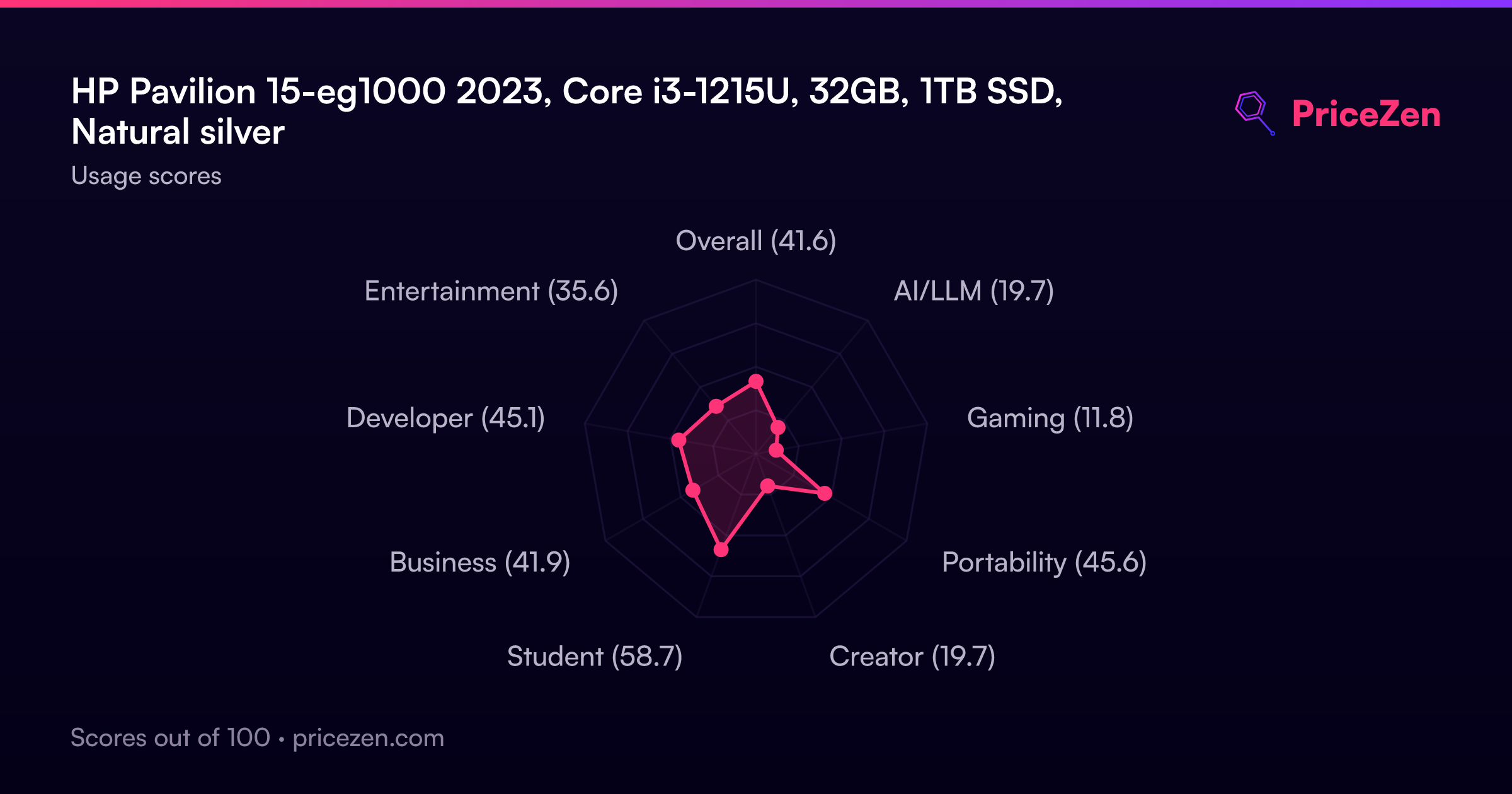
Our scoring model puts it at 59.4/100 for students, which is its best fit by a decent margin. Compact use lands at 45.5 and developer work at 45.1, both middling. The pattern makes sense once you look at the parts: lots of RAM means you can keep a pile of browser tabs, a couple of Office docs and a Zoom call open without things falling over, and the 1TB SSD gives you room for years of coursework and media. What you don't get is headroom for anything genuinely heavy.
The interesting tension here is that this thing is simultaneously generous and stingy. Generous with memory and storage, stingy with the display and graphics. The screen ranks in the bottom fifth of laptops we track, and the integrated Intel UHD Graphics sits near the back too. So it's a productivity box, not a creative or gaming machine, and the price of USD 836 on Amazon asks you to be okay with that trade.
Common Questions
Q: Is 32GB of RAM wasted on an i3 processor?
Not wasted, but it is unbalanced. The 32GB sits at the 72nd percentile in our rankings while the i3-1215U sits at the 36th, so memory will rarely be your limit but the CPU often will. In practice that means huge tab counts and many apps open at once stay smooth, while anything that actually needs processing power, like compiling or exporting, still takes as long as an i3 takes.
Q: Can it handle any gaming at all?
Our gaming score for this config is 11.8/100, the weakest area on the entire sheet, and the Intel UHD Graphics ranks at the 28th percentile. That combination rules out modern 3D titles. If gaming is part of why you're buying, the Lenovo Legion 5i 15.1" 83F00008US or MSI Raider 16" RAIDERGE6814247 in this comparison set are the direction to look instead.
Q: How good is the touchscreen display?
The touch functionality is a genuine plus for scrolling and quick navigation on a 15.6" panel, but the panel itself is the weak link. It's an HD-resolution screen and ranks at the 20th percentile in our display scoring, one of the lowest results on this product. If you read dense text or edit images all day, that's the compromise you'll feel every hour.
Q: Is USD 836 a fair price for this?
It's about average for the category, sitting at the 56th percentile for affordability, and we currently track a single US listing at USD 836 on Amazon plus MXN 20,377 in Mexico. You're getting above-average RAM and storage for that money, but a below-average CPU and screen. It's fair if capacity is your priority and less compelling if performance is.
Who Should Skip This
Gamers should skip this immediately. An 11.8/100 gaming score and Intel UHD Graphics at the 28th percentile isn't a machine you grow into, it's a hard ceiling. Look at the Lenovo Legion 5i 15.1" 83F00008US, ASUS ROG Flow Z13 GZ302EA or MSI Raider 16" RAIDERGE6814247 instead. Photo and video editors should also pass: the 20th-percentile HD panel undermines the one thing you need most, and the 36th-percentile CPU means exports crawl regardless of how much RAM you have.
Developers are the borderline case at 45.1/100. If you live in a lightweight editor and a browser, the 32GB will genuinely help. If you build large projects, run containers or compile regularly, the i3-1215U is the bottleneck and more memory won't fix it. And if you want a small, sharp, premium daily driver, the Apple MacBook Air 13.6" M4 or Samsung Galaxy Book5 Pro 14" NP944XHA-KG3US are worth cross-shopping, since this HP's compact score of 45.5 and 1.70kg 15.6" footprint aren't playing that game.
Verdict
For a student or a general home-office user, this is a reasonable buy. The 59.4/100 student score is its high-water mark, and the reasoning holds together: 32GB of RAM keeps a chaotic browser session alive, the 1TB SSD means you never play the delete-something game, the touchscreen speeds up casual navigation, and 1.70kg is manageable for a 15.6" machine you'll carry between home and campus. Owners seem to agree, with a 4.4/5 average across 33 reviews putting it at the 85th percentile for social proof. Buy it for capacity and convenience, not for speed.
For anyone else, we'd hesitate. Developers land at 45.1/100, which is middle-of-the-road, and the 36th-percentile CPU is the reason: RAM lets you keep a project open, but it doesn't make builds faster. Creative work runs into the same wall plus the 20th-percentile display, which is a bad combination if color or detail matters. And gamers should treat the 11.8/100 score as final. This is a laptop with one very clear job, and it does that job well enough. Just don't ask it to do a second one.
Usage Scores
- Overall41.6
- AI/LLM19.7
- Gaming11.8
- Portability45.6
- Creator19.7
- Student58.7
- Business41.9
- Developer45.1
- Entertainment35.6