Gigabyte GeForce RTX 3080 WINDFORCE OC 12GB GDDR6X
The 12GB GDDR6X memory and 384-bit bus on this RTX 3080 provide a substantial frame buffer for high-resolution textures, while the WINDFORCE 3X cooling system with alternate spinning fans keeps the 320mm card stable under load. Its triple HDMI 2.1 and triple DisplayPort 1.4 configuration offers exceptional multi-monitor flexibility rarely found on a single card. This GPU is best for 1440p and 4K gamers who need high frame rates and want a robust, cool-running card with extensive display connectivity.

No current retailer price











Snapshot
The 30-Second Version
The efficiency is the headline here: 165W TDP at the 96th percentile is exceptional for a 3080-class card. The 25,040 PassMark score and 12GB of VRAM make it a strong 1440p and 4K gaming card, and owners rate it 4.4 out of 5. Just make sure you're not paying new-card prices for two-generation-old tech.
Pros & Cons
Pros
- 96th percentile efficiency with a 165W TDP, nearly unheard of for this class 96th
- 12GB GDDR6X on a 384-bit bus with 912 GB/s bandwidth 72nd
- Quiet operation under load thanks to the WINDFORCE 3X cooler 72nd
- 25,040 PassMark score handles 1440p and 4K gaming well 69th
- 3x DisplayPort 1.4 and 3x HDMI 2.1 gives you six display outputs
Cons
- Feature set sits at the 41st percentile, thin for a card at this price
- Affordability at the 36th percentile, you're paying a premium
- AI and LLM workloads score just 50.8 out of 100, a weak spot
- No heatpads on backplate VRMs according to multiple owners
- Some users report driver issues requiring a full Windows reinstall
What owners think
The Word on the Street
How owner sentiment changed over time
ExclusiveBased on when customers actually wrote their reviews - so you can see whether early praise held up.
10 written reviews, Mar 2022 – Jun 2023: 9 happy, 1 mixed
Across all 199 store ratings: 4.4★. Most owners rate without writing a review. The chart counts the 10 written reviews.
Each dot is one written review, in the month it was written. Happy = 4-5★, mixed = 3★, unhappy = 1-2★.
The proof
Performance
The 25,040 PassMark score puts this card in the 67th percentile for raster performance, which sounds modest until you remember what it's up against. We're comparing it to RTX 50-series cards and RDNA 4 flagships in our database. For actual gaming, the story is much better. The 6,144 CUDA cores and 30.64 TFLOPS of FP32 compute deliver smooth high-refresh 1440p and very playable 4K in most titles. Owners consistently report excellent 1440p and 4K performance, and the 12GB framebuffer means you won't hit VRAM walls in modern games the way 8GB cards do.
The 1545MHz boost clock isn't the highest we've seen, but the WINDFORCE 3X cooler keeps things stable and quiet. Thermal performance sits at the 73rd percentile, which is solid for a triple-fan design. The card runs 320mm long and takes up 2.17 slots, so it's not a small card, but it's manageable in most ATX cases. Ray tracing lands at the 61st percentile, which is fine but not a standout. The 48 RT cores handle RT effects competently, just don't expect RTX 40 or 50-series level RT performance.
Specifications
Full Specifications
Chipset
| GPU Chipset | GeForce RTX 3080 |
| Brand | NVIDIA |
| Architecture | Ampere |
| Class | consumer |
| Process | 8 |
Memory
| VRAM | 12 GB |
| Memory Type | GDDR6X |
| Memory Bus | 384 |
| Bandwidth | 912.4 |
Compute
| CUDA Cores | 6144 |
| Tensor Cores | 192 |
| RT Cores | 48 |
| Base Clock | 1110 |
| Boost Clock | 1545 |
| FP16 TFLOPS | 30.64 |
| FP32 TFLOPS | 30.64 |
Performance
| PassMark G3D | 25040 |
| GPU Compute | 15059 |
Power & Cooling
| TDP | 165 |
| Recommended PSU | 750 |
| Cooler | Triple Fan |
| Fans | 3 |
Connectivity
| Interface | PCI Express 4.0 x16 |
| DisplayPort | 3 |
| HDMI | 3 |
| Max Resolution | 7680 x 4320 |
Physical
| Length | 320 |
| Slot Width | 2.17 |
| Form Factor | ATX |
| Weight | 1.9 kg / 4.3 lbs |
Features
| Ray Tracing | Yes |
| RGB | Yes |
vs Competition
Stacked against the current market, this card is in an awkward spot. The ASUS TUF RTX 5090 absolutely demolishes it in raw performance, but that's a card in a completely different price bracket. The more relevant comparison is the MSI Ventus RTX 5070 Ti, which offers newer architecture and better ray tracing for likely similar money. The ZOTAC SOLID OC and PNY ARGB OC are also RTX 50-series cards that outclass this 3080 in features and AI performance. Where the Gigabyte wins is efficiency. That 165W TDP is remarkable, and the 96th percentile efficiency ranking means it sips power compared to the 5070 Ti's much higher draw. The 12GB of VRAM is also still competitive, though the 5070 Ti's 16GB gives it more headroom. If you're buying new in 2025, the newer cards make more sense. If you're buying used and find a good deal, this 3080 still has legs.
| Spec | Gigabyte GeForce RTX 3080 WINDFORCE OC | ASUS GeForce RTX 5090 TUF Gaming | MSI GeForce RTX 5070 Ti Ventus 3X OC | ZOTAC GeForce RTX 5080 APOCALYPSE | Sapphire Radeon RX 7900 XTX NITRO+ | PNY GeForce RTX 5080 ARGB OC |
|---|---|---|---|---|---|---|
| Chipset | GeForce RTX 3080 | GeForce RTX 5090 | GeForce RTX 5070 Ti | GeForce RTX 5080 | Radeon RX 7900 XTX | GeForce RTX 5080 |
| Vram | 12GB GDDR6X | 32GB GDDR7 | 16GB GDDR7 | 16GB GDDR7 | 24GB GDDR6 | 16GB GDDR7 |
| Boost Clock Mhz | 1545 | 2407 | 2482 | 2730 | 2680 | 2620 |
| Tdp W | 165 | 575 | 300 | 360 | 339 | 360 |
| Memory Bus Bits | 384 | 512 | 256 | 256 | 384 | 256 |
| Ray Tracing | true | true | true | true | true | true |
| GPU Class | consumer | consumer | consumer | consumer | consumer | consumer |
| Compare | Compare | Compare | Compare | Compare |
| Product | AI | Rt | Vram | Raster | Compute | Feature | Thermal | User Sentiment | Efficiency | Connectivity | Social Proof | Affordability |
|---|---|---|---|---|---|---|---|---|---|---|---|---|
| Gigabyte GeForce RTX 3080 WINDFORCE OC | 63.2 | 60.8 | 62.2 | 66.6 | 68.8 | 38.6 | 72.3 | 71.6 | 96.4 | 62.7 | 69.1 | 34 |
| ASUS GeForce RTX 5090 TUF Gaming Compare | 97.1 | 90.6 | 97.8 | 98.8 | 97.6 | 95.9 | 72.3 | 85.5 | 23.8 | 99.3 | 98.7 | 2.3 |
| MSI GeForce RTX 5070 Ti Ventus 3X OC Compare | 79.4 | 92.5 | 86 | 89 | 88 | 95.9 | 91.8 | 85.5 | 71.9 | 94.1 | 83.9 | 23.4 |
| ZOTAC GeForce RTX 5080 APOCALYPSE Compare | 85.6 | 97.5 | 89 | 94.5 | 93.4 | 95.9 | 91.8 | 99.5 | 56.9 | 94.1 | 98.7 | 20.6 |
| Sapphire Radeon RX 7900 XTX NITRO+ Compare | 95.1 | 96.3 | 91.9 | 83.5 | 95.6 | 95.9 | 91.8 | 85.5 | 51.8 | 98.8 | 69.1 | 19 |
| PNY GeForce RTX 5080 ARGB OC Compare | 85.6 | 97.5 | 89 | 94.5 | 93.4 | 95.9 | 91.8 | 45.5 | 56.9 | 94.1 | 74.9 | 14.5 |
Price
Value & Pricing
Value is the trickiest part of this review because we only have one price point to work with: JPY 184,350 from a Japanese listing. That's a lot of yen, but without other regional prices we can't do a proper price-per-frame analysis. What we can say is that the affordability percentile sits at 36th, meaning this card is priced above most of the market. The 72.9 out of 100 budget score reflects that tension. Owners who bought it during the GPU shortage felt like they got a deal compared to scalped 10GB models, but at current prices the value proposition is less clear. If you can find it at a discount, the efficiency and 12GB of VRAM make it a reasonable buy. At full retail, you're paying a premium for a card that's now two generations old.
Price history
Read more
Overview
The Gigabyte RTX 3080 Gaming OC 12G posts a PassMark G3D score of 25,040, which lands it in the upper-middle of our database for raw raster performance. That's a card that still handles 1440p and 4K gaming without breaking a sweat, and the 12GB of GDDR6X on a 384-bit bus gives it 912 GB/s of memory bandwidth to play with. The efficiency story is the real headline here though. A 165W TDP on a triple-fan card puts it in the 96th percentile for efficiency, which is frankly absurd for an Ampere card. Most 3080-class GPUs pull way more power for similar numbers.
But the value picture is murkier. The only listing we're tracking is JPY 184,350 in Japan, and with no other price data we can't say much about how it stacks up globally. The affordability percentile sits at 36th, which tells you this card isn't cheap relative to the broader market. Owners seem to love it when the price is right, with a 4.4 out of 5 rating across 199 reviews. The sentiment score of 85/100 backs that up. Just know that the feature set is thin by modern standards, sitting at the 41st percentile.
Common Questions
Q: Is the 12GB version worth it over the 10GB RTX 3080?
For most people, yes. The extra 2GB of VRAM on the 384-bit bus gives you 912 GB/s of bandwidth and more headroom for high-resolution textures. Owners specifically mention the 12GB feels future-proof, and the efficiency is excellent at 165W TDP. The catch is price. If the 12GB costs significantly more than a used 10GB model, the performance difference in most games won't justify the premium.
Q: Can this card handle 4K gaming?
Yes, but with caveats. The 25,040 PassMark score and 12GB of VRAM handle 4K in most titles at playable frame rates, especially with DLSS enabled. Owners consistently report good 4K performance. However, ray tracing at 4K will push the 48 RT cores hard, and the card sits at the 61st percentile for RT performance. For high-refresh 4K gaming, you'd want something newer.
Q: How does this compare to the RTX 5070 Ti?
The 5070 Ti is the better card in most ways. It has newer architecture, better ray tracing, more VRAM at 16GB, and stronger AI performance. The Gigabyte's 50.8 out of 100 AI score is a real weak spot. Where the 3080 wins is efficiency, with that 165W TDP at the 96th percentile. If power draw matters to you and you find the 3080 at a good price, it's still a capable card. Otherwise, the 5070 Ti is the smarter buy.
Who Should Skip This
Skip this card if you care about AI workloads or modern features. The 50.8 out of 100 AI score is a real letdown, and the feature set at the 41st percentile means you're missing out on newer tech like frame generation. Also skip it if you're buying at full retail. The affordability percentile of 36th means you're paying above-market prices for a card that's two generations old. And if you're still gaming at 1080p, one owner reported seeing no improvement over a 2070 Super at that resolution, so your money is better spent elsewhere. Finally, if you're sensitive to driver headaches, the reports of Windows reinstall requirements are a red flag worth taking seriously.
Verdict
The Gigabyte RTX 3080 Gaming OC 12G is a genuinely good card that's caught between generations. The efficiency story is the standout: 165W TDP at the 96th percentile is exceptional, and the 12GB of VRAM gives it staying power that the original 10GB 3080 lacked. Owners love it, with an 85/100 sentiment score and consistent praise for quiet operation and solid thermals. But the feature set is dated, AI performance is weak at 50.8 out of 100, and the price needs to be right. If you can find this card used or discounted, it's a solid 1440p and 4K gaming option. At full retail, you're better off looking at newer alternatives.
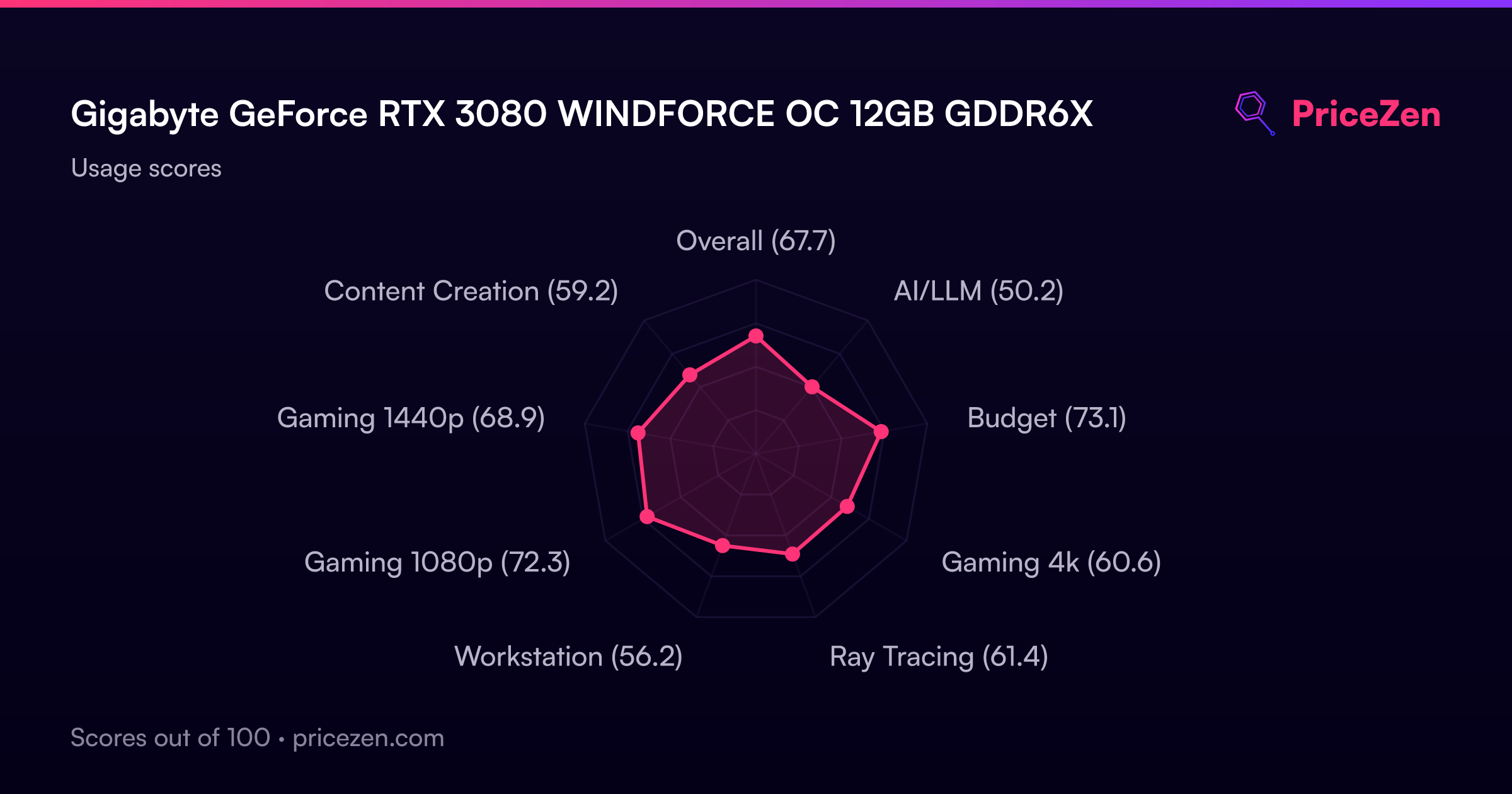
Usage Scores
- Overall67.7
- AI/LLM50.2
- Budget73.1
- Gaming 4k60.6
- Ray Tracing61.4
- Workstation56.2
- Gaming 1080p72.3
- Gaming 1440p68.9
- Content Creation59.2