OVAQUIXI 550TI 6GB GDDR5
The 550TI chipset with 6GB GDDR5 memory and 192-bit interface runs at 783MHz core and 1566MHz memory, supported by dual cooling fans and solid-state capacitors for stable operation. It requires no external power, only a 400W PSU, and offers plug-and-play setup with DVI, VGA, and HD Multimedia outputs across Windows and Linux. This card suits budget-conscious buyers needing basic 1080p gaming or office tasks, though it scores low for 4K gaming and heavy workstation workloads.

No current retailer price
Where we saw it before. Check the store for today's price.











Snapshot
The 30-Second Version
The OVAQUIXI 550TI is a $67 USD display adapter built around a 2011-era GPU. It's in the 2nd percentile for raster performance, so gaming is basically off the table. The 6GB of VRAM sounds nice but doesn't help when the core is this slow. Buy it if you need cheap video output for an old PC, skip it if you want to play games.
Pros & Cons
Pros
- Dirt cheap at around $67 USD, with affordability in the 95th percentile 95th
- No external power connector needed, runs off the PCIe slot alone
- DVI, VGA, and HDMI ports cover older and newer monitors
- Dual fan cooler keeps things quiet and cool enough
- Plug and play with Windows 7 through 11 and Linux support
Cons
- Raster performance in the 2nd percentile, slower than 98% of cards we track
- 6GB VRAM is misleading, the core can't use it effectively
- PCI Express 2.0 interface limits bandwidth on modern motherboards
- Connectivity score in the 5th percentile, no DisplayPort at all
- Efficiency score in the 2nd percentile, old architecture draws more power than it should
The proof
Performance
The raw numbers tell the story. Core frequency of 783MHz, memory frequency of 1566MHz, and a 192-bit memory interface. For context, even a budget card from five years ago runs circles around this. The raster score sits at the 2nd percentile, which means if you try to play anything made in the last decade at 1080p, you're going to have a bad time. The 4K gaming score is 4.2 out of 100, which is less a score and more a polite way of saying "don't."
The 6GB of VRAM is the marketing hook here, and it's a bit misleading. More VRAM doesn't help when the GPU core can't process frames fast enough to use it. The memory bandwidth is constrained by that 192-bit bus and the older GDDR5 spec. In practice, this card will handle desktop work, video playback, and maybe some very old or very light indie games. Think 2012-era titles at 720p, not modern esports. The thermal score is middle of the pack at the 43rd percentile, so the dual fan cooler does its job without drama, but it's cooling a chip that doesn't generate much heat to begin with.
Specifications
Full Specifications
Chipset
| GPU Chipset | 550TI |
| Brand | NVIDIA |
| Class | consumer |
Memory
| VRAM | 6 GB |
| Memory Type | GDDR5 |
| Memory Bus | 192 |
Compute
| Base Clock | 783 |
Power & Cooling
| Recommended PSU | 400 |
| Power Connectors | None |
| Cooler | Dual Fan |
| Fans | 2 |
Connectivity
| Interface | PCI Express 2.0 16X |
Physical
| Weight | 0.6 kg / 1.3 lbs |
Features
| DirectX | 11 |
vs Competition
Stacked against the competition, this card is in a weird spot. The MSI Ventus GTX 1660 SUPER costs more but is in a completely different universe of performance. The EVGA GTX 1070 SC and Gigabyte WINDFORCE GTX 1080 are both used-market favorites that will run modern games at 1080p without breaking a sweat. Even the ASRock Challenger A750, which is a budget Intel card, offers modern features like ray tracing and AV1 encoding that this card can't touch.
The trade-off is clear. Those cards all cost more, sometimes significantly more, and they all require external power connectors. The OVAQUIXI 550TI is for people who can't or won't spend more than $70 and just need something that works. The HP 20X24AA is another budget option worth mentioning, though it's more of a workstation card. If you're building a cheap office PC or reviving an old Dell, this card makes sense. If you want to play games, every single competitor here is a better choice.
| Spec | OVAQUIXI 550TI | HP RTX A4000 | EVGA GeForce GTX 1070 | Gigabyte GeForce GTX 1080 WINDFORCE OC | ASUS GeForce GTX 1070 Dual OC | ASRock Arc A750 Challenger |
|---|---|---|---|---|---|---|
| Chipset | 550TI | RTX A4000 | GeForce GTX 1070 | GeForce GTX 1080 | GeForce GTX 1070 | Arc A750 |
| Vram | 6GB GDDR5 | 16GB GDDR6 | 8GB GDDR5 | 8GB GDDR5X | 8GB GDDR5 | 8GB GDDR6 |
| Boost Clock Mhz | - | - | 1784 | 1797 | 1797 | 2200 |
| Tdp W | - | 140 | 150 | 180 | 150 | 225 |
| Memory Bus Bits | 192 | - | 256 | 256 | 256 | 256 |
| Ray Tracing | - | Yes | No | No | No | Yes |
| GPU Class | consumer | workstation | consumer | consumer | consumer | consumer |
| Compare | Compare | Compare | Compare | Compare |
| Product | AI | Rt | Vram | Raster | Feature | Thermal | Efficiency | Connectivity | Social Proof | Affordability |
|---|---|---|---|---|---|---|---|---|---|---|
| OVAQUIXI 550TI | 17.3 | 2.1 | 17.4 | 2.3 | 10.7 | 42.1 | 2.3 | 5.2 | 7.3 | 95.3 |
| HP RTX A4000 Compare | 66.2 | 34.5 | 62.5 | 41.2 | 33 | 16.2 | 92.2 | 35.4 | 0 | 20.2 |
| EVGA GeForce GTX 1070 Compare | 27.1 | 29.1 | 23.9 | 28.6 | 43.8 | 54.7 | 48.5 | 43.7 | 62.3 | 66.1 |
| Gigabyte GeForce GTX 1080 WINDFORCE OC Compare | 30.4 | 31.8 | 26 | 32.3 | 40 | 91.8 | 42.3 | 43.7 | 69.1 | 73.1 |
| ASUS GeForce GTX 1070 Dual OC Compare | 27.1 | 29.1 | 23.9 | 28.6 | 40 | 42.1 | 48.5 | 36.9 | 65 | 78.2 |
| ASRock Arc A750 Challenger Compare | 25 | 30.8 | 39.9 | 26.4 | 71.7 | 54.7 | 18.5 | 73.5 | 50.1 | 85.9 |
Price
Value & Pricing
At $67 USD, the OVAQUIXI 550TI is competing with used cards and whatever you can find in a bargain bin. The affordability percentile is 95th, which means it's cheaper than almost everything else in our database. But cheap and good value aren't the same thing. For the same money on the used market, you can often find something like a GTX 750 Ti or an RX 550 that will absolutely demolish this card in performance while using less power.
The value proposition really depends on what you need. If you just need video output for an old system, this is fine. It's new, it has a warranty, and it'll drive a couple of monitors. But if you have any gaming ambitions at all, even light ones, you're better off saving a bit more or shopping used. The 400W PSU recommendation is modest, which helps if you're working with an old office machine, but the efficiency score of 2nd percentile means you're getting very little performance per watt.
Price history
Read more
Overview
The OVAQUIXI 550TI is one of those products that makes you do a double take. A "new" graphics card built around a chip that was mid-range in 2011, now showing up on Amazon with 6GB of GDDR5 slapped on it and a dual fan cooler. It's aimed at people who need video output on a budget, or maybe someone trying to revive an old office PC without spending real GPU money. At around $67 USD, it's priced like a display adapter, not a gaming card.
Let's be clear about what this is. The GTX 550 Ti was a fine card when Obama was in office, but in our database this thing lands in the 2nd percentile for raster performance. That means 98% of the graphics cards we track are faster. The 6GB of VRAM sounds generous until you realize the memory bus is 192-bit and the core clock is 783MHz. This is not a sleeper gaming monster. It's a basic video output card with a nostalgic chip underneath.
But here's the thing. There's a real use case for this. Old office PCs, home theater boxes, machines that just need to drive a monitor or two. The card pulls all its power from the PCIe slot, so no extra power cables needed. It has DVI, VGA, and HDMI ports, which is actually handy for older monitors. And the affordability score is in the 95th percentile, which is the one place this card genuinely shines.
Common Questions
Q: Can this card play modern games at 1080p?
No. The 550TI chip is over a decade old and lands in the 2nd percentile for raster performance in our database. You might get playable frame rates in very old titles or simple indie games at 720p, but anything from the last several years will struggle. The 6GB of VRAM doesn't help because the GPU core itself is the bottleneck.
Q: Will this work in my old office PC without upgrading the power supply?
Probably, and that's one of the best reasons to buy it. The card draws all its power from the PCIe slot, so there's no external power connector to worry about. The manufacturer recommends a 400W PSU or above, which most standard office desktops already have. Just make sure your motherboard has a PCI Express 2.0 x16 slot available.
Q: Does this card support modern displays and multiple monitors?
It has DVI, VGA, and HDMI ports, so it can drive older monitors and most modern HDMI displays. However, there's no DisplayPort, which is a notable omission. The connectivity score sits in the 5th percentile, meaning most other cards offer more and newer port options. For a basic dual monitor setup with older screens, it'll work fine.
Q: Is the 6GB of VRAM actually useful?
Not really. The 550TI core is too slow to effectively use 6GB of VRAM in gaming workloads. The memory runs at 1566MHz on a 192-bit bus, which limits bandwidth significantly compared to modern cards. The extra VRAM might help with basic video editing or running multiple displays, but for gaming it's mostly a marketing number.
Who Should Skip This
If you have any intention of playing games made in the last ten years, skip this card. The raster performance is in the 2nd percentile, which means it's slower than 98% of the graphics cards we track. You'll be frustrated trying to run anything modern, and the 6GB of VRAM won't save you. Look at a used GTX 1660 SUPER or RX 580 instead. They cost more but actually deliver playable performance.
Also skip this if you need modern display connectivity. There's no DisplayPort, and the PCI Express 2.0 interface will bottleneck on newer motherboards. If you're building a new system or upgrading a relatively modern PC, this card is a step backward. It's really only suited for reviving old office machines or adding basic video output to a system that doesn't have it.
Verdict
For a basic display adapter, this card is fine. It'll push pixels to a monitor or two, handle video playback, and keep an old system useful. The lack of an external power connector is genuinely convenient for old office PCs with weak power supplies. The dual fan cooler is overkill for a chip this old, but it means the card runs quiet and cool. If that's all you need, the $67 USD price tag is hard to argue with.
For gaming, even casual gaming, look elsewhere. The 2nd percentile raster score means this card struggles with anything modern. The 6GB of VRAM is a marketing number that doesn't translate to real performance. If you want to play games on a budget, save up for a used GTX 1660 SUPER or an RX 580. You'll spend more, but you'll actually be able to play something. This card is a display adapter wearing a gaming card costume.
Usage Scores
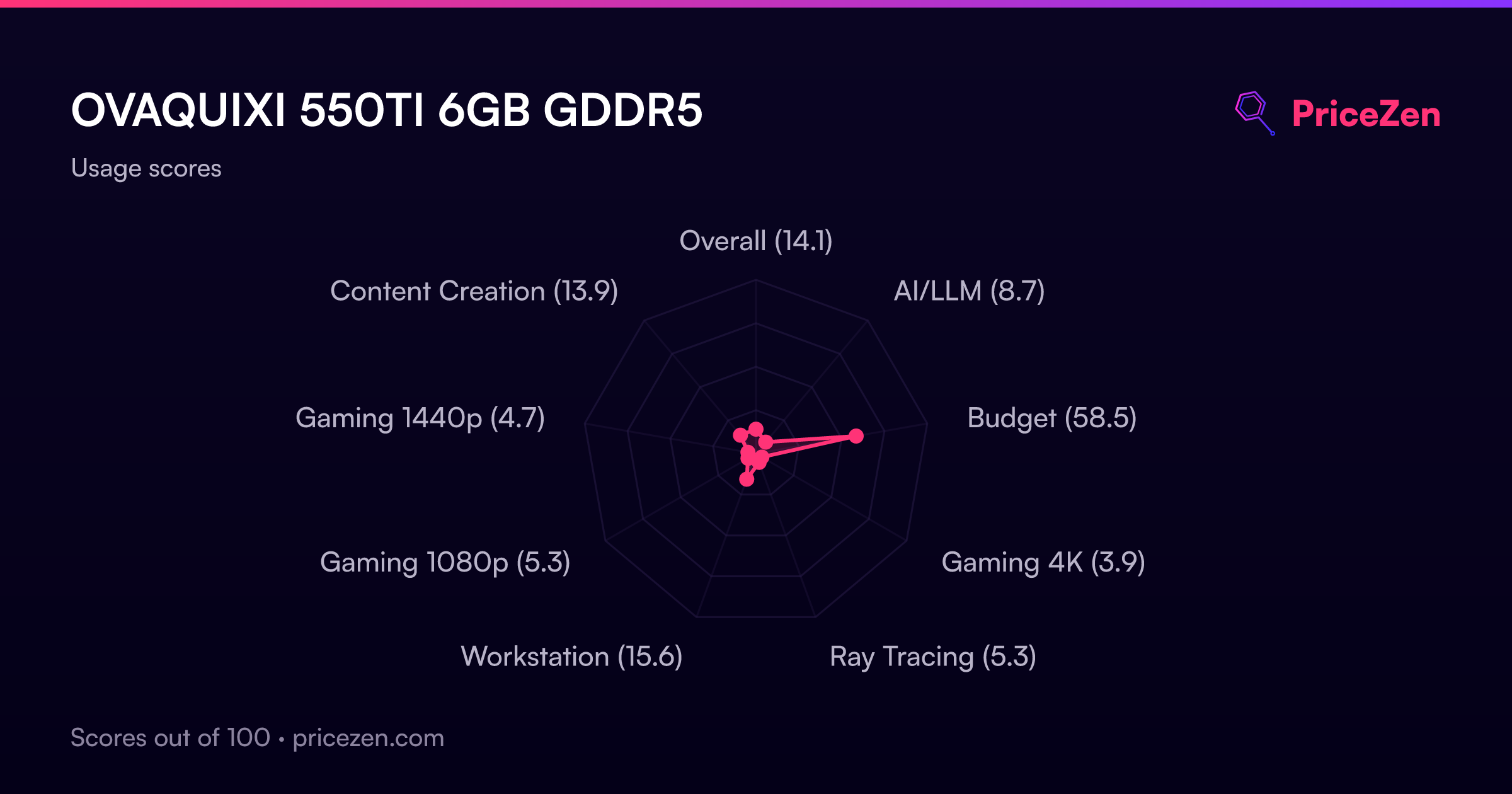
- Overall14.1
- AI/LLM8.7
- Budget58.5
- Gaming 4K3.9
- Ray Tracing5.3
- Workstation15.6
- Gaming 1080p5.3
- Gaming 1440p4.7
- Content Creation13.9