EVGA GeForce GTX 1070 8GB GDDR5 Black

8GB of VRAM for older titles verified Nov 29
34/100 overall score 4.5 average from 1,017 owner ratings
- GPU
- GeForce GTX 1070
- VRAM
- 8GB GDDR5
- Boost clock
- 1784 MHz
- TDP
- 150 W
- Memory bus
- 256 bit
- Class
- consumer
Compare prices at 1 store
Cheapest first. New, refurbished and bundled offers are kept apart, so you compare like with like.
| Store | Sold by | Colour and condition | Price | vs lowest | Last checked | Link |
|---|---|---|---|---|---|---|
| New1 offerSingle unit | ||||||
| Not checked in the last 7 days, so these prices may have changed | ||||||
| Newegg | Marketplace seller | Black | Price not confirmed | Not known | Go to store | |
 Source: PriceZen
A price counts as current when we checked it in the last 7 days. “Marketplace seller” means a third-party seller on that store, not the store itself.
Snapshot
The 30-Second Version
The EVGA GTX 1070 SC still has 8GB of GDDR5, 1920 CUDA cores and a friendly 150W TDP, and owners clearly adore it with a 4.5/5 across 1017 reviews. But our ranking puts it at 34.5/100 overall and 38.9/100 for 1080p gaming, with raster in the 28th percentile. At USD 349 from Newegg, that's a lot to pay for older performance. Buy it to rescue an aging build, not to start a new one.
Pros & Cons
Pros
- 8GB GDDR5 on a 256-bit bus at 256 GB/s, plenty for 1080p texture loads 75th
- 150W TDP with a single 8-pin, easy on an older power supply 73rd
- 4.5/5 from 1017 owners, 75th percentile for social proof
- Affordability at the 74th percentile, cheaper than most cards we track
- Three DisplayPort 1.4 outputs plus HDMI 2.0b and dual-link DVI-D
Cons
- Raster performance at the 28th percentile, behind most current cards
- AI score of 17/100, our weakest area for this card by far
- Compute at 6.46 TFLOPS lands in the 22nd percentile
- White-only LED lighting, no RGB customization on this model
- USD 349 at Newegg is a lot for a 34.5/100 overall score
What owners think
The Word on the Street
- Noise levels come up constantly, with multiple owners describing the dual-fan cooler as very quiet even when the fans spin up under load. Several also mention using EVGA's Precision XOC software to tune fan behavior and overclocking to their liking.
- Overclocking headroom is a recurring happy theme, with owners reporting they pushed core clocks well past the stock boost figure without much fuss. Enthusiast buyers seem to treat this card as a tinkering platform rather than a plug-and-forget part.
- EVGA's support gets singled out repeatedly, including from buyers who hit compatibility problems on fresh builds and came away impressed by how the company handled it. That reputation clearly feeds into the strong 4.5/5 average across 1017 reviews.
- The white-only LEDs divide people, since some builders wanted color matching and found this model can't do it. A smaller complaint is firmware: at least one owner had to update both the primary and secondary VBIOS before drivers would install properly.
How owner sentiment changed over time
ExclusiveBased on when customers actually wrote their reviews - so you can see whether early praise held up.
8 written reviews, Jul 2016 – Feb 2018: 8 happy
Across all 1,017 store ratings: 4.5★. Most owners rate without writing a review. The chart counts the 8 written reviews.
Each dot is one written review, in the month it was written. Happy = 4-5★, mixed = 3★, unhappy = 1-2★.
The proof
Performance
The external PassMark G3D benchmark score is 13513, and compute comes in at 6.46 FP32 TFLOPS. Translated into buying terms: that's enough muscle for older titles and esports at 1080p, and enough for desktop work, video playback and multi-monitor setups without breaking a sweat. But our raster ranking puts it at the 28th percentile, meaning roughly seven out of ten cards we track will out-render it. Compute sits even lower, around the 22nd percentile. If you're planning to play recent releases with settings turned up, this is where the dream ends.
The other numbers worth knowing: 150W TDP, a 500W PSU recommendation, one 8-pin connector, and a dual-fan cooler on a 267mm, two-slot card. That's a friendly power profile for an older system, though efficiency lands mid-pack at the 48th percentile and thermals at the 54th, so it's average rather than impressive. VRAM ranks at the 24th percentile despite the 8GB, because capacity alone doesn't save you when the bus and generation are behind. And AI is the clear weak spot: 17/100 in our scoring, 27th percentile. Ray tracing sits at the 29th percentile too. DLSS and VR Ready are listed in the feature set, but the feature score overall is only the 39th percentile, so don't buy this expecting modern tricks to carry it.
Specifications
Full Specifications
Chipset
| GPU Chipset | GeForce GTX 1070 |
| Brand | NVIDIA |
| Architecture | Pascal |
| Class | consumer |
| Process | 16 |
Memory
| VRAM | 8 GB |
| Memory Type | GDDR5 |
| Memory Bus | 256 |
| Bandwidth | 256.3 |
| ECC | No |
Compute
| CUDA Cores | 1920 |
| Base Clock | 1594 |
| Boost Clock | 1784 |
| FP32 TFLOPS | 6.46 |
Performance
| PassMark G3D | 13513 |
| GPU Compute | 6116 |
Power & Cooling
| TDP | 150 |
| Recommended PSU | 500 |
| Power Connectors | 1 x 8-pin |
| Cooler | Dual Fan |
| Fans | 2 |
Connectivity
| Interface | PCI Express 3.0 |
| DisplayPort | 3 |
| HDMI | 1 |
| Max Displays | 4 |
| Max Resolution | 7680 x 4320 |
Physical
| Length | 267 |
| Slot Width | 2 |
Features
| Ray Tracing | No |
| Upscaling | DLSS |
| AV1 Encode | No |
| VR Ready | Yes |
| DirectX | 12 |
| RGB | No |
vs Competition
Cross-shop this against the MSI GeForce RTX 5070 Gaming Trio and the ASUS GeForce RTX 5070 PRIME and the picture gets stark fast. Those are the cards our ranking places above it, and the reason shows up in this card's own numbers: 28th percentile raster, 29th percentile ray tracing, 22nd percentile compute. If you care about frame rates in anything recent, or you want ray tracing to be a real feature rather than a checkbox, either of those two is the direction to look. The EVGA's counterargument is its 150W TDP and single 8-pin, which is a genuinely easier fit for an aging build than a current-generation card.
On the AMD side, the Sapphire Radeon RX 9070 XT NITRO+, PowerColor Radeon RX 9070 XT Hellhound OC and Gigabyte Radeon RX 9070 XT Gaming OC all sit in the same competitor set, and again the gap is visible in this card's own rankings rather than any spec sheet comparison. Where the EVGA holds ground is affordability at the 74th percentile and owner satisfaction at the 75th, plus a display output spread that includes dual-link DVI-D for anyone still running an older monitor. That's a real niche. It's just a niche, not a recommendation for a new gaming build.
| Spec | EVGA GeForce GTX 1070 | MSI GeForce RTX 5070 Gaming Trio | ASUS GeForce RTX 5070 PRIME | Sapphire Radeon RX 9070 XT NITRO+ | PowerColor Radeon RX 9070 XT Hellhound OC | Gigabyte Radeon RX 9070 XT Gaming OC |
|---|---|---|---|---|---|---|
| Chipset | GeForce GTX 1070 | GeForce RTX 5070 | GeForce RTX 5070 | Radeon RX 9070 XT | Radeon RX 9070 XT | Radeon RX 9070 XT |
| Vram | 8GB GDDR5 | 12GB GDDR7 | 12GB GDDR7 | 16GB GDDR6 | 16GB GDDR6 | 16GB GDDR6 |
| Boost Clock Mhz | 1784 | 2610 | 2512 | 3060 | 3010 | 3060 |
| Tdp W | 150 | 250 | 250 | 304 | 304 | 424 |
| Memory Bus Bits | 256 | 192 | 192 | 256 | 256 | 256 |
| Ray Tracing | No | Yes | Yes | Yes | Yes | Yes |
| GPU Class | consumer | consumer | consumer | consumer | consumer | consumer |
| Compare | Compare | Compare | Compare | Compare |
| Product | AI | Rt | Vram | Raster | Compute | Feature | Thermal | Efficiency | Connectivity | Social Proof | Affordability |
|---|---|---|---|---|---|---|---|---|---|---|---|
| EVGA GeForce GTX 1070 | 26.5 | 28.5 | 23.5 | 28 | 21.8 | 39.2 | 54.2 | 48 | 42.9 | 75.2 | 73.4 |
| MSI GeForce RTX 5070 Gaming Trio Compare | 60.7 | 83 | 65.3 | 78.8 | 70.5 | 95.7 | 91.9 | 78.7 | 94.3 | 93.7 | 32.3 |
| ASUS GeForce RTX 5070 PRIME Compare | 60.7 | 83 | 65.3 | 78.8 | 70.5 | 95.7 | 91.9 | 78.7 | 94.3 | 93.7 | 39 |
| Sapphire Radeon RX 9070 XT NITRO+ Compare | 89.9 | 84.8 | 73.6 | 74.6 | 90.6 | 95.7 | 91.9 | 44.5 | 89.1 | 84.1 | 32.6 |
| PowerColor Radeon RX 9070 XT Hellhound OC Compare | 89.8 | 84.8 | 75.1 | 74.6 | 95.1 | 88.4 | 91.9 | 44.5 | 94.3 | 48.7 | 38.4 |
| Gigabyte Radeon RX 9070 XT Gaming OC Compare | 89.1 | 77.9 | 73.6 | 74.6 | 90.6 | 95.7 | 91.9 | 19.8 | 89.1 | 84.1 | 40.3 |
Price
Value & Pricing
Here's the uncomfortable part. We track this at USD 349, and the only listing in our data is Newegg at that same USD 349, so there's no cross-store shopping to be done and no cheaper option to point you toward. Our affordability ranking says it's cheaper than most of the category, and that's true in a relative sense. But price-to-performance is a different question, and a 34.5/100 total score with a 38.9/100 gaming-at-1080p score means you're paying a fairly modern amount of money for a distinctly non-modern result.
If you already own a working card of similar vintage, upgrading to this makes very little sense. If your card died and you need something with 8GB and low power draw to keep an older machine alive, the value argument gets a lot more reasonable. That's the whole case for it, and it's a narrow one.
Price history
Read more
Overview
The EVGA GTX 1070 SC Gaming ACX 3.0 is a card that refuses to leave the conversation. It's built on Nvidia's Pascal silicon at 16nm, with 1920 CUDA cores, a 1594 MHz core clock and a 1784 MHz boost, plus 8GB of GDDR5 on a 256-bit bus pushing 256 GB/s. On paper that's still a respectable pile of hardware. In our category-wide ranking it lands at 34.5 out of 100 overall, which tells you exactly where it sits right now: not dead, but well behind the current crop.
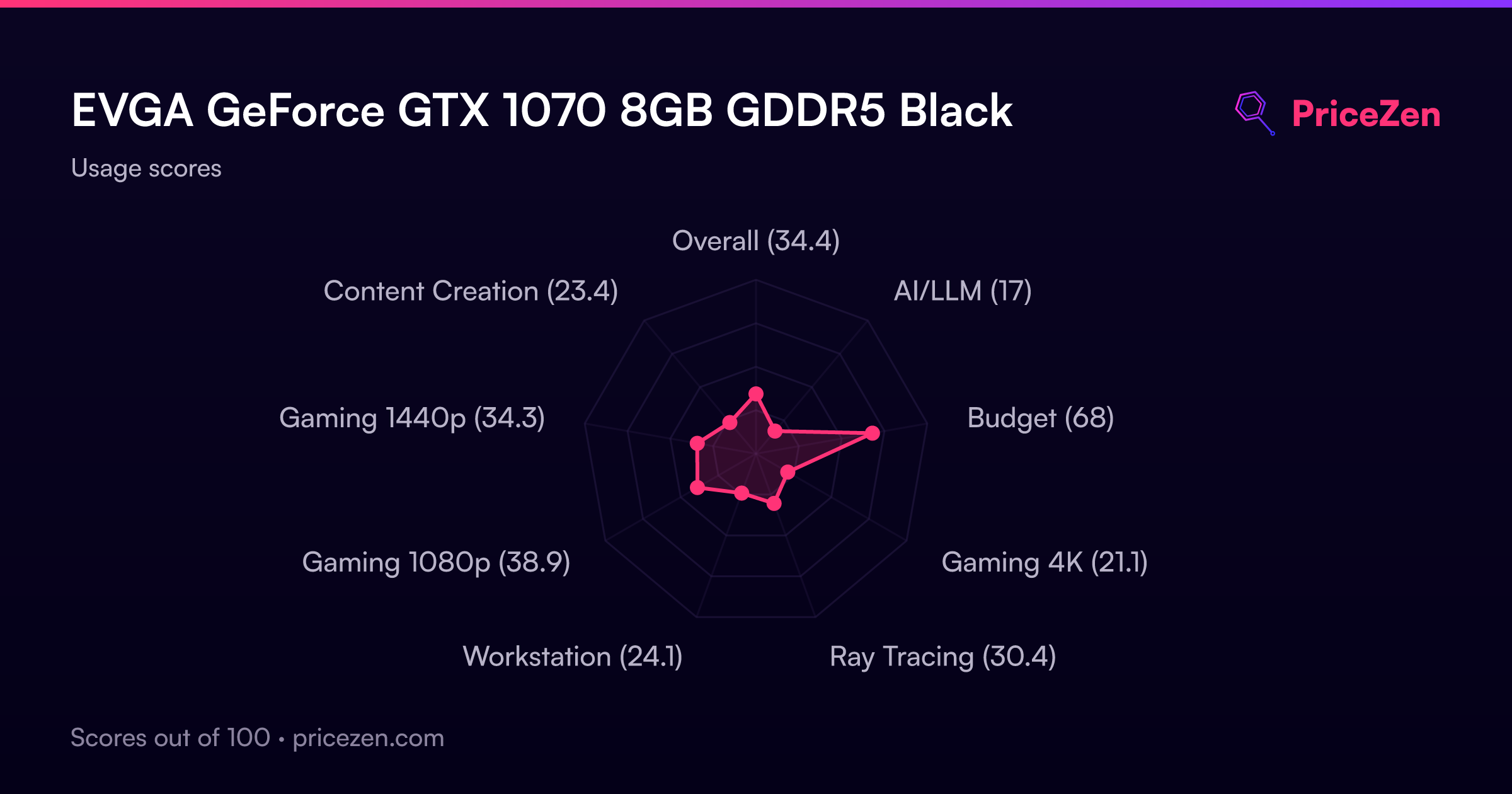
So who's this for? Honestly, someone replacing a failed card in an older build, or someone who wants 8GB of framebuffer and DisplayPort 1.4 outputs without spending modern-GPU money. Our affordability score puts it at the 74th percentile, so it's cheaper than most of what we track in this category, and the budget fit score of 68/100 backs that up. But the gaming-at-1080p score is only 38.9/100, and that's the number I'd stare at longest before clicking buy.
What makes it interesting is the gap between how owners feel about it and where the data puts it. It carries a 4.5/5 rating across 1017 reviews, sitting at the 75th percentile for social proof, which is genuinely strong. People love this card. The catch is that affection and raw capability are two different things, and the trade-off here is simple: you get a quiet, well-supported, cheap-ish card, and you give up a lot of headroom for anything newer than a few years old.
Common Questions
Q: Will this handle games at 1080p right now?
For older titles and esports, yes, and the 8GB of GDDR5 with 256 GB/s of bandwidth helps with texture-heavy scenes. But our 1080p gaming score is 38.9/100 and raster performance sits in the 28th percentile of the category, so recent demanding releases will need settings pulled way down. Treat it as a 1080p card for a back catalog, not a current one.
Q: Can I run local AI models or LLMs on it?
This is the card's worst area in our scoring, at 17/100, with AI capability in the 27th percentile and compute at just 6.46 FP32 TFLOPS. The 8GB buffer sounds useful, but VRAM ranks in the 24th percentile overall and the underlying architecture is the bottleneck. If AI work is the goal, look elsewhere entirely.
Q: What power supply and case space do I need?
It's a 150W TDP card with a single 8-pin connector and a 500W PSU recommendation, which is modest enough for most older systems. Physically it's 267mm long and takes two slots, so check your case clearance but expect it to fit most mid-towers. Thermals rank mid-pack at the 54th percentile, so decent case airflow still matters.
Q: Does it have RGB lighting or a backplate?
Based on owner Q&A, this SC ACX 3.0 model has white LEDs only, with no color customization, and it does include a backplate. Buyers who want RGB were pointed toward EVGA's higher-tier models instead. There's also a Black Edition variant that drops both the backplate and the lighting, so read the model number carefully.
Who Should Skip This
Anyone building a new gaming PC should walk past this one. A 38.9/100 score for 1080p gaming and raster in the 28th percentile means you'd be installing a limitation on day one, and at USD 349 you're not saving enough to justify it. Cross-shop the MSI GeForce RTX 5070 Gaming Trio, ASUS GeForce RTX 5070 PRIME, or the Radeon RX 9070 XT options from Sapphire, PowerColor and Gigabyte instead.
Also skip it if you're doing AI or LLM work, since 17/100 is our weakest score for this card and 6.46 TFLOPS won't get you far. Same story for anyone chasing ray tracing, which ranks in the 29th percentile here. And if you already have a card of this era running fine, there's no upgrade to be had.
Verdict
For a repair or a stopgap in an older system, this is defensible. The 150W draw, single 8-pin, 267mm length and two-slot width mean it'll drop into a lot of cases and power supplies without drama, and 1017 owners averaging 4.5/5 suggests it does its job quietly and reliably. If your use case is 1080p esports, older titles, or a general-purpose desktop with several monitors attached, you'll be fine.
For a new gaming build, skip it. A 38.9/100 score for 1080p gaming and a 17/100 for AI workloads mean you're buying a ceiling, not a foundation. Anyone planning to keep this card for years should put the money toward one of the current-generation competitors instead. The honest summary: this is a good card that time has moved past, and USD 349 doesn't change that.
Usage Scores
- Overall34.4
- AI/LLM17
- Budget68
- Gaming 4K21.1
- Ray Tracing30.4
- Workstation24.1
- Gaming 1080p38.9
- Gaming 1440p34.3
- Content Creation23.4