MSI GeForce RTX 5090 Gaming Trio 32GB GDDR7
The 32GB of GDDR7 memory on a 512-bit bus and 21,760 CUDA cores provide massive headroom for local LLM inference and complex AI content creation pipelines. Its TRI FROZR 4 thermal design and included GPU holder ensure sustained performance and long-term build stability under heavy load. This card is best for AI researchers and developers running large on-device models who also demand high-end 4K gaming with DLSS 4 and ray tracing.












Snapshot
The 30-Second Version
The MSI RTX 5090 Gaming Trio is a monster: 32GB GDDR7, 21760 CUDA cores and a 38958 PassMark G3D score that puts it at the top of our raster rankings. It scores 89.7/100 for AI and local LLM work, which is where that VRAM really earns its keep. But at USD 8,469 with a 575W TDP and affordability in the 1st percentile, this is a specialist purchase. Buy it for AI and heavy creation work; gamers should cross-shop the 5080 crowd first.
Pros & Cons
Pros
- Top-of-the-charts raster performance, 99th percentile with a 38958 PassMark G3D score 99th
- 32GB GDDR7 on a 512-bit bus at 28 Gbps, 98th percentile for VRAM 98th
- 3352 AI TOPS from 5th Gen Tensor Cores, 89.7/100 in our AI and LLM scoring 98th
- Factory OC to 2482 MHz, 2497 MHz via MSI Center Extreme Performance mode 98th
- TRI FROZR 4 triple-fan cooler plus a bundled GPU holder to fight sag
Cons
- USD 8,469 with affordability in the 1st percentile, the priciest tier we track
- 575W TDP puts efficiency at the 24th percentile, a real weak spot
- Thermal ranking only 72nd percentile despite the premium cooler
- Connectivity sits mid-pack at the 73rd percentile with 3x DP 2.1b and 1x HDMI 2.1b
- Customer rating of 3.1/5 from just 2 reviews, social proof in the 3rd percentile
The proof
Performance
Let's start with the number that matters most for raw grunt: a PassMark G3D benchmark score of 38958. That lands it in the 99th percentile for raster performance among every graphics card we track, meaning there's essentially nothing above it. Compute sits at the 98th percentile too, which tracks with 21760 CUDA cores and that 512-bit bus feeding them at 28 Gbps. For a real buyer, that combination means large textures, huge scene files and GPU-accelerated renders don't hit the usual memory-bandwidth wall. Ray tracing ranks at the 85th percentile with 4th Gen RT cores, so it's one of the stronger options out there, though it's a step down from the near-perfect scores elsewhere. DLSS 4 support helps close that gap in supported titles by generating frames rather than brute-forcing them.
The trade-off is power and heat. This is a 575W TDP card, and our efficiency ranking puts it at the 24th percentile, which is a genuine weak spot. You're paying for that top-tier performance twice: once at checkout and again on your electricity bill, plus whatever it costs to feed a power supply that can handle it. MSI's TRI FROZR 4 cooler with STORMFORCE fans, a copper baseplate and heatpipes is doing serious work here, but our thermal ranking still only lands at the 72nd percentile, solid rather than exceptional. Sustained loads are exactly where a 575W card earns or loses its reputation, so plan your case airflow accordingly. The bundled GPU holder is a small but sensible inclusion given how much card this is.
Specifications
Full Specifications
Chipset
| GPU Chipset | GeForce RTX 5090 |
| Brand | NVIDIA |
| Architecture | Blackwell |
| Class | consumer |
Memory
| VRAM | 32 GB |
| Memory Type | GDDR7 |
| Memory Bus | 512 |
| ECC | No |
Compute
| CUDA Cores | 21760 |
| Tensor Cores | 5 |
| RT Cores | 4 |
| Base Clock | 2482 |
| Boost Clock | 2497 |
Performance
| PassMark G3D | 38958 |
| GPU Compute | 24458 |
Power & Cooling
| TDP | 575 |
| Cooler | Triple Fan |
| Fans | 3 |
Connectivity
| DisplayPort | 3 |
| HDMI | 1 |
| USB-C | 0 |
| Max Displays | 4 |
| Max Resolution | 8K |
Features
| Ray Tracing | Yes |
| Upscaling | DLSS 4 |
vs Competition
The obvious cross-shop is the ASUS GeForce RTX 5090 TUF Gaming, since it shares the same chipset family. We only have names for competitors, not their specs, so here's the honest framing: if you're set on a 5090, the decision between these two comes down to cooler design, factory clocks and bundle extras. MSI brings TRI FROZR 4, a 2497 MHz Extreme Performance mode and a GPU holder in the box. Our thermal ranking for this card is 72nd percentile, solid but not dominant, so it's worth weighing whether the TUF's approach appeals more to your build. Neither is a bad pick on paper; both sit on the same top-tier silicon.
Then there's the step-down question. The Gigabyte GeForce RTX 5080 WINDFORCE, ZOTAC GeForce RTX 5080 AMP Extreme Infinity and the reference NVIDIA GeForce RTX 5080 are all in our competitor set, and given this card's 1st-percentile affordability, they're the natural place to look if USD 8,469 makes you flinch. What you give up is the stuff that puts this MSI at the 98th percentile for VRAM and AI: 32GB and 3352 AI TOPS are the differentiators. For pure gaming, that gap matters less than it does for AI work. And if you're doing professional workstation ML, the PNY NVIDIA RTX PRO 6000 Blackwell Max-Q Workstation Edition is the other direction to look, aimed squarely at that audience rather than at gamers who also create.
| Spec | MSI GeForce RTX 5090 Gaming Trio | ASUS GeForce RTX 5090 TUF Gaming | Gigabyte GeForce RTX 5080 WINDFORCE | ZOTAC GeForce RTX 5080 AMP Extreme Infinity | PNY NVIDIA RTX PRO 6000 Blackwell Max-Q Workstation Edition | NVIDIA GeForce RTX 5080 |
|---|---|---|---|---|---|---|
| Chipset | GeForce RTX 5090 | GeForce RTX 5090 | GeForce RTX 5080 | GeForce RTX 5080 | NVIDIA RTX PRO 6000 Blackwell Max-Q Workstation Edition | GeForce RTX 5080 |
| Vram | 32GB GDDR7 | 32GB GDDR7 | 16GB GDDR7 | 16GB GDDR7 | 96GB GDDR7 | 16GB GDDR7 |
| Boost Clock Mhz | 2497 | 2407 | 2617 | 2670 | 2280 | 2617 |
| Tdp W | 575 | 575 | 360 | 360 | 300 | 360 |
| Memory Bus Bits | 512 | 512 | 256 | 256 | 512 | 256 |
| Ray Tracing | Yes | Yes | Yes | Yes | Yes | Yes |
| GPU Class | consumer | consumer | consumer | consumer | workstation | consumer |
| Compare | Compare | Compare | Compare | Compare |
| Product | AI | Rt | Vram | Raster | Compute | Feature | Thermal | Efficiency | Connectivity | Social Proof | Affordability |
|---|---|---|---|---|---|---|---|---|---|---|---|
| MSI GeForce RTX 5090 Gaming Trio | 97.6 | 85.3 | 97.8 | 98.8 | 98.4 | 52.2 | 72 | 23.3 | 73.3 | 2.6 | 0.9 |
| ASUS GeForce RTX 5090 TUF Gaming Compare | 97.2 | 90.4 | 97.8 | 98.8 | 97.7 | 95.7 | 72 | 23.3 | 99.3 | 98.7 | 2.1 |
| Gigabyte GeForce RTX 5080 WINDFORCE Compare | 85.5 | 95.3 | 89.1 | 94.5 | 93.3 | 88.4 | 91.9 | 56.8 | 94.2 | 93.4 | 11.3 |
| ZOTAC GeForce RTX 5080 AMP Extreme Infinity Compare | 85.5 | 97.6 | 89.1 | 94.5 | 93.3 | 95.7 | 91.9 | 56.8 | 94.2 | 98.7 | 7.6 |
| PNY NVIDIA RTX PRO 6000 Blackwell Max-Q Workstation Edition Compare | 99.8 | 99.6 | 99.8 | 87.2 | 99.4 | 99.8 | 25 | 69.2 | 87.2 | 46.8 | 0.4 |
| NVIDIA GeForce RTX 5080 Compare | 85.5 | 97.6 | 89.1 | 94.5 | 93.3 | 65.7 | 31.2 | 56.8 | 81.4 | 93.4 | 8.8 |
Price
Value & Pricing
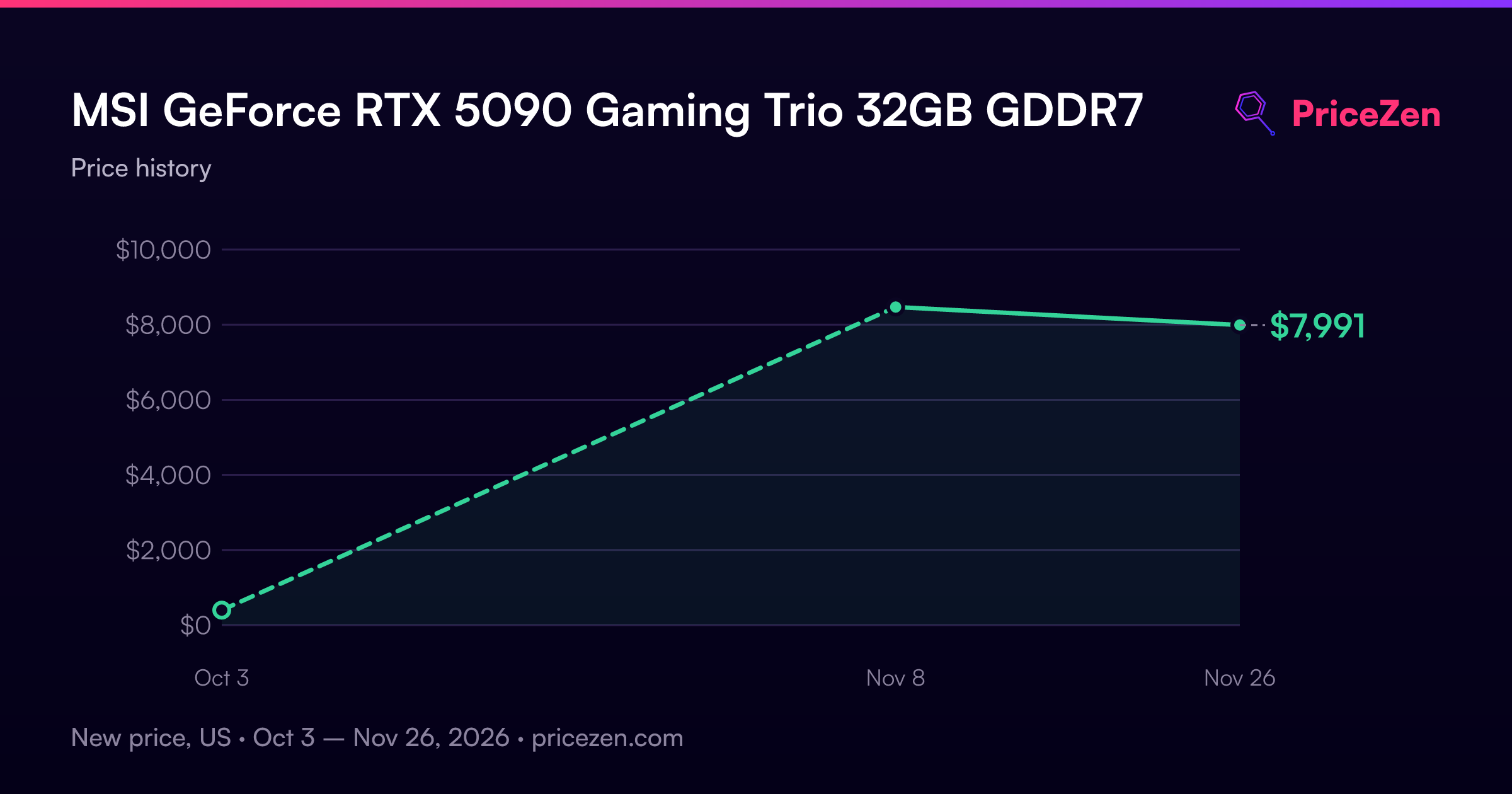
Here's the uncomfortable part. At USD 8,469 from Amazon, this is the only listing we currently track, so there's no cross-store shopping to soften the blow. Our price tracking, partly fed by our community browser extension, shows a single US listing at that figure. Affordability ranks in the 1st percentile, meaning almost every other card in the category costs less relative to what it delivers. The budget score of 54.9/100 is the lowest of all its use-case ratings.
Does the performance justify it? Depends entirely on what you do. If you're running local LLM inference where 32GB of VRAM lets you load models that simply won't fit on smaller cards, the math changes. You're not buying frames, you're buying capability that has no cheaper substitute in this lineup. If you're mostly gaming at 4K, the 82/100 gaming score is excellent but you're paying a steep premium over the 89.7/100 AI score that this card is really optimized around. Buy it for the workload that needs it, not for the badge.
Amazon 1 offer From $7,991
Price history
Read more
Overview
The MSI GeForce RTX 5090 Gaming Trio is the kind of card you buy when "good enough" stopped being good enough a while ago. It's built on NVIDIA's Blackwell platform with 21760 CUDA cores, 32GB of GDDR7 running at 28 Gbps across a 512-bit memory bus, and a factory boost clock up to 2482 MHz that stretches to 2497 MHz through MSI Center's Extreme Performance mode. In our data it sits at the very top of the graphics card category for raster performance, compute throughput, VRAM capacity and AI capability. That's four separate areas where this thing is basically best-in-class right now.
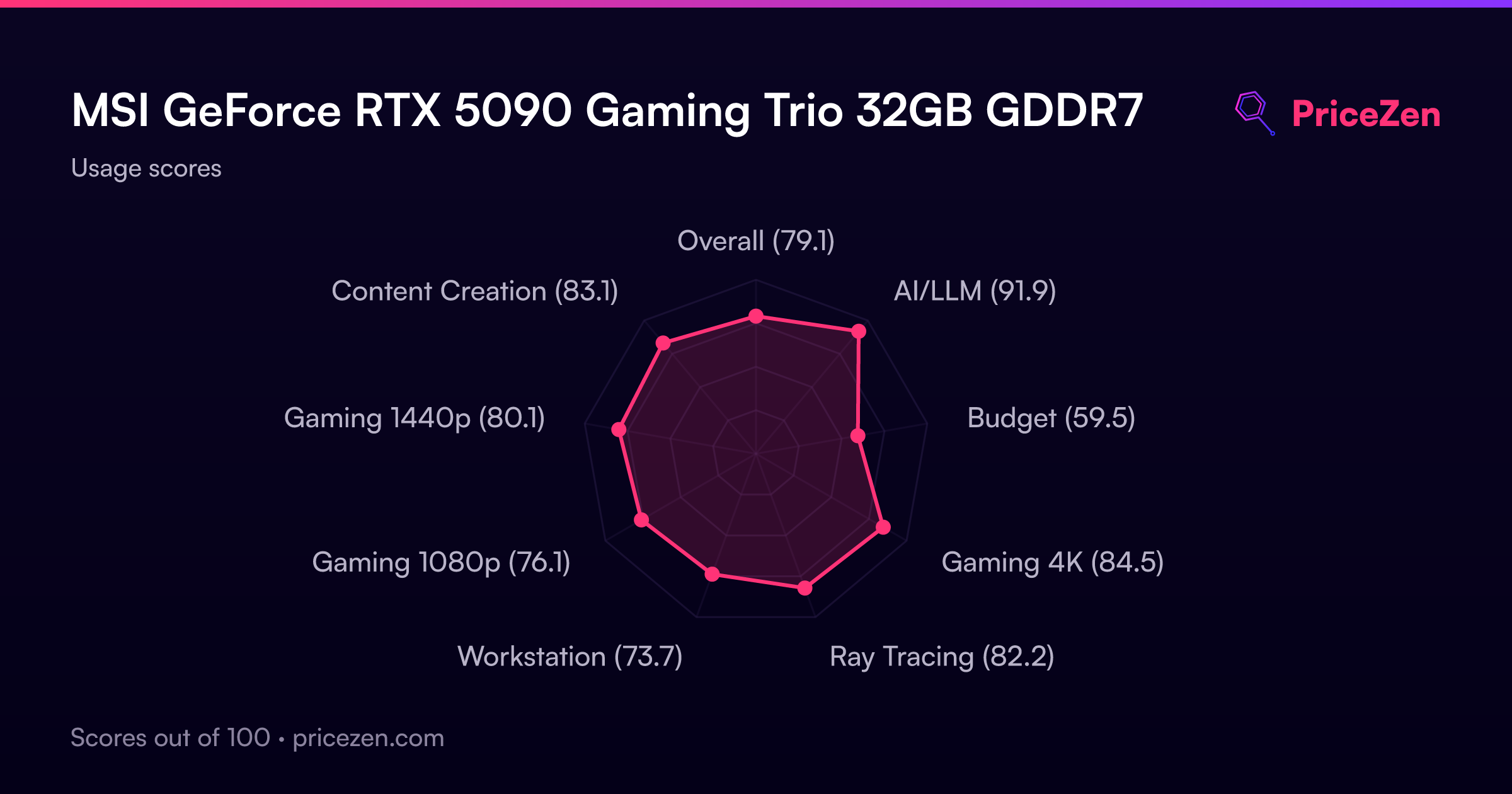
Who's it for? Our scoring model gives it 89.7/100 for AI and local LLM work, 82/100 for 4K gaming and 81.1/100 for content creation. That ordering tells you something. The headline here isn't just frames per second, it's the 32GB of VRAM and the 3352 AI TOPS from the 5th Gen Tensor Cores. If you're running larger language models locally, chewing through generative AI pipelines, or juggling heavy timelines with big assets, that memory headroom is the reason to look at this card instead of something cheaper. Gamers get the benefit too, but they're arguably not... sorry, they're not the only audience anymore.
And then there's the price. USD 8,469 at Amazon, which is the only listing we currently track for it. Our affordability ranking puts this in the bottom sliver of the entire category, and the budget score of 54.9/100 is its weakest area by a wide margin. So the interesting question with this card isn't whether it's fast. It obviously is. It's whether the specific workloads you run justify paying flagship money for flagship silicon.
Common Questions
Q: Is 32GB of VRAM actually useful, or is it overkill?
For gaming alone, most titles won't come close to filling it. But this card ranks in the 98th percentile for VRAM in our data, and that headroom is the whole point for local LLM inference, where model size and context length are limited by memory before anything else. If you're loading larger models or running generative AI alongside a heavy creative app, 32GB on a 512-bit bus at 28 Gbps is the difference between a workflow that runs and one that doesn't.
Q: What kind of power supply and cooling do I need for a 575W card?
575W TDP is a lot, and our efficiency ranking puts this card at the 24th percentile, so plan for a PSU with real headroom above the GPU's draw alone plus the rest of your system. MSI's TRI FROZR 4 cooler with STORMFORCE fans, copper baseplate and heatpipes handles the load, but our thermal ranking is only 72nd percentile, so case airflow still matters. The bundled GPU holder helps with sag, which is worth using given the size of a triple-fan flagship.
Q: How does it compare to an RTX 5080 for gaming?
This card sits at the 99th percentile for raster performance with a 38958 PassMark G3D benchmark score and scores 82/100 for 4K gaming in our model, so it's about as fast as consumer graphics get. The RTX 5080 options from Gigabyte, ZOTAC and NVIDIA are in our competitor set and are the sensible cross-shop if the USD 8,469 price stings. The gap between them matters far more for AI and VRAM-hungry work than it does for frames.
Q: What displays can I run off this card?
You get 3x DisplayPort 2.1b and 1x HDMI 2.1b, supporting up to 4 displays. The HDMI 2.1b output supports up to 4K 480Hz or 8K 120Hz with DSC, provided your display and cable support it. Connectivity ranks at the 73rd percentile in our data, solid and well above average rather than class-leading, which is fine for most multi-monitor creator and gaming setups.
Who Should Skip This
Pure gamers on any kind of budget should skip this. Not because it's slow, it's the opposite, but because USD 8,469 buys you a 98th-percentile VRAM figure and 3352 AI TOPS that games largely ignore. The Gigabyte RTX 5080 WINDFORCE, ZOTAC RTX 5080 AMP Extreme Infinity and NVIDIA's own RTX 5080 are all in our competitor set and are where your money goes further if frames are the goal. Same advice if your case is compact or your PSU is modest: a 575W TDP card with a 24th-percentile efficiency ranking is not a drop-in upgrade.
Also skip it if you need quiet, low-power operation or if you're building a workstation for professional ML deployment rather than experimentation. The PNY RTX PRO 6000 Blackwell Max-Q Workstation Edition exists in our competitor list precisely for that professional lane. And with only 2 customer reviews averaging 3.1/5, social proof sits in the 3rd percentile, so there's very little owner feedback to lean on yet. That's not a red flag about the hardware, but it does mean you're buying on specs and benchmarks rather than a track record.
Verdict
If you run local LLMs, generative AI pipelines or heavy GPU-accelerated creative work, this is one of the strongest cards you can buy right now. The 89.7/100 AI score, 32GB of GDDR7 and 3352 AI TOPS aren't marketing garnish, they're the reason this card exists in your shortlist. Nothing else in our competitor set matches that VRAM percentile without going full workstation. Just go in with your eyes open about the 575W draw and make sure your PSU and case can actually live with it.
If you're a gamer first and a creator second, we'd slow you down. The 82/100 4K gaming score is genuinely great and the 99th-percentile raster ranking means you'll never feel shortchanged on frames. But you're paying flagship-plus money at USD 8,469 for headroom you may never touch, and the RTX 5080 options in our competitor list deserve a serious look before you commit. Buy this card because your work demands 32GB, not because you want the biggest number on the box.
Usage Scores
- Overall79.1
- AI/LLM91.9
- Budget59.5
- Gaming 4K84.5
- Ray Tracing82.2
- Workstation73.7
- Gaming 1080p76.1
- Gaming 1440p80.1
- Content Creation83.1