ASUS GeForce RTX 3060 Ti Dual Mini V2 OC 8GB GDDR6 Black
The compact dual-fan design and 1740MHz boost clock of the Ampere-based RTX 3060 Ti deliver solid 1080p and 1440p gaming with ray tracing and DLSS 2 support. Its 2-slot, mini form factor makes it a strong fit for small-form-factor builds where space is at a premium. This refurbished card is best for budget-conscious PC builders upgrading from older GTX or RX series GPUs in compact cases.

No current retailer price


Snapshot
The 30-Second Version
A tiny card with big 1080p energy and a VRAM problem. Buy it for small builds, skip it for ray tracing.
Pros & Cons
Pros
- Tiny 200mm card fits in almost any case 78th
- Solid 1080p and 1440p raster performance 71st
- Runs cool and quiet for a dual-fan card
- Easy software and driver experience
Cons
- 8GB VRAM is a real limitation in 2025
- Ray tracing performance is weak
- 750W PSU recommendation is overkill for a 200W card
- No meaningful AI or compute chops
What owners think
The Word on the Street
How owner sentiment changed over time
ExclusiveBased on when customers actually wrote their reviews - so you can see whether early praise held up.
6 written reviews, Jan 2022 – May 2023: 5 happy, 1 unhappy
Across all 28 store ratings: 4.6★. Most owners rate without writing a review. The chart counts the 6 written reviews.
Each dot is one written review, in the month it was written. Happy = 4-5★, mixed = 3★, unhappy = 1-2★.
The proof
Performance
The 1710MHz boost clock and 16.2 FP32 TFLOPS put this card right around the middle of the pack for raster performance, which honestly surprised us. It's not going to blow anyone away on paper, but in real games it punches above its weight at 1080p and holds its own at 1440p as long as you don't crank ray tracing. The 608 GB/s memory bandwidth helps, but the 8GB frame buffer is the bottleneck. Ray tracing performance lands in the bottom third of our database, so treat RT as a bonus feature, not a reason to buy.
Specifications
Full Specifications
Chipset
| GPU Chipset | GeForce RTX 3060 Ti |
| Brand | NVIDIA |
| Architecture | Ampere |
| Class | consumer |
| Process | 8 |
Memory
| VRAM | 8 GB |
| Memory Type | GDDR6 |
| Memory Bus | 256 |
| Bandwidth | 608.3 |
Compute
| CUDA Cores | 4864 |
| Tensor Cores | 152 |
| RT Cores | 38 |
| Base Clock | 1680 |
| Boost Clock | 1710 |
| FP16 TFLOPS | 16.2 |
| FP32 TFLOPS | 16.2 |
Performance
| PassMark G3D | 20241 |
| GPU Compute | 9920 |
Power & Cooling
| TDP | 200 |
| Recommended PSU | 750 |
| Power Connectors | 1 x 8-pin |
| Cooler | Dual Fan |
| Fans | 2 |
Connectivity
| Interface | PCI Express 4.0 |
| DisplayPort | 3 |
| HDMI | 1 |
| Max Displays | 4 |
| Max Resolution | 7680 x 4320 |
Physical
| Length | 200 |
| Slot Width | 2 |
| Form Factor | ITX |
| Weight | 1.4 kg / 3.0 lbs |
Features
| Ray Tracing | Yes |
| Upscaling | DLSS |
| VR Ready | Yes |
| DirectX | 12 Ultimate |
| RGB | Yes |
vs Competition
The ZOTAC SOLID SFF OC and MSI GAMING TRIO are the two competitors worth a look. The ZOTAC is another small form factor card but with a newer architecture and better efficiency. The MSI GAMING TRIO is bigger and louder but delivers more raw performance. Against the Gigabyte Gaming and Sapphire PULSE, this ASUS card loses on VRAM and ray tracing, but it wins on size and simplicity. If you need a card that fits in a micro ATX or ITX build, the ASUS is the easiest choice. If you have a full-size case, skip it and get something with more VRAM.
| Spec | ASUS GeForce RTX 3060 Ti Dual Mini V2 OC | MSI GeForce RTX 5070 Gaming Trio | Sapphire Radeon RX 9070 XT PULSE | XFX Radeon RX 9070 XT Mercury | PowerColor Radeon RX 9070 XT Hellhound OC | Gigabyte Radeon RX 9070 XT Gaming |
|---|---|---|---|---|---|---|
| Chipset | GeForce RTX 3060 Ti | GeForce RTX 5070 | Radeon RX 9070 XT | Radeon RX 9070 XT | Radeon RX 9070 XT | Radeon RX 9070 XT |
| Vram | 8GB GDDR6 | 12GB GDDR7 | 16GB GDDR6 | 16GB GDDR6 | 16GB GDDR6 | 16GB GDDR6 |
| Boost Clock Mhz | 1710 | 2610 | 2970 | 3100 | 3010 | 2970 |
| Tdp W | 200 | 250 | 304 | 304 | 304 | 304 |
| Memory Bus Bits | 256 | 192 | 256 | 256 | 256 | 256 |
| Ray Tracing | true | true | true | true | true | true |
| GPU Class | consumer | consumer | consumer | consumer | consumer | consumer |
| Compare | Compare | Compare | Compare | Compare |
| Product | AI | Rt | Vram | Raster | Compute | Feature | Thermal | Efficiency | Connectivity | Social Proof | Affordability |
|---|---|---|---|---|---|---|---|---|---|---|---|
| ASUS GeForce RTX 3060 Ti Dual Mini V2 OC | 43.5 | 62.4 | 41.1 | 47.9 | 42.5 | 78 | 55.2 | 62.8 | 55.6 | 47.7 | 70.7 |
| MSI GeForce RTX 5070 Gaming Trio Compare | 61.4 | 82.9 | 65.3 | 79.2 | 71.4 | 95.9 | 91.8 | 78.8 | 94.1 | 93.4 | 30.9 |
| Sapphire Radeon RX 9070 XT PULSE Compare | 89.2 | 84.8 | 73.6 | 75.2 | 90.1 | 95.9 | 72.3 | 45.2 | 88.9 | 93.4 | 43.2 |
| XFX Radeon RX 9070 XT Mercury Compare | 89.4 | 84.8 | 75.2 | 75.2 | 91 | 95.9 | 72.3 | 45.2 | 94.1 | 93.4 | 42.7 |
| PowerColor Radeon RX 9070 XT Hellhound OC Compare | 89.6 | 84.8 | 75.2 | 75.2 | 95.1 | 88.8 | 91.8 | 45.2 | 94.1 | 47.8 | 42.1 |
| Gigabyte Radeon RX 9070 XT Gaming Compare | 89.5 | 77.9 | 73.6 | 75.2 | 90.1 | 95.9 | 91.8 | 45.2 | 88.9 | 74.9 | 26.8 |
Price
Value & Pricing
Pricing is all over the place right now. US listings range from USD 320 to USD 360, and that USD 40 spread matters. At USD 320 this is a decent deal for a compact 3060 Ti. At USD 360 you're getting into used 3070 or 2080 Ti territory, and those cards beat this one in most scenarios. The CAD 800 listing in Canada is a hard pass. If you're buying in the US, hunt for the USD 320 listing and don't pay a cent more.
Price history
Read more
Overview
The ASUS Dual RTX 3060 Ti MINI V2 is the card you buy when you want real 1080p and 1440p gaming muscle without rearranging your entire case. It's a 200mm dual-fan card that squeezes a full 3060 Ti into tiny builds, and that's the whole pitch. The 8GB of GDDR6 and 4864 CUDA cores are still enough for most games at high settings, but the 8GB VRAM ceiling is starting to feel tight in 2025.
Common Questions
Q: What power supply do I actually need for this card?
ASUS says 750W, but that's conservative. A quality 550W or 600W unit will handle this 200W card fine as long as you're not running a power-hungry CPU. The 8-pin connector is all it needs.
Q: Can this card handle 1440p ultra-wide gaming?
Sort of. It'll run esports titles and older games at 1440p ultra-wide without issues, but newer AAA games will choke on the 8GB VRAM. If ultra-wide 1440p is your main goal, get a card with 12GB or more.
Q: Is this card good for high-end gaming?
For 1080p high refresh rate, yes. For 1440p high settings, mostly yes. For 4K or heavy ray tracing, no. It's a mid-tier card that excels at 1080p and does okay at 1440p.
Who Should Skip This
If you're building a full-size ATX rig and care about ray tracing, 4K, or keeping the card for more than two years, this isn't it. Go get a used RTX 3070, a 2080 Ti, or a newer card with 12GB or 16GB of VRAM instead. The 8GB buffer is already a liability in 2025, and it's only going to get worse.
Verdict
Buy this card if you need a compact GPU that handles 1080p and light 1440p gaming without drama. It's quiet, cool, and easy to install. But don't buy it for ray tracing, AI workloads, or future-proofing. The 8GB VRAM is already a problem in newer titles, and the price needs to be right. At USD 320 it's a solid pick. At USD 360 it's a pass.
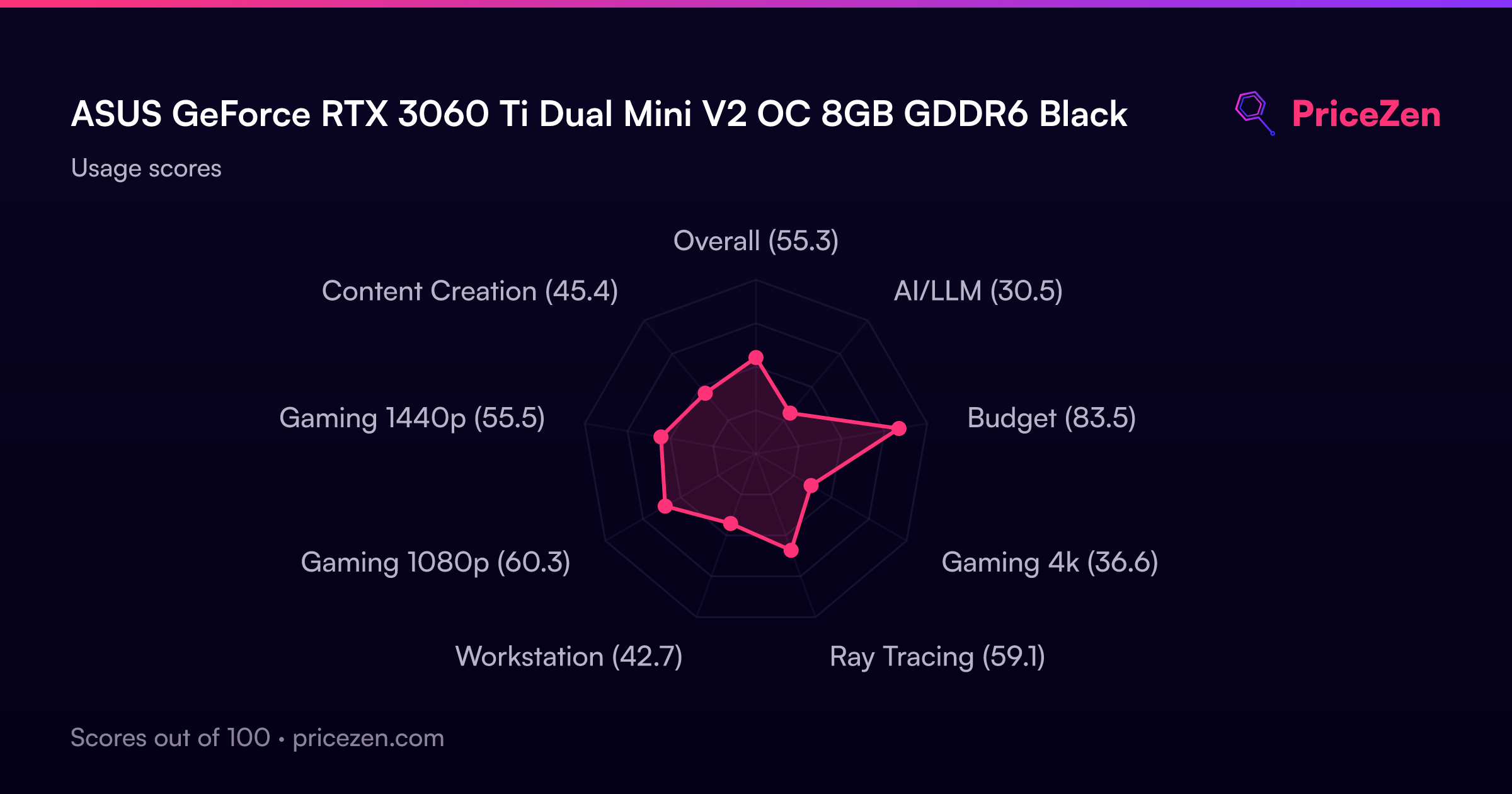
Usage Scores
- Overall55.3
- AI/LLM30.5
- Budget83.5
- Gaming 4k36.6
- Ray Tracing59.1
- Workstation42.7
- Gaming 1080p60.3
- Gaming 1440p55.5
- Content Creation45.4