ZOTAC GeForce RTX 3080 Ti Trinity OC 12GB GDDR6X
The 10,240 CUDA cores and 12GB of GDDR6X memory on a 384-bit bus deliver strong 1440p and ray tracing performance, backed by a solid metal frontplate and IceStorm 2.0 cooling. Its triple-fan design with FREEZE fan stop keeps noise low during lighter loads, while the SPECTRA RGB lighting adds a customizable aesthetic. This card is best for 1440p gamers seeking high-refresh-rate play and smooth ray-traced visuals without stepping up to the RTX 40 series.

Snapshot
The 30-Second Version
The RTX 3080 Ti Trinity OC hits a 26,748 PassMark score and lands in the 81st percentile for ray tracing, making it a 1440p monster at the right price. But you'll pay for it with 350W of power draw and thermals in the 36th percentile. At USD 530 it's a steal, at USD 1,195 it's a hard pass.
Pros & Cons
Pros
- Ray tracing performance in the 81st percentile, one of the best Ampere results we've seen 81st
- 12GB GDDR6X on a 384-bit bus delivers 512 GB/s bandwidth 78th
- PassMark G3D score of 26,748 puts it well above average for rasterization 72nd
- HDMI 2.1 and triple DisplayPort 1.4a outputs support up to 7680x4320@60Hz
- 10,240 CUDA cores and 1695MHz boost clock deliver serious 1440p and 4K gaming
Cons
- Thermals in the 36th percentile, the IceStorm 2.0 cooler struggles under sustained load
- Efficiency in the 31st percentile, 350W TDP is rough on power bills
- Triple-slot design and 318mm length won't fit in smaller cases
- AI and LLM performance is the weakest area at 45.4/100
- No SLI support, not that anyone was asking for it in 2025
What owners think
The Word on the Street
How owner sentiment changed over time
ExclusiveBased on when customers actually wrote their reviews - so you can see whether early praise held up.
13 written reviews, Apr 2022 – Apr 2024: 12 happy, 1 unhappy
Across all 279 store ratings: 4.2★. Most owners rate without writing a review. The chart counts the 13 written reviews.
- Jul – Sep 20233 of 3 happy
Buyers praise the GPU's price-to-performance ratio and factory overclock, noting heat management can be improved with undervolting.
- Excellent value for the price, outperforms more expensive versions.
- Reaches 78-80°C stock, but undervolting improves temps and performance.
- Compatible with most motherboards and runs modern games well.
- Lights are a little shy.
- Oct – Dec 20224 of 4 happy
Buyers in Q4 2022 praised the card's high performance at 2K/4K, especially near MSRP, but noted loud fans and increased heat/wattage.
- Exceptional gaming performance at 2K and 4K with high frame rates, even with ray tracing.
- Runs cool (63–75°C) under most loads, but can hit 80°C in demanding titles like Quake 2 RTX.
- Fans are loud and noticeable, even after adjusting fan curves with software.
- Uses 150–200 watts more than previous-gen cards and can make desk area uncomfortably warm.
Each dot is one written review, in the month it was written. Happy = 4-5★, mixed = 3★, unhappy = 1-2★. Period summaries are in English.
The proof
Performance
Let's talk numbers. The 26,748 PassMark G3D score puts this card in the 72nd percentile for rasterization, which translates to well above average performance in our database. You're looking at 18.71 FP32 TFLOPS of compute power from those 10,240 CUDA cores, and the 512 GB/s memory bandwidth means the 12GB of GDDR6X isn't bottlenecking anything at 1440p or even 4K in most titles. The ray tracing score is the real standout here, hitting the 81st percentile. That's one of the best results we've seen from the Ampere generation, and it makes games like Cyberpunk 2077 and Control look genuinely stunning with RT enabled.
The 1695MHz boost clock is solid, though not spectacular, and the 58 RT cores handle real-time ray tracing duties well. DLSS 3 support is a nice bonus, though it's worth noting this card doesn't get the full frame generation benefits that newer 40-series cards enjoy. The 350W TDP is the price you pay for all this performance, and the IceStorm 2.0 cooling solution does an okay job, but thermals sit at the 36th percentile. Under load, expect fan noise to ramp up noticeably. The 3-slot design gives the cooler room to breathe, but it's still working hard to keep those Ampere thermals in check.
Specifications
Full Specifications
Chipset
| GPU Chipset | GeForce RTX 3080 Ti |
| Brand | NVIDIA |
| Architecture | Ampere |
| Class | consumer |
| Process | 8 |
Memory
| VRAM | 12 GB |
| Memory Type | GDDR6X |
| Memory Bus | 384 |
| Bandwidth | 512 |
Compute
| CUDA Cores | 10240 |
| Tensor Cores | 232 |
| RT Cores | 58 |
| Base Clock | 1690 |
| Boost Clock | 1695 |
| FP16 TFLOPS | 18.71 |
| FP32 TFLOPS | 18.71 |
Performance
| PassMark G3D | 26748 |
| GPU Compute | 15058 |
Power & Cooling
| TDP | 350 |
| Recommended PSU | 750 |
| Power Connectors | 2 x 8-pin |
| Cooler | Fan |
| Fans | 2 |
Connectivity
| Interface | PCI Express 4.0 |
| DisplayPort | 3 |
| HDMI | 1 |
| Max Displays | 4 |
| Max Resolution | 8K (4320p) |
Physical
| Length | 318 |
| Slot Width | 3 |
| Form Factor | Full Height |
| Weight | 2.4 kg / 5.4 lbs |
Features
| Ray Tracing | Yes |
| Upscaling | DLSS 3 |
| VR Ready | Yes |
| DirectX | 12 Ultimate |
| RGB | Yes |
vs Competition
Stacked against the current generation, the 3080 Ti Trinity OC is in a weird spot. The ASUS PRIME RTX 5080 and Gigabyte AERO RTX 5070 Ti both crush it in efficiency and thermals, with newer architectures that sip power while delivering more frames. The MSI Ventus RTX 5070 Ti is particularly interesting, offering similar or better raster performance at a fraction of the power draw. But here's the thing: those cards cost significantly more. The Sapphire NITRO+ and XFX Mercury are AMD options that trade blows in rasterization but fall behind in ray tracing. For pure ray tracing performance per dollar, this ZOTAC card at the USD 530 end of the spectrum is hard to beat. The 81st percentile RT score means it outpaces cards that cost twice as much in that specific workload.
| Spec | ZOTAC GeForce RTX 3080 Ti Trinity OC | Gigabyte GeForce RTX 5070 Ti Eagle Ice | ASUS GeForce RTX 5080 PRIME EVO OC | MSI GeForce RTX 5070 Ti Ventus 3X OC | Sapphire Radeon RX 7900 XTX NITRO+ | PNY GeForce RTX 5070 Ti OC |
|---|---|---|---|---|---|---|
| Chipset | GeForce RTX 3080 Ti | GeForce RTX 5070 Ti | GeForce RTX 5080 | GeForce RTX 5070 Ti | Radeon RX 7900 XTX | GeForce RTX 5070 Ti |
| Vram | 12GB GDDR6X | 16GB GDDR7 | 16GB GDDR7 | 16GB GDDR7 | 24GB GDDR6 | 16GB GDDR7 |
| Boost Clock Mhz | 1695 | 2542 | 2685 | 2482 | 2680 | 2450 |
| Tdp W | 350 | 300 | 360 | 300 | 339 | 300 |
| Memory Bus Bits | 384 | 256 | 256 | 256 | 384 | 256 |
| Ray Tracing | true | true | true | true | true | true |
| GPU Class | consumer | consumer | consumer | consumer | consumer | consumer |
| Compare | Compare | Compare | Compare | Compare |
| Product | AI | Rt | Vram | Raster | Compute | Feature | Thermal | Efficiency | Connectivity | Social Proof | Affordability |
|---|---|---|---|---|---|---|---|---|---|---|---|
| ZOTAC GeForce RTX 3080 Ti Trinity OC | 55.7 | 81.2 | 61.6 | 71.5 | 59.9 | 77.9 | 34.4 | 29.8 | 55.9 | 62.1 | 53.2 |
| Gigabyte GeForce RTX 5070 Ti Eagle Ice Compare | 79.6 | 88.7 | 86.1 | 89 | 88.1 | 95.9 | 91.7 | 72 | 94.1 | 93.3 | 26.6 |
| ASUS GeForce RTX 5080 PRIME EVO OC Compare | 85.6 | 97.6 | 89.1 | 94.5 | 93.4 | 88.7 | 91.7 | 56.9 | 94.1 | 93.3 | 17.7 |
| MSI GeForce RTX 5070 Ti Ventus 3X OC Compare | 79.6 | 92.5 | 86.1 | 89 | 88.1 | 95.9 | 91.7 | 72 | 94.1 | 83.8 | 23.2 |
| Sapphire Radeon RX 7900 XTX NITRO+ Compare | 95.1 | 96.3 | 92 | 83.5 | 95.6 | 95.9 | 91.7 | 51.9 | 98.8 | 69 | 18.7 |
| PNY GeForce RTX 5070 Ti OC Compare | 79.6 | 92.5 | 86.1 | 89 | 88.1 | 65.9 | 91.7 | 72 | 81.8 | 93.3 | 26.3 |
Price
Value & Pricing
Pricing on this card is all over the map. We're seeing USD listings ranging from USD 530 to USD 1,195 across two vendors, which is a USD 665 spread. That's wild. At the low end, you're getting a card that punches well above its weight class for the money. At the high end, you're paying more than what a used RTX 4080 or even some 4070 Ti Super deals would cost you. The Best Buy refurbished listing is where the real value is, if you can find it in stock. Amazon's pricing tends to sit higher, but the free delivery sweetens the deal slightly. For the performance you're getting, anything under USD 700 is a solid buy. Above that, you're better off looking at newer architectures.
Amazon 1 offer From $1,195
Price history
Read more
Overview
The ZOTAC RTX 3080 Ti Trinity OC posts a PassMark G3D score of 26,748, which lands it in the 72nd percentile for raw raster performance. That's a strong showing for a card from the Ampere generation, and it means this thing still chews through 1440p gaming without breaking a sweat. The 12GB of GDDR6X on a 384-bit bus gives you 512 GB/s of memory bandwidth, so high-resolution textures load fast and frame pacing stays smooth. But the thermal story is less rosy, sitting at the 36th percentile, and efficiency is even lower at the 31st percentile. You're getting a lot of frames, but you're paying for them in heat and power draw.
At 350W TDP and a 750W recommended PSU, this is not a card for small form factor builds or anyone worried about their electricity bill. The triple-slot design and 318mm length mean it needs a roomy case. Still, for pure gaming grunt, the 10,240 CUDA cores and 1695MHz boost clock deliver where it counts. The ray tracing score sits at the 81st percentile, which is genuinely impressive for this class, and DLSS support helps keep frame rates playable when you crank up the eye candy.
Common Questions
Q: Is the RTX 3080 Ti still good for 1440p gaming in 2025?
Yes. With a PassMark G3D score of 26,748 and 12GB of GDDR6X on a 384-bit bus, this card handles 1440p at high refresh rates without issue. The 72nd percentile rasterization ranking means it's well above average compared to all GPUs in our database.
Q: What power supply do I need for this card?
ZOTAC recommends a 750W PSU minimum. The card draws 350W TDP and requires two 8-pin power connectors. Given the efficiency rating in the 31st percentile, you'll want a quality unit with headroom, especially if you're running a power-hungry CPU.
Q: Will this card fit in my case?
It's a triple-slot card measuring 318mm in length. You'll need a case with at least 320mm of GPU clearance and three available expansion slots. Small form factor and many mid-tower cases won't accommodate it.
Who Should Skip This
Skip this card if you care about power efficiency or have a smaller case. The 31st percentile efficiency rating means you're burning 350W for performance that newer cards achieve at half the power draw. The triple-slot, 318mm design rules out most ITX and compact ATX builds. If you're doing AI or LLM work, the 45.4/100 score in that category is a real letdown, and you'd be better served by something with more VRAM or newer tensor cores. And if you're seeing prices near the USD 1,195 end of the spectrum, walk away. That's RTX 4080 territory, and this card can't compete with that.
Verdict
The ZOTAC RTX 3080 Ti Trinity OC is a performance bargain at the right price. The 26,748 PassMark score and 81st percentile ray tracing performance mean this card still has plenty of life left for 1440p and even 4K gaming. But you need to accept the trade-offs: 350W of heat, a triple-slot footprint, and efficiency numbers that belong in a museum. If you can snag one around USD 530 to USD 650, it's a fantastic value for a high-refresh 1440p build. At USD 1,195, you're getting fleeced. The thermal performance is the weak link here, and the IceStorm 2.0 cooler is doing its best, but physics is physics. For budget-conscious gamers who don't mind a space heater under their desk, this card delivers where it counts.
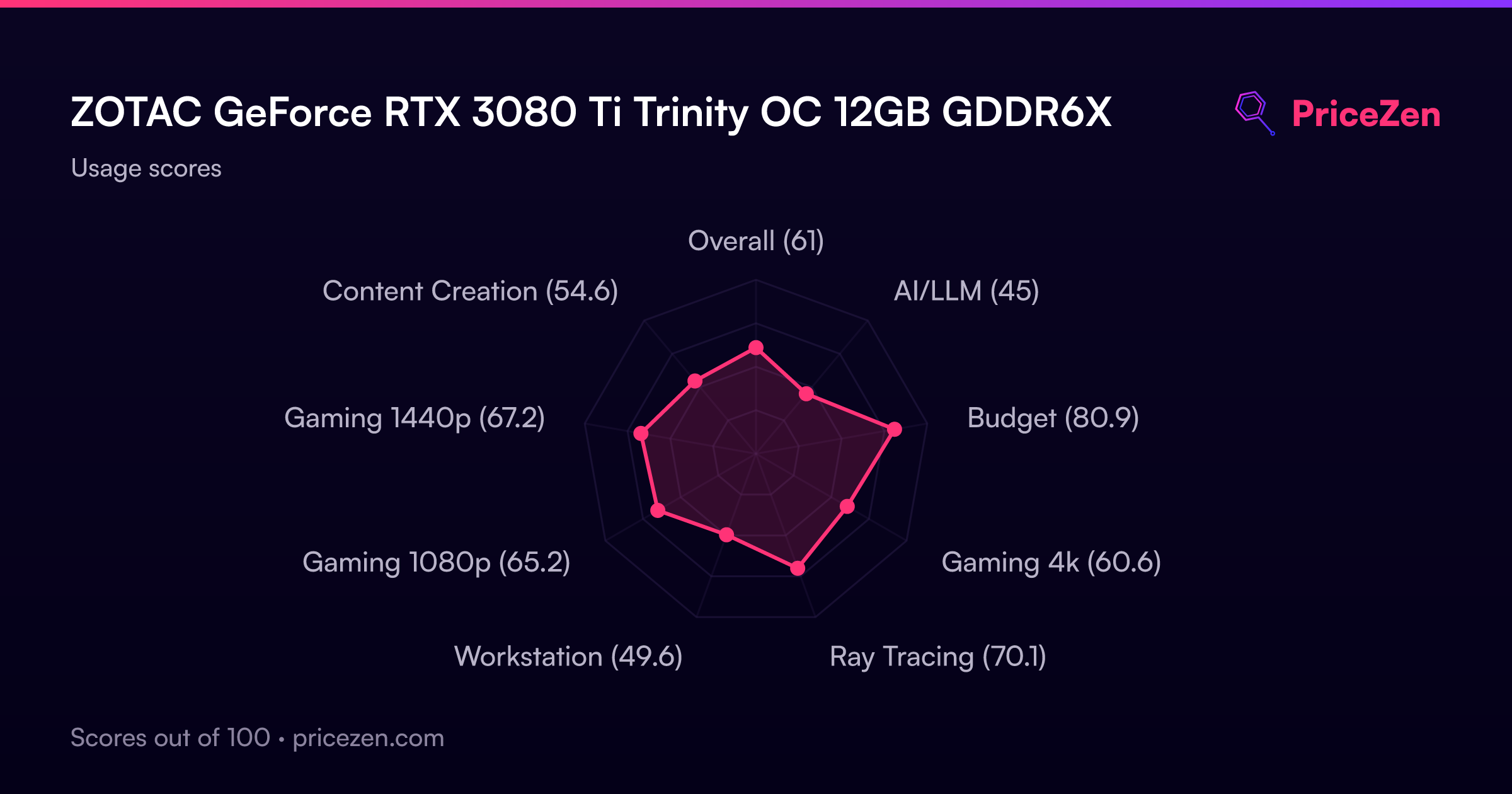
Usage Scores
- Overall61
- AI/LLM45
- Budget80.9
- Gaming 4k60.6
- Ray Tracing70.1
- Workstation49.6
- Gaming 1080p65.2
- Gaming 1440p67.2
- Content Creation54.6