MSI GeForce GT 730 2GB DDR3
The Fermi-based GeForce GT 730 with 2GB of DDR3 VRAM on a 128-bit bus provides basic multi-monitor support via DL-DVI-I and HDMI 1.4a outputs in a compact 145mm dual-slot card. Its 50W TDP and single-fan cooler allow it to run solely off the PCI Express slot, making it a simple drop-in upgrade for older, low-power systems with a 300W PSU. This card is best for users needing to add modern display connectivity to an aging office PC or troubleshooting a system without integrated graphics, not for gaming or compute tasks.

No current retailer price


Snapshot
The 30-Second Version
The GT 730 scores 825 on PassMark G3D, putting it in the 9th percentile for raster performance. It's a 50W card that works in almost any system with a 300W PSU, and the 89th percentile affordability ranking is its saving grace. Buy it cheap for basic display duties, not for gaming.
Pros & Cons
Pros
- 89th percentile affordability, it's cheap for what it does 89th
- 50W TDP works with a 300W PSU, no extra power connector needed
- 145mm length fits in small cases and older prebuilts
- 2GB of VRAM is enough for basic desktop and multi-monitor use
- PCI Express 2.0 x16 works on older motherboards
Cons
- 825 PassMark G3D score lands in the 9th percentile for raster
- 2nd percentile compute performance, it's slow even for its class
- 26th percentile thermal ranking, the single fan struggles
- Driver support is effectively dead, last Nvidia driver is 391.35
- Only 2 displays supported simultaneously
What owners think
The Word on the Street
How owner sentiment changed over time
ExclusiveBased on when customers actually wrote their reviews - so you can see whether early praise held up.
47 written reviews, May 2016 – May 2026: 30 happy, 3 mixed, 7 unhappy, 7 without stars
Across all 104 store ratings: 3.9★. Most owners rate without writing a review. The chart counts the 47 written reviews.
- Jan – Mar 20213 of 3 happy
Buyers in Q1 2021 found this GPU a good budget option for older systems, praising its performance and temperatures, though noting it's basic and best as a stopgap.
- Good value for budget builds and as a temporary GPU while waiting for prices to drop.
- Temperatures are excellent: idle around 90°F, max 160°F under Furmark load.
- Performance is adequate for auto settings and frame rates, but not for high-end gaming visuals.
- Compatible and suitable for older systems, described as basic but overall good.
- Jan – Mar 20183 of 3 happy
Buyers in Q1 2018 found this card suitable for workstations and light gaming, noting quiet operation, good value, and compatibility with older systems.
- Quiet operation and good value for the price.
- Works for general gaming, e.g., WOW at default settings.
- Compatible with older PCIe 2.0 motherboards.
- Software not recommended; stick with drivers.
Each dot is one written review, in the month it was written. Happy = 4-5★, mixed = 3★, unhappy = 1-2★. Period summaries are in English.
The proof
Performance
Let's be blunt: the GT 730 is not fast. The 825 PassMark G3D score puts it in the 9th percentile for raster performance, which means 91% of the cards in our database outperform it. The 96 CUDA cores and 700 MHz core clock are Kepler-era specs, and the 2GB of DDR3 on a 128-bit bus is a serious bottleneck. The compute ranking is even worse at the 2nd percentile, and AI workloads land at 6th. This card is not built for heavy lifting.
For basic tasks, though, it's fine. Driving a 1080p desktop, playing video, running office apps, maybe some very light older titles at low settings. The gaming scores tell the story: 14 out of 100 for 1080p gaming and 11.1 for 1440p. If you're hoping to play anything from the last decade at reasonable settings, this isn't the card. The thermal ranking at the 26th percentile is also a weak spot, though the 50W TDP means it's not exactly a space heater. Just don't expect quiet, cool operation under sustained load.
Specifications
Full Specifications
Chipset
| GPU Chipset | GeForce GT 730 |
| Brand | NVIDIA |
| Architecture | Kepler |
| Class | consumer |
| Process | 40 |
Memory
| VRAM | 2 GB |
| Memory Type | DDR3 |
| Memory Bus | 128 |
| Bandwidth | 25.6 |
Compute
| CUDA Cores | 96 |
| Base Clock | 700 |
Performance
| PassMark G3D | 825 |
| GPU Compute | 510 |
Power & Cooling
| TDP | 50 |
| Recommended PSU | 300 |
| Power Connectors | None |
| Cooler | Single Fan |
| Fans | 1 |
Connectivity
| Interface | PCI Express 2.0 x16 |
| DisplayPort | 0 |
| HDMI | 1 |
| USB-C | 0 |
| Max Displays | 2 |
| Max Resolution | 4096 x 2160 |
Physical
| Length | 145 |
| Slot Width | 2 |
| Form Factor | ATX |
Features
| Ray Tracing | No |
| AV1 Encode | No |
| DirectX | 12 |
vs Competition
Stacked against the competition in our database, the GT 730 is outclassed in almost every category. The XFX Radeon RX 570 RX-570P8DFD6 and the Kelinx RX 580 both offer dramatically better raster performance, with the RX 570's 8GB of VRAM making the GT 730's 2GB look like a rounding error. The ASUS Dual GTX 1060 6GB is in a completely different league for gaming, and even the Sapphire PULSE 11265-05-20G leaves the GT 730 in the dust. The HP 20X24AA is the closest competitor in spirit, another budget-oriented card, but it still manages better overall scores. The GT 730's only real advantage is price and compatibility with older systems. If you have a 300W PSU and a PCIe 2.0 slot, this card will work. The others might not. That's the trade-off.
| Spec | MSI GeForce GT 730 | HP RTX A4000 | XFX Radeon RX 570 | Sapphire Radeon RX 580 PULSE | ASUS GeForce GTX 1060 Dual OC | PNY Quadro P2000 |
|---|---|---|---|---|---|---|
| Chipset | GeForce GT 730 | RTX A4000 | Radeon RX 570 | Radeon RX 580 | GeForce GTX 1060 | Quadro P2000 |
| Vram | 2GB DDR3 | 16GB GDDR6 | 8GB GDDR5 | 8GB GDDR5 | 6GB GDDR5 | 5GB GDDR5 |
| Boost Clock Mhz | - | - | 1286 | 1366 | 1809 | 2000 |
| Tdp W | 50 | 140 | 150 | 185 | 120 | 75 |
| Memory Bus Bits | 128 | - | 256 | 256 | 192 | 160 |
| Ray Tracing | false | true | - | false | false | false |
| GPU Class | consumer | workstation | consumer | consumer | consumer | workstation |
| Compare | Compare | Compare | Compare | Compare |
| Product | AI | Rt | Vram | Raster | Compute | Feature | Thermal | User Sentiment | Efficiency | Connectivity | Social Proof | Affordability |
|---|---|---|---|---|---|---|---|---|---|---|---|---|
| MSI GeForce GT 730 | 6.8 | 9.4 | 5.2 | 9.5 | 2.3 | 10.9 | 25.7 | 13.9 | 10.5 | 16.8 | 57.6 | 89.3 |
| HP RTX A4000 Compare | 66.8 | 35.1 | 63.1 | 41.9 | 36 | 33.7 | 16.6 | 0 | 92.2 | 36.4 | 0 | 19.5 |
| XFX Radeon RX 570 Compare | 24.2 | 18.4 | 21.4 | 19 | 14.7 | 25.3 | 55.4 | 85.4 | 17.7 | 50.1 | 83.7 | 93.6 |
| Sapphire Radeon RX 580 PULSE Compare | 27.1 | 22.8 | 24.5 | 20.2 | 15.5 | 41 | 42.7 | 71.5 | 16.3 | 47.4 | 74.7 | 78.2 |
| ASUS GeForce GTX 1060 Dual OC Compare | 19.3 | 23.6 | 18.6 | 23.8 | 16 | 41 | 42.7 | 58.1 | 37 | 40.7 | 58.9 | 81.5 |
| PNY Quadro P2000 Compare | 17.5 | 17.1 | 15.7 | 17.5 | 14.4 | 10.9 | 16.6 | 0 | 53.1 | 48.4 | 83.7 | 86.2 |
Price
Value & Pricing
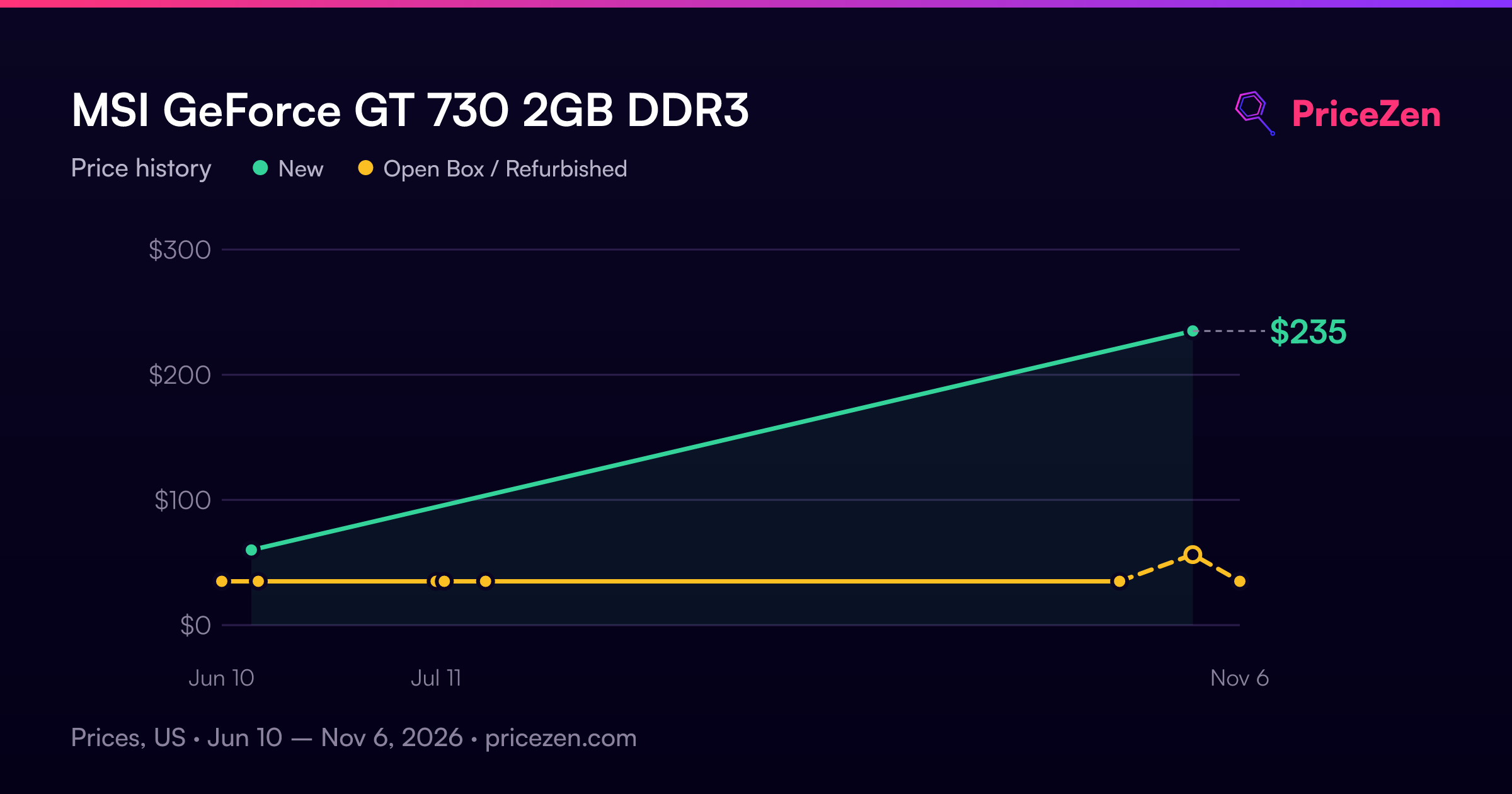
The value story here is complicated. The affordability ranking is strong at the 89th percentile, and the price spread in USD runs from $56 to $235 across two listings. That's a $179 gap, which is wild for a card this old. At the low end, around $56, you're getting a functional video output card for less than the cost of a decent dinner for two. At $235, you're getting robbed. The sweet spot is clearly the cheaper listing. For comparison, a used GT 1030 or even some older Radeon cards can be found in that same price range with significantly better performance. But if you just need something to make an old system display video, the low-end price is hard to argue with.
Price history
Read more
Overview
The MSI GeForce GT 730 N730-2GD3V3 posts a PassMark G3D score of 825, which lands it in the 9th percentile for raster performance in our database. That's not a typo. This card sits near the bottom of the charts for anything resembling modern graphics work. But here's the thing: it's not trying to be a gaming card, and if you judge it by that yardstick you'll miss what it actually does well.
What it does well is show up, fit in almost anything, and drive a couple of monitors without complaining. It's a 50W card with a single fan, a 145mm length, and a 2-slot footprint. The 2GB of DDR3 on a 128-bit bus is ancient by today's standards, but for a basic office rig or an older system that needs a video output, it's enough. The affordability ranking is the one bright spot in the data: 89th percentile. You're not paying much for what you get, and for the right use case, that's exactly the point.
Common Questions
Q: Can I use this for gaming?
Technically yes, but the numbers say no. The PassMark G3D score of 825 puts it in the 9th percentile for raster performance, and the gaming scores are 14/100 for 1080p and 11.1/100 for 1440p. You might run very old or very basic titles at low settings, but anything modern will struggle badly.
Q: Will this work in an older PC with a 300W power supply?
Yes, that's actually one of its strengths. The card draws only 50W and doesn't need a separate power connector, so a 300W PSU is sufficient. The PCI Express 2.0 x16 interface also means it'll work in older motherboards that don't support newer PCIe standards.
Q: Is driver support still available for this card?
This is a real problem. The Kepler architecture is no longer supported by Nvidia, and the last driver version available is 391.35. That means no more updates, no bug fixes, and potential compatibility issues with newer operating systems or software. Some users report unresolved driver issues even on supported systems.
Who Should Skip This
Skip this card if you have any intention of gaming, video editing, or running anything that touches the GPU beyond basic desktop rendering. The 9th percentile raster performance and 2nd percentile compute scores make that clear. Also skip it if you need more than two displays, since that's the hard limit. And if you're running a modern system with a newer PCIe slot, you're leaving performance on the table by using a PCIe 2.0 card. The 26th percentile thermal ranking means the single fan can get noisy under load, so silence-focused builders should look elsewhere too. Finally, if you're buying at the high end of the $56 to $235 USD price range, you're overpaying dramatically for what this card delivers.
Verdict
The MSI GT 730 N730-2GD3V3 is a card with exactly one job: make an old or basic system display video. It does that job adequately, and at the right price, it's a reasonable purchase. The 89th percentile affordability ranking is the headline, and the 50W power draw means it'll work in almost any system with a 300W PSU. But the 9th percentile raster performance and 2nd percentile compute scores mean it's not a gaming card, not a workstation card, and not a future-proof anything. The user sentiment score of 65/100 reflects the mixed reality: some buyers are happy with basic functionality, others hit glitched video output and driver dead-ends. If you need a cheap display adapter for an old rig, buy it at the low end of the price range. If you want to play games or do anything demanding, look elsewhere.
Usage Scores
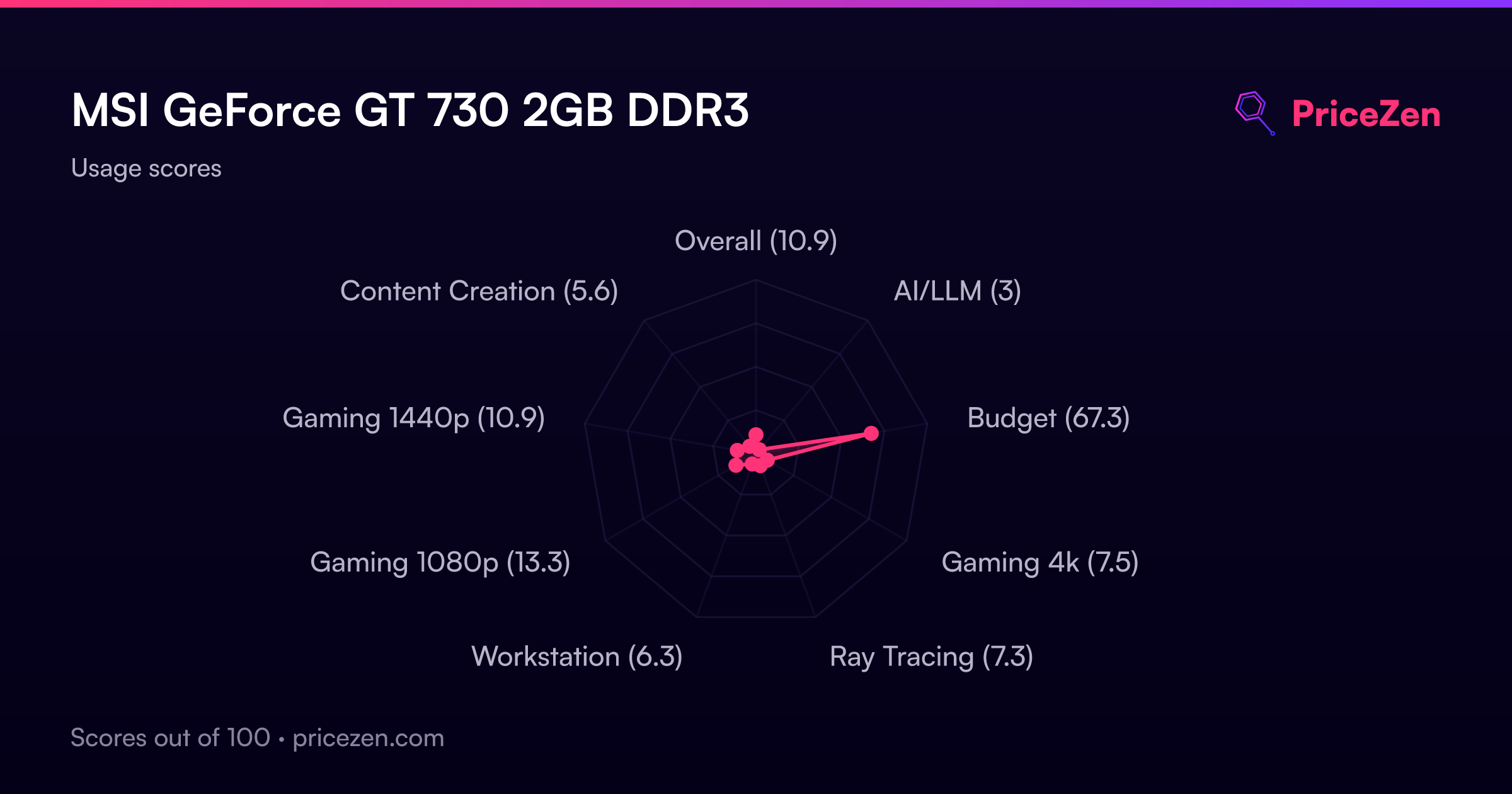
- Overall10.9
- AI/LLM3
- Budget67.3
- Gaming 4k7.5
- Ray Tracing7.3
- Workstation6.3
- Gaming 1080p13.3
- Gaming 1440p10.9
- Content Creation5.6