Panasonic LUMIX BS1H DC-BS1H Black 2021
A 24.2MP full-frame sensor captures 6K/24p 10-bit video with 14+ stops of dynamic range and records without overheating via a heat-dispersing box-style body. Simultaneous SDI and HDMI output, Genlock, Timecode, and PoE+ Ethernet simplify multi-camera live production and remote power. It’s best for broadcast and live streaming crews needing a compact, sync-capable camera with 6K capture and integrated IP control.












Snapshot
The 30-Second Version
The Panasonic LUMIX BS1H is a box-style full-frame cinema camera built for multicam production, live streaming, and broadcast work. It packs a 24.2MP sensor with 6K recording, 14+ stops of dynamic range, and Dual Native ISO into a compact body with Ethernet, PoE+, Genlock, and Timecode. At $3,500 USD, it's a specialist tool that excels in controlled, remote-controlled setups. Skip it if you need handheld shooting or reliable autofocus.
Pros & Cons
Pros
- Full-frame 6K sensor with 14+ stops of dynamic range in V-Log 95th
- Ethernet with PoE+ for single-cable power, control, and IP streaming
- Simultaneous SDI and HDMI output for flexible monitoring and recording
- Genlock IN and Timecode IN/OUT for multicam sync
- Unlimited video recording thanks to the heat dispersion design
Cons
- No in-body stabilization at all
- No built-in display or viewfinder, you need an external monitor
- Autofocus performance is mediocre compared to Sony or Canon
- Battery life is middle of the pack at best
- No weather sealing despite the rugged-looking box design
The proof
Performance
Let's talk about what this sensor can actually do. The 24.2MP full-frame CMOS captures 6K at 24p and 5.9K at 30p in 10-bit 4:2:0 internally. That's a lot of resolution headroom, which means you can crop in post for punch-ins or reframing without losing sharpness on a 4K timeline. The 14+ stops of dynamic range in V-Log is the real headline though. That's cinema camera territory, and it shows in the highlights and shadows. You can recover a surprising amount of detail from a slightly overexposed window or an underexposed face.
Dual Native ISO is the other trick up its sleeve. The sensor has two base ISO settings, which means you can push into low light without the noise penalty you'd normally expect. The spec sheet says max ISO 51200, and while we wouldn't recommend shooting at the top end, the second native ISO gives you usable footage in dimly lit venues or event spaces. The 4K 60p 10-bit 4:2:2 HDMI output is also solid for external recording, and the 12-bit RAW output over HDMI to an Atomos Ninja V or Blackmagic Video Assist opens up even more flexibility in post.
One thing to keep in mind: there's no in-body stabilization. None. The sensor sits completely still. If you're on a gimbal, a tripod, or a locked-off rig, that's fine. If you're hoping to run and gun handheld, this camera will punish you. The video performance is strong, but it's built for controlled environments, not shaky handheld work.
Specifications
Full Specifications
Sensor
| Type | CMOS |
| Size | full-frame |
| Megapixels | 24.2 MP |
| ISO Range | 100 |
Autofocus
| Eye AF | No |
Shooting
| Electronic Shutter | Yes |
Video
| Max Resolution | 6K |
| 4K FPS | 60 |
| 10-bit | Yes |
| Log Profile | Yes |
| RAW Video | Yes |
| Codec | H.264, H.265 |
Display & EVF
| Touchscreen | No |
| Articulating | No |
Build
| Weather Sealed | No |
| Weight | 0.6 kg / 1.3 lbs |
Connectivity
| Wi-Fi | Yes |
| Bluetooth | Yes |
| USB | USB 3.1 Type-C |
| HDMI | HDMI Type-A |
| Hot Shoe | Yes |
vs Competition
The BS1H's closest competitor in spirit is probably the Nikon Z9, but that's a very different beast. The Z9 is a flagship hybrid with incredible autofocus, 8K recording, and a built-in body that can actually be used handheld. It's also significantly more expensive. If you need one camera that does everything, the Z9 wins. If you need a camera that lives on a tripod and gets controlled from a laptop, the BS1H makes more sense.
The Sony a1 II is another high-end option, and it's a monster for both stills and video. But again, you're paying for a lot of features the BS1H doesn't even attempt to offer, like class-leading autofocus and burst shooting. The BS1H's autofocus sits in the 36th percentile, which is frankly not great. If you need reliable subject tracking, look at Sony or Canon. The Canon EOS R6 Mark III is a strong hybrid at a similar price point, with much better AF and in-body stabilization, but it lacks the Ethernet, Genlock, and Timecode features that make the BS1H special for multicam work.
The Fujifilm X-H2S is an interesting alternative if you're on a tighter budget. It's APS-C, not full-frame, but it has excellent video features, good autofocus, and a much more versatile body. The OM System OM-1 is a different animal entirely, a Micro Four Thirds camera built for wildlife and action, not really a competitor for this use case. The BS1H's connectivity is in the 96th percentile, which is where it really shines. No other camera in this price range gives you this level of network integration.
| Spec | Panasonic LUMIX BS1H DC-BS1H | Sony Alpha a7R VI | Fujifilm X-H2 | Nikon Z8 | OM System OM-1 Mark II | Canon EOS R6 Mark III |
|---|---|---|---|---|---|---|
| Type | mirrorless | mirrorless | mirrorless | mirrorless | mirrorless | mirrorless |
| Sensor | 24.2MP full-frame | 66.8MP full-frame | 40.2MP aps-c | 45.7MP full-frame | 20.4MP micro-four-thirds | 32.5MP full-frame |
| AF Points | - | 759 | 425 | 493 | 1053 | 1053 |
| Burst FPS | - | 30 | 15 | 30 | 120 | 40 |
| Video | 6K @60fps | 8K @120fps | 8K @60fps | 8K @120fps | 4K @60fps | 6K @120fps |
| IBIS | false | true | true | true | true | true |
| Weather Sealed | false | true | true | true | true | true |
| Weight (g) | 585 | 622 | 579 | 820 | 511 | 608 |
| Compare | Compare | Compare | Compare | Compare |
| Product | AF | EVF | Build | Burst | Video | Sensor | Battery | Display | Affordability | Stabilization |
|---|---|---|---|---|---|---|---|---|---|---|
| Panasonic LUMIX BS1H DC-BS1H | 36.9 | 37.2 | 50.6 | 31.5 | 62.3 | 52.2 | 46 | 27.2 | 19.4 | 32.8 |
| Sony Alpha a7R VI Compare | 96.4 | 98.9 | 94.2 | 87.9 | 98.9 | 80.4 | 96.5 | 97.4 | 13.2 | 99.5 |
| Fujifilm X-H2 Compare | 91.2 | 96.3 | 93.1 | 79 | 94.7 | 98.8 | 97.3 | 94.9 | 28.2 | 95.6 |
| Nikon Z8 Compare | 92.6 | 90.4 | 97.4 | 94.6 | 98.4 | 67 | 88.7 | 97.1 | 17.4 | 87.4 |
| OM System OM-1 Mark II Compare | 98.6 | 99.8 | 92.5 | 99.4 | 83.6 | 45.8 | 95.3 | 94.9 | 26.3 | 99.5 |
| Canon EOS R6 Mark III Compare | 98.6 | 89.7 | 93.7 | 90.7 | 89.4 | 61.4 | 96.9 | 94.9 | 22.7 | 99.5 |
Price
Value & Pricing
At $3,500 USD, the BS1H sits in a strange spot. It's more expensive than a hybrid mirrorless like the Canon EOS R6 Mark III, but significantly cheaper than a dedicated cinema camera or broadcast unit. What you're paying for is the connectivity and form factor. The Ethernet, PoE+, Genlock, and Timecode features are not things you find on a typical mirrorless body, and they're exactly what a multicam production needs.
If you're a solo shooter, this is probably overkill. You're paying for infrastructure features you won't use. But if you're building out a small studio or a live streaming rig, the BS1H starts to look like a bargain. One cable for power and control means less cabling mess, fewer power strips, and a cleaner setup. The unlimited recording is also a huge deal for long events, interviews, or church services where you can't stop to swap cards or cool down the camera.
For context, the CAD price is $4,845, which tracks roughly with the USD figure after conversion. It's not cheap, but it's also not trying to be. This is a tool for people who need reliability and remote control more than they need a flip-out screen.
Best Buy 1 offer From $3,500
We started tracking prices for this product on May 29, 2026. The chart appears once we have more data.
Read more
Overview
The Panasonic LUMIX BS1H is a weird one, and we mean that as a compliment. It's a full-frame cinema camera stuffed into a box the size of a chunky sandwich, with no screen, no viewfinder, and no grip. This is not a camera you take on vacation. It's a camera you bolt to a rig, plug into a network, and forget about while it quietly produces some of the best 6K footage you can get for the money. Panasonic basically took the guts of the S1H, their video-focused mirrorless flagship, and repackaged it for multicam shoots, live streaming, and broadcast work.
Who's this for? If you run a live production setup, a streaming studio, or you shoot interviews and events where cameras need to be controlled remotely, the BS1H is aimed squarely at you. The Ethernet port with PoE+ support means one cable handles power, control, and IP streaming. That's a big deal when you're managing four or five cameras from a laptop. The simultaneous SDI and HDMI outputs also mean you can send a clean feed to a switcher while recording externally to an Atomos or Blackmagic recorder.
What makes it interesting is the sensor. You're getting a 24.2MP full-frame chip with Dual Native ISO, 14+ stops of dynamic range in V-Log, and 6K recording at up to 30p internally. For a box camera at this price point, that's a serious amount of image quality. It's not cheap, but it's also not competing with a $10,000 broadcast camera. It's carving out a niche for people who want cinema-grade footage without the cinema-grade price tag or the bulk.
And yes, the name is a mouthful. We'll just call it the BS1H from here on out.
Common Questions
Q: Can I use the BS1H as a handheld camera?
Technically yes, but it's not designed for that. There's no built-in screen, no viewfinder, and no in-body stabilization. You'd need an external monitor, a rig, and probably a gimbal to make it work handheld. If that's your primary use case, a hybrid mirrorless like the Canon EOS R6 Mark III or Sony a1 II would serve you much better.
Q: Does the BS1H work with external recorders for RAW video?
Yes. The BS1H can output 12-bit RAW video over HDMI to an Atomos Ninja V for Apple ProRes RAW or to a Blackmagic Video Assist 12G HDR for Blackmagic RAW. You can record 5.9K, 4K, and Anamorphic 3.5K RAW formats externally, which gives you a lot of flexibility in post-production.
Q: How does the Ethernet and PoE+ connection work?
The BS1H has an Ethernet port that supports Power over Ethernet Plus (PoE+). That means a single Ethernet cable can power the camera, provide network connectivity for IP streaming, and allow remote control through the LUMIX Tether for Multicam software. You can also stream 4K 60p video in H.265 directly over the network. It's a huge convenience for multicam setups where running separate power and control cables would be a nightmare.
Q: What kind of lenses does the BS1H use?
The BS1H uses the L-mount system, which Panasonic shares with Leica and Sigma. That gives you access to a wide range of native lenses from all three manufacturers, plus plenty of adapters for other mounts. For video work, the Sigma Art primes and Panasonic's own S Pro lenses are popular choices.
Who Should Skip This
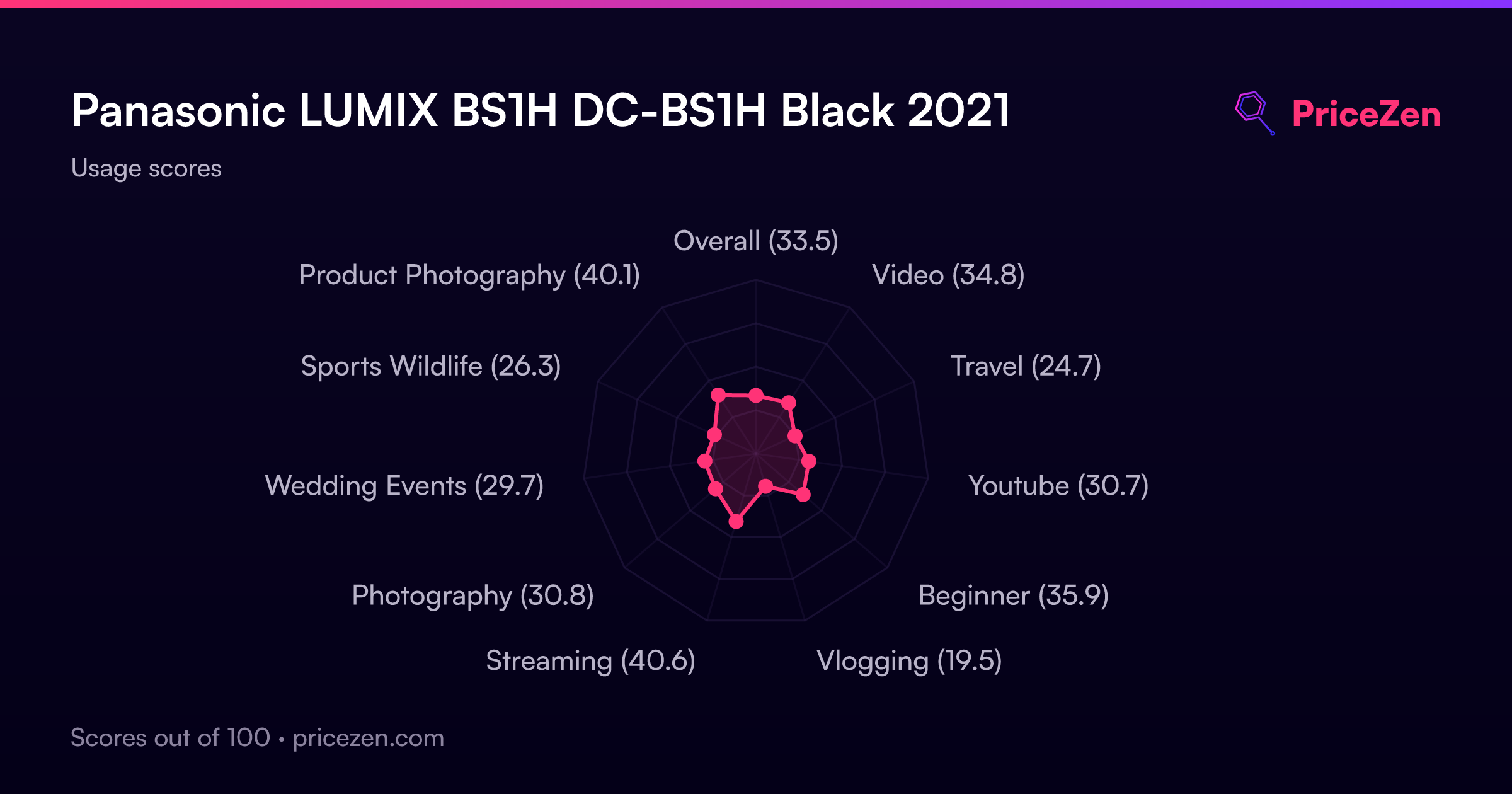
If you're a vlogger, a run-and-gun shooter, or someone who needs a camera that works handheld out of the box, the BS1H is not for you. The lack of in-body stabilization, no built-in display, and mediocre autofocus make it a poor fit for that kind of work. The vlogging score of 20.4 out of 100 tells you everything you need to know. You'd be better off with a Canon EOS R6 Mark III or a Sony a1 II, both of which offer excellent stabilization and autofocus in a body you can actually hold.
Also skip it if you're primarily a stills photographer. The BS1H can technically take photos, but it's clearly designed for video. The burst rate is in the 33rd percentile, and the lack of a viewfinder makes composing stills awkward. If you need a hybrid camera that does both well, look elsewhere. This is a video tool, full stop.
Verdict
If you're building a multicam live production setup, the BS1H is one of the best tools you can buy without jumping into true broadcast territory. The combination of full-frame 6K image quality, PoE+ power, Genlock, and Timecode makes it a natural fit for streaming studios, houses of worship, corporate events, and interview setups. The unlimited recording means you can hit record and forget about it, which is exactly what you want in those scenarios.
But if you're a solo videographer or a hybrid shooter who needs to move around, this camera will frustrate you. No stabilization, no built-in screen, and mediocre autofocus mean you'll be fighting the camera instead of working with it. For that kind of work, a Canon EOS R6 Mark III or Sony a1 II is a much better fit. The BS1H is a specialist, and it's very good at its specialty. Just don't expect it to be something it's not.
Usage Scores
- Overall33.4
- Video34.6
- Travel24.5
- Youtube30.6
- Beginner35.4
- Vlogging19.4
- Streaming40.4
- Photography30.6
- Wedding Events29.7
- Sports Wildlife26.1
- Product Photography40.1