Best Content Creation GPUs Premium in 2026




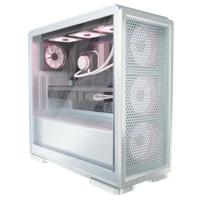

ASUS GeForce RTX 5080 ProArt 16GB GDDR7

Great Alternatives
These options also score highly and may better suit your specific needs
MSI GeForce RTX 5080 Suprim 16GB GDDR7
Why we recommend this ▼
The integrated AIO liquid cooling on the Blackwell-based RTX 5080 keeps the 10,752 CUDA cores and 16GB of GDDR7 memory running at a 2740MHz boost clock without throttling. Its 280mm length and 2.5-slot design make this a uniquely compact high-end card for powerful small-form-factor builds. This GPU is best for 4K gamers and content creators who demand sustained peak performance and low noise in a space-constrained chassis.

Gigabyte GV-N5080AORUSX W-16GD
Why we recommend this ▼
The 10,752 CUDA cores and 2,805 MHz boost clock on the Blackwell RTX 5080 deliver strong 4K gaming and ray tracing performance, backed by 16 GB of GDDR7 memory at 960 GB/s. Its 360 mm WATERFORCE AIO liquid cooler with three 120 mm ARGB fans keeps the card cool and quiet in a compact 220 mm, 2-slot design. Best for enthusiasts building a high-end 4K gaming or content creation rig who want liquid cooling without a custom loop.

PNY GeForce RTX 5080 ARGB OC 16GB GDDR7
Why we recommend this ▼
The 2775 MHz boost clock and 16GB of GDDR7 memory on the Blackwell architecture deliver a 56.3 TFLOPS compute uplift, making 4K gaming with full ray tracing exceptionally fluid. Its triple-fan cooler with ARGB lighting and VelocityX software offers precise thermal and aesthetic control in a 2.99-slot design. This card is best for 4K gamers and content creators who need high frame rates with DLSS 4 and reliable AV1 encoding without stepping up to the RTX 5090.

ASUS GeForce RTX 5080 ROG Astral 16GB GDDR7
Why we recommend this ▼
A quad-fan cooler and patented vapor chamber keep the 5nm Blackwell GPU at a 2670 MHz boost clock, delivering 56.3 FP32 TFLOPS and 960 GB/s memory bandwidth. Its dual HDMI 2.1b ports and premium die-cast metal frame offer exceptional connectivity and build rigidity beyond raw specs. This card is best for content creators and ray-tracing enthusiasts who need DLSS 4 and AV1 encoding for demanding 4K workflows.

ASUS GeForce RTX 5080 PRIME 16GB GDDR7
Why we recommend this ▼
Combining the Blackwell architecture with a compact 2.5-slot design, this card delivers 56.3 FP32 TFLOPS and 16GB of GDDR7 memory in a package compatible with small-form-factor builds. Its vapor chamber and phase-change thermal pad ensure sustained performance under load, while the Axial-tech triple-fan cooler maximizes airflow in tight chassis. This GPU is best for SFF enthusiasts who want uncompromised 1440p gaming and ray tracing at high frame rates.

Gigabyte GeForce RTX 5080 AERO 16GB GDDR7
Why we recommend this ▼
The Blackwell architecture and 10,752 CUDA cores deliver 56.3 FP16 TFLOPS, with 16GB of GDDR7 memory on a 256-bit interface for 960 GB/s bandwidth. Its 304mm length and 2.5-slot design fit SFF builds, while the triple-fan WINDFORCE cooling keeps noise low. Best for gamers and creators who want high ray tracing and content creation scores (98.5 and 98.3) in a compact white card.

Gigabyte GV-N5080GAMING OC-16GD
Why we recommend this ▼
The Blackwell RTX 5080 chip with 10752 CUDA cores and a 2730MHz boost delivers 56.28 FP16 TFLOPS, paired with 16GB of GDDR7 memory at 960 GB/s. Its WINDFORCE triple-fan cooling, RGB Halo lighting, and dual BIOS (Performance/Silent) add practical flexibility, backed by a 4-year warranty with online registration. Best for 4K gamers and content creators who want ray tracing (97.9/100) and strong creation performance (97.6/100) without needing top-tier AI LLM capabilities.

MSI GeForce RTX 5080 SHADOW 16GB GDDR7
Why we recommend this ▼
The Blackwell-based RTX 5080 SHADOW packs 10752 CUDA cores and 16GB of GDDR7 memory on a 256-bit bus, delivering 960 GB/s bandwidth for high-resolution gaming. Its triple TORX 5.0 fan cooler and 2.5-slot design keep the 360W TDP manageable, while DLSS 4 and AV1 encoding add versatility for creators. Best for gamers and content creators targeting 4K ray-traced play and video work, though AI LLM tasks score lower.

ASUS GeForce RTX 5080 NOCTUA 16GB GDDR7
Why we recommend this ▼
The triple Noctua NF-A12x25 G2 fans and optimized vapor chamber deliver near-silent operation for the 10752 CUDA core Blackwell chip and 16GB of GDDR7 memory. Its phase-change GPU thermal pad and dual BIOS provide exceptional thermal headroom, making it one of the quietest high-end air-cooled cards available. This card is best for 1440p and 4K gamers who prioritize a silent PC build above all else.

Gigabyte GeForce RTX 5080 WINDFORCE 16GB GDDR7
Why we recommend this ▼
The Blackwell-based RTX 5080 delivers 10752 CUDA cores and 16GB of GDDR7 memory at 960 GB/s, paired with a triple-fan WINDFORCE cooler that keeps the 360W TDP in check. Its 2617MHz boost clock and DLSS 4 support make it a strong pick for 4K gaming and content creation, scoring 96.9 and 97 out of 100 respectively. Best for gamers and creators who want high-end performance in a 304mm card that fits most ATX cases.

MSI GeForce RTX 5080 Ventus 3X 16GB GDDR7
Why we recommend this ▼
The Blackwell-based RTX 5080 chipset with 16GB of GDDR7 memory and a 2640 MHz boost clock delivers a 96.7 ray tracing score, backed by DLSS 4.0 and AV1 encoding. Its triple-fan cooler fits a neutral, resilient 2.9-slot enclosure that integrates cleanly into any build without excessive size. This card is best for 4K gamers and content creators who prioritize top-tier rendering and encoding performance in a straightforward, no-frills design.

ASUS ROG-STRIX-RTX5070TI-O16G-GAMING
Why we recommend this ▼
The 8960 CUDA cores and 2625 MHz OC boost deliver 43.94 FP32 TFLOPS, with 16GB GDDR7 at 896 GB/s for high-resolution gaming. The 3.2-slot cooler with Axial-tech fans and 0 dB mode keeps noise low during light loads, while GPU Tweak III offers intuitive tuning. Best for enthusiasts building a high-end ray tracing and content creation rig who want a quiet, overclockable card.

Sapphire Radeon RX 7900 XTX NITRO+ 24GB GDDR6
Why we recommend this ▼
The triple-fan Vapor-X cooler and 2680MHz boost clock on this RDNA 3 chip deliver top-tier 4K rasterization performance that rivals NVIDIA’s best. Its 24GB framebuffer and dual DP 2.1 outputs provide a clear advantage for high-resolution, multi-monitor setups without the typical NVIDIA price premium. This card is best for 4K gamers and content creators who prioritize raw frame rates and memory capacity over ray tracing leadership.

ASRock Radeon RX 7900 XTX Phantom Gaming 24GB GDDR6
Why we recommend this ▼
The 24GB frame buffer and 960 GB/s bandwidth on the RDNA 3 chipset deliver strong 4K gaming and ray tracing performance, while the triple-fan cooler with 0dB Silent mode keeps noise in check. A reinforced metal frame and stylish metal backplate add structural rigidity, complemented by Polychrome SYNC lighting for system customization. This card is best for 4K gamers and content creators who need high VRAM capacity and AV1 encoding without stepping up to a workstation-class GPU.

PowerColor Radeon RX 7900 XTX Hellhound 24GB GDDR6
Why we recommend this ▼
The 24GB frame buffer and 384-bit memory bus on the RDNA 3 chipset excel at 4K gaming, delivering high-resolution textures without stutter. Its triple-fan cooler and 320mm length provide effective heat dissipation for the 355W TDP while maintaining a relatively compact three-slot footprint. This card is best for 4K gamers who prioritize raw rasterization performance and large VRAM capacity over top-tier ray tracing.
