SK Hynix 16GB DDR4-2133 CL13 RDIMM (HMA42GR7MFR4N-TF)
The dual-rank x4 design and ECC registered architecture deliver reliable 2133 MT/s performance at CL13 timings for enterprise server environments. This SK Hynix module uses genuine Hynix chips and maintains a 4.4-star rating from over 340 reviews, reflecting consistent quality in 24/7 operation. It is best for IT administrators populating DDR4-based servers that require validated, single-rank replacement memory for virtualization or database workloads.

Sin precio actual de tiendas
Dónde lo vimos antes. Consulta el precio de hoy en la tienda.











Resumen
The 30-Second Version
The SK Hynix HMA42GR7MFR4N-TF is a 16GB DDR4 registered ECC module built for enterprise servers, not desktops. At $105 USD it's one of the cheapest ways to get new server-grade memory, with a 90th percentile feature score and solid CL13 latency. The 2133 MT/s speed is slow, but that's fine for older Xeon platforms. If you're in the US and running a homelab, buy it. If you're in Europe at 319 EUR, don't.
Pros & Cons
Ventajas
- ECC and registered support at a budget-friendly $105 USD 90th
- 90th percentile feature score for its class 74th
- CL13 latency is solid at 74th percentile
- 4.4/5 rating from 86 verified buyers
- Drop-in compatible with older Xeon E5 platforms
Desventajas
- 2133 MT/s is slow, 23rd percentile for speed
- 16GB capacity is only 45th percentile
- No heat spreader, runs warm under sustained load
- Useless for consumer desktops, registered DIMMs won't post
- EUR pricing is wildly inflated at 319 EUR
Las pruebas
Performance
Let's talk numbers. This module runs at 2133 MT/s with CL13 timings. That's the baseline DDR4 speed from 2014, and in our database it lands in the 23rd percentile for speed. For a modern desktop, that would be a problem. For an older Xeon E5 v3 or v4 server, it's often exactly what the platform expects. Those chips officially supported 2133 MT/s, and dropping in faster sticks usually just means they downclock anyway.
The latency story is better. CL13 at 2133 MT/s works out to roughly 12.2 nanoseconds of first-word latency, which puts it in the 74th percentile for latency. That's solid, not spectacular. In real terms, you won't feel this in a database workload the way you'd feel it in a game. Server memory bandwidth matters, but capacity and stability matter more. And this stick delivers the stability part with ECC and registered buffering, which is why the feature score is so strong.
Specifications
Full Specifications
Memory
| Type | DDR4 |
| Form Factor | RDIMM |
| Total Capacity | 16384 |
| Modules | 1 |
| Per Module | 16384 |
| Rank | 2Rx4 |
Performance
| Speed | 2133 |
| CAS Latency | 13 |
Class
| ECC | Yes |
| Registered | Yes |
vs Competition
The competitors listed here are all consumer gaming RAM, which tells you how weird this product's positioning is. The Corsair Vengeance RGB Pro SL, G.Skill TridentZ RGB, and Kingston FURY Beast are all faster, prettier, and completely incompatible with the servers this Hynix stick is designed for. Comparing them directly is like comparing a forklift to a sports car. Different jobs.
Where the comparison gets useful is against other server memory. Used Samsung M393A2G40DB0 and Micron MTA18ASF2G72PZ modules are the real competition, and they often sell for similar or lower prices on the secondary market. The Hynix advantage is that it's new, backed by a retailer, and has a 4.4-star rating from 86 buyers. The disadvantage is that 2133 MT/s is the slowest DDR4 speed tier. If your server supports 2400 or 2666 MT/s, a used faster module might serve you better for the same money.
| Spec | SK Hynix 16GB DDR4 RDIMM | Kingston FURY Beast | G.Skill Trident Z5 Royal | Corsair VENGEANCE RGB | KLEVV CRAS V RGB | V-Color TUF GAMING ALLIANCE |
|---|---|---|---|---|---|---|
| Capacity | 16GB | 64GB | 64GB | 64GB | 64GB | 64GB |
| Kit | 1 x 16GB | 2 x 32GB | 2 x 32GB | 2 x 32GB | 2 x 32GB | 2 x 32GB |
| Memory Type | DDR4 | DDR5 | DDR5 | DDR5 | DDR5 | DDR5 |
| Speed Mts | 2133 | 6400 | 6000 | 6400 | 6000 | 6400 |
| Cas Latency | CL13 | CL32 | CL26 | CL32 | CL30 | CL32 |
| Form Factor | RDIMM | UDIMM | UDIMM | UDIMM | UDIMM | UDIMM |
| Ecc | Yes | No | No | No | No | No |
| Compare | Compare | Compare | Compare | Compare |
| Producto | Speed | Latency | Capacity | Valoración social | Affordability |
|---|---|---|---|---|---|
| SK Hynix 16GB DDR4 RDIMM | 22.1 | 73.7 | 44.8 | 59.2 | 62.3 |
| Kingston FURY Beast Compare | 94.8 | 87.6 | 89.5 | 96.4 | 7.6 |
| G.Skill Trident Z5 Royal Compare | 87.6 | 99 | 89.5 | 58.4 | 3.8 |
| Corsair VENGEANCE RGB Compare | 94.8 | 87.6 | 89.5 | 96.4 | 6.6 |
| KLEVV CRAS V RGB Compare | 87.6 | 87.6 | 89.5 | 76.9 | 10.2 |
| V-Color TUF GAMING ALLIANCE Compare | 94.8 | 87.6 | 89.5 | 26.8 | 10.5 |
Precio
Value & Pricing
Here's where it gets weird. In the US, this stick is $105. That's a genuinely good deal for 16GB of registered ECC DDR4. The affordability score sits at the 63rd percentile, which feels about right. You can populate a dual-socket server with eight of these for under $850 and get 128GB of error-correcting memory. That's homelab gold.
But look at the European pricing. 319 EUR for the same stick. That's more than triple the US price before you even think about exchange rates. At that point, you're better off hunting for used Samsung or Micron RDIMMs on eBay. The CAD and GBP prices, $162 and 120 GBP respectively, land somewhere in between. If you're in the US, this is a no-brainer for the right server. If you're in Europe, shop around first.
Seguimos los precios de este producto desde el 5 nov 2026. El gráfico aparecerá cuando tengamos más datos.
Leer más
Overview
The SK Hynix HMA42GR7MFR4N-TF is not the kind of stick you buy because it looks cool in a glass side panel. It's a 16GB DDR4 registered ECC module built for enterprise servers, the kind of part that quietly keeps a database from corrupting itself at 3am. No heat spreaders, no RGB, no marketing nonsense. Just a green PCB and a job to do.
Who is this for? Homelabbers running older Xeon platforms, small businesses keeping a PowerEdge or ProLiant alive, and anyone who needs error-correcting memory without paying new-enterprise prices. If you're building a gaming rig, this is not your RAM. It's registered, it's ECC, and it runs at 2133 MT/s. Your Ryzen desktop won't even post with it.
What makes it interesting is the price story. At $105 USD on Amazon, this is one of the cheapest ways to get 16GB of genuine server-grade DDR4. The feature score sits in the 90th percentile for its class, which makes sense, ECC and registered support are the whole point. But the speed ranking is rough, landing near the bottom at the 23rd percentile. You're trading raw bandwidth for reliability and compatibility, and for the right server, that's exactly the trade you want.
Common Questions
Q: Will this work in my desktop PC?
No. This is a registered ECC RDIMM, which requires a server-class motherboard and CPU. Consumer platforms from Intel and AMD don't support registered memory at all. If you're building a desktop, look for unregistered UDIMM DDR4 instead.
Q: What servers are compatible with this module?
This stick is designed for DDR4-era enterprise servers, particularly older Intel Xeon E5 v3 and v4 platforms like the Dell PowerEdge R730, HP ProLiant DL380 Gen9, and similar systems. Those platforms officially support 2133 MT/s, so this module runs at its rated speed without downclocking.
Q: Can I mix this with other RAM in my server?
Technically yes, but it's not ideal. Mixing different speeds or ranks can force all modules to run at the slowest common speed, and some servers get picky about mixed configurations. For best results, populate your memory channels with identical modules. This is a 2Rx4 dual-rank stick, so match it with other 2Rx4 modules if possible.
Q: Is 16GB enough for a server in 2025?
Depends on the workload. For a basic file server, virtualization host with a few light VMs, or a homelab running Proxmox, 16GB is workable but tight. The capacity score here is only 45th percentile, meaning half the modules in our database offer more. If you're running heavier workloads, consider buying multiple sticks or looking at 32GB modules instead.
Who Should Skip This
Skip this if you're building or upgrading a desktop. Registered ECC memory simply won't work in consumer motherboards, and you'd be better off with standard UDIMM DDR4. Also skip it if you're running a newer server platform that supports 2400 MT/s or faster. The 2133 MT/s ceiling here would leave performance on the table.
European buyers should also think twice. At 319 EUR, this stick costs more than triple the US price, and that's before you factor in that used server memory is plentiful and cheap across the EU. For that money, you could get faster used modules or even step up to 32GB sticks. The value only makes sense at the US price point.
Verdict
For homelabbers running older Xeon E5 v3 or v4 systems, this is a solid buy at the US price. The ECC and registered support are exactly what those platforms need, and $105 for 16GB of new server RAM is hard to beat. Buy a few, populate your slots, and enjoy the peace of mind that comes with error correction.
For anyone else, look elsewhere. If you're on a newer Xeon Scalable or EPYC platform, you'll want faster modules. If you're on a desktop, this won't even work. And if you're in Europe, the 319 EUR price tag makes this a bad deal no matter what server you're running. The US price is the story here, and it's a good one. Everywhere else, the value proposition falls apart.
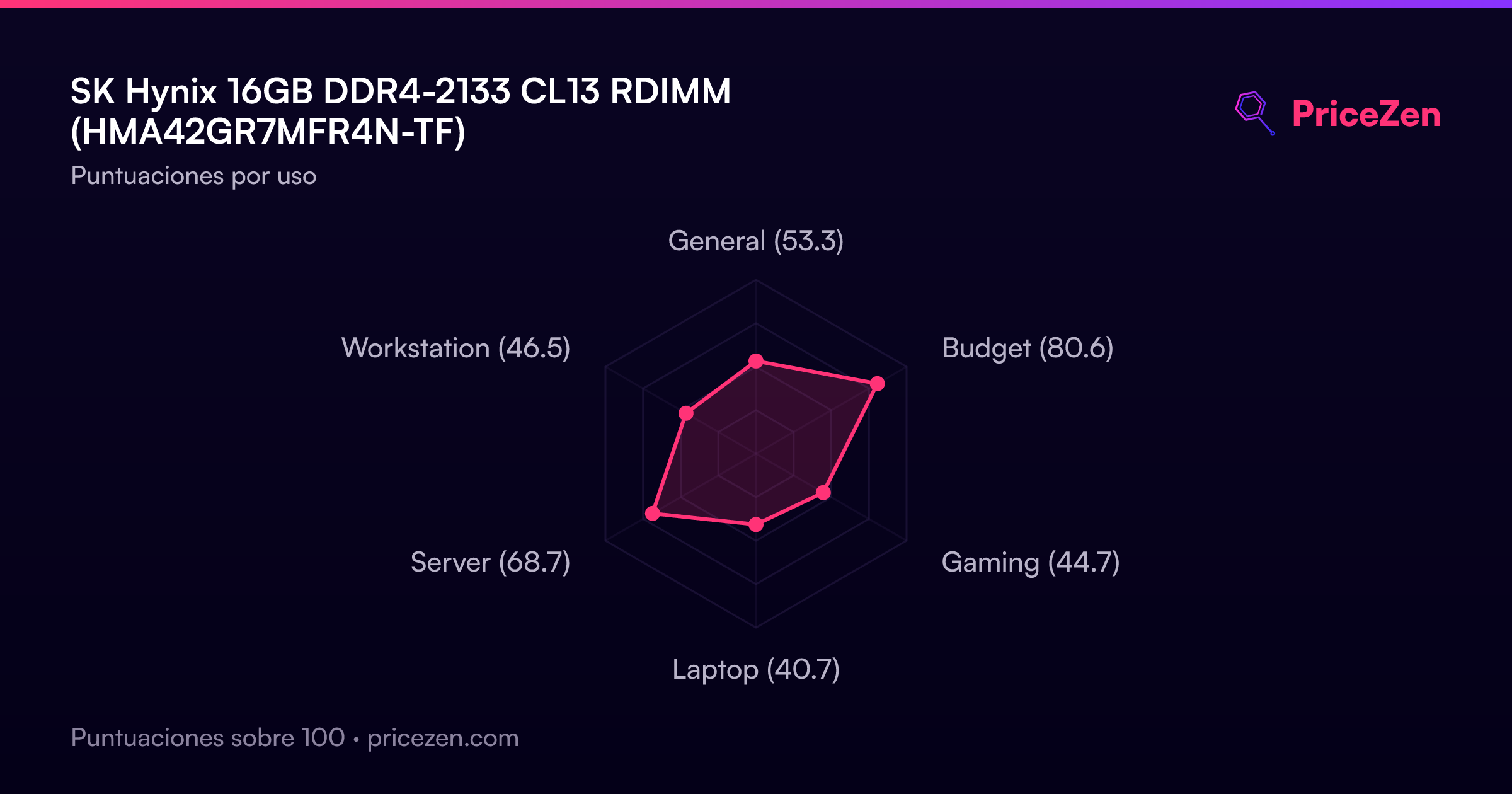
Usage Scores
- General53.3
- Budget80.6
- Gaming44.7
- Laptop40.7
- Server68.7
- Workstation46.5