Lenovo Legion Pro 32UD-10 31.5" Raven Black
The 31.5-inch OLED panel delivers 4K resolution, a 240Hz refresh rate, and a 0.03ms response time, making motion clarity a top priority for competitive play. Its 99% DCI-P3 coverage and true 10-bit color depth suit color-critical work, while the 250-nit brightness is modest for HDR. Best for gamers who also edit photos or video and want one monitor that handles both fast-paced titles and accurate color reproduction.

Sin precio actual de tiendas



Resumen
The 30-Second Version
The Legion Pro 32UD-10 packs a 4K OLED panel running at 240Hz with a 0.03ms response time, landing it in the 97th percentile for performance. Color coverage hits 99% DCI-P3 with true 10-bit depth, making it a legit option for creative work too. At $1,100 USD, it's priced competitively against 27-inch rivals while giving you more screen real estate.
Pros & Cons
Ventajas
- 4K OLED at 240Hz is a rare combo, 97th percentile performance 98th
- 0.03ms response time means zero motion blur 97th
- 99% DCI-P3 and true 10-bit color for stunning HDR 85th
- USB-C connectivity with hub functionality 81st
- PIP/PBP support for multitasking
Desventajas
- 300 nits brightness is modest for bright rooms
- 130W power draw is hefty for a monitor
- 4128g weight makes it a pain to move
- Only 16 reviews so far, social proof is thin
- HDR mode locks brightness control per one reviewer
Opinión de los propietarios
The Word on the Street
Cómo cambió la opinión de los propietarios con el tiempo
ExclusivaSegún cuándo escribieron realmente sus opiniones los clientes, para ver si los elogios iniciales se mantuvieron.
17 opiniones escritas, ene–nov 2026: 15 satisfechos, 1 neutral, 1 insatisfecho
En las 46 valoraciones de tiendas: 4,7★. La mayoría de los propietarios valora sin escribir una opinión. El gráfico cuenta las 17 opiniones escritas.
- abr–jun 20261 de 3 satisfechos
Buyers praise the panel's image quality and USB hub for productivity, but criticize HDR brightness control, weak USB-C power delivery, sleep/wake issues, and OLED maintenance annoyances.
- Image quality is faultless, text is sharp, and games/media look stunning; great for productivity and gaming.
- HDR mode locks brightness to maximum, causing eye strain; no brightness adjustment in HDR.
- USB-C delivers only 15W, insufficient for laptop power, limiting KVM functionality; requires separate power cable.
- Monitor often fails to wake from sleep, blocking other monitors from waking, requiring restart; also lacks Windows driver updates.
- ene–mar 20264 de 4 satisfechos
Buyers praise the monitor's image quality, gaming and HDR performance, and design. One notes a pixel refresh prompt after 2 hours and dislikes the white bezel, but overall satisfaction is high.
- Image quality is phenomenal, especially with HDR for gaming and video.
- Design is sleek and practical, with a rectangular build that fits setups well.
- OLED care features are appreciated, but pixel refresh prompt occurs too frequently during work.
- White bezel around the screen is unattractive and creates unnecessary contrast.
Cada punto es una opinión escrita, en el mes en que se escribió. Satisfechos = 4-5★, neutrales = 3★, insatisfechos = 1-2★. Los resúmenes por periodo están en inglés.
Las pruebas
Performance
The headline number is 240Hz at 4K. That's the kind of spec that makes competitive gamers do a double take, because until recently you had to choose between high refresh rate or high resolution. Now you get both. The 0.03ms response time is effectively instant, which means no ghosting, no smearing, just clean motion. In our database, this puts the Legion Pro in the 97th percentile for performance, which is about as close to the top as you can get without being the actual best.
The OLED panel is the real star though. You get perfect blacks, infinite contrast, and HDR that actually looks like HDR. The 300 nits brightness might sound low on paper compared to some LCD panels pushing 600 or 1000 nits, but OLED doesn't need to blast your retinas to look good. The per-pixel lighting means highlights pop even at lower overall brightness. And with 99% DCI-P3 coverage, games with rich color palettes look stunning. Just keep in mind that HDR mode locks brightness control according to one reviewer, so you might want to tweak settings before settling in for a long session.
Specifications
Full Specifications
Display
| Size | 31.5" |
| Resolution | 3840x2160 (4K UHD) |
| Panel Type | OLED |
| Aspect Ratio | 16:9 |
| Curved | No |
Performance
| Refresh Rate | 240 Hz |
| Response Time | 0.03 |
Color & HDR
| Brightness | 250 nits |
| Color Gamut | 99% sRGB (CIE 1931), 99% DCI-P3 (CIE 1976) |
| Color Depth | True 10-bit |
| HDR | ✓ |
| HDR Support | HDR |
Connectivity
| HDMI Ports | 2 |
| DisplayPort | 1 |
| USB-C | 1 |
| Speakers | No |
Ergonomics
| Height Adjustable | Yes |
| Tilt | Yes |
| Swivel | Yes |
| Pivot | No |
Features
| Webcam | No |
| Touchscreen | No |
| PIP/PBP | Yes |
| Power | 130 |
| Weight | 8.5 kg / 18.7 lbs |
vs Competition
Against the ASUS ROG Strix XG27UCDMG and MSI MPG 271QR QD-OLED X50, the Legion Pro has a clear size advantage at 31.5 inches versus 27 inches. That extra screen real estate matters for both gaming immersion and productivity. The LG UltraGear 45GX950A-B goes bigger still, but you're paying for that size and losing some pixel density. The Samsung Odyssey G60SD and Gigabyte M Series OLED MO27U2 SA are both solid 27-inch options, but neither matches the Legion Pro's combination of 4K resolution and 240Hz refresh rate. Where the Legion Pro falls behind is ergonomics, sitting at the 67th percentile. The height adjust, tilt, and swivel are all there, but competitors offer more flexible stands. And at 4128g, this thing is heavier than most of its rivals, so make sure your desk mount can handle it.
| Spec | Lenovo Legion Pro 32UD-10 31.5" | ASUS ROG Strix XG27UCDMG 27" | LG UltraGear 45GX950A-B 45" | Dell UltraSharp U4025QW 39.7" | Alienware AW-Series AW3425DW 34" | MSI MAG 271QPX QD-OLED E2 27" |
|---|---|---|---|---|---|---|
| Screen Size | 31.5 | 27 | 45 | 39.7 | 34 | 27 |
| Resolution | 3840 x 2160 | 3840 x 2160 | 5120 x 2160 | 5120 x 2160 | 3440 x 1440 | 2560 x 1440 |
| Panel Type | OLED | QD-OLED | OLED | IPS | QD-OLED | QD-OLED |
| Refresh Rate | 240 | 240 | 330 | 120 | 240 | 240 |
| Response Time Ms | 0.03 | 0.03 | 0.03 | 5 | 0.03 | 0.03 |
| Adaptive Sync | - | FreeSync Premium Pro | FreeSync Premium Pro | Adaptive-Sync | FreeSync Premium Pro | FreeSync Premium Pro |
| Hdr | HDR | DisplayHDR True Black 400 | DisplayHDR True Black 400 | HDR600 | HDR400 | DisplayHDR True Black 400 |
| Compare | Compare | Compare | Compare | Compare |
| Producto | Color | Portabilidad | Display | Feature | Ergonomic | Performance | Connectivity | Valoración social |
|---|---|---|---|---|---|---|---|---|
| Lenovo Legion Pro 32UD-10 31.5" | 80 | 49.4 | 97.7 | 85 | 66.9 | 96.6 | 81.1 | 51.9 |
| ASUS ROG Strix XG27UCDMG 27" Compare | 96.5 | 57.4 | 97.7 | 85 | 90.8 | 97.9 | 81.1 | 98.9 |
| LG UltraGear 45GX950A-B 45" Compare | 99.4 | 76.5 | 99.7 | 96.3 | 90.8 | 99.4 | 96.9 | 91.9 |
| Dell UltraSharp U4025QW 39.7" Compare | 97.9 | 76.5 | 98.6 | 96.3 | 90.8 | 56.1 | 99.3 | 96.8 |
| Alienware AW-Series AW3425DW 34" Compare | 98.9 | 73.9 | 84.1 | 96.3 | 90.8 | 97.9 | 95.4 | 96.8 |
| MSI MAG 271QPX QD-OLED E2 27" Compare | 99.2 | 57.4 | 73.4 | 85 | 90.8 | 97.9 | 81.1 | 98.9 |
Precio
Value & Pricing
At $1,100 USD, the Legion Pro 32UD-10 is priced right in line with other high-end 4K OLED gaming monitors. The Canadian listing at $1,540 CAD tracks similarly. You're paying a premium for that 240Hz refresh rate at 4K resolution, which is still a relatively new capability. Compared to the competition, you're getting a slightly larger panel than the 27-inch options from ASUS and MSI, which makes the price feel more justified. The value proposition comes down to whether you'll actually use 240Hz at 4K. If you're running a GPU that can push those frame rates, this is money well spent. If not, you might be paying for headroom you'll never use.
Leer más
Overview
The Lenovo Legion Pro 32UD-10 sits in the 98th percentile for display quality in our database, and that's not a typo. You're getting a 31.5-inch 4K OLED panel running at 240Hz with a 0.03ms response time. That combination of resolution, speed, and panel tech is basically the holy trinity for gaming monitors right now. The color coverage backs it up too, 99% DCI-P3 and true 10-bit depth, which puts it in the top tier for creative work as well.
But here's the thing. This monitor is heavy at 4128g and pulls 130W of power. It's not trying to be portable or efficient. It's a desk anchor built for people who want the best picture possible and are willing to sacrifice everything else to get it. The 4.4 out of 5 rating from 16 reviews suggests most buyers are happy, though the social proof percentile sits at a middling 56th, meaning not enough people have weighed in yet to call this a proven crowd favorite.
Common Questions
Q: Can this monitor actually run 4K at 240Hz?
Yes, the Legion Pro 32UD-10 supports 3840 x 2160 resolution at 240Hz. You'll need a GPU with HDMI 2.1 or DisplayPort 1.4 with DSC to push those frame rates. The 0.03ms response time means the panel itself won't be the bottleneck.
Q: Is the 300 nits brightness enough for HDR?
For OLED, yes. The per-pixel lighting means you get true blacks and bright highlights without needing the high sustained brightness of LCD panels. However, if you're in a very bright room with direct sunlight, you might wish for more. One reviewer noted that HDR mode locks brightness at maximum, which can be intense in dark rooms.
Q: How does the USB-C port work?
The USB-C port supports video input and acts as a hub, which is handy for connecting a laptop. One reviewer mentioned the USB-C has some limitations, but didn't specify details. For most users, it should handle single-cable connectivity for both display and peripherals.
Who Should Skip This
If you're not running a high-end GPU, you're paying for 240Hz at 4K that you'll never actually see. The 130W power draw and 4128g weight also make this a poor choice for anyone who moves their setup frequently or has a flimsy desk. And if you're sensitive to brightness, the 300 nits ceiling combined with the HDR brightness lock could be a dealbreaker. The ergonomics are just average at the 67th percentile, so if you need aggressive positioning options, look elsewhere. Finally, with only 16 reviews and a social proof percentile of 56, early adopters are still doing the heavy lifting here.
Verdict
The Lenovo Legion Pro 32UD-10 is the monitor to beat if you want 4K OLED gaming at 240Hz without compromise. The 98th percentile display quality and 97th percentile performance tell the story, this is a top-tier panel that delivers on every visual front. The 4.4 out of 5 rating from early buyers backs that up, with reviewers praising the image quality and OLED care features. The main drawbacks are the modest 300 nits brightness, the hefty 130W power draw, and the fact that only 16 people have reviewed it so far. If you're building a high-end gaming rig and want a monitor that can keep up with a flagship GPU, this is an easy recommendation. Just make sure your desk can handle the weight.
Usage Scores
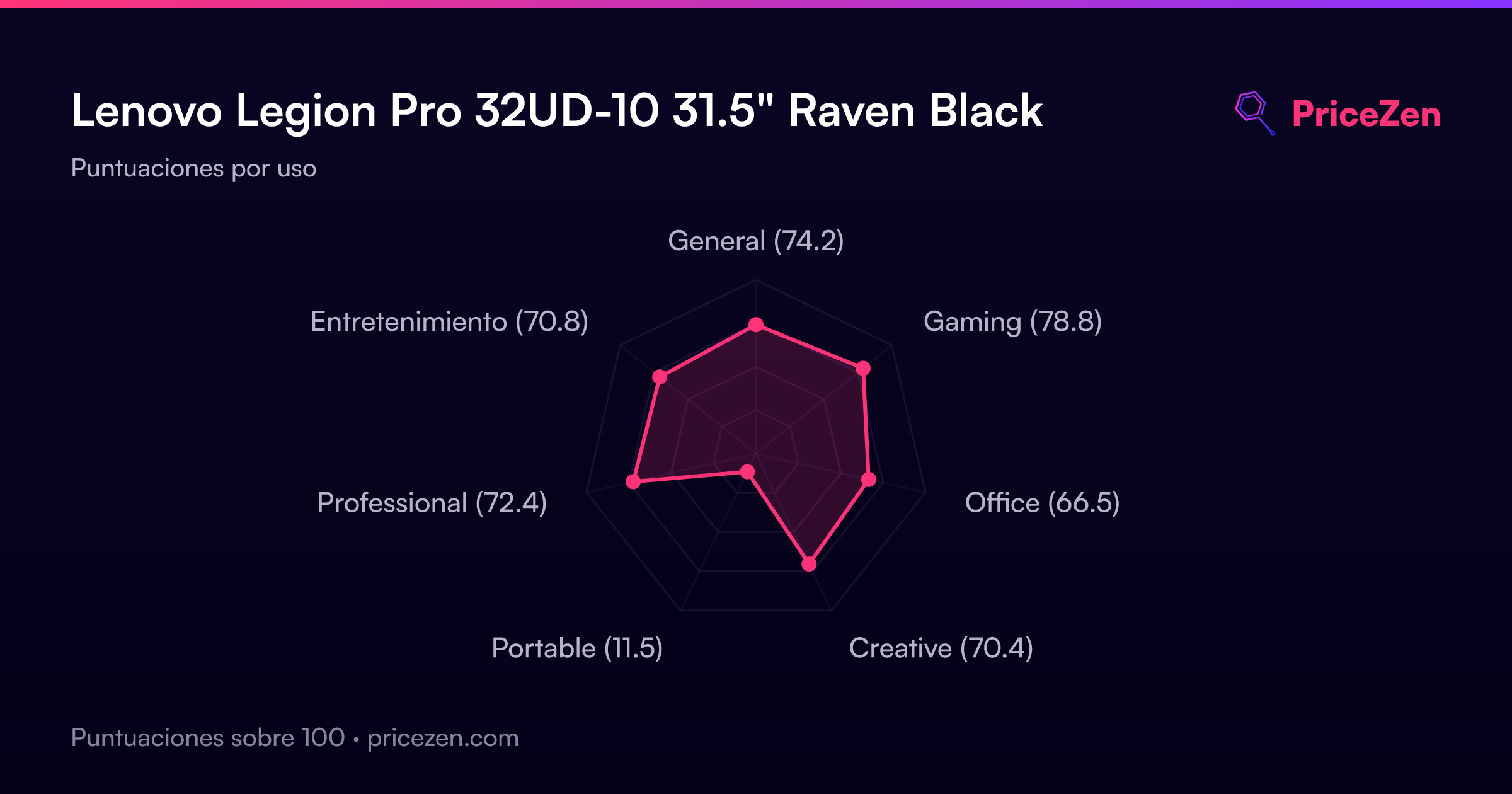
- General74.2
- Gaming78.8
- Office66.5
- Creative70.4
- Portable11.5
- Professional72.4
- Entretenimiento70.8