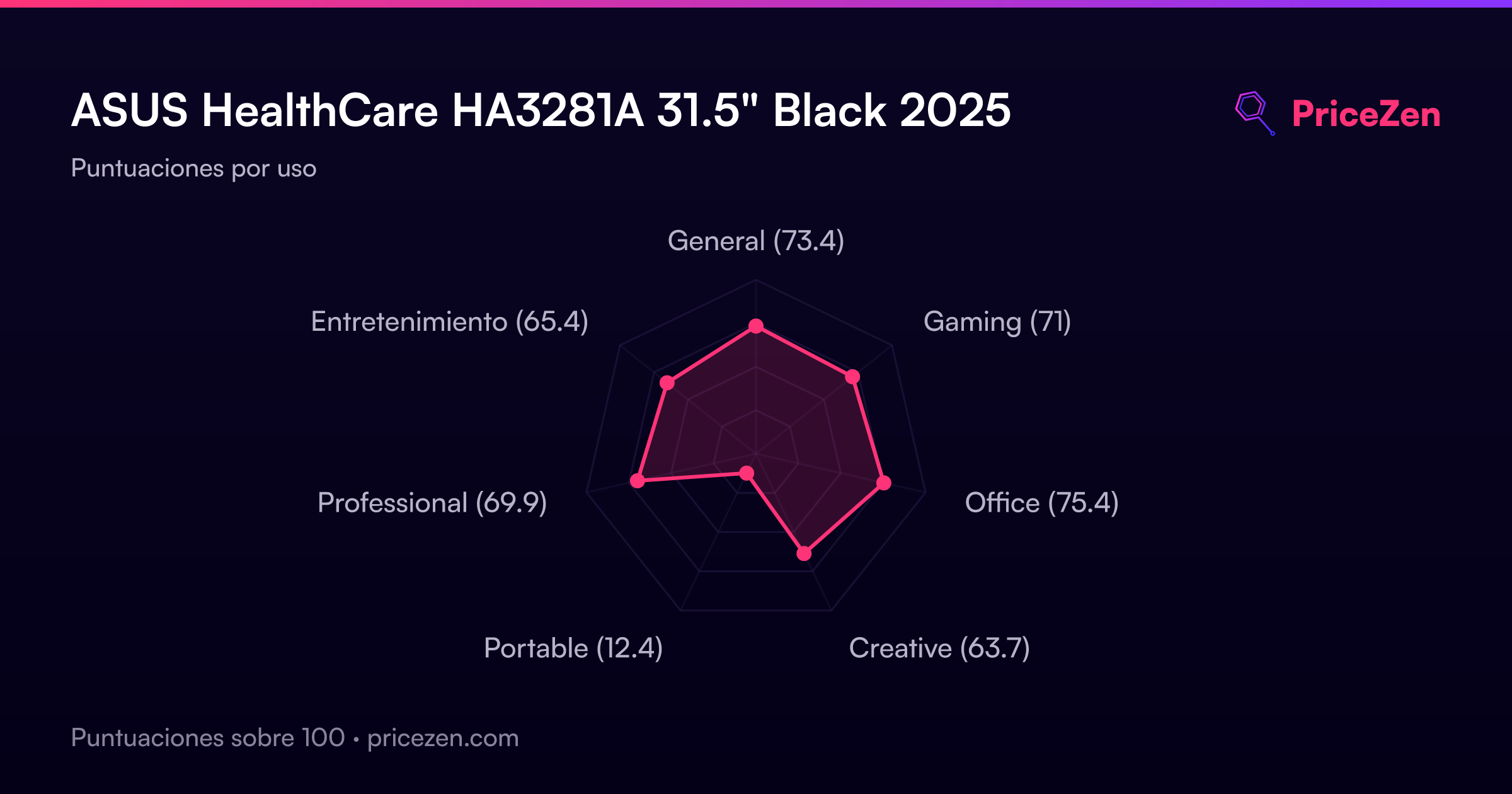
ASUS HealthCare HA3281A 31.5" Black 2025
The pure RGB-stripe OLED panel delivers true blacks and DICOM Part 14 GSDF factory calibration for precise grayscale accuracy, essential for medical imaging. A built-in colorimeter supports self-calibration to maintain long-term consistency, while the anti-glare, low-reflection coating and TUV-certified eye care enhance viewing comfort during extended use. This display is best for radiologists and healthcare professionals who require a stable, high-clarity 8MP monitor for diagnostic review.

Sin precio actual de tiendas











Resumen
The 30-Second Version
The ASUS HealthCare HA3281A is a 31.5-inch 4K OLED medical monitor with a 98th percentile display score and built-in DICOM self-calibration. It's built for diagnostic accuracy, not entertainment, with a 60Hz refresh rate and 250 nits brightness. At around $4,800 USD, it's a hospital-grade tool, not a consumer bargain.
Pros & Cons
Ventajas
- 98th percentile display quality with pure RGB stripe OLED panel 98th
- Built-in colorimeter for self and auto DICOM calibration 94th
- 8MP resolution gives 300% more onscreen space than 2MP displays 91st
- Anti-glare low-reflection coating protects image detail in bright rooms 91st
- 93rd percentile connectivity with 3x HDMI, DisplayPort, and USB-C
Desventajas
- 60Hz refresh rate limits any non-medical use
- 250 nits brightness is dim for a $4,800 panel
- 55th percentile color performance for general content
- 14.8kg weight makes it a desk anchor
- No consumer-friendly features like HDR or high refresh gaming modes
Las pruebas
Performance
The display performance is where this thing earns its keep. The 31.5-inch panel pushes 3840 x 2160 resolution, which ASUS claims gives you four times the pixel density and up to 300% more onscreen space than a similarly-sized 2 megapixel display. That's the kind of headroom you need when you're comparing two full-resolution CT scans side by side. The 0.1ms response time is technically impressive, but at 60Hz it's more about eliminating motion blur in static diagnostic images than chasing frames in a shooter.
Color performance lands at the 55th percentile, which sounds mediocre until you remember this panel is tuned for grayscale accuracy, not wide gamut vibrancy. The 10-bit color depth and 250 nits brightness are calibrated for DICOM Part 14 GSDF compliance, meaning every shade of gray is mapped to a standard that radiologists trust. The built-in colorimeter supports self and auto calibration, so the panel can maintain that accuracy over time without a technician showing up with a probe. That's a big deal for hospital IT departments.
Specifications
Full Specifications
Display
| Size | 31.5" |
| Resolution | 3840x2160 (4K UHD) |
| Panel Type | OLED |
| Aspect Ratio | 16:9 |
| Curved | No |
| Screen Finish | matte |
Performance
| Refresh Rate | 60 Hz |
| Response Time | 0.1 |
Color & HDR
| Brightness | 250 nits |
| Color Depth | 10-bit |
Connectivity
| HDMI Ports | 3 |
| DisplayPort | 1 |
| USB-C | 1 |
| Speakers | No |
| Headphone Jack | Yes |
Ergonomics
| Height Adjustable | Yes |
| Tilt | Yes |
| Swivel | Yes |
| Pivot | Yes |
| VESA Mount | 100x100 |
Features
| Webcam | No |
| Touchscreen | No |
| PIP/PBP | Yes |
| Power | 23 |
| Weight | 14.8 kg / 32.6 lbs |
vs Competition
Stacked against the LG UltraGear 45GX950A-B or the MSI MAG 271QPX QD-OLED E2, the HA3281A looks almost quaint on paper. Those panels offer high refresh rates, HDR, and gaming features at a fraction of the cost. But they're not DICOM calibrated, they don't have built-in colorimeters, and they're not built for 24/7 clinical use. The Samsung Odyssey G60SD is a closer match on OLED tech, but again, it's tuned for games, not grayscale accuracy. The Apple Studio Display XDR and Dell UltraSharp U4025QW are the more realistic alternatives for professional work, but neither has the medical certification or self-calibration hardware that the ASUS brings. If you need DICOM compliance, none of these competitors are actually competing.
| Spec | ASUS HealthCare HA3281A 31.5" | BenQ MOBIUZ EX381U 37.5" | Samsung Odyssey Ark 2nd Gen 55" | Gigabyte M Series M32U 31.5" | LG UltraGear 32GS95UV-W.AUS 31.5" | Acer CB342CU UM.CB2AA.004 34" |
|---|---|---|---|---|---|---|
| Screen Size | 31.5 | 37.5 | 55 | 31.5 | 31.5 | 34 |
| Resolution | 3840 x 2160 | 3840 x 2160 | 3840 x 2160 | 3840 x 2160 | 3840 x 2160 | 3440 x 1440 |
| Panel Type | OLED | IPS | Mini-LED | IPS | OLED | IPS |
| Refresh Rate | 60 | 144 | 165 | 144 | 240 | 75 |
| Response Time Ms | 0.10000000149011612 | 1 | 1 | 1 | 0.029999999329447746 | 1 |
| Adaptive Sync | - | FreeSync Premium Pro | FreeSync Premium Pro | FreeSync Premium Pro | FreeSync Premium Pro | FreeSync |
| Hdr | - | HDR10 | HDR10+ | HDR400 | DisplayHDR True Black 400 | HDR400 |
| Compare | Compare | Compare | Compare | Compare |
| Producto | Color | Portabilidad | Display | Feature | Ergonomic | Performance | Connectivity |
|---|---|---|---|---|---|---|---|
| ASUS HealthCare HA3281A 31.5" | 48.3 | 57.5 | 97.7 | 43.5 | 90.8 | 93.9 | 91 |
| BenQ MOBIUZ EX381U 37.5" Compare | 93.6 | 68 | 95.1 | 70.2 | 73.5 | 72.6 | 99.8 |
| Samsung Odyssey Ark 2nd Gen 55" Compare | 98.4 | 20.7 | 91.5 | 96.3 | 30.4 | 77.1 | 81.2 |
| Gigabyte M Series M32U 31.5" Compare | 90.1 | 63 | 87.1 | 85.1 | 73.5 | 72.6 | 87.6 |
| LG UltraGear 32GS95UV-W.AUS 31.5" Compare | 63.6 | 20.7 | 97.7 | 70.2 | 78.7 | 97.9 | 43.3 |
| Acer CB342CU UM.CB2AA.004 34" Compare | 79 | 63 | 78.9 | 70.2 | 78.7 | 65.7 | 70.3 |
Precio
Value & Pricing
At $4,798 to $4,800 USD, the HA3281A is not a value play in the traditional sense. You can buy a 32-inch 4K OLED gaming monitor for a third of that price. But medical displays live in a different economy. The DICOM calibration, the built-in colorimeter, the AGLR coating, and the long-term stability guarantees are what you're paying for. If you're a hospital or clinic that needs consistent diagnostic accuracy across multiple workstations, the price per unit is a rounding error compared to a misread scan. For everyone else, it's a very expensive way to get a 60Hz monitor.
Historial de precios
Leer más
Overview
The ASUS HealthCare HA3281A is a 31.5-inch 4K OLED monitor that sits in the 98th percentile for display quality in our database. That's not a typo. This is a medical-grade panel with a pure RGB stripe OLED, 8 megapixels of resolution, and DICOM Part 14 GSDF calibration out of the box. It's built for radiologists and clinicians who need to spot a 1mm nodule on a chest scan, not for someone who wants to watch Netflix in HDR.
And that's the thing. The HA3281A isn't trying to be a gaming monitor or a creative workhorse. It's a specialized tool with a specialized price tag. At around $4,800 USD, you're paying for factory calibration, a built-in colorimeter for self-calibration, and an anti-glare low-reflection coating that keeps ambient light from wrecking image detail. The 60Hz refresh rate and 250 nits brightness will feel modest to anyone coming from a consumer OLED, but those specs are deliberate choices for medical imaging consistency.
Common Questions
Q: Is the HA3281A good for gaming?
No. The 60Hz refresh rate and 250 nits brightness put it well below what modern gaming monitors offer. The 0.1ms response time is nice, but without high refresh support, it's not built for fast-paced games. The gaming score in our database is 72.6 out of 100, which is fine for casual use but nowhere near the 95th percentile performance of dedicated gaming panels.
Q: Why is this monitor so expensive compared to other 4K OLEDs?
You're paying for medical-grade features that consumer monitors skip. The built-in colorimeter for self and auto DICOM calibration, the anti-glare low-reflection coating, and the factory DICOM Part 14 GSDF compliance all add cost. The panel is also a pure RGB stripe OLED, which is more expensive to manufacture than the pentile or WOLED panels in cheaper displays.
Q: Can I use this monitor for photo or video editing?
You can, but it's not ideal. The 55th percentile color performance means it's tuned for grayscale accuracy, not wide color gamut work. The 10-bit color depth helps, but the 250 nits brightness and DICOM-focused calibration mean you'd be fighting the monitor's intended purpose. A dedicated color-accurate display like the Dell UltraSharp U4025QW would serve you better for creative work.
Who Should Skip This
Skip this if you're not in a medical or diagnostic imaging environment. The 60Hz refresh rate and 250 nits brightness are dealbreakers for gaming and general content consumption. The 55th percentile color performance means it's not a great fit for creative professionals who need wide gamut accuracy. And at 14.8kg, it's not something you'll want to move around. If you're looking for a high-end OLED for home use, the LG UltraGear 45GX950A-B or Samsung Odyssey G60SD will give you far more for far less money.
Verdict
The HA3281A is a specialist's tool, and it's excellent at what it does. The 98th percentile display quality, the built-in calibration hardware, and the medical-grade OLED panel make it a strong choice for healthcare institutions that need consistent, accurate imaging. But the 60Hz refresh rate, 250 nits brightness, and 55th percentile color performance mean it's a poor fit for anything outside a clinical or diagnostic setting. If you're a radiologist or hospital IT buyer, this is a serious contender. If you're shopping for a home office monitor, keep looking.
Usage Scores
- General73.4
- Gaming71
- Office75.4
- Creative63.7
- Portable12.4
- Professional69.9
- Entretenimiento65.4