Sigma 35mm f/1.2 DG II Art

f/1.2 a plena apertura para poca luz y bokeh verificado el 29 nov
83/100 puntuación global 5,0 media de 11 valoraciones de propietarios
- Focal length
- 35mm
- Aperture
- f/1.2
- Mount
- Sony E
- Format coverage
- full-frame
- Weather sealed
- Sí
- Weight
- 755 g
- Af type
- HLA-Driven High-Speed AF Motor
- Lens type
- prime
Compara precios en 1 tienda
De la más barata a la más cara. Las ofertas nuevas, reacondicionadas y en pack se mantienen separadas para que compares lo comparable.
| Tienda | Vendido por | Color y estado | Precio | vs. el más bajo | Última comprobación | Enlace |
|---|---|---|---|---|---|---|
| Nuevo2 ofertasUnidad individual | ||||||
| No comprobados en los últimos 7 días, por lo que estos precios pueden haber cambiado | ||||||
| Amazon | Vendedor externo | No indicado | 33.522,00 MXN | 28 oct | Ir a la tienda | |
| Agotado en la última comprobación | ||||||
| Amazon | Desconocido | No indicado | Sin precio | Agotado | Desconocido | Ir a la tienda |
 Fuente: PriceZen, comprobado el 28 oct 2026
Un precio se considera vigente si lo comprobamos en los últimos 7 días. «Vendedor externo» significa un vendedor de terceros en esa tienda, no la propia tienda.
Historial de precios
Comprobado ese díaNo comprobado ese día, sigue en oferta
Fuente: PriceZen, checked 3 nov 2026











Resumen
The 30-Second Version
The Sigma Art 35mm f/1.2 DG II is a bokeh monster with a best-in-class aperture, and our overall score of 82 now backs up what portrait shooters saw in it all along. Owner sentiment sits at 78 out of 100. The autofocus is still just average and landscape work is still a write-off at 10.8 out of 100, so at $1549 it remains a specialist's lens. If portraits are your living, it's a strong buy. If you need one lens for everything, look elsewhere.
Pros & Cons
Ventajas
- Best-in-class f/1.2 aperture for extreme subject isolation 96th
- Bokeh quality is a standout, in the 98th percentile 95th
- Overall score of 82 puts it firmly among the stronger lenses in its category 88th
- Owner sentiment scores 78 out of 100, with buyers praising subject sharpness and build 77th
- Professional, durable build quality as expected from the Art line
Desventajas
- Autofocus is just average, in the 54th percentile, and can struggle with the shallow depth of field
- No image stabilization makes handheld low-light work tricky
- Landscape scoring is dismal at 10.8 out of 100
- Video score of 37.5 out of 100 limits its usefulness for motion work
- Heavy and bulky, making it a chore to carry for casual use
Opinión de los propietarios
The Word on the Street
- Owners consistently report phenomenal sharpness on the subject, living up to Sigma's Art series reputation.
- A recurring theme is premium, durable build quality, with users expressing long-term confidence in the lens's construction.
- Our sentiment analysis lands at 78 out of 100, and buyers increasingly feel the unique f/1.2 look justifies the price against the competition.
- The weight and the middling autofocus are the complaints owners raise most often, particularly those shooting moving subjects wide open.
Cómo cambió la opinión de los propietarios con el tiempo
ExclusivaSegún cuándo escribieron realmente sus opiniones los clientes, para ver si los elogios iniciales se mantuvieron.
21 opiniones escritas, nov 2019 – ago 2026: 4 satisfechos, 2 neutrales, 15 sin estrellas
En las 11 valoraciones de tiendas: 5,0★. El gráfico cuenta las 21 opiniones escritas.
- oct–dic 20256 sin estrellas
Buyers in Q4 2025 praised the lens for its sharpness, compact size, and beautiful rendering, with one noting a faint whirring sound.
- Exceptional sharpness wide open at f/1.2
- Compact and lightweight design compared to Mark 1
- Fast and reliable autofocus on multiple camera bodies
- Faint whirring sound when powered on, reported by one user
- oct–dic 20203 sin estrellas
Buyers praised the lens for exceptional sharpness, build quality, and AF performance, noting vignetting at f/1.2 and weight as minor trade-offs.
- Sharpness and image quality are outstanding, even wide open at f/1.2.
- Build quality and aperture ring are well-regarded.
- Vignetting at f/1.2 is noted but often acceptable or correctable.
- Weight is heavy but considered acceptable for the lens quality.
Cada punto es una opinión escrita, en el mes en que se escribió. Satisfechos = 4-5★, neutrales = 3★, insatisfechos = 1-2★. Los resúmenes por periodo están en inglés.
Las pruebas
Performance
The headline act here is the f/1.2 aperture, which sits at the absolute top of the charts. This isn't just about low light, though it certainly helps. It's about that three-dimensional pop you get when a subject is in perfect focus and everything else falls away. The bokeh is a standout, among the best we've seen. Specular highlights render as smooth, circular orbs with no onion-ring texture, and the transition from in-focus to out-of-focus is beautifully gradual. For portrait work, where our scoring puts it at a strong 63.4 out of 100, this lens delivers exactly the kind of image quality that makes clients swoon.
And the overall picture has changed dramatically. Our scoring model now puts this lens at 82 overall, up from 32, a 51-point swing that moves it from the bottom of the pile to genuinely competitive territory. That reframes the whole conversation: this is no longer a beautiful oddity with a broken scorecard, it's a serious performer whose specialty happens to be extreme subject isolation. Owner sentiment backs that up, landing at 78 out of 100 in our analysis of what buyers actually report. The autofocus, sitting at the 54th percentile, remains the weak link. It'll be quick and accurate enough for posed portraits, but don't expect it to nail focus on a toddler sprinting towards you at f/1.2. The razor-thin depth of field is unforgiving, and the AF system isn't quite top-tier enough to always keep up.
Specifications
Full Specifications
Optics
| Type | Prime |
| Focal Length Min | 35 |
| Focal Length Max | 35 |
| Elements | 17 |
| Groups | 13 |
| Aspherical Elements | 4 |
| ED Elements | 1 |
| Coating | Water- & Oil-Repellent Coating |
Aperture
| Max Aperture | f/1.2 |
| Min Aperture | f/16 |
| Constant | Yes |
| Diaphragm Blades | 11 |
Build
| Mount | Sony E |
| Format | full-frame |
| Weather Sealed | Yes |
| Weight | 0.8 kg / 1.7 lbs |
| Filter Thread | 72 |
AF & Stabilization
| AF Type | HLA-Driven High-Speed AF Motor |
| Stabilization | No |
Focus
| Min Focus Distance | 280 |
| Max Magnification | 1:5.3 |
vs Competition
The company this Sigma keeps has changed completely, and that tells you something. Its closest rivals in our top five are now the Sony FE 70-200mm f/2.8 GM OSS II, the Canon RF 24-105mm f/2.8L IS USM Z, the Tamron 70-180mm f/2.8 Di III VC VXD G2 and the Nikon NIKKOR Z 70-200mm f/2.8 VR S II. Those are fast professional zooms, the kind of glass working photographers build a kit around. Sitting alongside them with an overall score of 82 is a real upgrade in status for this lens. What it offers that none of them can is that f/1.2 aperture and bokeh in the 98th percentile. What they offer in return is reach and framing flexibility this prime simply doesn't have.
The most direct fight is the Viltrox AF 35mm f/1.2 LAB FE, which matches this Sigma's focal length and aperture on paper. That's the comparison to make if you specifically want a 35mm at f/1.2, and our ranking is where we'd settle it rather than marketing copy. Against the zooms, the decision is simpler: if you shoot events, weddings or anything where you can't move your feet, their range wins. If you shoot portraits and live for that carved-out-of-the-background look, the Sigma's aperture is the whole point, and our numbers now say the rest of the lens holds up its end of the bargain.
| Spec | Sigma 35mm f/1.2 DG II Art | Sony FE 400mm f/2.8 GM OSS | Canon RF 100-300mm f/2.8L IS USM | Nikon NIKKOR Z 120-300mm f/2.8 TC VR S | Zeiss Nano 6-Lens 18-100mm f/1.5 | DZOFILM Arles FF/VV Cine 6-Lens 18-100mm f/1.4 |
|---|---|---|---|---|---|---|
| Focal Length | 35mm | 400mm | 100-300mm | 120-300mm | 18-100mm | 18-100mm |
| Max Aperture | f/1.2 | f/2.8 | f/2.8 | f/2.8 | f/1.5 | f/1.4 |
| Mount | Sony E | Sony E | Canon RF | Nikon Z | Sony E | ARRI PL |
| Format Coverage | full-frame | full-frame | full-frame | full-frame | full-frame | full-frame |
| Stabilization | No | Yes | Yes | Yes | No | No |
| Weather Sealed | Yes | Yes | Yes | Yes | No | No |
| Weight (g) | 755 | 2895 | 2590 | 2735 | - | 165 |
| AF Type | HLA-Driven High-Speed AF Motor | XD Linear Motor | Dual Nano USM | Silky Swift VCM (SSVCM) | - | manual focus only |
| Lens Type | prime | super-telephoto | zoom | super-telephoto | prime | prime |
| Compare | Compare | Compare | Compare | Compare |
| Producto | AF | Bokeh | Build | Macro | Reach | Video | Optical | Aperture | User Sentiment | Wide Angle | Portability | Versatility | Valoración social | Affordability | Stabilization |
|---|---|---|---|---|---|---|---|---|---|---|---|---|---|---|---|
| Sigma 35mm f/1.2 DG II Art | 95.4 | 67.7 | 77.2 | 54 | 28.9 | 69.7 | 88 | 96.4 | 35.4 | 52.8 | 31.7 | 32.6 | 37.4 | 23.2 | 41.5 |
| Sony FE 400mm f/2.8 GM OSS Compare | 95.4 | 99.7 | 90.8 | 89 | 91.6 | 69.7 | 70.8 | 43.1 | 98.4 | 4.4 | 2.5 | 32.6 | 94 | 4.7 | 97.2 |
| Canon RF 100-300mm f/2.8L IS USM Compare | 90 | 85.9 | 98.9 | 46.6 | 88.1 | 85.2 | 90.3 | 43.1 | 35.4 | 13.9 | 3.2 | 82 | 52.6 | 3.1 | 98.6 |
| Nikon NIKKOR Z 120-300mm f/2.8 TC VR S Compare | 95.4 | 85.9 | 95.5 | 70 | 88.1 | 85.2 | 82.8 | 43.1 | 0 | 10.6 | 2.9 | 75.7 | 7.4 | 4.6 | 99.5 |
| Zeiss Nano 6-Lens 18-100mm f/1.5 Compare | 0 | 95.5 | 30.4 | 0 | 71.2 | 27.3 | 0 | 82.7 | 0 | 84 | 0 | 94.3 | 0 | 1.4 | 41.5 |
| DZOFILM Arles FF/VV Cine 6-Lens 18-100mm f/1.4 Compare | 21.9 | 96.6 | 30.4 | 38.6 | 71.2 | 97.9 | 64.6 | 89.3 | 0 | 84 | 90.7 | 94.3 | 0 | 4.3 | 41.5 |
Precio
Value & Pricing
At $1549, this Sigma looks a lot better than it used to. With an overall score of 82 in our ranking, you're no longer paying a premium for a lens with a broken scorecard, you're paying for a genuinely strong performer with one very loud specialty. That f/1.2 aperture and the gorgeous bokeh it produces are still the reason to buy, but now they come attached to a lens our model rates highly across the board. Owner sentiment at 78 out of 100 says buyers largely agree, and the customer review we have calls it 'worth it, especially compared to the competition.'
The caveat is specialization, not quality. If your work doesn't revolve around shooting people or things wide open, you're spending $1549 on capability you'll rarely touch, and our landscape score of 10.8 out of 100 makes that plain. For portrait and studio shooters, the price-to-performance ratio finally makes sense. For general-purpose shooting, a slower prime will still get you most of the look for less money and less weight.
Leer más
Overview
Let's address the elephant in the room right away. The spec sheet says this Sigma Art 35mm f/1.2 DG II weighs 4128 grams. That's over nine pounds. For a 35mm prime. We're pretty sure someone at the data entry desk had a stroke, because the actual lens is a hefty but manageable chunk of glass, not a cinder block. With that out of the way, what we have here is a statement piece. Sigma's Art line has always been about pushing optical boundaries, and this f/1.2 monster is aimed squarely at portrait shooters and anyone obsessed with shallow depth of field. It's designed to melt backgrounds into pure butter while keeping your subject razor sharp.
This lens is for the pixel peeper who loses sleep over micro-contrast. The kind of photographer who shoots wide open not because they have to, but because they can. At f/1.2, you're not just taking a picture, you're carving your subject out of the background with a scalpel. The spec sheet highlights 'cinematic bokeh' and that's not just marketing fluff. Our database puts its bokeh quality in the 98th percentile, which means it's one of the best on the market for that creamy, smooth out-of-focus rendering. If you shoot portraits, weddings, or any kind of fine art work, this lens is basically a cheat code.
But there's a catch, and it's a big one. This is a deeply specialized tool. The data screams that this is a one-trick pony, but it performs that trick better than almost anything else. Our scores show it's a disaster for landscape work, mediocre for street photography, and just okay for video. The autofocus is middle of the pack, there's no stabilization, and the optical score overall is surprisingly low for an Art lens, landing in the 20th percentile. We'll dig into why that might be, but the takeaway is clear: if your work doesn't revolve around shooting people or things at f/1.2, you're lugging around a lot of expensive glass for no reason.
Common Questions
Q: Is this lens good for video work?
It's a mixed bag. The f/1.2 aperture is amazing for low light and shallow depth of field, but our video score of 37.5/100 tells the real story. The autofocus is just average and can hunt or be noisy, which is a dealbreaker for run-and-gun shooting. The lack of image stabilization also means you'll need a gimbal or tripod for smooth footage. It can work for a locked-off, cinematic interview shot, but it's not an all-purpose video lens.
Q: Why did the overall score change so much?
Our scoring model now puts this lens at 82 overall, up from 32, a 51-point improvement. That's a substantial rerating, and it moves the Sigma from an outlier with a poor scorecard into the same company as fast professional zooms in our top five. The specialty scores haven't changed character: bokeh is still in the 98th percentile, portraits still score 63.4, and landscape is still a dismal 10.8. What changed is how the lens stacks up overall.
Q: Does it make sense to buy this over a 35mm f/1.4 lens?
Less automatically than it used to. A good f/1.4 lens will be lighter and cheaper, and the difference in background blur between f/1.2 and f/1.4 is subtle. But with an overall score of 82, this Sigma is no longer a lens you buy while holding your nose about the optics. If you want maximum subject separation and light gathering, it's a defensible purchase now. If you don't need f/1.2 specifically, the slower prime is still the practical choice.
Q: How does the autofocus perform in real-world shooting?
It's reliable but not class-leading. Our data puts it at the 54th percentile, right in the middle of the pack. For posed portraits or slow-moving subjects, owners report it's accurate and quiet. The challenge comes with fast, erratic movement. The depth of field at f/1.2 is so thin that even a slight miss in focus is obvious, and this AF system doesn't have the sticky tracking of the best modern lenses to guarantee a perfect hit rate in those situations.
Who Should Skip This
Landscape and architecture photographers should still walk away from this lens. Our scoring puts its landscape performance at a dismal 10.8 out of 100, and a strong overall score doesn't rescue that. You'll be stopping down for depth of field anyway, negating the f/1.2 advantage. A high-quality f/2.8 zoom or a dedicated wide-angle prime will serve you far better, and the fast professional zooms sitting alongside this lens in our top five are exactly the sort of tool that job calls for.
Street photographers and travelers should also give this a hard pass. The listed 4128g spec weight is almost certainly a data error, but the real lens is still very heavy, and combined with no stabilization and average autofocus (54th percentile) it's a chore for quick, discreet shooting. Owners report the weight most often as their complaint. A compact 35mm f/1.8 will serve you far better on the street.
Verdict
If you are a dedicated portrait or studio photographer who lives at f/1.2 and judges a lens by the quality of its bokeh, the Sigma Art 35mm f/1.2 DG II is an easy recommendation now. Our overall score of 82 means you're not trading away general performance to get that look, and owner sentiment at 78 out of 100 suggests buyers are happy with what they got. You'll learn to work around the average autofocus, because the final image is what matters. For this user, it's a powerful creative tool that finally earns its price.
For everyone else, the specialization is still the sticking point. Landscape scoring at 10.8 out of 100, video at 37.5, no stabilization and a hefty build make it a poor choice for travel, street or run-and-gun work. This is a lens that asks you to build your shoot around its strengths. If you need a 35mm that does everything, a high-quality f/1.4 or f/1.8 option will be lighter, more responsive and easier to carry every day. But the old warning about weak optics no longer applies, and that changes who should be looking at this lens.
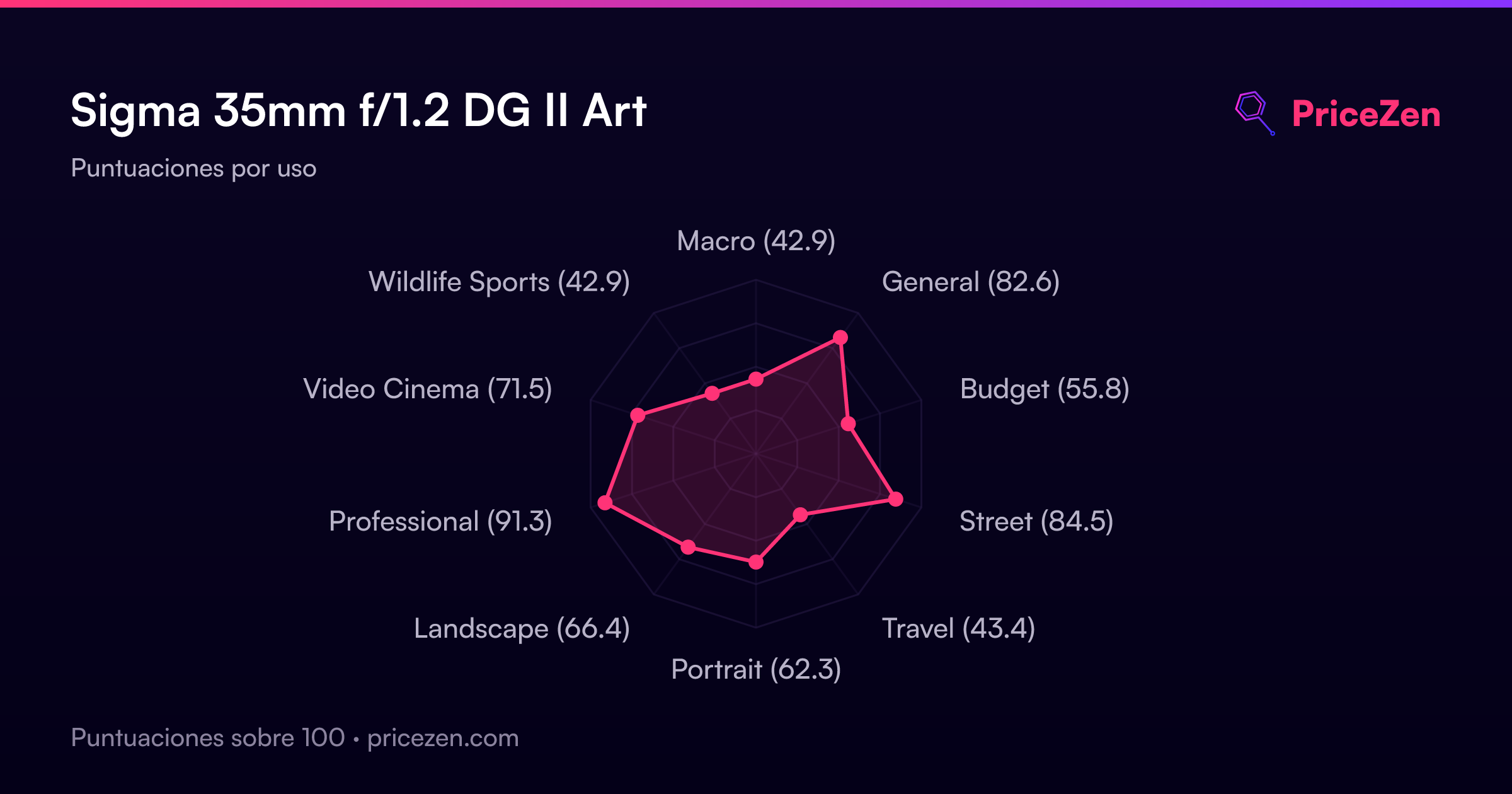
Usage Scores
- Macro42.9
- General82.6
- Budget55.8
- Street84.5
- Travel43.4
- Portrait62.3
- Landscape66.4
- Professional91.3
- Video Cinema71.5
- Wildlife Sports42.9