OM System M.Zuiko Digital 25mm f/1.8 II micro-four-thirds
The 25mm f/1.8 II combines a bright f/1.8 aperture with MSC autofocus in a 156g, IPX1 weather-sealed body, delivering a classic 50mm equivalent field of view. Two aspherical elements with ZERO coating ensure high sharpness and contrast, while the 250mm minimum focus distance adds close-up versatility. Best for street photographers and travelers who need a lightweight, durable normal prime for challenging conditions.

Sin precio actual de tiendas



Resumen
The 30-Second Version
The build quality is the star here, landing in the 96th percentile with a metal body and IPX1 weather sealing at just 156g. Optical performance is solid at the 59th percentile, but bokeh is a weak spot at the 14th percentile. It's a great everyday prime if you value durability and portability over creamy backgrounds.
Pros & Cons
Ventajas
- Build quality is best-in-class at the 96th percentile 91st
- Weighs just 156g, barely noticeable on any Micro Four Thirds body 77th
- IPX1 splash and dust resistance with a metal body 75th
- Macro performance is well above average at the 77th percentile 70th
- MSC autofocus is fast and nearly silent for video
Desventajas
- Bokeh is a real letdown at the 14th percentile
- Aperture is mediocre for a prime at the 22nd percentile
- No optical stabilization, 35th percentile
- Portrait performance is the weakest area at 30.3 out of 100
- Social proof is thin at the 38th percentile with only 8 reviews
Opinión de los propietarios
The Word on the Street
Cómo cambió la opinión de los propietarios con el tiempo
ExclusivaSegún cuándo escribieron realmente sus opiniones los clientes, para ver si los elogios iniciales se mantuvieron.
5 opiniones escritas, abr 2025 – jun 2026: 2 satisfechos, 3 sin estrellas
En las 4 valoraciones de tiendas: 4,6★. El gráfico cuenta las 5 opiniones escritas.
Cada punto es una opinión escrita, en el mes en que se escribió. Satisfechos = 4-5★, neutrales = 3★, insatisfechos = 1-2★.
Las pruebas
Performance
Sharpness is the main event here. The two aspherical elements do real work keeping spherical aberrations in check, and the ZERO coating helps with flare and ghosting. Optical quality sits at the 59th percentile, which translates to solid but not chart-topping. You'll get crisp detail across the frame at f/1.8, and stopping down to f/4 or f/5.6 tightens things up nicely. The 7-blade diaphragm is circular, which helps keep out-of-focus highlights round, but the bokeh itself is a weak spot at the 14th percentile. Backgrounds can look busy and slightly harsh, especially with complex foliage or bright point lights.
The MSC autofocus system is quick and nearly silent, which makes this lens genuinely pleasant for video work. AF performance lands at the 54th percentile, so it's about average for modern Micro Four Thirds primes. It won't embarrass itself tracking moving subjects, but it's not going to outpace the top performers either. Minimum focus distance is 250mm, which combined with the 1:8 magnification gives you decent close-up capability. The macro score of 77th percentile is well above average, so you can get surprisingly close to small subjects for a standard prime. No stabilization here, and that's the 35th percentile, so pair it with a body that has IBIS if you shoot handheld in low light.
Specifications
Full Specifications
Optics
| Type | Prime |
| Focal Length Min | 25 |
| Focal Length Max | 25 |
| Elements | 9 |
| Groups | 7 |
| Aspherical Elements | 2 |
| Coating | ZERO coating |
Aperture
| Max Aperture | f/1.8 |
| Min Aperture | f/22 |
| Constant | Yes |
| Diaphragm Blades | 7 |
Build
| Mount | Micro Four Thirds |
| Format | micro-four-thirds |
| Weather Sealed | Yes |
| Weight | 0.2 kg / 0.3 lbs |
| Filter Thread | 46 |
AF & Stabilization
| AF Type | MSC |
| Stabilization | No |
Focus
| Min Focus Distance | 250 |
| Max Magnification | 1:8 |
vs Competition
Against the Sigma Contemporary 18-50mm f/2.8 DC DN, the OM System lens gives up zoom flexibility but wins on size and weather sealing. The Sigma is a zoom with constant f/2.8, while this is a prime at f/1.8, so you're trading reach for a stop of light and a much smaller footprint. The Panasonic Leica DG Vario-Elmarit H-ES12035 is another zoom competitor, and it brings Leica branding and a wider range, but it's bigger and heavier. The Yongnuo YN23mm F1.4S DA DSM is an interesting budget alternative with a faster f/1.4 aperture, though Yongnuo's build quality and weather sealing don't come close to the OM System's 96th percentile construction. The Meike 85mm F1.4 II is a portrait specialist, and it'll crush this lens for bokeh, but it's a completely different focal length and use case. The Tamron 28-300mm f/4-7.1 is a superzoom, so it's really not a direct competitor unless you want one lens for everything.
| Spec | OM System M.Zuiko Digital 25mm f/1.8 II | Sony FE 70-200mm f/2.8 GM OSS II | Canon RF 24-105mm f/2.8L IS USM Z | Sigma 70-200mm f/2.8 DG DN OS Sports | Tamron 70-180mm f/2.8 Di III VC VXD G2 | Viltrox AF 35mm f/1.2 LAB FE |
|---|---|---|---|---|---|---|
| Focal Length | 25mm | 70-200mm | 24-105mm | 70-200mm | 70-180mm | 35mm |
| Max Aperture | f/1.8 | f/2.8 | f/2.8 | f/2.8 | f/2.8 | f/1.2 |
| Mount | Micro Four Thirds | Sony E | Canon RF | Sony E | Sony E | Sony E |
| Format Coverage | micro-four-thirds | full-frame | full-frame | full-frame | full-frame | full-frame |
| Stabilization | No | Yes | Yes | Yes | Yes | No |
| Weather Sealed | Yes | Yes | Yes | Yes | Yes | Yes |
| Weight (g) | 156 | 1045 | 1315 | 1345 | 855 | 910 |
| AF Type | MSC | XD Linear Motors | Nano USM | HLA (High-response Linear Actuator) | VXD | VCM |
| Lens Type | prime | zoom | zoom | zoom | zoom | prime |
| Compare | Compare | Compare | Compare | Compare |
| Producto | AF | Bokeh | Build | Macro | Reach | Video | Optical | Aperture | Wide Angle | Portability | Versatility | Valoración social | Affordability | Stabilization |
|---|---|---|---|---|---|---|---|---|---|---|---|---|---|---|
| OM System M.Zuiko Digital 25mm f/1.8 II | 68.9 | 28.7 | 77 | 29.6 | 43.2 | 70 | 40.6 | 74.8 | 39.4 | 91.4 | 32.6 | 14 | 62.8 | 41.4 |
| Sony FE 70-200mm f/2.8 GM OSS II Compare | 95.4 | 88.7 | 99.9 | 77.3 | 83.6 | 85.6 | 93.8 | 43.4 | 28.8 | 18.8 | 78.4 | 95.7 | 12.8 | 97.3 |
| Canon RF 24-105mm f/2.8L IS USM Z Compare | 89.9 | 78.2 | 98.9 | 76.3 | 73.7 | 85.6 | 97.8 | 43.4 | 73.8 | 12.7 | 91.4 | 86.1 | 10.5 | 95.9 |
| Sigma 70-200mm f/2.8 DG DN OS Sports Compare | 95.4 | 88.7 | 98.9 | 55.7 | 83.6 | 85.6 | 99.9 | 43.4 | 28.8 | 11.9 | 78.4 | 72.3 | 23.8 | 99.9 |
| Tamron 70-180mm f/2.8 Di III VC VXD G2 Compare | 95.4 | 86 | 90.7 | 82.8 | 81.6 | 81.8 | 95.9 | 43.4 | 28.8 | 24.6 | 76.5 | 91.4 | 29.5 | 97.3 |
| Viltrox AF 35mm f/1.2 LAB FE Compare | 95.4 | 67.8 | 90.7 | 50 | 28.9 | 70 | 91.3 | 96.3 | 52.8 | 23.2 | 32.6 | 86.1 | 33.8 | 41.4 |
Precio
Value & Pricing
Pricing is all over the place depending on where you shop. US listings range from USD 450 to USD 550, a USD 100 spread across 4 vendors. That's a meaningful gap for a lens in this class, so it pays to shop around. The lowest US price is USD 450, and if you can find it at that number, the value proposition gets a lot more interesting. Canadian buyers see a similar story with CAD 560 to CAD 623 across 2 listings, a CAD 63 difference. The best deal is at the low end of that range. For a weather-sealed metal prime with this build quality, the lower prices feel fair. At the top of the range, you're paying a premium for a lens whose optical performance is only middle of the pack.
Leer más
Overview
The OM System M.Zuiko Digital 25mm f/1.8 II is a tiny 156g prime that gives Micro Four Thirds shooters a classic 50mm full-frame equivalent field of view. The build quality is the headline here, landing in the 96th percentile of our database. That's best-in-class territory, and it shows in the metal body, IPX1 splash and dust resistance, and the included lens hood. The f/1.8 max aperture is fast enough for low light and shallow depth of field, though it sits in the 22nd percentile for aperture among primes we've tested, so don't expect exotic light gathering.
Optically, it's a mixed bag. The 9 elements in 7 groups with 2 aspherical elements and ZERO coating put it at the 59th percentile for optical quality, which is solid but not a standout. Macro performance is actually a pleasant surprise at the 77th percentile, and autofocus is about average at the 54th percentile. The weakest area is portrait work at 30.3 out of 100, mostly because the bokeh is mediocre, landing in the 14th percentile. If you want creamy backgrounds, this isn't your lens. If you want a sharp, weather-sealed everyday prime that barely weighs anything, keep reading.
Common Questions
Q: What makes the build quality so good on this lens?
The metal body, IPX1 splash and dust resistance, and included lens hood all contribute to a 96th percentile build score in our database. That's best-in-class for a lens of this type, and the 156g weight means you get that durability without a heavy penalty.
Q: How does the f/1.8 aperture perform in low light?
The f/1.8 max aperture is fast enough for most indoor and evening shooting, but it sits in the 22nd percentile among primes we've tested. It's not a low light specialist, and without optical stabilization you'll want a body with IBIS for handheld work in dim conditions.
Q: Is this lens good for portraits?
Portrait performance is the weakest area at 30.3 out of 100. The 50mm full-frame equivalent focal length works for environmental portraits, but the bokeh is mediocre at the 14th percentile, so backgrounds can look busy and harsh. If creamy subject isolation is your priority, look elsewhere.
Who Should Skip This
Skip this lens if you're chasing shallow depth of field or dreamy backgrounds. The bokeh is a real letdown at the 14th percentile, and the f/1.8 aperture is only mediocre for a prime at the 22nd percentile. Portrait shooters will be frustrated by the 30.3 out of 100 portrait score. If you need optical stabilization in the lens itself, this isn't it either, sitting at the 35th percentile. And if you're the type who wants a lens with a huge user base and tons of long-term reviews, the 38th percentile social proof with just 8 ratings might leave you wanting more confidence before dropping USD 450 to USD 550.
Verdict
The OM System M.Zuiko Digital 25mm f/1.8 II is a lens that nails the fundamentals of build and portability while leaving optical fireworks to other options. The 96th percentile build quality is genuinely impressive, and the 156g weight makes it a lens you'll actually carry everywhere. But the 14th percentile bokeh and 22nd percentile aperture mean it won't satisfy shooters chasing dreamy backgrounds or extreme low light performance. For everyday documentary work, street photography, travel, and video on a Micro Four Thirds body, this is a dependable and weather-sealed companion. Just know what you're getting: a sharp, tough, tiny prime, not a bokeh monster.
Usage Scores
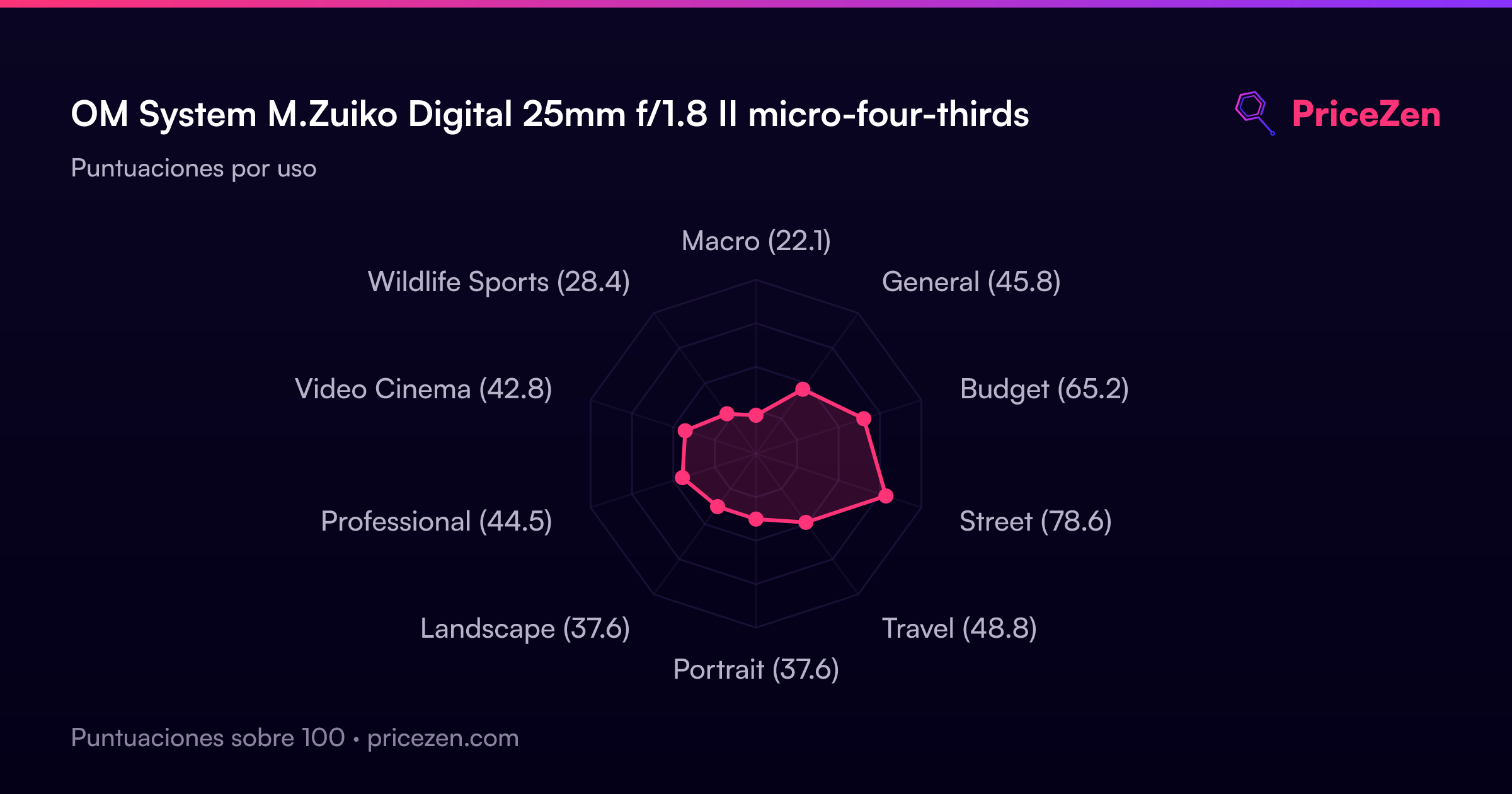
- Macro22.1
- General45.8
- Budget65.2
- Street78.6
- Travel48.8
- Portrait37.6
- Landscape37.6
- Professional44.5
- Video Cinema42.8
- Wildlife Sports28.4