Samyang XP 14mm f/2.4
The sophisticated 18-element optical design with hybrid aspherical and ED glass delivers sharp, low-distortion images with a bright f/2.4 aperture for full-frame Canon EF cameras. Its durable aluminum-alloy housing and built-in lens hood provide a robust, flare-resistant build in a fully manual focus package. This lens is best for architectural and astrophotography specialists who prioritize precise manual control and edge-to-edge sharpness over autofocus convenience.

Sin precio actual de tiendas


Resumen
The 30-Second Version
The Samyang XP 14mm f/2.4 delivers 93rd percentile optical quality with a fast f/2.4 aperture, making it a standout for astrophotography. But user sentiment sits at just the 16th percentile, with owners reporting vignetting, flare, and adapter compatibility issues. Great glass with real caveats, buy it for the optics, not the experience.
Pros & Cons
Ventajas
- 93rd percentile optical quality, genuinely sharp glass 93rd
- Fast f/2.4 aperture for a 14mm prime 78th
- Lightweight at 791g for an ultra-wide full-frame lens
- Excellent value for astrophotography work
- 18-element design with 2 aspherical and 2 ED elements
Desventajas
- User sentiment in the 16th percentile, owners are frustrated
- Significant vignetting reported by multiple buyers
- Manual focus only, AF score in the 15th percentile
- Compatibility issues with Canon RF and Nikon Z adapters
- Build quality score in the 8th percentile
Opinión de los propietarios
The Word on the Street
Cómo cambió la opinión de los propietarios con el tiempo
ExclusivaSegún cuándo escribieron realmente sus opiniones los clientes, para ver si los elogios iniciales se mantuvieron.
6 opiniones escritas, may 2018 – feb 2024: 4 satisfechos, 2 insatisfechos
En las 6 valoraciones de tiendas: 3,5★. El gráfico cuenta las 6 opiniones escritas.
Cada punto es una opinión escrita, en el mes en que se escribió. Satisfechos = 4-5★, neutrales = 3★, insatisfechos = 1-2★.
Las pruebas
Performance
The optical score is the headline here, and it's a big one. At the 93rd percentile, this lens is punching way above its price class. The 18-element, 14-group design with 2 aspherical and 2 ED elements does real work keeping chromatic aberration and distortion in check. The Ultra Multi-Coating helps with contrast, though owners still report flare can be a problem in bright, direct light. The f/2.4 max aperture is fast for a 14mm prime, and that's a big deal for astrophotography, where every stop of light matters. Minimum focus distance is 280mm, which gets you surprisingly close for an ultra-wide.
But the weaknesses are just as real. Stabilization sits at the 34th percentile, which is expected for a manual focus prime but still worth noting if you're shooting handheld in low light. The aperture ranking of 22nd percentile seems odd until you remember this is compared against all lens types, including zooms with wider ranges. For a 14mm prime, f/2.4 is genuinely fast. The bokeh score of 25th percentile is not a shocker, ultra-wides aren't bokeh machines, and with a 9-blade diaphragm you'll get decent sunstars stopped down but nothing creamy wide open.
Specifications
Full Specifications
Optics
| Type | Wide-angle |
| Focal Length Min | 14 |
| Focal Length Max | 14 |
| Elements | 18 |
| Groups | 14 |
| Aspherical Elements | 2 |
| ED Elements | 2 |
| Coating | Ultra Multi-Coating |
Aperture
| Max Aperture | f/2.4 |
| Min Aperture | f/22 |
| Constant | No |
| Diaphragm Blades | 9 |
Build
| Mount | Canon EF |
| Format | full-frame |
| Weight | 0.8 kg / 1.7 lbs |
AF & Stabilization
| AF Type | manual focus only |
| Stabilization | No |
Focus
| Min Focus Distance | 280 |
| Max Magnification | 1:12.5 |
vs Competition
Stacked against the competition, this Samyang is a weird beast. The Tamron Di III VC 28-300mm f/4-7.1 and Sigma Contemporary 16-300mm f/3.5-6.7 DC OS are zooms with stabilization and autofocus, they're far more versatile but can't touch the Samyang's optical sharpness or f/2.4 aperture. The Nikon NIKKOR 20059 and Panasonic Leica DG Vario-Elmarit H-ES12035 are also zooms aimed at different use cases entirely. The Sony E 18-135mm f/3.5-5.6 OSS has stabilization and AF, which the Samyang lacks completely. What the Samyang offers is a specific thing: ultra-wide, fast, sharp, manual. If that's your workflow, none of these competitors do what it does. If you need autofocus or stabilization, every single one of them beats it.
| Spec | Samyang XP 14mm f/2.4 | Sony FE 70-200mm f/2.8 GM OSS II | Canon RF 24-105mm f/2.8L IS USM Z | Sigma 70-200mm f/2.8 DG DN OS Sports | Tamron 70-180mm f/2.8 Di III VC VXD G2 | Viltrox AF 35mm f/1.2 LAB FE |
|---|---|---|---|---|---|---|
| Focal Length | 14mm | 70-200mm | 24-105mm | 70-200mm | 70-180mm | 35mm |
| Max Aperture | f/2.4 | f/2.8 | f/2.8 | f/2.8 | f/2.8 | f/1.2 |
| Mount | Canon EF | Sony E | Canon RF | Sony E | Sony E | Sony E |
| Format Coverage | full-frame | full-frame | full-frame | full-frame | full-frame | full-frame |
| Stabilization | false | true | true | true | true | false |
| Weather Sealed | false | true | true | true | true | true |
| Weight (g) | 791 | 1045 | 1315 | 1345 | 855 | 910 |
| AF Type | manual focus only | XD Linear Motors | Nano USM | HLA (High-response Linear Actuator) | VXD | VCM |
| Lens Type | wide-angle | zoom | zoom | zoom | zoom | prime |
| Compare | Compare | Compare | Compare | Compare |
| Producto | AF | Bokeh | Build | Macro | Reach | Video | Optical | Aperture | User Sentiment | Wide Angle | Portability | Versatility | Valoración social | Affordability | Stabilization |
|---|---|---|---|---|---|---|---|---|---|---|---|---|---|---|---|
| Samyang XP 14mm f/2.4 | 21.8 | 12.2 | 30.2 | 10.1 | 4.2 | 27.3 | 78.2 | 56.6 | 18.7 | 93.1 | 29 | 32.4 | 3 | 47.6 | 41.4 |
| Sony FE 70-200mm f/2.8 GM OSS II Compare | 95.3 | 88.6 | 99.9 | 77.4 | 83.5 | 85.6 | 89.4 | 43.4 | 94.4 | 28.9 | 19.1 | 78.4 | 95.7 | 12.4 | 97.3 |
| Canon RF 24-105mm f/2.8L IS USM Z Compare | 89.9 | 78.1 | 98.9 | 76.4 | 73.8 | 85.6 | 97.9 | 43.4 | 84.5 | 74 | 12.8 | 91.5 | 86.1 | 10.3 | 95.9 |
| Sigma 70-200mm f/2.8 DG DN OS Sports Compare | 95.3 | 88.6 | 98.9 | 55.7 | 83.5 | 85.6 | 99.9 | 43.4 | 77 | 28.9 | 12 | 78.4 | 72.3 | 23.5 | 99.9 |
| Tamron 70-180mm f/2.8 Di III VC VXD G2 Compare | 95.3 | 85.9 | 90.6 | 82.9 | 81.5 | 81.8 | 96 | 43.4 | 69.7 | 28.9 | 24.9 | 76.5 | 91.5 | 29.8 | 97.3 |
| Viltrox AF 35mm f/1.2 LAB FE Compare | 95.3 | 67.7 | 90.6 | 50 | 28.7 | 69.8 | 91.4 | 96.3 | 35.3 | 52.9 | 23.5 | 32.4 | 86.1 | 33.6 | 41.4 |
Precio
Value & Pricing
Pricing is all over the place depending on where you look. In the US, you'll find this lens listed between USD 695 and USD 799 across 2 listings, that's a USD 104 spread for the exact same piece of glass. Canadian buyers face an even wider gap, with prices ranging from CAD 865 to CAD 1,031, a CAD 166 difference. If you're buying in the US, shop around before you commit, that USD 104 savings is real money. The value proposition is strongest for astrophotographers who need a fast, sharp ultra-wide and don't mind manual focus. For everyone else, the compatibility headaches and vignetting might eat into the savings.
Leer más
Overview
The Samyang XP 14mm f/2.4 sits in the 93rd percentile for optical quality in our database, which is the kind of number that makes you sit up and pay attention. That's a manual focus, full-frame EF mount prime with 18 elements in 14 groups, including 2 aspherical and 2 ED elements, all wrapped in a 791g aluminum-alloy body. On paper, this is a serious piece of glass for anyone who wants ultra-wide coverage without selling a kidney.
But here's the thing: the user sentiment score lands at just the 16th percentile, and the customer rating is 3.5 out of 5 across 6 reviews. Owners love the sharpness and the f/2.4 aperture for astrophotography, but they're also reporting significant vignetting, flare issues, and real compatibility headaches with Canon RF bodies and third-party adapters. So you've got a lens with elite optics and a frustrating set of caveats. Classic Samyang, honestly.
Common Questions
Q: Is the Samyang XP 14mm f/2.4 good for astrophotography?
Yes, this is where the lens shines. The f/2.4 max aperture lets in a lot of light for a 14mm prime, and the 93rd percentile optical score means stars stay sharp across much of the frame. The manual focus design is actually a plus for astro work, since you'll be focusing at infinity anyway. Just be aware that owners report noticeable vignetting, which you'll need to correct in post.
Q: Will this lens work on a Canon RF mount camera?
It's an EF mount lens, so you'll need an adapter for RF bodies. Multiple owners report compatibility issues with third-party adapters, including electronic communication failures. Some users have had success with the official Canon adapter, but the safest bet is to use this lens on a native EF mount body.
Q: How does the Samyang XP 14mm f/2.4 compare to the Sigma 14mm?
At least one owner who has used both says the Samyang is extraordinary in quality compared to the Sigma 14mm. The Samyang's 93rd percentile optical score backs that up. However, the Sigma likely has better build quality and fewer compatibility headaches. If you're willing to deal with manual focus and potential adapter issues, the Samyang delivers comparable or better optics for less money.
Who Should Skip This
Skip this lens if you're shooting on a Canon RF or Nikon Z body with an adapter. The compatibility issues owners report are not theoretical, they're showing up in real-world use with electronic communication failures. Also skip it if you need autofocus, the AF score sits at the 15th percentile because there is no autofocus at all. And if build quality matters to you, the 8th percentile build score should give you pause. This is a lens for patient photographers on native EF mounts who value optical sharpness over convenience.
Verdict
The Samyang XP 14mm f/2.4 is a lens with a split personality. The 93rd percentile optical score is legitimately impressive, and for astrophotography on a budget, it's hard to argue with f/2.4 at this price. But the 16th percentile user sentiment tells the other half of the story. Owners are dealing with vignetting, flare, and adapter compatibility issues that range from annoying to deal-breaking. The 3.5 out of 5 rating across 6 reviews reflects that frustration. If you're on a native EF body and you know you want manual focus, this lens delivers outstanding image quality for the money. If you're adapting to RF or Z mount, or you need autofocus, look elsewhere.
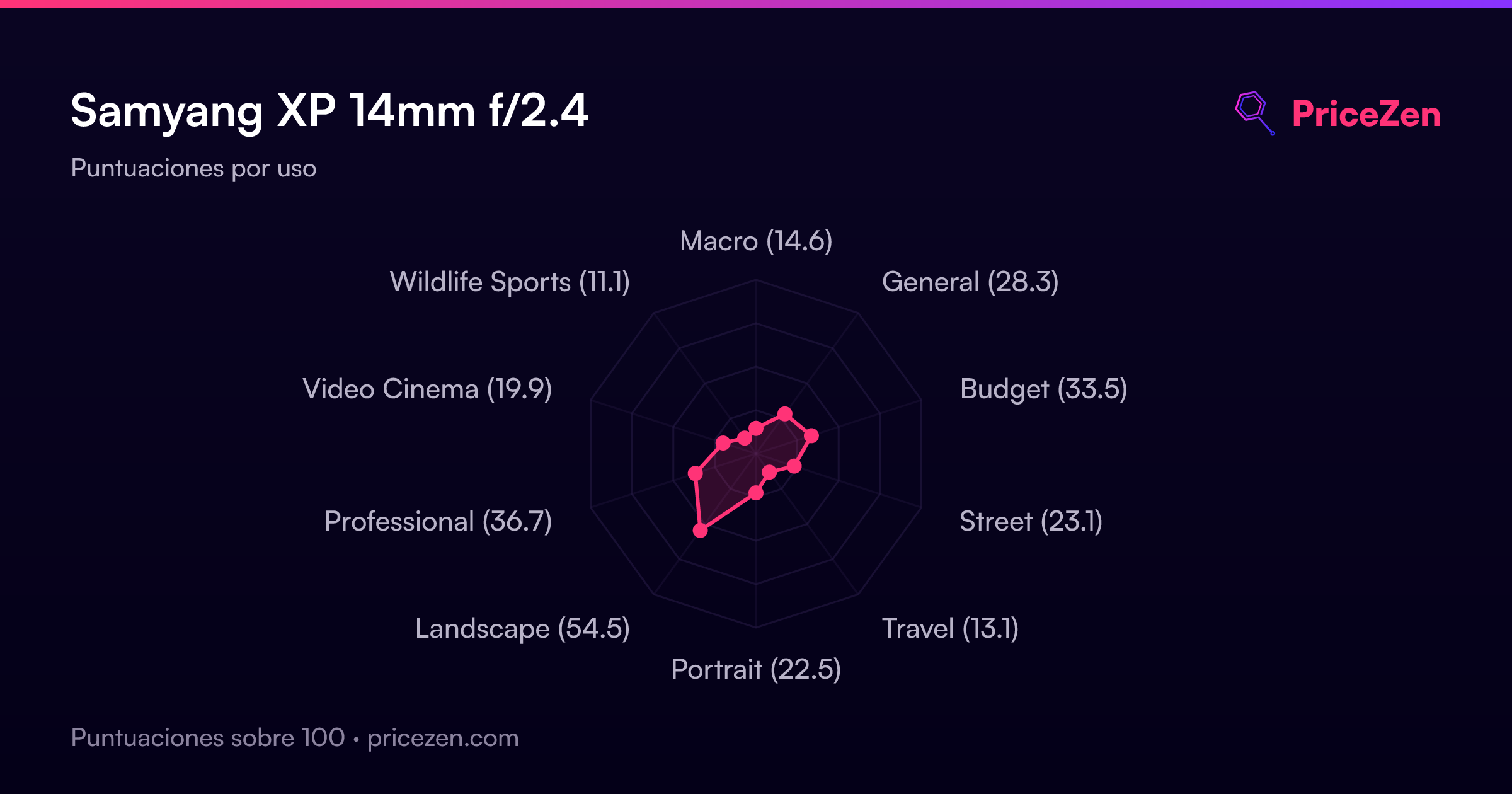
Usage Scores
- Macro14.6
- General28.3
- Budget33.5
- Street23.1
- Travel13.1
- Portrait22.5
- Landscape54.5
- Professional36.7
- Video Cinema19.9
- Wildlife Sports11.1