Canon CN-E Cinema 14-60mm T2.6L S APS-C

11 láminas de diafragma para un bokeh redondo verificado el 29 nov
35/100 puntuación global
- Focal length
- 14-60mm
- Aperture
- f/2.6
- Mount
- Canon EF
- Format coverage
- APS-C
- Weight
- 4500 g
- Af type
- Geared Inner Focusing
- Lens type
- zoom


Resumen
The 30-Second Version
The Canon CN-E 14.5-60mm T2.6 L S is a Super 35 EF-mount cinema zoom lens that ranks in the 98th percentile for video work, with a constant T2.6 and near-zero focus breathing. At CAD 45,999 and 4500g, it's a professional production tool, not an everyday lens.
Pros & Cons
Ventajas
- Top-tier cinema performance, 98th percentile for video 98th
- Constant T2.6 across the full 4.1x zoom range 91st
- Near-zero focus breathing from geared inner focusing 79th
- Dual-sided angled markings with switchable metric scale 70th
- 11-blade aperture for smooth defocus
Desventajas
- CAD 45,999 puts affordability in the 1st percentile
- 4500g, the worst portability ranking in the category
- No stabilization and no weather sealing
- 700mm minimum focus kills any close-up work
- Weak autofocus ranking, manual-focus workflow only
Las pruebas
Performance
The optical package is 18 elements including fluorite and a large aspherical element, designed to hold sharpness across the whole zoom range and resolve up to 4K. The 11-blade diaphragm gives smooth out-of-focus rendering, though bokeh ranks only about average in our data, which makes sense: T2.6 on Super 35 isn't a shallow-depth machine. Aperture speed sits mid-pack too. Where this lens dominates is motion picture work, where breathing control, parfocal-style zoom behavior and repeatable manual rings matter more than raw speed.
The trade-offs are real. At 4500g it's the heaviest thing in its class by our ranking, dead last for portability, and there's no stabilization and no weather sealing. Autofocus ranks near the bottom as well, which is expected on a cinema lens but worth knowing if you were hoping to run it solo on a gimbal. The 136mm filter thread also means big, expensive glass up front. Our optical score puts it below the middle of the category, so don't expect it to out-resolve modern premium primes; you're paying for the zoom mechanics and production workflow, not chart-topping lab numbers.
Specifications
Full Specifications
Optics
| Type | Zoom |
| Focal Length Min | 14 |
| Focal Length Max | 60 |
| Elements | 18 |
| Aspherical Elements | 1 |
| ED Elements | 1 |
Aperture
| Max Aperture | f/2.6 |
| Constant | Yes |
| Diaphragm Blades | 11 |
Build
| Mount | Canon EF |
| Format | APS-C |
| Weight | 4.5 kg / 9.9 lbs |
AF & Stabilization
| AF Type | Geared Inner Focusing |
Focus
| Min Focus Distance | 700 |
vs Competition
Against the other names in our comparison pool, the Canon's case rests on its category-leading video ranking and its production features: consistent ring torque, flange-back adjustment, dual-side markings. The Viltrox EPIC Maestro 25-135mm T2 is the closest philosophical rival, another cine zoom, so cross-shop those two if you specifically need a parfocal-style zoom for narrative work. The Sigma 18-125mm f/3.8-5.6 AF DC OS HSM is the pick if you want autofocus and stabilization instead of cinema mechanics, since the Canon has neither.
The Sony FE 600mm f/4 GM OSS, Nikon NIKKOR Z 120-300mm f/2.8 TC VR S and Zeiss Milvus 35mm f/1.4 ZE show up in the same competitive set but serve different jobs. If your work is long-lens sports or wildlife, or fast prime portraits, the Canon's 14.5-60mm Super 35 range and T2.6 simply aren't aimed at you. Buy this lens because you shoot Super 35 cinema, not because it's a Canon L.
| Spec | Canon CN-E Cinema 14-60mm T2.6L S | Sony FE 70-200mm f/2.8 GM OSS II | Sigma 70-200mm f/2.8 DG DN OS Sports | Tamron 70-180mm f/2.8 Di III VC VXD G2 | Viltrox AF 35mm f/1.2 LAB FE | Nikon NIKKOR Z 70-200mm f/2.8 VR S |
|---|---|---|---|---|---|---|
| Focal Length | 14-60mm | 70-200mm | 70-200mm | 70-180mm | 35mm | 70-200mm |
| Max Aperture | f/2.6 | f/2.8 | f/2.8 | f/2.8 | f/1.2 | f/2.8 |
| Mount | Canon EF | Sony E | Sony E | Sony E | Sony E | Nikon Z |
| Format Coverage | APS-C | full-frame | full-frame | full-frame | full-frame | full-frame |
| Stabilization | No | Yes | Yes | Yes | No | Yes |
| Weather Sealed | No | Yes | Yes | Yes | Yes | Yes |
| Weight (g) | 4500 | 1045 | 1345 | 855 | 910 | 1440 |
| AF Type | Geared Inner Focusing | XD Linear Motors | HLA (High-response Linear Actuator) | VXD | VCM | STM (stepping motor) |
| Lens Type | zoom | zoom | zoom | zoom | prime | zoom |
| Compare | Compare | Compare | Compare | Compare |
| Producto | AF | Bokeh | Build | Macro | Reach | Video | Optical | Aperture | Wide Angle | Portability | Versatility | Affordability | Stabilization |
|---|---|---|---|---|---|---|---|---|---|---|---|---|---|
| Canon CN-E Cinema 14-60mm T2.6L S | 44.7 | 54.2 | 30.4 | 15.1 | 69.7 | 97.9 | 41.5 | 53.9 | 78.6 | 0.2 | 90.7 | 0.7 | 41.4 |
| Sony FE 70-200mm f/2.8 GM OSS II Compare | 95.4 | 88.6 | 99.9 | 77.2 | 83.5 | 85.2 | 89.3 | 43.2 | 28.8 | 19.2 | 78.5 | 12.7 | 97.2 |
| Sigma 70-200mm f/2.8 DG DN OS Sports Compare | 95.4 | 88.6 | 98.9 | 55.8 | 83.5 | 85.2 | 99.9 | 43.2 | 28.8 | 12.1 | 78.5 | 24.1 | 99.9 |
| Tamron 70-180mm f/2.8 Di III VC VXD G2 Compare | 95.4 | 85.9 | 90.8 | 82.9 | 81.5 | 81.5 | 96 | 43.2 | 28.8 | 25.2 | 76.5 | 29.5 | 97.2 |
| Viltrox AF 35mm f/1.2 LAB FE Compare | 95.4 | 67.8 | 90.8 | 50.2 | 28.9 | 69.7 | 91.3 | 96.4 | 52.7 | 23.8 | 32.6 | 34 | 41.4 |
| Nikon NIKKOR Z 70-200mm f/2.8 VR S Compare | 69 | 85.9 | 98.9 | 58 | 83.5 | 85.2 | 98 | 43.2 | 28.8 | 10.3 | 78.5 | 14.4 | 98.6 |
Precio
Value & Pricing
Let's be blunt: at CAD 45,999 this is one of the most expensive lenses we track in this category, sitting in the 1st percentile for affordability. We watch prices over time through our own system and community browser extension, and there's currently one listing, at Vistek. For a rental house or a production company billing this to clients, the cost amortizes across shoots. For an individual shooter, alternatives like the Viltrox EPIC Maestro 25-135mm T2 or the Sigma 18-125mm f/3.8-5.6 AF DC OS HSM exist in this comparison set and deserve a hard look before you commit cinema-zoom money.
Leer más
Overview
The Canon CN-E 14.5-60mm T2.6 L S is a Super 35 cinema zoom lens with an EF mount, and it sits at the very top of the price pile: CAD 45,999 at Vistek right now. That's not a typo, and it's not a lens you buy on impulse. It's built for working cinematographers shooting on APS-C or Super 35 sensor cameras like Canon's EOS C300, covering a 14.5-60mm range (a 4.1x zoom) at a constant T2.6.
So who is this actually for? If you're asking whether the Canon CN-E 14.5-60mm is good for video, our data says yes, emphatically: it scores 65.4/100 for cinema work and lands in the 98th percentile against everything else in the video cine lens category. The geared inner focusing keeps focus breathing close to zero, the control rings have consistent torque, and the markings sit on angled surfaces on both sides of the barrel so your focus puller can read them from either side of the camera. You can even switch the focus scale between standard and metric labeling.
What it isn't is a general-purpose stills lens. Portrait scores 36.1/100, landscape 35.8/100, and macro is a dismal 10.7/100 thanks to a 700mm minimum focus distance. This is a specialist tool, priced like one.
Common Questions
Q: Is the Canon CN-E 14.5-60mm T2.6 good for video?
Yes, that's exactly what it's built for. It scores 65.4/100 for cinema in our data and ranks in the 98th percentile among video cine lenses, with geared inner focusing that keeps focus breathing virtually at zero.
Q: Does the Canon CN-E 14.5-60mm have autofocus or stabilization?
Our data shows no stabilization, and its autofocus ranking is near the bottom of the category. This is a manual-focus cinema lens with geared control rings designed for a focus puller.
Q: What cameras does the Canon CN-E 14.5-60mm T2.6 L S fit?
It uses a Canon EF mount and covers APS-C and Super 35 sensors, including Canon's EOS C300. It's designed to resolve images up to 4K on those formats.
Q: How much does the Canon CN-E 14.5-60mm cost?
We currently track it at CAD 45,999 at Vistek, which puts it in the 1st percentile for affordability in its category. This is professional cinema glass priced accordingly.
Who Should Skip This
Skip this if you shoot stills, portraits, landscapes or anything close-up: the 700mm minimum focus and a 10.7/100 macro score rule out macro entirely, and portrait and landscape scores sit in the mid-30s. Solo operators who need autofocus or stabilization should look at the Sigma 18-125mm f/3.8-5.6 AF DC OS HSM instead, and anyone shooting full-frame, long telephoto or fast-prime work will be better served by the Sony FE 600mm f/4 GM OSS, Nikon NIKKOR Z 120-300mm f/2.8 TC VR S or Zeiss Milvus 35mm f/1.4 ZE. And if CAD 45,999 makes your eyes water, that's your answer.
Verdict
Should you buy the Canon CN-E 14.5-60mm T2.6 L S? If you run a Super 35 EF-mount production camera and need a breathing-free, crew-friendly zoom that resolves 4K, yes, this is about as good as the category gets for video work according to our scoring model. The mechanics are the product here, and they're best-in-class.
For almost everyone else, no. It's heavy, unstabilized, unsealed, can't focus closer than 700mm, and costs CAD 45,999. That combination only makes sense when someone else is paying the invoice, or when this lens is the business.
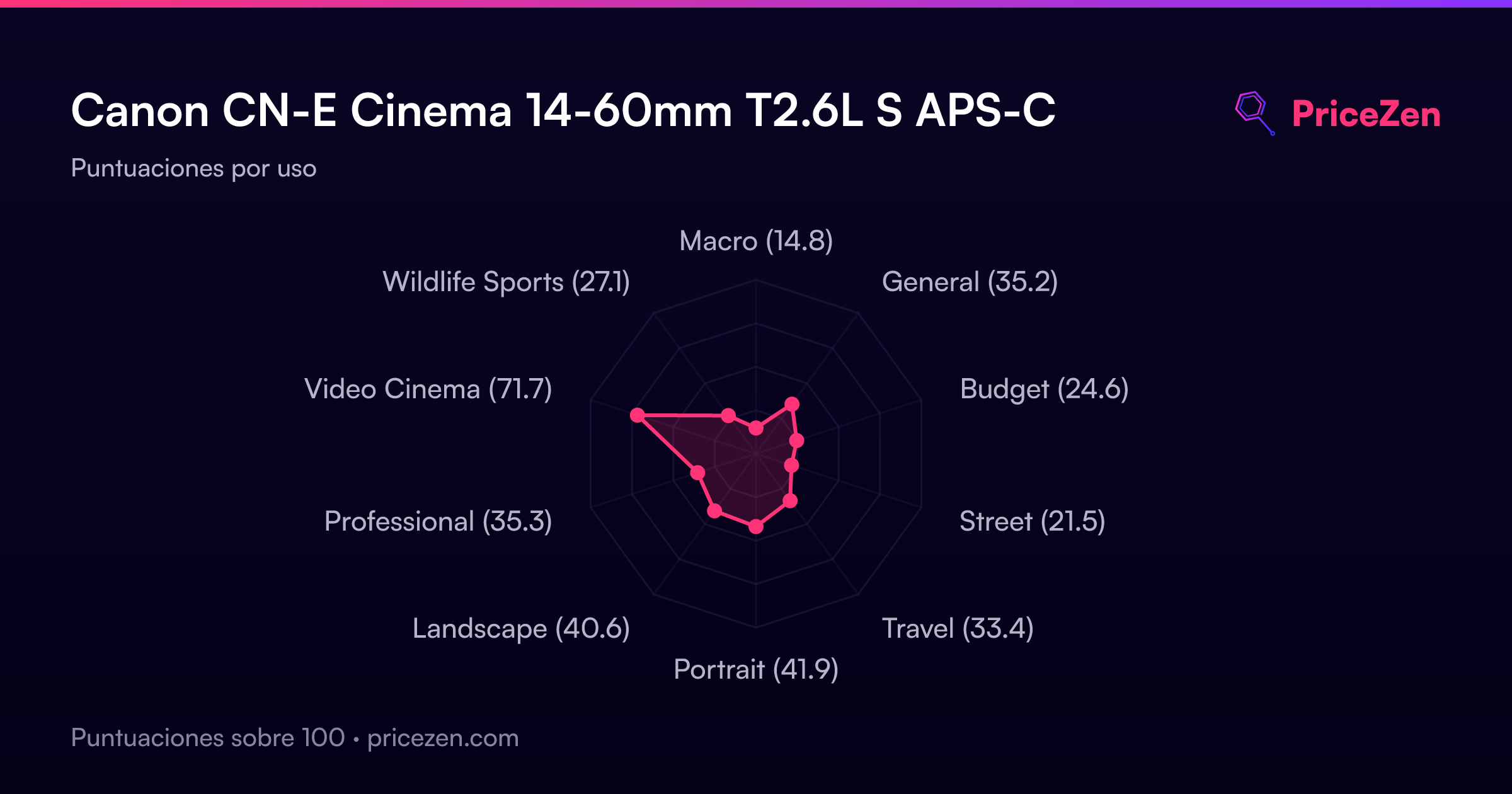
Usage Scores
- Macro14.8
- General35.2
- Budget24.6
- Street21.5
- Travel33.4
- Portrait41.9
- Landscape40.6
- Professional35.3
- Video Cinema71.7
- Wildlife Sports27.1