Rokinon TSL24M-N 24mm f/3.5

Tilt-shift para mantener rectos los edificios verificado el 29 nov
29/100 puntuación global 3,6 media de 50 valoraciones de propietarios
- Focal length
- 24mm
- Aperture
- f/3.5
- Mount
- Nikon F
- Format coverage
- full-frame
- Weight
- 680 g
- Af type
- manual focus only
- Lens type
- tilt-shift
Compara precios en 1 tienda
De la más barata a la más cara. Las ofertas nuevas, reacondicionadas y en pack se mantienen separadas para que compares lo comparable.
| Tienda | Vendido por | Color y estado | Precio | vs. el más bajo | Última comprobación | Enlace |
|---|---|---|---|---|---|---|
| Nuevo2 ofertasUnidad individual | ||||||
| No comprobados en los últimos 7 días, por lo que estos precios pueden haber cambiado | ||||||
| Amazon | Vendedor externo | No indicado | 16.235,41 MXN | 3 nov | Ir a la tienda | |
| Amazon | Vendedor externo | No indicado | 19.069,39 MXN | 29 oct | Ir a la tienda | |
 Fuente: PriceZen, comprobado el 3 nov 2026
Un precio se considera vigente si lo comprobamos en los últimos 7 días. «Vendedor externo» significa un vendedor de terceros en esa tienda, no la propia tienda.
Historial de precios
Comprobado ese díaNo comprobado ese día, sigue en oferta
Fuente: PriceZen, checked 3 nov 2026











Resumen
The 30-Second Version
The Rokinon TSL24M-E is a budget tilt-shift lens with excellent build quality and solid sharpness when stopped down to f/5.6 or higher. It costs around $656 to $699 USD, roughly a third of what Canon or Nikon charge for comparable tilt-shift glass. But it's soft wide open, prone to ghosting and flare, and has no electronic communication with the camera. If you need perspective control on a budget and can work around the quirks, it's a solid buy. If you need consistent professional results, save up for the Canon TS-E 24mm instead.
Pros & Cons
Ventajas
- Build quality is excellent, 97th percentile in our database 74th
- Sharp when stopped down to f/5.6 or f/8 74th
- Full tilt and shift range: ±8.5° tilt, ±12mm shift
- Much cheaper than Canon or Nikon tilt-shift options
- Precise manual controls with 30° click stops for rotation
Desventajas
- Soft wide open at f/3.5 with ghosting and flare issues
- No electronic communication with the camera body
- Manual focus only, no autofocus at all
- Heavy on smaller mirrorless bodies
- User sentiment in the bottom 10 percent of our database
Opinión de los propietarios
The Word on the Street
- A recurring theme is that this lens delivers excellent value for architectural and real estate work, with multiple owners saying it gets the job done for a fraction of the price of name-brand tilt-shift options.
- Sharpness is a divisive topic. Many users report very good results at f/5.6 and smaller apertures, but a significant number also mention softness wide open at f/3.5.
- Ghosting and flare are common complaints, especially when shooting with bright light sources in or near the frame. Some owners describe it as a dealbreaker for their work.
- The weight and balance on smaller mirrorless bodies comes up repeatedly. Several users mention that the lens feels front-heavy and awkward on compact Sony bodies.
Cómo cambió la opinión de los propietarios con el tiempo
ExclusivaSegún cuándo escribieron realmente sus opiniones los clientes, para ver si los elogios iniciales se mantuvieron.
20 opiniones escritas, abr 2015 – abr 2026: 8 satisfechos, 2 insatisfechos, 10 sin estrellas
En las 50 valoraciones de tiendas: 3,6★. La mayoría de los propietarios valora sin escribir una opinión. El gráfico cuenta las 20 opiniones escritas.
Cada punto es una opinión escrita, en el mes en que se escribió. Satisfechos = 4-5★, neutrales = 3★, insatisfechos = 1-2★.
Las pruebas
Performance
Let's talk about what this lens does well first. The optical score sits in the 87th percentile, which is strong. When you stop down to f/5.6 or f/8, this lens delivers genuinely sharp results across the frame. That's where tilt-shift lenses live anyway. You're not shooting architecture wide open at f/3.5, you're on a tripod at f/8 or f/11, and at those apertures the Rokinon holds its own. The 16 elements in 11 groups, including 2 aspherical and 2 ED elements, do real work here. Color separation is accurate, and the UMC coating helps with light transmission.
But wide open at f/3.5, things get rough. Multiple owners report softness, ghosting, and flare issues. One reviewer called it the worst lens they've used in their career, which is harsh but not entirely unfair based on the pattern we're seeing. The aperture ranking lands in the 21st percentile, and the bokeh is even worse at the 14th percentile. That's not a dealbreaker for a tilt-shift lens, since you're rarely chasing creamy backgrounds with one of these, but it does mean you need to be careful with bright light sources in the frame. The stabilization score is mediocre too, at the 35th percentile, but again, tripod use is the norm here.
Specifications
Full Specifications
Optics
| Type | Tilt-shift |
| Focal Length Min | 24 |
| Focal Length Max | 24 |
| Elements | 16 |
| Groups | 11 |
| Aspherical Elements | 2 |
| ED Elements | 2 |
| Coating | UMC |
Aperture
| Max Aperture | f/3.5 |
| Min Aperture | f/22 |
| Constant | Yes |
| Diaphragm Blades | 6 |
Build
| Mount | Nikon F |
| Format | full-frame |
| Weather Sealed | No |
| Weight | 0.7 kg / 1.5 lbs |
| Filter Thread | 82 |
AF & Stabilization
| AF Type | manual focus only |
| Stabilization | No |
Focus
| Min Focus Distance | 200 |
vs Competition
The obvious comparison is the Canon TS-E 24mm f/3.5L II. The Canon is sharper wide open, has better flare resistance, and communicates with the camera. But it costs nearly three times as much. If you're on a budget and willing to work around the Rokinon's quirks, the savings are real. The Nikon PC-E 24mm f/3.5D is another option, but it's also expensive and requires an adapter for Sony E mount, which adds cost and complexity.
Against the other lenses in our database, the Rokinon is a weird outlier. The Tamron 28-300mm f/4-7.1 and Sigma 16-300mm f/3.5-6.7 are superzooms, not tilt-shift lenses, so they're not really competitors in the traditional sense. But they do highlight what the Rokinon gives up: autofocus, stabilization, and versatility. The Rokinon's versatility score is in the 33rd percentile, which makes sense. It does one thing, and it does it okay. If you need a general-purpose lens, this isn't it. If you need perspective control on a budget, nothing else in this price range comes close.
| Spec | Rokinon TSL24M-N 24mm f/3.5 | Sony FE 400mm f/2.8 GM OSS | Canon RF 100-300mm f/2.8L IS USM | Nikon NIKKOR Z 120-300mm f/2.8 TC VR S | Sigma 300-600mm f/4 DG OS Sports | Fujifilm Fujinon XF 200mm f/2 R LM OIS WR |
|---|---|---|---|---|---|---|
| Focal Length | 24mm | 400mm | 100-300mm | 120-300mm | 300-600mm | 200mm |
| Max Aperture | f/3.5 | f/2.8 | f/2.8 | f/2.8 | f/4 | f/2 |
| Mount | Nikon F | Sony E | Canon RF | Nikon Z | Sony E | Fujifilm X |
| Format Coverage | full-frame | full-frame | full-frame | full-frame | full-frame | APS-C |
| Stabilization | No | Yes | Yes | Yes | Yes | Yes |
| Weather Sealed | No | Yes | Yes | Yes | Yes | Yes |
| Weight (g) | 680 | 2895 | 2590 | 2735 | 3970 | 2265 |
| AF Type | manual focus only | XD Linear Motor | Dual Nano USM | Silky Swift VCM (SSVCM) | HLA (High-response Linear Actuator) | Linear motor |
| Lens Type | tilt-shift | super-telephoto | zoom | super-telephoto | super-telephoto | prime |
| Compare | Compare | Compare | Compare | Compare |
| Producto | AF | Bokeh | Build | Macro | Reach | Video | Optical | Aperture | User Sentiment | Wide Angle | Portability | Versatility | Valoración social | Affordability | Stabilization |
|---|---|---|---|---|---|---|---|---|---|---|---|---|---|---|---|
| Rokinon TSL24M-N 24mm f/3.5 | 21.9 | 13.9 | 61.6 | 35.1 | 15.6 | 27.3 | 74.1 | 25 | 4.1 | 73.9 | 37.1 | 32.6 | 34.2 | 44.1 | 41.5 |
| Sony FE 400mm f/2.8 GM OSS Compare | 95.4 | 99.7 | 90.8 | 89 | 91.6 | 69.7 | 70.8 | 43.1 | 98.4 | 4.4 | 2.5 | 32.6 | 94 | 4.7 | 97.2 |
| Canon RF 100-300mm f/2.8L IS USM Compare | 90 | 85.9 | 98.9 | 46.6 | 88.1 | 85.2 | 90.3 | 43.1 | 35.4 | 13.9 | 3.2 | 82 | 52.6 | 3.1 | 98.6 |
| Nikon NIKKOR Z 120-300mm f/2.8 TC VR S Compare | 95.4 | 85.9 | 95.5 | 69.9 | 88.1 | 85.2 | 82.8 | 43.1 | 0 | 10.6 | 2.9 | 75.7 | 7.4 | 4.6 | 99.5 |
| Sigma 300-600mm f/4 DG OS Sports Compare | 95.4 | 97.6 | 98.9 | 48.4 | 95.8 | 85.2 | 96.8 | 16 | 35.4 | 5.2 | 0.5 | 70.6 | 16.8 | 4.7 | 98.6 |
| Fujifilm Fujinon XF 200mm f/2 R LM OIS WR Compare | 95.4 | 98.6 | 90.8 | 27.5 | 88.1 | 69.7 | 77.3 | 64.1 | 94.9 | 5.2 | 4.1 | 32.6 | 31.6 | 9.2 | 97.2 |
Precio
Value & Pricing
Here's where things get interesting. The Rokinon TSL24M-E sells for around $656 to $699 USD in the US market. A Canon TS-E 24mm f/3.5L II runs well over $1,800. A Nikon PC-E 24mm f/3.5D is in the same ballpark. So you're getting tilt-shift functionality for roughly a third of the price of the big names. That's the entire appeal of this lens, and for a lot of buyers, it's enough.
But value isn't just about the sticker price. The lack of electronic communication means no EXIF data, no aperture control from the camera, and no focus confirmation. You're fully manual in every sense. For some shooters, that's fine. For others, it's a constant annoyance. The build quality helps justify the price, but the optical inconsistencies mean you might need to shoot extra frames to make sure you got a clean one. If you're using this for paid work, that time adds up.
Leer más
Overview
Tilt-shift lenses are a weird niche. Most photographers will never need one, but for the ones who do, there's no substitute. The Rokinon TSL24M-E is a 24mm f/3.5 tilt-shift for Sony E mount that tries to bring perspective control to people who don't want to spend Canon or Nikon money. And on paper, it's a compelling pitch. You get ±8.5 degrees of tilt, ±12mm of shift, and a full-frame image circle, all for a price that undercuts the big names by a huge margin.
This is a lens for architecture shooters, real estate photographers, and product photographers who need to keep vertical lines straight without fixing everything in post. It's also for the curious hobbyist who wants to experiment with the miniature effect or selective focus without dropping four figures on a name-brand tilt-shift. The manual controls are the whole point here, and Rokinon built this thing with a level of mechanical solidity that surprised us. The build quality sits in the 97th percentile of our database, which is genuinely impressive for a lens at this price.
But there's a catch. Actually, a few catches. The optical performance is a mixed bag, the lens is completely manual with no electronic communication, and user sentiment lands in the bottom 10 percent of our database. That's a big red flag. Some owners love it, some absolutely hate it. We dug into the numbers and the reviews to figure out what's actually going on.
Common Questions
Q: Does this lens have autofocus?
No, this is a fully manual lens. There's no autofocus motor, and the lens doesn't communicate electronically with the camera body at all. You won't get EXIF data, focus confirmation, or aperture control from the camera. For tilt-shift work this is normal, since you're typically on a tripod making precise manual adjustments, but it's worth knowing before you buy.
Q: Will this lens work on my APS-C Sony camera?
Yes, it will work on APS-C bodies, but the field of view changes. On full frame you get an 83.5 degree angle of view, while on APS-C it narrows to 59.9 degrees, which is roughly equivalent to a 36mm lens on full frame. The tilt and shift functions still work the same way, but the effective focal length changes how you'll use it for architecture and interiors.
Q: How sharp is this lens compared to the Canon TS-E 24mm?
When stopped down to f/5.6 or f/8, the Rokinon is quite sharp and many users say it's close to the Canon in real-world use. But wide open at f/3.5, the Rokinon falls behind with noticeable softness, ghosting, and flare. The Canon is more consistent across the aperture range, but it also costs nearly three times as much. If you're shooting architecture on a tripod at f/8, the difference is much smaller than the price gap suggests.
Q: Is this lens weather sealed?
No, there's no weather sealing on this lens. The build quality is solid, with a 97th percentile ranking in our database, but you'll want to be careful in rain, dust, or humid conditions. For most architectural and real estate work this isn't a huge issue, but if you shoot exteriors in unpredictable weather, it's something to keep in mind.
Who Should Skip This
If you need autofocus, this lens is not for you. There's no AF motor, no electronic communication, and no focus confirmation. If you're shooting fast-moving subjects or you rely on your camera's automation, look elsewhere. The same goes for anyone who shoots in challenging light conditions regularly. The ghosting and flare issues at wider apertures are well documented, and if you're shooting interiors with bright windows or exterior shots with the sun in the frame, you'll be fighting this lens.
Also skip this if you're shooting on a small mirrorless body and you're sensitive to weight and balance. Multiple owners mention the lens feels heavy and front-heavy on compact Sony cameras. If you want a lightweight walkaround lens, this isn't it. For general-purpose shooting, look at something like the Sony E 18-135mm f/3.5-5.6 OSS instead. It has autofocus, stabilization, and far more versatility, even if it can't do tilt-shift tricks.
Verdict
For architectural and real estate photographers on a budget, the Rokinon TSL24M-E is worth a serious look. The build quality is genuinely impressive, and when you stop down to f/5.6 or beyond, the sharpness is there. The tilt and shift ranges are full-spec, and the 30° click stops make precise adjustments repeatable. If you're shooting on a tripod, which you should be with a tilt-shift lens, the lack of stabilization and autofocus matters less than you might think.
But if you're shooting in challenging light, or you need consistent results for high-end clients, the optical issues at wider apertures are a real problem. The ghosting and flare complaints aren't isolated. And the complete lack of electronic communication means you're working blind in some ways. For hobbyists who want to experiment with tilt-shift effects, this is a fun and affordable entry point. For professionals who need reliability, the Canon or Nikon options are worth the extra money.
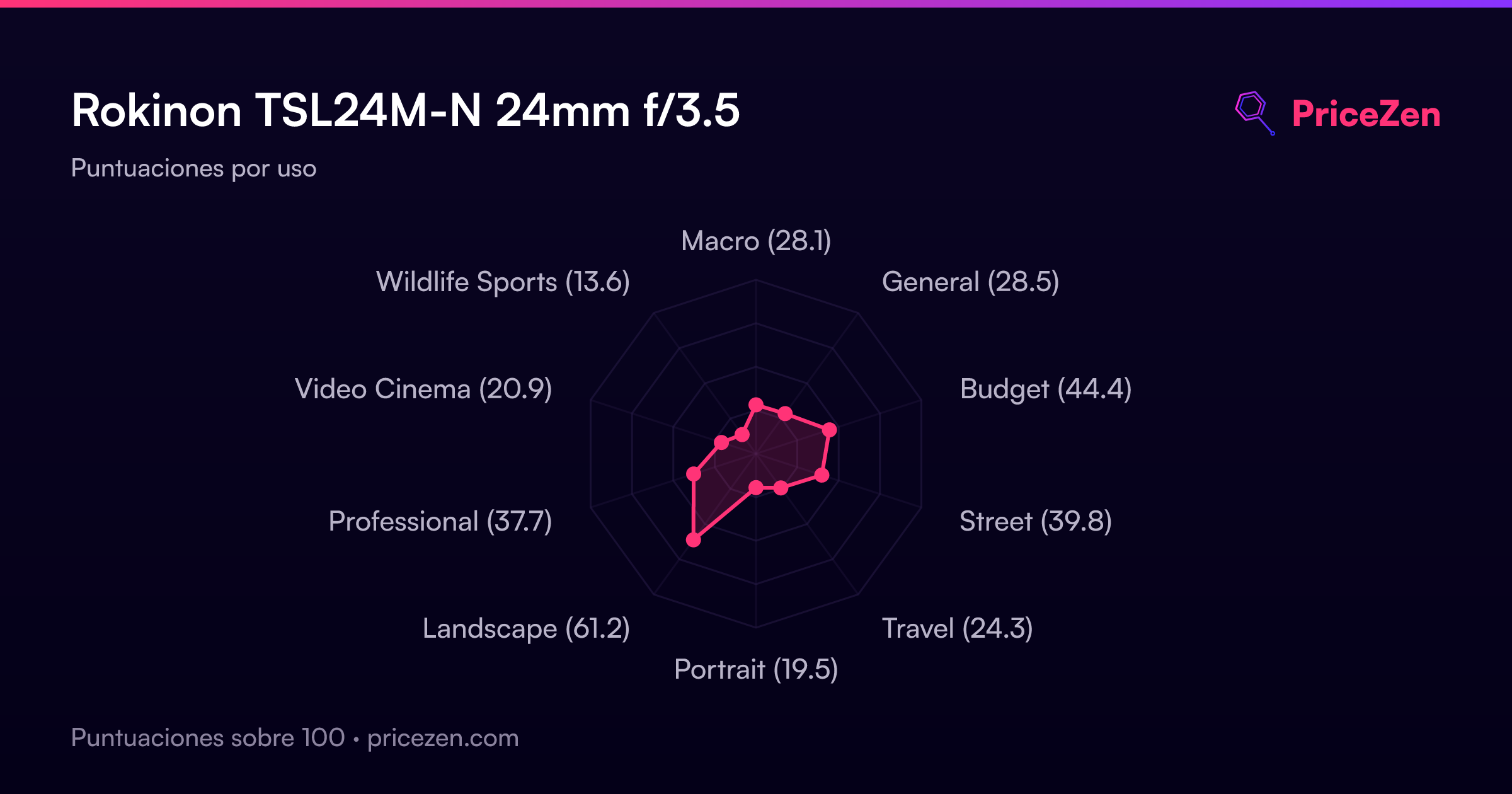
Usage Scores
- Macro28.1
- General28.5
- Budget44.4
- Street39.8
- Travel24.3
- Portrait19.5
- Landscape61.2
- Professional37.7
- Video Cinema20.9
- Wildlife Sports13.6