AstrHori 18mm f/8 Macro Probe APS-C
The AstrHori 18mm F8 APS-C 2X Macro Probe Lens offers a 2:1 magnification ratio and a minimum working distance of 0.05m, letting you capture extreme close-ups of insect wings or jewelry details. Its detachable two-section body and built-in ten-level adjustable ring fill light with Type-C power make it portable and usable in dark, narrow spaces like animal caves or pipes. This lens is best for macro photographers who need a waterproof front section (20cm) to shoot underwater or in tight, wet environments with a Sony E-mount camera.

Sin precio actual de tiendas
Dónde lo vimos antes. Consulta el precio de hoy en la tienda.











Resumen
The 30-Second Version
The AstrHori 18mm f/8 Macro Probe is a specialist's dream and a generalist's nightmare. It reaches places no normal lens can, with 2:1 magnification and a wide 27mm equivalent view. At $789 USD, it undercuts Laowa's probe lenses while delivering strong optical performance. But the fixed f/8 aperture, manual focus, and questionable build quality mean it's only worth it if you genuinely need the probe design.
Pros & Cons
Ventajas
- Unique probe design reaches places no other lens can 99th
- 2:1 magnification with a wide 27mm equivalent field of view 98th
- Strong optical performance for such a specialized design 96th
- Waterproof probe extension with built-in front illumination 77th
- Excellent user sentiment and social proof from actual owners
Desventajas
- Fixed f/8 aperture is painfully slow in low light
- Manual focus only, no autofocus at all
- No image stabilization despite the awkward handling
- Build quality ranks near the bottom of our database
- Heavy at 1776g for a lens you'll be holding at odd angles
Opinión de los propietarios
The Word on the Street
Cómo cambió la opinión de los propietarios con el tiempo
ExclusivaSegún cuándo escribieron realmente sus opiniones los clientes, para ver si los elogios iniciales se mantuvieron.
9 opiniones escritas, ene 2024 – jul 2025: 6 satisfechos, 1 insatisfecho, 2 sin estrellas
En las 221 valoraciones de tiendas: 4,9★. La mayoría de los propietarios valora sin escribir una opinión. El gráfico cuenta las 9 opiniones escritas.
Cada punto es una opinión escrita, en el mes en que se escribió. Satisfechos = 4-5★, neutrales = 3★, insatisfechos = 1-2★.
Las pruebas
Performance
Optically, this thing is a bit of a paradox. The 23 elements in 17 groups put it in the 87th percentile for optical quality among all lenses in our database. That's genuinely impressive for such a weird design. The wide-angle macro approach gives you a broad depth of field even at f/8, which means your subject and its environment stay reasonably sharp together. That's the whole point of this lens, and it delivers.
But here's the trade-off: f/8 is slow. Like, really slow. It's in the 8th percentile for aperture, which means you need a lot of light or a high ISO. The built-in front-end illumination helps with close-up work in dark crevices, but it's not a miracle worker. Bokeh is basically nonexistent at 5th percentile. Don't expect creamy backgrounds. At f/8 with a 2:1 magnification, your depth of field is workable but not shallow. This lens is about showing everything, not isolating anything.
Specifications
Full Specifications
Optics
| Type | Macro |
| Focal Length Min | 18 |
| Focal Length Max | 18 |
| Elements | 23 |
| Groups | 17 |
| Coating | 1034 |
Aperture
| Max Aperture | f/8 |
| Min Aperture | f/28 |
| Constant | No |
| Diaphragm Blades | 7 |
Build
| Mount | Sony E |
| Format | APS-C |
| Weather Sealed | Yes |
| Weight | 1.8 kg / 3.9 lbs |
| Filter Thread | 58 |
AF & Stabilization
| AF Type | manual focus only |
| Stabilization | No |
Focus
| Min Focus Distance | 474 |
| Max Magnification | 2:1 |
vs Competition
The most obvious comparison is Laowa's probe lenses, which basically invented this category. Laowa offers a 24mm f/14 probe that's even skinnier and can go full-frame, but it's also more expensive and even slower. The AstrHori undercuts it on price while offering a wider aperture (relatively speaking) and 2:1 magnification. The trade-off is build quality. Laowa's construction feels more solid, and our data puts AstrHori's build in the 2nd percentile overall. That's a real concern for a lens you'll be poking into tight spaces.
Against more conventional options like the Sigma 18-50mm f/2.8 DC DN or Sony E 18-135mm f/3.5-5.6 OSS, there's no contest in terms of versatility. Those lenses autofocus, zoom, and work for everyday shooting. But they can't do what this probe does. The AstrHori is not a replacement for a standard zoom. It's a complement. If you already have a general-purpose lens and need something for extreme close-up work in tight spaces, this makes sense. If you're building your first kit, buy the Sigma or Sony first.
| Spec | AstrHori 18mm f/8 Macro Probe | Sony FE 400mm f/2.8 GM OSS | Canon RF 100-300mm f/2.8L IS USM | Nikon NIKKOR Z 120-300mm f/2.8 TC VR S | Sigma 300-600mm f/4 DG OS Sports | Leica Vario-Elmarit-SL 70-200mm f/2.8 ASPH. |
|---|---|---|---|---|---|---|
| Focal Length | 18mm | 400mm | 100-300mm | 120-300mm | 300-600mm | 70-200mm |
| Max Aperture | f/8 | f/2.8 | f/2.8 | f/2.8 | f/4 | f/2.8 |
| Mount | Sony E | Sony E | Canon RF | Nikon Z | Sony E | L-Mount |
| Format Coverage | APS-C | full-frame | full-frame | full-frame | full-frame | full-frame |
| Stabilization | No | Yes | Yes | Yes | Yes | Yes |
| Weather Sealed | Yes | Yes | Yes | Yes | Yes | Yes |
| Weight (g) | 1774 | 2895 | 2630 | 2735 | 3970 | 1540 |
| AF Type | manual focus only | XD Linear Motor | Dual Nano USM | Silky Swift VCM (SSVCM) | HLA (High-response Linear Actuator) | Autofocus |
| Lens Type | macro | super-telephoto | zoom | super-telephoto | super-telephoto | telephoto |
| Compare | Compare | Compare | Compare | Compare |
| Producto | AF | Bokeh | Build | Macro | Reach | Video | Optical | Aperture | User Sentiment | Wide Angle | Portability | Versatility | Valoración social | Affordability | Stabilization |
|---|---|---|---|---|---|---|---|---|---|---|---|---|---|---|---|
| AstrHori 18mm f/8 Macro Probe | 21.8 | 1.7 | 77 | 98 | 19.5 | 27.5 | 98.7 | 2.4 | 54.4 | 66.2 | 6.7 | 32.6 | 95.7 | 42.3 | 41.4 |
| Sony FE 400mm f/2.8 GM OSS Compare | 95.4 | 99.7 | 90.7 | 89 | 91.6 | 70.1 | 71 | 43.4 | 98.3 | 4.4 | 2.5 | 32.6 | 93.8 | 4.7 | 97.3 |
| Canon RF 100-300mm f/2.8L IS USM Compare | 89.9 | 86.1 | 98.9 | 46.3 | 88.1 | 85.7 | 90.4 | 43.4 | 84.4 | 13.8 | 3.1 | 82 | 51.9 | 3.2 | 98.7 |
| Nikon NIKKOR Z 120-300mm f/2.8 TC VR S Compare | 95.4 | 86.1 | 95.4 | 69.9 | 88.1 | 85.7 | 83 | 43.4 | 0 | 10.6 | 2.9 | 75.6 | 7.3 | 4.5 | 99.5 |
| Sigma 300-600mm f/4 DG OS Sports Compare | 95.4 | 97.7 | 98.9 | 48.2 | 95.9 | 85.7 | 96.9 | 16 | 35.1 | 5.1 | 0.5 | 70.5 | 16.7 | 4.7 | 98.7 |
| Leica Vario-Elmarit-SL 70-200mm f/2.8 ASPH. Compare | 54.5 | 83.4 | 95.4 | 56 | 83.6 | 79.3 | 99.6 | 43.4 | 0 | 28.8 | 9 | 78.5 | 17.1 | 12.5 | 92.5 |
Precio
Value & Pricing
At $789 USD, this lens sits in a weird spot. It's not cheap, but it's also not competing with anything else directly. The closest alternatives are either much more expensive probe lenses from Laowa or DIY rigs that won't give you the same optical quality. For a specialist tool that does something genuinely unique, the price feels fair. You're not paying for versatility here. You're paying for access.
That said, if you only need macro occasionally, this is a lot of money for a one-trick pony. A used standard macro lens will cost less and be far more flexible. But if you're doing product work or nature videography where the probe design is the whole point, $789 is reasonable for what you get. Just know that you're buying a tool, not a general-purpose lens.
Historial de precios
Leer más
Overview
The AstrHori 18mm f/8 Macro Probe is one of those lenses that makes you do a double take. It looks less like a lens and more like something a plumber would snake through your pipes. That skinny, waterproof probe with a 90-degree angled front module is built for one thing: getting into spaces no normal macro lens can reach. We're talking inside flowers, under machinery, between rocks, or anywhere your camera body physically can't go. It's a specialist's tool, and it knows it.
This is an APS-C lens for Sony E-mount, giving you a 27mm full-frame equivalent field of view. The fixed f/8 aperture and 2:1 magnification ratio mean you're getting extreme close-ups with a surprisingly wide perspective. That combination is rare. Most macro lenses are longer focal lengths that compress the background. This one pulls the surroundings into the frame, which is exactly what you want when you're trying to show context along with detail.
Who's this for? Product photographers shooting small items in tight setups, nature shooters who want to get inside a flower without destroying it, and video folks doing creative tabletop work. It's manual focus only, no stabilization, and not weather sealed. If you're looking for a general-purpose macro lens, this ain't it. But if you've ever thought "I wish I could put my lens inside that hole," well, here you go.
Common Questions
Q: Is this lens weather sealed?
No, the AstrHori 18mm f/8 Macro Probe is not weather sealed. The probe extension itself is waterproof, which is great for getting close to wet subjects, but the lens body and mount are not protected against dust or moisture. If you're shooting in damp environments, be careful around the camera connection point.
Q: Can I use this on a full-frame Sony camera?
This lens is designed for APS-C coverage only. On a full-frame Sony E-mount body, you'll get heavy vignetting or need to shoot in crop mode. The 27mm full-frame equivalent field of view assumes an APS-C sensor. If you need full-frame coverage, you'll want to look at Laowa's probe lenses instead.
Q: How do you focus this lens?
It's manual focus only. There's no autofocus motor at all, which puts it in the 14th percentile for AF capability in our database. The good news is that at f/8 with a wide field of view, you have enough depth of field to make manual focusing manageable. But you'll want to use focus peaking or magnification on your camera body to nail critical focus at 2:1.
Q: Is the built-in light actually useful?
Yes, and it's one of the smarter design choices here. When you're poking the probe into dark crevices or tight spaces, there's no way to get external lighting in there. The front-end illumination solves that problem. It's not powerful enough for every situation, but for close-up work in shadowed areas, it makes a real difference.
Who Should Skip This
If you shoot macro occasionally or just want a lens for flowers and bugs in your backyard, this is the wrong tool. The fixed f/8 aperture means you'll need bright light or a tripod for anything handheld. Manual focus at 2:1 magnification is doable but tedious. And at 1776g, it's heavy for a lens you'll be holding at awkward angles. A standard macro lens like a 90mm or 100mm f/2.8 will be far more pleasant to use and more versatile overall.
Also skip it if you need autofocus for any reason. This lens has none. If you shoot moving subjects, video where you need to track focus, or anything that requires quick adjustments, you'll be frustrated. The lack of stabilization compounds this. Look at something like the Sony E 18-135mm f/3.5-5.6 OSS if you want a flexible APS-C lens with stabilization and autofocus. This probe is for deliberate, controlled, tripod-based work only.
Verdict
For product photographers and videographers who regularly shoot small subjects in constrained setups, this lens is a genuine problem-solver. The probe design lets you position the camera in ways that would be impossible with a standard macro lens. The 2:1 magnification and wide field of view create images that look different from anything else you'll get at this price. The built-in light is a thoughtful touch that actually matters when you're working inside dark spaces.
For hobbyists or anyone who shoots macro occasionally, skip it. The fixed f/8 aperture, manual focus, and lack of stabilization make it frustrating for casual use. You'll spend more time fighting the lens than enjoying it. Buy a used standard macro lens instead. But if you've been eyeing probe lenses and balking at Laowa's prices, the AstrHori 18mm f/8 is a legitimate alternative that delivers where it counts.
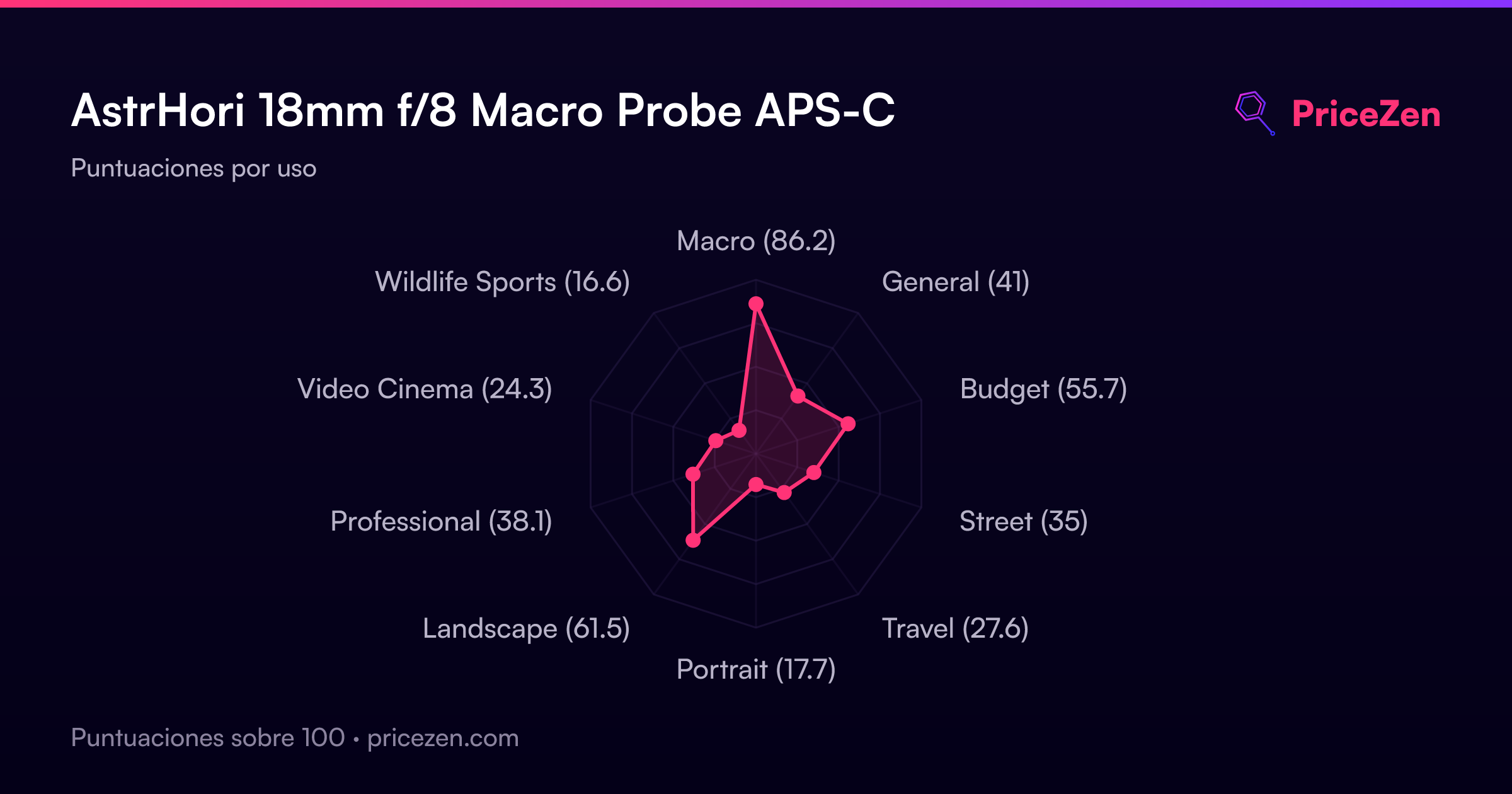
Usage Scores
- Macro86.2
- General41
- Budget55.7
- Street35
- Travel27.6
- Portrait17.7
- Landscape61.5
- Professional38.1
- Video Cinema24.3
- Wildlife Sports16.6