Razer Blade 16" RZ09-05288EN3-R3U1 2025, Ryzen AI 9 365, 32GB, 2TB SSD, RTX 5080, Black
Combining a 10-core AMD Ryzen AI 9 365 processor with 16GB GeForce RTX 5080 graphics, this machine drives a vivid 16-inch 240Hz OLED panel for fluid, high-fidelity gaming. Its premium unibody construction houses a spacious 2TB SSD and 32GB of fast LPDDR5X memory, delivering a desktop-caliber experience in a relatively portable chassis. This laptop is best for competitive gamers and game developers who need top-tier frame rates and color accuracy without sacrificing build quality.

Sin precio actual de tiendas
Resumen
The 30-Second Version
The Razer Blade 16 packs an RTX 5080 and a gorgeous 240Hz OLED panel into a 2.09kg chassis, making it a top-tier gaming laptop. The 2TB SSD and 32GB of fast RAM are standout specs, but the RAM is soldered with no upgrade path. At $4,114 USD, it's expensive, and the reliability score of 4th percentile is a genuine concern. Buy it for the performance and screen, but know you're taking a gamble on longevity.
Pros & Cons
Ventajas
- RTX 5080 with 16GB GDDR7 VRAM sits at the 91st percentile, leading gaming performance 98th
- 16-inch 2560x1600 OLED 240Hz display is a standout, 92nd percentile for screen quality 94th
- 32GB of LPDDR5X at 8000 MHz is fast and lands at the 92nd percentile 91st
- 2TB NVMe Gen4 SSD at the 94th percentile means tons of fast storage out of the box 91st
- Strong port selection selection with 3x USB-A, 2x USB-C, HDMI 2.1, and Wi-Fi 7
Desventajas
- RAM is soldered, no upgrade path beyond 32GB
- Reliability sits at the 4th percentile, one of the worst in our database
- Compact score is just 43.6 out of 100, it's a chunky 2.09kg machine
- Battery life under gaming load is a recurring complaint from owners
- Social proof is weak at the 25th percentile, very few reviews out there
Opinión de los propietarios
The Word on the Street
Cómo cambió la opinión de los propietarios con el tiempo
ExclusivaSegún cuándo escribieron realmente sus opiniones los clientes, para ver si los elogios iniciales se mantuvieron.
Las pruebas
Performance
The RTX 5080 with 16GB of GDDR7 VRAM is the headline act, and it lands at the 91st percentile among all gaming laptops in our database. That puts it in the leading pack, right up there with the best mobile GPUs you can buy right now. At the native 2560x1600 resolution, you can expect high refresh rate gaming in most modern titles without dropping settings to potato mode. The 240Hz OLED panel means you'll actually see the benefit of those extra frames in fast shooters and esports titles.
The Ryzen AI 9 365 is no slouch either, sitting at the 84th percentile for CPUs. Its 10 cores and 20 threads handle multitasking and CPU-heavy games without breaking a sweat. The 32GB of LPDDR5X running at 8000 MHz is fast memory, and it lands at the 92nd percentile. That's a standout spec, but here's the catch: it's soldered. You cannot add more RAM later. For most gamers and creators, 32GB is plenty today, but if you're the type who keeps a laptop for five years and runs virtual machines or massive video edits, that ceiling could sting down the road.
Specifications
Full Specifications
Processor
| CPU | AMD Ryzen AI 9 365 |
| Cores | 10 |
| Frequency | 2.0 GHz |
| L3 Cache | 16 MB |
Graphics
| GPU | NVIDIA GeForce RTX 5080 |
| Type | Discrete |
| VRAM | 16 GB |
| VRAM Type | GDDR7 |
Memory & Storage
| RAM | 32 GB |
| RAM Generation | LPDDR5X |
| Storage | 2 TB |
| Storage Type | NVMe SSD |
Display
| Size | 16" |
| Resolution | 2560x1600 (QHD) |
| Panel | OLED |
| Refresh Rate | 240 Hz |
Connectivity
| USB-C Ports | 2 |
| USB Ports | 3 |
| HDMI | HDMI 2.1 |
| Wi-Fi | Wi-Fi 7 |
| Bluetooth | Bluetooth 5.4 |
Physical
| Weight | 2.1 kg / 4.6 lbs |
| Battery | 90 Wh |
| OS | Windows 11 Home |
vs Competition
The most obvious competitor is the ASUS ROG Zephyrus G14. It's smaller, lighter, and typically cheaper while still packing serious gaming performance. You give up the 16-inch OLED and some GPU headroom, but you gain portability. The Lenovo Legion Pro 7i Gen 10 is another strong alternative, often with better reliability scores and more aggressive pricing. If you want raw performance per dollar, Lenovo usually wins that fight.
Then there's the Apple MacBook Pro M4 Max. It's not a gaming machine in the traditional sense, but for creators and developers, the M4 Max is a beast with incredible efficiency. Battery life on the MacBook will absolutely embarrass the Blade 16 under load. The trade-off is gaming performance and Windows compatibility. If you're a gamer first, the Blade makes more sense. If you're a creator who occasionally games, the MacBook is worth a hard look. The HP OMEN Transcend 14 and Samsung Galaxy Book5 Pro are also in the mix, but they're more mid-range options that don't quite match the Blade's raw GPU muscle.
| Spec | Razer Blade 16" RZ09-05288EN3-R3U1 | Apple MacBook Pro 14.2" M4 Pro | ASUS ROG Zephyrus 14" GA403WW-G14.R95080 | Lenovo Legion Pro 7i Gen 10 16" | HP OMEN Transcend | Samsung Galaxy Book5 Pro 14" NP944XHA-KG3US |
|---|---|---|---|---|---|---|
| CPU | AMD Ryzen AI 9 365 | Apple M4 Pro | AMD Ryzen AI 9 HX 370 | Intel Core Ultra 9 275HX | Intel Core Ultra 9 285H | Intel Core Ultra 7 258V |
| RAM (GB) | 32 | 48 | 32 | 32 | 32 | 32 |
| Storage (GB) | 2048 | 4096 | 2048 | 1024 | 1024 | 1024 |
| Screen | 16" 2560x1600 | 14.2" 3024x1964 | 14" 2880x1800 | 16" 2560x1600 | 14" 2880x1800 | 14" 2880x1800 |
| GPU | NVIDIA GeForce RTX 5080 | Apple (16-Core) | NVIDIA GeForce RTX 5080 | NVIDIA GeForce RTX 5070 Ti | NVIDIA GeForce RTX 5070 | Intel Arc Graphics 140V |
| OS | Windows 11 Home | macOS | Windows 11 Home | Windows 11 Home | Windows 11 Home | Windows 11 Pro |
| Weight (kg) | 2.1 | 1.6 | 1.6 | 2.7 | 1.6 | 1.2 |
| Battery (Wh) | 90 | 72 | - | 99 | 71 | 63 |
| Compare | Compare | Compare | Compare | Compare |
| Producto | CPU | GPU | RAM | Puertos | Pantalla | Portabilidad | Almacenamiento | User Sentiment | Fiabilidad | Affordability |
|---|---|---|---|---|---|---|---|---|---|---|
| Razer Blade 16" RZ09-05288EN3-R3U1 | 86.2 | 98.3 | 90.8 | 77.8 | 91.4 | 17.7 | 93.9 | 51.3 | 4.1 | 3.2 |
| Apple MacBook Pro 14.2" M4 Pro Compare | 92.4 | 78.9 | 90.6 | 73.9 | 99.1 | 68.9 | 98.4 | 90.8 | 98.2 | 4.7 |
| ASUS ROG Zephyrus 14" GA403WW-G14.R95080 Compare | 91.2 | 98.3 | 90.8 | 89.5 | 96 | 73.6 | 89.7 | 99.1 | 60.6 | 6.1 |
| Lenovo Legion Pro 7i Gen 10 16" Compare | 97.2 | 96.7 | 89 | 97.3 | 95 | 9.5 | 79.3 | 90.8 | 81.9 | 5.9 |
| HP OMEN Transcend Compare | 90.1 | 93.5 | 89.7 | 89.5 | 96 | 72.2 | 65.4 | 81.5 | 33.7 | 9 |
| Samsung Galaxy Book5 Pro 14" NP944XHA-KG3US Compare | 65.8 | 69.7 | 79.5 | 83.5 | 90.4 | 89.4 | 79.3 | 0 | 81.9 | 21.3 |
Precio
Value & Pricing
Pricing is where this gets tricky. The only listing we have is $4,114 USD, and that's a lot of money for any laptop. For that price, you're getting a top-tier GPU, a gorgeous OLED panel, and a massive 2TB SSD. The storage alone is at the 94th percentile, which means you won't need to crack this thing open to add space anytime soon.
But value isn't just about specs per dollar. The reliability score of 4th percentile is a red flag. If you're spending over four grand, you want to know this thing will last. The weak social proof doesn't help either. There just aren't enough owners out there to give us confidence in long-term durability. Compared to something like the ASUS ROG Zephyrus G14 or Lenovo Legion Pro 7i, you're paying a Razer tax for the brand and the build aesthetic. Whether that's worth it depends on how much you value the Blade's design language.
Leer más
Overview
The Razer Blade 16 for 2025 is one of those machines that makes you do a double take at the spec sheet. You've got an AMD Ryzen AI 9 365 with 10 cores and 20 threads, paired with NVIDIA's RTX 5080 and 16GB of GDDR7 VRAM. That's a serious amount of horsepower in a chassis that weighs 2.09kg. Razer has always chased the thin-and-powerful dream, and this config pushes that idea further than most.
Who is this for? Gamers who want desktop-class frame rates at QHD+ resolution without lugging around a desktop replacement. Creators who need the OLED panel's color accuracy and the GPU's rendering muscle. Developers who can live with 32GB of soldered RAM. If you fall into those camps and have the budget, this thing is aimed squarely at you.
The interesting wrinkle here is the AMD CPU. Razer has historically leaned hard on Intel, so seeing a Ryzen AI 9 365 in the Blade 16 is a shift. The chip sits at the 84th percentile in our database, which is strong but not top of the charts. The real star is the GPU, landing at the 91st percentile. That combo makes this a gaming-first machine with creator chops, not the other way around.
Common Questions
Q: What ports does this laptop have, and does it support Thunderbolt 4?
You get 3 USB 3.2 Gen 2 Type-A ports, 2 USB4 Type-C ports, and an HDMI 2.1 output. The USB4 ports support Thunderbolt-like speeds and functionality, but Razer doesn't explicitly list Thunderbolt 4 certification. For connectivity, it also has Wi-Fi 7 and Bluetooth 5.4, which are both current-gen standards.
Q: Can I upgrade the RAM later?
No. The 32GB of LPDDR5X is soldered directly to the motherboard. What you buy is what you get for the life of the machine. If you think you'll need more than 32GB for future workloads, this is not the laptop for you.
Q: How is the battery life for gaming?
The 90Wh battery is decent on paper, but real-world gaming will drain it fast. The RTX 5080 and 240Hz OLED panel are power-hungry components. Expect to stay plugged in for serious gaming sessions. For light productivity and web browsing, you'll get much better longevity, but this is not an all-day unplugged gaming machine.
Q: Is the display good for content creation?
Yes. The 16-inch 2560x1600 OLED panel runs at 240Hz and sits at the 92nd percentile in our screen quality rankings. OLED means deep blacks and excellent contrast, which is great for photo and video editing. The high refresh rate is a bonus for smooth motion in games and UI animations.
Who Should Skip This
If you need more than 32GB of RAM, skip this. The soldered memory is a hard ceiling, and no amount of wishing will change that. Video editors working with 8K footage, 3D artists with massive scenes, or developers running multiple virtual machines should look at the Lenovo Legion Pro 7i or a mobile workstation with upgradeable RAM slots.
If reliability is your top priority, this is not the machine for you. The 4th percentile reliability score is one of the worst we've seen in this category. For a laptop that costs over $4,000, that's a tough pill to swallow. Consider the ASUS ROG Zephyrus G14 or a MacBook Pro if you want something with a better track record. And if portability matters, the 2.09kg weight and 43.6 compact score mean this is not a great travel companion. The Zephyrus G14 or HP OMEN Transcend 14 will fit in a bag much more easily.
Verdict
If you're a gamer who wants a big, beautiful OLED screen and top-tier frame rates, the Blade 16 delivers. The RTX 5080 and 240Hz panel are a killer combo for immersive gaming. The 2TB SSD means you can install a huge library without external drives. Just know that you're paying a premium for the Razer name and design.
For creators, this is a solid pick if you need Windows and NVIDIA's CUDA ecosystem. The OLED panel is excellent for color work, and the GPU will chew through renders. But the soldered RAM is a real limitation for heavy video editing or 3D work. If you think you'll need more than 32GB in the next few years, look elsewhere. And for anyone who values reliability and long-term durability, the 4th percentile reliability score should give you serious pause. This is a high-risk, high-reward purchase.
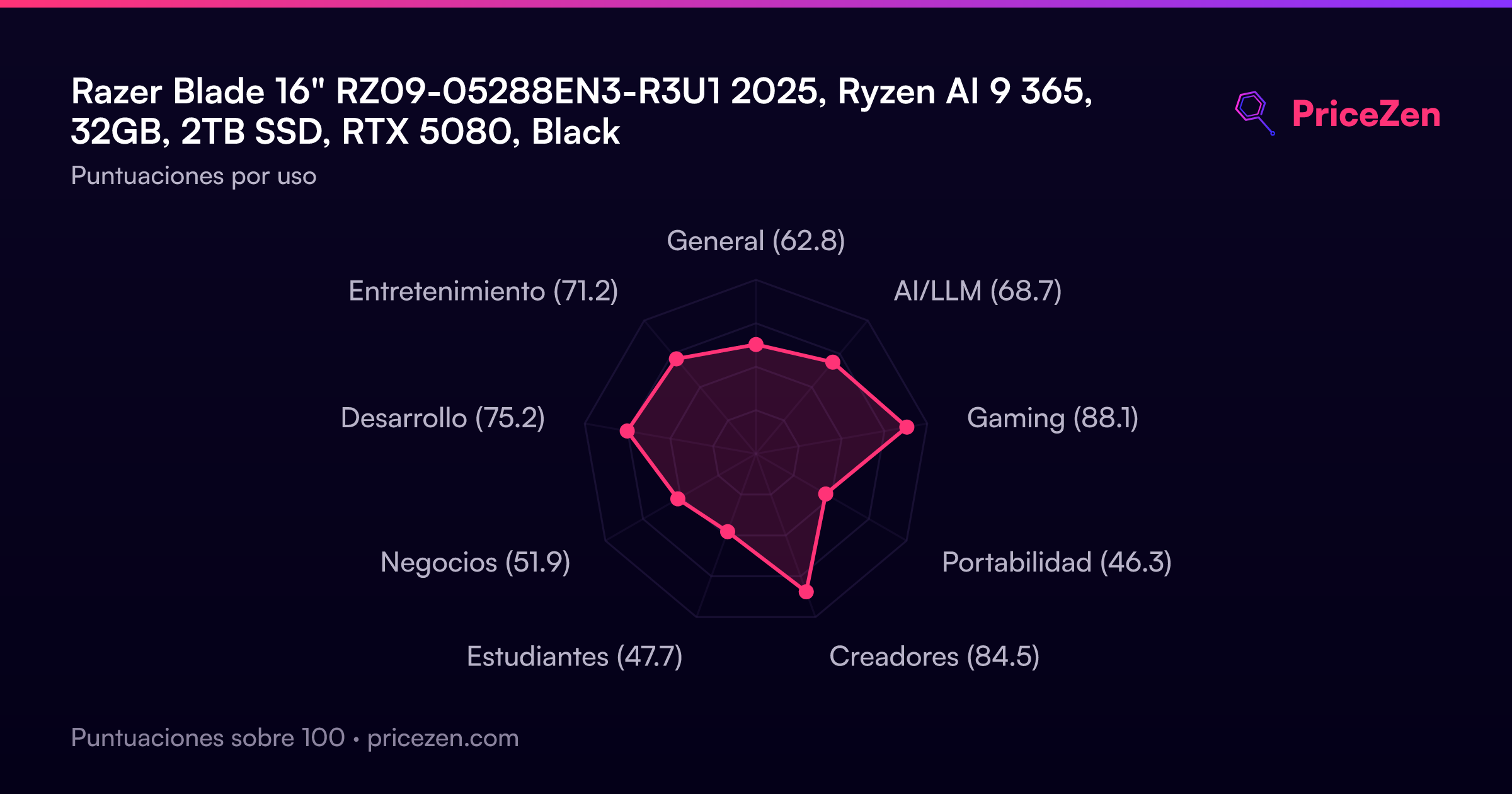
Usage Scores
- General62.8
- AI/LLM68.7
- Gaming88.1
- Portabilidad46.3
- Creadores84.5
- Estudiantes47.7
- Negocios51.9
- Desarrollo75.2
- Entretenimiento71.2