Gigabyte GeForce RTX 4080 SUPER AERO OC 16GB GDDR6X Black
The 16GB GDDR6X memory and 2595MHz boost clock on the AD103 chip deliver strong 4K gaming at 85.5/100, backed by DLSS 3 and full ray tracing support. Its white AERO design with RGB Fusion and a triple-fan WINDFORCE cooler offers a clean aesthetic and a Dual BIOS for quiet operation. This card is best for 4K gamers and builders of white-themed PCs who want high frame rates without stepping up to the RTX 4090.

Sin precio actual de tiendas


Resumen
The 30-Second Version
The Gigabyte RTX 4080 SUPER AERO OC is a 4K gaming monster with ray tracing performance in the 94th percentile and a gorgeous white design. It's huge at 342mm and expensive, with affordability in the 11th percentile. User sentiment is mixed at 37th percentile, with reports of dead units and coil whine. But if you've got the case space and the budget, this card will keep you gaming at max settings for years.
Pros & Cons
Ventajas
- Ray tracing performance in the 94th percentile, best-in-class for this generation 94th
- 16GB GDDR6X with 432 GB/s bandwidth handles 4K textures with ease 91st
- Stunning white and silver design that's perfect for themed builds 78th
- Includes an anti-sag bracket, which you'll definitely need at 342mm 77th
- Silent operation in most scenarios thanks to the triple-fan WINDFORCE cooler
Desventajas
- Affordability in the 11th percentile, this is a premium-priced card
- Massive footprint at 342mm and 3.7 slots, won't fit many cases
- User sentiment in the 37th percentile, with reports of dead units and poor support
- Coil whine under heavy load reported by multiple owners
- AI and LLM performance is the weakest area at 64/100
Opinión de los propietarios
The Word on the Street
Cómo cambió la opinión de los propietarios con el tiempo
ExclusivaSegún cuándo escribieron realmente sus opiniones los clientes, para ver si los elogios iniciales se mantuvieron.
8 opiniones escritas, feb 2024 – mar 2025: 7 satisfechos, 1 insatisfecho
En las 365 valoraciones de tiendas: 4,5★. La mayoría de los propietarios valora sin escribir una opinión. El gráfico cuenta las 8 opiniones escritas.
Cada punto es una opinión escrita, en el mes en que se escribió. Satisfechos = 4-5★, neutrales = 3★, insatisfechos = 1-2★.
Las pruebas
Performance
Let's talk numbers. The PassMark G3D score of 34,240 puts this card in elite territory. For context, that's the kind of score that makes 4K gaming feel effortless. You're looking at maxed-out settings in demanding titles without having to fiddle with sliders. The 24.72 TFLOPS of FP32 compute is solid, though it lands in the 74th percentile, which is more about the 4090 and newer cards pulling ahead than any weakness here. The 432 GB/s memory bandwidth means texture streaming and high-resolution assets load without hitching.
Ray tracing is where this card really shines. The 58 RT cores and DLSS 3 support mean you can crank up Cyberpunk 2077's path tracing and still get playable frame rates. Our ray tracing score of 87/100 backs that up. The 1440p gaming score of 88.4 and 1080p score of 89.1 are both excellent, though honestly, buying this card for 1080p is like buying a sports car to drive to the grocery store. The 320W TDP is manageable, but you'll want a quality 850W PSU to keep things stable. Efficiency lands in the 70th percentile, which is fine but not class-leading.
Specifications
Full Specifications
Chipset
| GPU Chipset | GeForce RTX 4080 SUPER |
| Brand | NVIDIA |
| Architecture | Ada Lovelace |
| Class | consumer |
| Process | 5 |
Memory
| VRAM | 16 GB |
| Memory Type | GDDR6X |
| Memory Bus | 256 |
| Bandwidth | 432 |
Compute
| CUDA Cores | 10240 |
| Tensor Cores | 232 |
| RT Cores | 58 |
| Base Clock | 2595 |
| Boost Clock | 2595 |
| FP16 TFLOPS | 24.72 |
| FP32 TFLOPS | 24.72 |
Performance
| PassMark G3D | 34240 |
| GPU Compute | 20448 |
Power & Cooling
| TDP | 320 |
| Recommended PSU | 850 |
| Power Connectors | 1 x 16-Pin |
| Cooler | Triple Fan |
| Fans | 3 |
Connectivity
| Interface | PCI Express 4.0 |
| DisplayPort | 3 |
| HDMI | 1 |
| Max Displays | 4 |
| Max Resolution | 7680 x 4320 |
Physical
| Length | 342 |
| Slot Width | 3.7 |
| Form Factor | ATX |
| Weight | 2.6 kg / 5.7 lbs |
Features
| Ray Tracing | Yes |
| Upscaling | DLSS 3 |
| AV1 Encode | No |
| VR Ready | Yes |
| DirectX | 12 Ultimate |
| RGB | Yes |
vs Competition
The elephant in the room is the RTX 5090. The ASUS TUF Gaming TUF-RTX5090-32G-GAMING is the new flagship, and it absolutely demolishes the 4080 SUPER in raw performance. But it also costs significantly more and draws way more power. If money is no object, the 5090 is the obvious choice. For everyone else, the 4080 SUPER is the sensible middle ground.
On the other end, the MSI Ventus RTX 5070 Ti 16G VENTUS 3X PZ OC is an interesting alternative. It's newer, likely cheaper, and offers similar VRAM capacity. The 4080 SUPER still holds an edge in raw raster and ray tracing performance, but the gap isn't as wide as you might think. The ZOTAC APOCALYPSE ZT-B50800C-10P is another option worth considering if you're looking at the 5080 class. The Sapphire NITRO+ 11322-01-40G is an AMD card, so you'd be trading DLSS 3 for FSR, which is a whole different conversation. The PNY ARGB OC VCG508016TFXXPB1-O is another 5080-class card that might offer better value depending on pricing.
| Spec | Gigabyte GeForce RTX 4080 SUPER AERO OC | ASUS GeForce RTX 5090 TUF Gaming | MSI GeForce RTX 5070 Ti Ventus 3X OC | ZOTAC GeForce RTX 5080 APOCALYPSE | Sapphire Radeon RX 7900 XTX NITRO+ | PNY GeForce RTX 5080 ARGB OC |
|---|---|---|---|---|---|---|
| Chipset | GeForce RTX 4080 SUPER | GeForce RTX 5090 | GeForce RTX 5070 Ti | GeForce RTX 5080 | Radeon RX 7900 XTX | GeForce RTX 5080 |
| Vram | 16GB GDDR6X | 32GB GDDR7 | 16GB GDDR7 | 16GB GDDR7 | 24GB GDDR6 | 16GB GDDR7 |
| Boost Clock Mhz | 2595 | 2407 | 2482 | 2730 | 2680 | 2620 |
| Tdp W | 320 | 575 | 300 | 360 | 339 | 360 |
| Memory Bus Bits | 256 | 512 | 256 | 256 | 384 | 256 |
| Ray Tracing | true | true | true | true | true | true |
| GPU Class | consumer | consumer | consumer | consumer | consumer | consumer |
| Compare | Compare | Compare | Compare | Compare |
| Producto | AI | Rt | Vram | Raster | Compute | Feature | Thermal | User Sentiment | Efficiency | Connectivity | Valoración social | Affordability |
|---|---|---|---|---|---|---|---|---|---|---|---|---|
| Gigabyte GeForce RTX 4080 SUPER AERO OC | 71.6 | 93.7 | 77.4 | 91.2 | 73.1 | 77.9 | 72.3 | 37.2 | 68.2 | 55.8 | 74.8 | 10.7 |
| ASUS GeForce RTX 5090 TUF Gaming Compare | 97.1 | 90.6 | 97.7 | 98.8 | 97.6 | 95.9 | 72.3 | 85.4 | 23.9 | 99.3 | 98.7 | 2.3 |
| MSI GeForce RTX 5070 Ti Ventus 3X OC Compare | 79.5 | 92.5 | 86 | 89 | 88.1 | 95.9 | 91.8 | 85.4 | 72 | 94.1 | 83.8 | 23.4 |
| ZOTAC GeForce RTX 5080 APOCALYPSE Compare | 85.6 | 97.5 | 89 | 94.5 | 93.4 | 95.9 | 91.8 | 99.5 | 57 | 94.1 | 98.7 | 20.5 |
| Sapphire Radeon RX 7900 XTX NITRO+ Compare | 95.1 | 96.3 | 91.9 | 83.5 | 95.6 | 95.9 | 91.8 | 85.4 | 52 | 98.8 | 69 | 19 |
| PNY GeForce RTX 5080 ARGB OC Compare | 85.6 | 97.5 | 89 | 94.5 | 93.4 | 95.9 | 91.8 | 45.6 | 57 | 94.1 | 74.8 | 14.7 |
Precio
Value & Pricing
Here's where things get tricky. The price varies wildly depending on where you're shopping. In Canada, you're looking at around CAD 3,100. In Japan, it's roughly JPY 408,332. Neither of those is what anyone would call cheap. The affordability percentile of 11% tells the story. This card is expensive, period.
But value isn't just about the sticker price. The 4080 SUPER delivers performance that's close enough to the 4090 that most people won't notice the difference in real-world gaming. And with 16GB of VRAM, you're buying some future-proofing. The real question is whether you can stomach the price for what you get. If you're gaming at 4K and want to keep settings maxed for the next few years, this card makes a case for itself. If you're at 1440p or lower, you're paying for headroom you'll never use.
Leer más
Overview
The Gigabyte RTX 4080 SUPER AERO OC is one of those cards that makes you stop and stare. It's got this clean, almost surgical white and silver look that's become the go-to for people building those bright, minimalist rigs. But this isn't just a pretty face. Under that shroud sits NVIDIA's AD103 chip with 10,240 CUDA cores and 16GB of GDDR6X memory running at 23 Gbps. That's a serious amount of horsepower for 4K gaming and creative work.
Who's this for? Honestly, it's for the person who wants flagship-adjacent performance without quite stepping up to the RTX 4090 price tag. The 4080 SUPER sits in a sweet spot where it'll chew through 4K games at high refresh rates, handle ray tracing without breaking a sweat, and still have enough VRAM headroom for the next few years. Our database puts its ray tracing chops in the 94th percentile, which means it's one of the best on the market right now. Raster performance isn't far behind at the 91st percentile.
But here's the thing. This card is huge. 342mm long and nearly 4 slots thick. You're not sliding this into a compact ITX build without some serious planning. And the price, well, it's not cheap. Affordability sits in the 11th percentile, which is a polite way of saying this thing costs a lot of money. If you're still rocking a 1080p monitor, you're leaving a ton of performance on the table.
Common Questions
Q: Will this card fit in my case?
At 342mm long and 3.7 slots thick, this is a big card. You'll need a case with at least 350mm of GPU clearance and 4 expansion slots available. Measure twice before you buy. The included anti-sag bracket also adds some installation complexity, so factor that into your build planning.
Q: Is the RTX 4080 SUPER worth it over the RTX 4070 Ti SUPER?
For 4K gaming, yes. The 4080 SUPER has more CUDA cores (10,240 vs 8,448), higher memory bandwidth (432 GB/s vs 672 GB/s on the 4070 Ti SUPER, though the 4070 Ti SUPER has a wider bus), and better ray tracing performance. If you're at 1440p, the 4070 Ti SUPER is probably the smarter buy. At 4K, the 4080 SUPER's extra horsepower makes a real difference.
Q: What power supply do I need for this card?
Gigabyte recommends an 850W PSU for this card. The TDP is 320W, but transient spikes can push higher. A quality 850W unit with a 16-pin connector (or adapter) is the minimum. If you're running a high-end CPU and lots of peripherals, consider going 1000W for headroom.
Q: Does this card support DLSS 3?
Yes, the RTX 4080 SUPER fully supports DLSS 3 and DLSS 3.5, including Frame Generation. This is a huge advantage in supported games, letting you push frame rates much higher than native rendering would allow. It's one of the key reasons this card handles 4K gaming so well.
Who Should Skip This
If you're gaming at 1080p or 1440p, this card is overkill. You're paying a premium for 4K performance you'll never use. A 4070 SUPER or 4070 Ti SUPER will give you excellent frame rates at those resolutions for significantly less money. The same goes for anyone doing AI or LLM work. The 64/100 score in that category is the weakest area for this card, and you'd be better served by something with more VRAM or better AI acceleration.
Also skip this if you have a compact case. At 342mm and 3.7 slots, this card simply won't fit in most ITX or smaller mid-tower cases. And if you're sensitive to coil whine, the mixed reports on noise under load might be a dealbreaker. Consider the MSI Ventus RTX 5070 Ti or a 5080-class card if you want newer architecture with better efficiency.
Verdict
If you're building a white-themed 4K gaming rig and you want a card that looks as good as it performs, the Gigabyte RTX 4080 SUPER AERO OC is a fantastic choice. The performance is there, the aesthetics are on point, and the included anti-sag bracket shows Gigabyte understands the physics of a 342mm card. Just make sure your case can actually fit it. And your PSU can handle it. And your wallet can survive it.
For everyone else, think carefully. If you're at 1440p, you're overpaying for performance you won't fully use. If you're into AI workloads or LLM inference, the 64/100 score in that category suggests you should look elsewhere. The 5070 Ti or a 5080-class card might serve you better. But for pure 4K gaming with ray tracing cranked up, this card delivers the goods.
Usage Scores
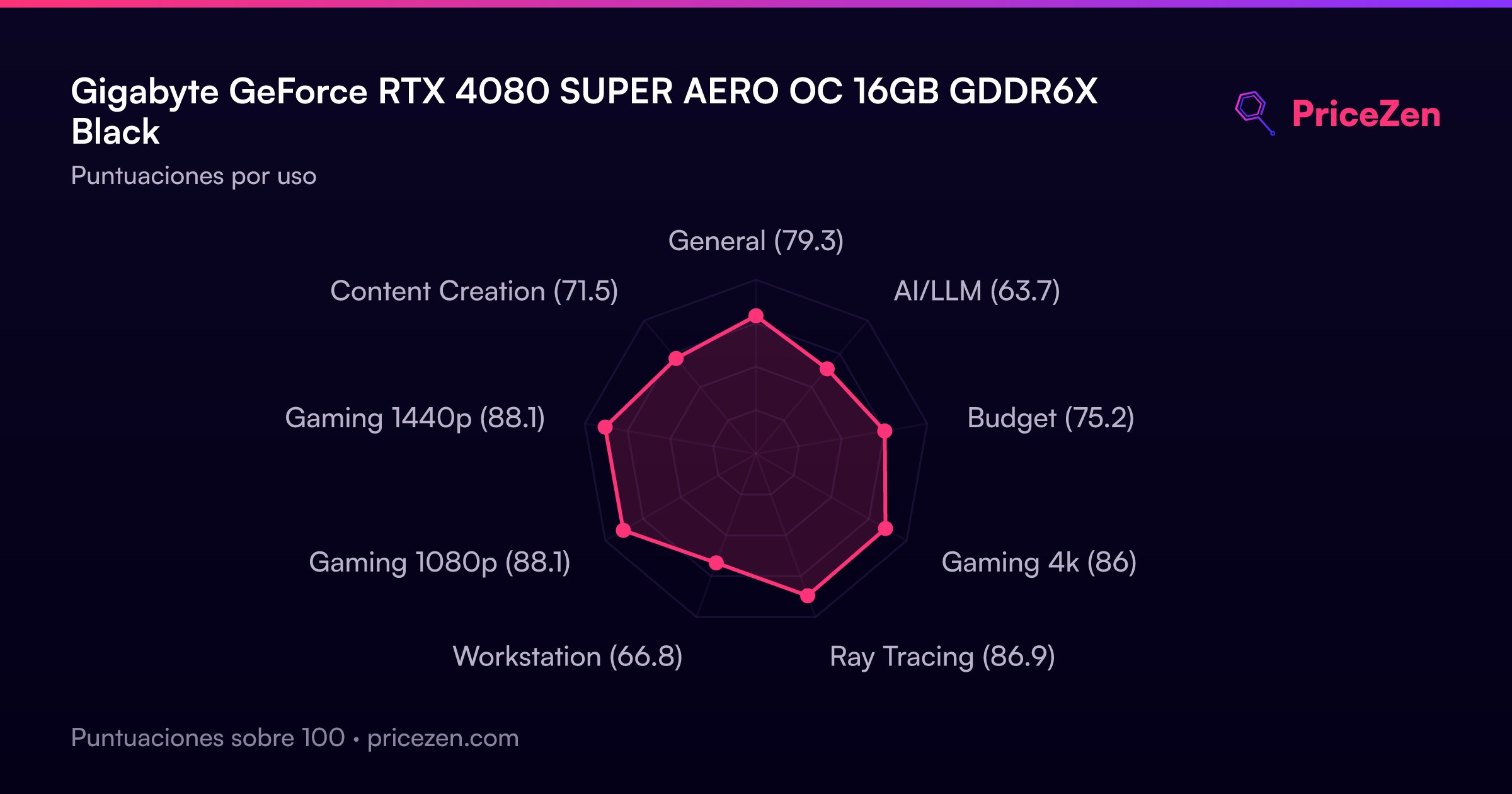
- General79.3
- AI/LLM63.7
- Budget75.2
- Gaming 4k86
- Ray Tracing86.9
- Workstation66.8
- Gaming 1080p88.1
- Gaming 1440p88.1
- Content Creation71.5