ZOTAC GeForce RTX 3050 Twin Edge OC 6GB GDDR6 Black
Its 70W TDP and compact 162mm dual-fan design make it a standout for low-power, small form factor builds that still need modern features like DLSS 3 and ray tracing. The 6GB GDDR6 memory on a 96-bit bus limits high-resolution texture performance, but the card’s slot-only power delivery simplifies installation in OEM systems. This GPU is best for budget-conscious 1080p gamers upgrading older office PCs who prioritize efficiency and a small footprint over raw frame rates.

Sin precio actual de tiendas
Dónde lo vimos antes. Consulta el precio de hoy en la tienda.











Resumen
The 30-Second Version
The ZOTAC RTX 3050 Twin Edge OC scores 9498 in PassMark, landing in the 23rd percentile for raster performance. Its 70W TDP and 91st percentile efficiency are the real highlights. But with 6GB VRAM and weak ray tracing, this is a card for small, quiet builds, not serious gaming.
Pros & Cons
Ventajas
- 70W TDP means no PCIe power cable needed 91st
- 91st percentile efficiency, one of the best we've seen 83rd
- 162mm length fits in almost any case
- DLSS 3 support despite the budget price
- Dual fan cooler with fan stop for silent idle
Desventajas
- 23rd percentile raster performance, lags behind most
- 6GB VRAM on a 96-bit bus is a real limitation
- 29th percentile ray tracing, don't expect much
- Only 1x DisplayPort and 1x HDMI, connectivity is thin
- 12th percentile social proof, very few reviews out there
Opinión de los propietarios
The Word on the Street
Cómo cambió la opinión de los propietarios con el tiempo
ExclusivaSegún cuándo escribieron realmente sus opiniones los clientes, para ver si los elogios iniciales se mantuvieron.
1 opinión escrita, may 2026: 1 satisfecho
Cada punto es una opinión escrita, en el mes en que se escribió. Satisfechos = 4-5★, neutrales = 3★, insatisfechos = 1-2★.
Las pruebas
Performance
Let's talk numbers. The 2304 CUDA cores and 1477MHz boost clock translate to 4.81 FP32 TFLOPS, which is about what you'd expect from a card in the 19th percentile for compute. In our database, the raster score sits at the 23rd percentile, meaning roughly three quarters of GPUs we track beat it. The 6GB VRAM on a 96-bit bus is also a weak spot, landing at the 22nd percentile for memory.
Ray tracing is technically here, with 16 RT cores, but it's a 29th percentile performer. DLSS 3 support helps in games that use it, but don't expect miracles. The 70W TDP is the real story. This thing runs cool and quiet, with a dual fan setup and ZOTAC's FREEZE fan stop. Thermals are middle of the pack at the 56th percentile, which is fine for a card this small.
Specifications
Full Specifications
Chipset
| GPU Chipset | GeForce RTX 3050 |
| Brand | NVIDIA |
| Architecture | Ampere |
| Class | consumer |
| Process | 8 |
Memory
| VRAM | 6 GB |
| Memory Type | GDDR6 |
| Memory Bus | 96 |
| Bandwidth | 192 |
Compute
| CUDA Cores | 2304 |
| Tensor Cores | 64 |
| RT Cores | 16 |
| Base Clock | 1500 |
| Boost Clock | 1477 |
| FP16 TFLOPS | 4.813 |
| FP32 TFLOPS | 4.813 |
Performance
| PassMark G3D | 9498 |
| GPU Compute | 6442 |
Power & Cooling
| TDP | 70 |
| Recommended PSU | 450 |
| Power Connectors | None |
| Cooler | Dual Fan |
| Fans | 2 |
Connectivity
| Interface | PCI Express 4.0 x8 |
| DisplayPort | 1 |
| HDMI | 1 |
| Max Displays | 4 |
| Max Resolution | 7680 x 4320 |
Physical
| Length | 162 |
| Slot Width | 2 |
| Form Factor | ATX |
| Weight | 0.7 kg / 1.5 lbs |
Features
| Ray Tracing | Yes |
| Upscaling | DLSS 3 |
| AV1 Encode | No |
| DirectX | 12 Ultimate |
| RGB | No |
vs Competition
Stacked against the competition, this card has a rough time. The ASUS PRIME RTX 5070, MSI SHADOW G5070, and PNY OC RTX 5070 all blow past it in raw performance, though they cost significantly more and need proper power delivery. The XFX RX 7900 GRE and Gigabyte RX 7800 XT are in a completely different league for gaming. Where the ZOTAC wins is efficiency and size. None of those cards run at 70W or fit in a 162mm slot. If you're building a tiny, quiet PC that never sees a demanding game, this card makes sense. For anything else, the competitors are worth the extra cash.
| Spec | ZOTAC GeForce RTX 3050 Twin Edge OC | ASUS GeForce RTX 5090 TUF Gaming | Gigabyte GeForce RTX 5070 Ti Eagle Ice | MSI GeForce RTX 5070 Ti Ventus 3X OC | Sapphire Radeon RX 7900 XTX NITRO+ | PNY GeForce RTX 5080 ARGB OC |
|---|---|---|---|---|---|---|
| Chipset | GeForce RTX 3050 | GeForce RTX 5090 | GeForce RTX 5070 Ti | GeForce RTX 5070 Ti | Radeon RX 7900 XTX | GeForce RTX 5080 |
| Vram | 6GB GDDR6 | 32GB GDDR7 | 16GB GDDR7 | 16GB GDDR7 | 24GB GDDR6 | 16GB GDDR7 |
| Boost Clock Mhz | 1477 | 2407 | 2542 | 2482 | 2680 | 2620 |
| Tdp W | 70 | 575 | 300 | 300 | 339 | 360 |
| Memory Bus Bits | 96 | 512 | 256 | 256 | 384 | 256 |
| Ray Tracing | Yes | Yes | Yes | Yes | Yes | Yes |
| GPU Class | consumer | consumer | consumer | consumer | consumer | consumer |
| Compare | Compare | Compare | Compare | Compare |
| Producto | AI | Rt | Vram | Raster | Compute | Feature | Thermal | Efficiency | Connectivity | Valoración social | Affordability |
|---|---|---|---|---|---|---|---|---|---|---|---|
| ZOTAC GeForce RTX 3050 Twin Edge OC | 18 | 28.5 | 21.5 | 21.3 | 19.7 | 52.2 | 54.4 | 90.9 | 31 | 27.7 | 83.3 |
| ASUS GeForce RTX 5090 TUF Gaming Compare | 97.2 | 90.4 | 97.8 | 98.8 | 97.7 | 95.7 | 72 | 23.3 | 99.3 | 98.7 | 2.2 |
| Gigabyte GeForce RTX 5070 Ti Eagle Ice Compare | 78.9 | 88.6 | 85.9 | 88.9 | 87.9 | 95.7 | 91.8 | 71.8 | 94.2 | 93.4 | 22.9 |
| MSI GeForce RTX 5070 Ti Ventus 3X OC Compare | 78.9 | 92.3 | 85.9 | 88.9 | 87.9 | 95.7 | 91.8 | 71.8 | 94.2 | 83.9 | 22.2 |
| Sapphire Radeon RX 7900 XTX NITRO+ Compare | 95.3 | 96.4 | 92.1 | 83.4 | 95.7 | 95.7 | 91.8 | 51.5 | 98.8 | 69.2 | 13.5 |
| PNY GeForce RTX 5080 ARGB OC Compare | 85.5 | 97.6 | 89.1 | 94.5 | 93.3 | 95.7 | 91.8 | 56.7 | 94.2 | 74.9 | 15.7 |
Precio
Value & Pricing
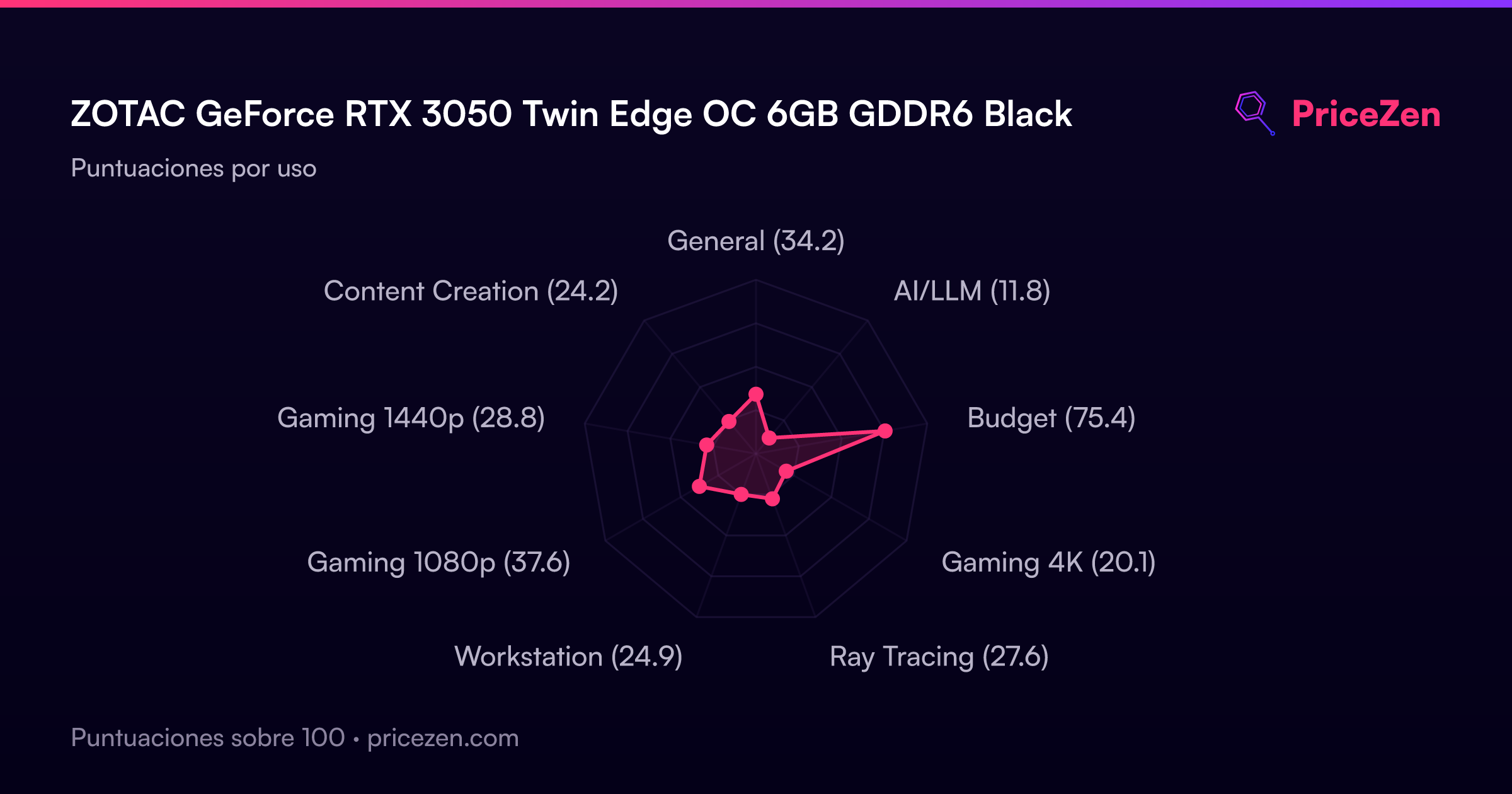
Pricing is a bit scattered. US listings run from USD 207 to USD 230, a USD 23 spread across just two vendors. At the low end, you're getting a card that's affordable, sitting at the 82nd percentile for price. But value is about what you get for that money, and the total score of 32.6 out of 100 tells the story. The budget score of 72.5 is decent, but gaming at 1080p scores just 37. If you can find it at USD 207, it's a reasonable buy for a low-power build. At USD 230, you're paying a premium for a card that struggles to justify it.
Leer más
Overview
The ZOTAC RTX 3050 Twin Edge OC posts a PassMark G3D score of 9498, which lands it in the 23rd percentile for raster performance. That's not a typo. This is a card that gets outrun by a lot of the market, but it sips power at 70W and doesn't need a PCIe power cable. For a compact, bus-powered card, that's the whole pitch.
Our database puts its efficiency at the 91st percentile, which is genuinely impressive. The catch is that efficiency only matters if the card can actually run what you want. With 6GB of GDDR6 on a 96-bit bus and a 1477MHz boost clock, this is a card for light esports and older titles, not modern AAA at high settings.
Common Questions
Q: Can this card run modern games at 1080p?
It can run them, but not well. With a PassMark score of 9498 and 23rd percentile raster performance, expect low to medium settings in demanding titles. Esports games like Valorant or CS2 will run fine, but AAA games will struggle.
Q: Does this card need a power cable from the PSU?
No. The 70W TDP means it draws all its power from the PCIe slot. ZOTAC recommends a 450W PSU, but the card itself doesn't need a 6-pin or 8-pin connector.
Q: Is 6GB of VRAM enough in 2025?
It's tight. The 6GB GDDR6 on a 96-bit bus lands at the 22nd percentile for VRAM in our database. For 1080p esports and older games, it's fine. For modern titles with high-res textures, you'll hit limits quickly.
Who Should Skip This
Skip this if you care about gaming performance. The 23rd percentile raster score and 29th percentile ray tracing mean you'll be turning settings down constantly. The 6GB VRAM is already a bottleneck in newer games, and the 12th percentile social proof means there's barely any community feedback. If you have a standard ATX case and a PSU with PCIe cables, spend a bit more on something with real horsepower.
Verdict
The ZOTAC RTX 3050 Twin Edge OC is a niche card. Its 91st percentile efficiency and 70W bus-powered design are genuinely impressive, and the 162mm length means it fits almost anywhere. But the 23rd percentile raster performance and 6GB VRAM cap what it can do. If you need a low-profile, low-power card for an HTPC or light esports rig, this is a solid pick at USD 207. If you want to play modern games at 1080p with decent settings, look elsewhere.
Usage Scores
- General34.2
- AI/LLM11.8
- Budget75.4
- Gaming 4K20.1
- Ray Tracing27.6
- Workstation24.9
- Gaming 1080p37.6
- Gaming 1440p28.8
- Content Creation24.2