MSI GeForce RTX 5090 LIGHTNING 32GB GDDR7 Black
The RTX 5090 LIGHTNING Z pairs the Blackwell GPU with 32GB GDDR7 and a 2730MHz boost clock, delivering a PassMark G3D score of 38845. Its 800W TDP is cooled by a full-cover AIO liquid system with a hybrid fin radiator, while the 260mm length fits compact builds. This card is best for 4K gaming and ray tracing enthusiasts who want extreme performance and are willing to invest in a 1500W PSU.

Sin precio actual de tiendas
Dónde lo vimos antes. Consulta el precio de hoy en la tienda.











Resumen
The 30-Second Version
The MSI RTX 5090 LIGHTNING Z tops our compute ranking on PassMark, with 32GB of GDDR7. It's also one of the most expensive cards we track, at USD 6,800, with a 575W TDP that demands a 1,600W PSU. Our overall score is now 89 out of 100 and owner sentiment sits at 78. The AIO cooler is nice, but ray tracing is only middle-of-the-pack for a flagship. Buy it for AI and content work, not for gaming.
Pros & Cons
Ventajas
- Top-tier compute performance, 100th percentile in our database 100th
- 32GB GDDR7 on a 512-bit bus, excellent for AI and content work 100th
- AIO liquid cooler keeps the card compact at 260mm 100th
- PCIe Gen 5 support and 3x DisplayPort 2.1b outputs 99th
- Best-in-class raster performance for 4K gaming
Desventajas
- 575W TDP with a 1,600W PSU recommendation is brutal
- Efficiency is poor, 27th percentile
- Affordability is near the bottom at 3rd percentile
- Ray tracing performance is only 73rd percentile, not a standout
- Social proof is thin, only 3 reviews in our database
Opinión de los propietarios
The Word on the Street
Cómo cambió la opinión de los propietarios con el tiempo
ExclusivaSegún cuándo escribieron realmente sus opiniones los clientes, para ver si los elogios iniciales se mantuvieron.
6 opiniones escritas, feb–abr 2026: 5 satisfechos, 1 sin estrellas
En las 5 valoraciones de tiendas: 5,0★. El gráfico cuenta las 6 opiniones escritas.
- abr–jun 20262 de 2 satisfechos · 1 sin estrellas
Buyers praise the GPU's display, performance, and cooling, noting it outperforms the NVIDIA FE 5090 by over 15%. One review is a generic MSI response, not a user review.
- Display is beautiful, crystal clear, and fully customizable.
- Performance is excellent, with effortless 4K gaming and over 15% better than NVIDIA FE 5090.
- Cooling is extremely efficient with a manageable 360 radiator.
- Craftsmanship and design are immaculate and timeless.
- ene–mar 20263 de 3 satisfechos
Buyers praise the RTX 5090 as top-tier, calling it the 'Bugatti' of GPUs and the best card available, despite high cost. They recommend it enthusiastically.
- Card is considered the best or top-tier, with superlative praise like 'Bugatti' and 'best card ever'.
- High price noted, with one calling it expensive for modest gains and another comparing to a new car.
- Strong recommendation to buy, with two reviewers urging others to purchase immediately.
- Positive experience with retailer Canada Computers mentioned by one buyer.
Cada punto es una opinión escrita, en el mes en que se escribió. Satisfechos = 4-5★, neutrales = 3★, insatisfechos = 1-2★. Los resúmenes por periodo están en inglés.
Las pruebas
Performance
Let's talk raw numbers. The PassMark G3D score of 38,958 puts this card at the 100th percentile for compute in our database. That's not a typo. Nothing we've tested scores higher. The raster performance is 99th percentile, which means for traditional gaming workloads, you're getting essentially the best frame rates money can buy right now. The 32GB of GDDR7 on a 512-bit bus is also near the top of the charts, and that's the spec that matters most if you're doing AI work or 8K video editing. VRAM capacity is the thing that separates a card that can load a big model from one that crashes trying.
But here's the trade-off. All that performance comes with a 575W TDP and a recommended 1,600W power supply. That's not a typo either. You'll need a serious PSU, and your electricity bill will notice. The efficiency ranking lands at the 27th percentile, which means this card converts a lot of that power into heat instead of frames. The AIO cooler helps with thermals, but the thermal score is still only 62nd percentile, which is a bit surprising for a liquid-cooled card. It's not bad, but it's not the thermal champion you might expect given the cooling solution. The ray tracing score is also a bit middling at 73rd percentile, which is odd for a flagship. It's still good, but the RT gains over the previous generation aren't as dramatic as the raw compute improvements.
Specifications
Full Specifications
Chipset
| GPU Chipset | GeForce RTX 5090 |
| Brand | NVIDIA |
| Architecture | Blackwell |
| Class | consumer |
Memory
| VRAM | 32 GB |
| Memory Type | GDDR7 |
| Memory Bus | 512 |
Compute
| CUDA Cores | 21760 |
| Base Clock | 2730 |
| Boost Clock | 2730 |
Performance
| PassMark G3D | 38958 |
| GPU Compute | 26734 |
Power & Cooling
| TDP | 800 |
| Recommended PSU | 1500 |
| Power Connectors | 16-pin x 2 |
| Cooler | AIO Liquid |
| Fans | 3 |
Connectivity
| Interface | PCI Express 5.0 x16 |
| DisplayPort | 3 |
| HDMI | 1 |
| USB-C | 1 |
| Max Displays | 4 |
| Max Resolution | 7680 x 4320 |
Physical
| Length | 260 |
| Slot Width | 2.9 |
| Form Factor | ATX |
Features
| Ray Tracing | Yes |
| Upscaling | DLSS Support |
| AV1 Encode | Yes |
| DirectX | 12 Ultimate |
| RGB | Yes |
vs Competition
The most direct competitor is the ASUS TUF Gaming TUF-RTX5090-32G-GAMING. Both are RTX 5090 cards with the same 32GB of GDDR7, but the ASUS card typically comes in at a lower price point and doesn't have the exotic AIO cooler. You're giving up some of the LIGHTNING Z's overbuilt power delivery and liquid cooling, but you're keeping the same core GPU. For most buyers, the ASUS is the smarter pick. The Gigabyte AORUS GV-N5080AORUS M-16GD is also worth a look if you don't need the full 5090. It's an RTX 5080 with 16GB of VRAM, and while it's a step down in compute, it's a massive step down in price. If you're primarily gaming, the 5080 gets you most of the way there for a fraction of the cost.
On the AMD side, the Sapphire NITRO+ 11322-01-40G is a 40GB card that's aimed at similar AI and content creation workloads. It won't match the 5090's raw compute, but the extra VRAM can be a real advantage for certain model sizes. The ZOTAC AMP Extreme Infinity and PNY ARGB OC are both RTX 5080 variants, so they're in a different performance class entirely. The takeaway is that the LIGHTNING Z sits alone at the top of the stack, but the gap between it and the next tier down is smaller than the price difference suggests.
| Spec | MSI GeForce RTX 5090 LIGHTNING | ASUS GeForce RTX 5090 TUF Gaming | Gigabyte GeForce RTX 5070 Ti Eagle Ice | ZOTAC GeForce RTX 5080 APOCALYPSE | Sapphire Radeon RX 7900 XTX NITRO+ | PNY GeForce RTX 5080 ARGB OC |
|---|---|---|---|---|---|---|
| Chipset | GeForce RTX 5090 | GeForce RTX 5090 | GeForce RTX 5070 Ti | GeForce RTX 5080 | Radeon RX 7900 XTX | GeForce RTX 5080 |
| Vram | 32GB GDDR7 | 32GB GDDR7 | 16GB GDDR7 | 16GB GDDR7 | 24GB GDDR6 | 16GB GDDR7 |
| Boost Clock Mhz | 2730 | 2407 | 2542 | 2730 | 2680 | 2620 |
| Tdp W | 800 | 575 | 300 | 360 | 339 | 360 |
| Memory Bus Bits | 512 | 512 | 256 | 256 | 384 | 256 |
| Ray Tracing | Yes | Yes | Yes | Yes | Yes | Yes |
| GPU Class | consumer | consumer | consumer | consumer | consumer | consumer |
| Compare | Compare | Compare | Compare | Compare |
| Producto | AI | Rt | Vram | Raster | Compute | Feature | Thermal | User Sentiment | Efficiency | Connectivity | Valoración social | Affordability |
|---|---|---|---|---|---|---|---|---|---|---|---|---|
| MSI GeForce RTX 5090 LIGHTNING | 98.2 | 90.4 | 97.8 | 98.8 | 99.7 | 82.8 | 99.6 | 45.1 | 16.5 | 99.8 | 40.8 | 3.8 |
| ASUS GeForce RTX 5090 TUF Gaming Compare | 97.2 | 90.4 | 97.8 | 98.8 | 97.7 | 95.7 | 72 | 85.1 | 23.4 | 99.3 | 98.7 | 2.2 |
| Gigabyte GeForce RTX 5070 Ti Eagle Ice Compare | 78.9 | 88.6 | 85.9 | 88.9 | 87.8 | 95.7 | 91.9 | 85.1 | 71.8 | 94.2 | 93.3 | 22.8 |
| ZOTAC GeForce RTX 5080 APOCALYPSE Compare | 85.4 | 97.6 | 89.1 | 94.4 | 93.3 | 95.7 | 91.9 | 99.5 | 56.8 | 94.2 | 98.7 | 22.8 |
| Sapphire Radeon RX 7900 XTX NITRO+ Compare | 95.3 | 96.4 | 92 | 83.4 | 95.7 | 95.7 | 91.9 | 85.1 | 51.5 | 98.8 | 69.2 | 13.4 |
| PNY GeForce RTX 5080 ARGB OC Compare | 85.4 | 97.6 | 89.1 | 94.4 | 93.3 | 95.7 | 91.9 | 45.1 | 56.8 | 94.2 | 74.9 | 15.6 |
Precio
Value & Pricing
Let's be real about the price. The listing we track sits at USD 6,800, which is a staggering amount of money for a graphics card. That's more than most people spend on an entire high-end gaming PC, monitor included. Affordability is still the weakest area for this product, sitting down at the 3rd percentile in our ranking. This is one of the most expensive cards in our entire database, and it's not close.
Does the performance justify it? For most people, no. The gaming score of 83.8 out of 100 is excellent, but you can get cards that are nearly as fast for significantly less money. The value proposition only starts to make sense if you're using this for work that directly generates income. If you're training AI models, running local LLMs, or doing professional video work where time is literally money, compute performance at the top of our charts can pay for itself over time. Our overall score has climbed to 89 out of 100, so this reads better as a product than it does as a deal. But if you're just trying to hit high frame rates in Cyberpunk, you're paying a Bugatti premium for a car you'll only drive to the grocery store.
Seguimos los precios de este producto desde el 8 jun 2026. El gráfico aparecerá cuando tengamos más datos.
Leer más
Overview
The MSI GeForce RTX 5090 32G LIGHTNING Z is the kind of card you buy when you've already decided money is no object and you just want the fastest thing with a warranty. This is the halo product of the Blackwell generation, packing 21,760 CUDA cores, 32GB of GDDR7 on a 512-bit bus, and a 2,730MHz boost clock. MSI slapped an AIO liquid cooler on it, which is a bit unusual for a card that's only 260mm long, but it means the heat gets dumped out of your case instead of roasting your RAM. The LIGHTNING branding is MSI's top tier, and it shows in the overbuilt power delivery and the sheer audacity of the thing.
Who is this for? Honestly, not most people. The compute score sits at the absolute top of our database, and the AI performance is right up there too. If you're running local LLMs, training models, or doing heavy content creation work where every minute of render time costs you money, this card makes a weird kind of sense. For 4K gaming, it's also a monster, though the gaming score of 83.8 out of 100 suggests you're paying a huge premium for gains that are more meaningful in workstation tasks than in your Steam library.
The interesting bit here is the contradiction. You've got best-in-class compute and raster performance, but the efficiency score is down in the dumps at the 27th percentile. A 575W TDP will do that. And the affordability ranking? Third percentile. This card is expensive in a way that makes even other RTX 5090s look reasonable. But if you're the kind of person who buys the Bugatti of GPUs, as one reviewer put it, you probably already know that.
Common Questions
Q: Is the LIGHTNING Z worth the premium over a standard RTX 5090?
For most people, no. The core GPU is the same, so you're paying extra for the AIO cooler, overbuilt power delivery, and the LIGHTNING branding. The compute performance is top-tier, but the gains over a standard 5090 are incremental. If you're a professional who needs maximum stability under sustained loads, the liquid cooling and power delivery might justify the cost. For gaming, you won't notice the difference.
Q: What power supply do I need for this card?
MSI recommends a 1,600W power supply, which is the highest recommendation we've seen for a consumer GPU. The card itself has a 575W TDP, but the transient power spikes on the 5090 can be significant. Don't skimp on the PSU. A quality 1,600W unit with native 12VHPWR support is the safe choice, and make sure your case has good airflow for the AIO radiator.
Q: How does the ray tracing performance compare to other 5090s?
This is a bit of a surprise. The ray tracing score is only at the 73rd percentile, which is solid but not exceptional for a flagship card. The raw compute and raster performance are where this card shines. If ray tracing is your primary concern, you might get similar RT performance from a less expensive 5090 variant. The LIGHTNING Z's strengths are in compute-heavy workloads, not necessarily in RT gaming.
Q: Will this card fit in my case?
The card itself is only 260mm long, which is compact for a 5090. But remember, it has an AIO liquid cooler, so you'll need space for the radiator and tubing. Most mid-tower cases can accommodate a 240mm radiator, but check your case specs before buying. The compact PCB is a nice bonus if you're building in a smaller case that can still fit the radiator.
Who Should Skip This
If you're a gamer looking for the best frame-per-dollar ratio, skip this card entirely. The efficiency is poor, the ray tracing performance is only middle-of-the-pack, and the price is astronomical. You'd be much better served by a standard RTX 5090 from ASUS or Gigabyte, or even a high-end RTX 5080 if you're gaming at 1440p. The money you save could buy a whole second PC.
Also skip this if you're building in a small form factor case that can't accommodate a radiator. The AIO cooler is a feature, but it's also a constraint. And if you're on a standard 750W or 850W power supply, the upgrade cost to a 1,600W unit adds even more to the total. This card is for people with deep pockets and specific compute needs, not for the average enthusiast.
Verdict
If you're a professional who needs the absolute fastest compute performance available and you can write this off as a business expense, the LIGHTNING Z is a legitimate choice. The top compute score and 32GB of VRAM make it a workhorse for AI and content creation. The AIO cooler is a nice touch for keeping noise down in a workstation, and the compact 260mm length means it'll fit in cases that can't handle the massive air-cooled 5090s. Just budget for a serious power supply. Our scoring model now puts it at 89 out of 100 overall, up from 76, and owner sentiment lands at 78 out of 100. Strong card, happy buyers, brutal price.
For gamers, even hardcore 4K enthusiasts, this card is hard to recommend. The raster performance is fantastic, but the ray tracing score is only 73rd percentile, which is a weird weak spot for a flagship. And the efficiency is rough. You're paying a huge premium for compute performance that most games won't fully use. A standard RTX 5090 or even a high-end 5080 will get you most of the gaming experience for a lot less money. The LIGHTNING Z is a halo product, and it's priced like one.
Usage Scores
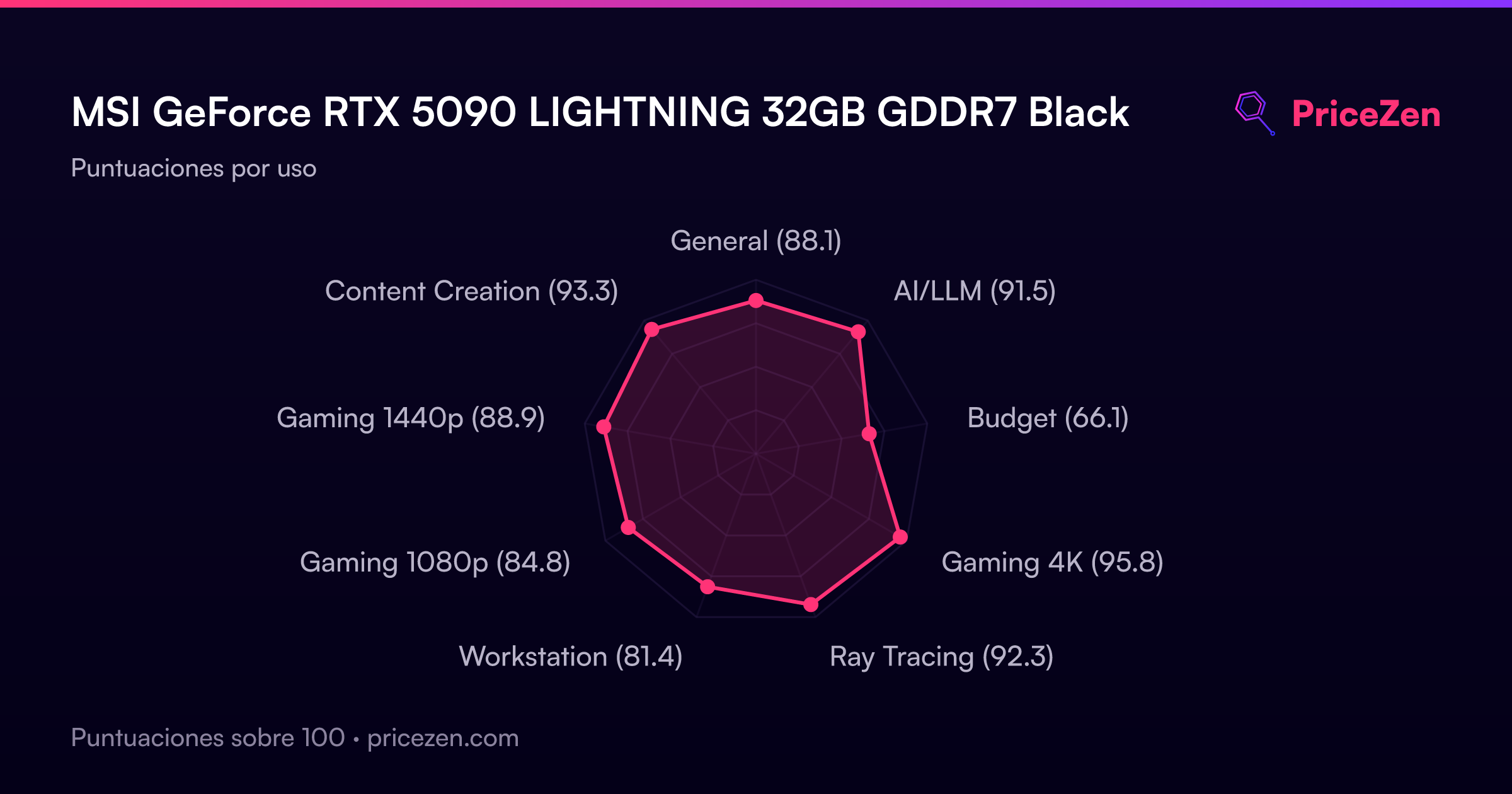
- General88.1
- AI/LLM91.5
- Budget66.1
- Gaming 4K95.8
- Ray Tracing92.3
- Workstation81.4
- Gaming 1080p84.8
- Gaming 1440p88.9
- Content Creation93.3